It was 20 years ago today…
October 22nd, 2022
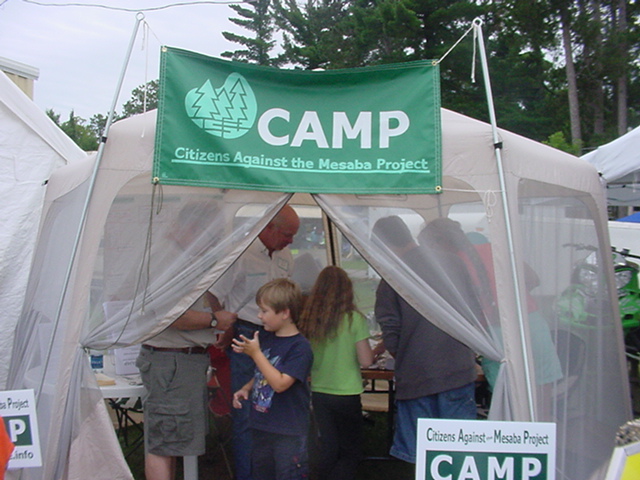
EXCELSIOR ENERGY’S MESABA PROJECT
PARTIAL DOCUMENT REPOSITORY
Well, a bit more than 20 years ago… January 15, 2002, just after the start of the legislative session, I was at an energy committee meeting, Senate? House? I think Senate was first, then heard again at House, and the following year they got their legislation through as a part of the 2003 Prairie Island bill.
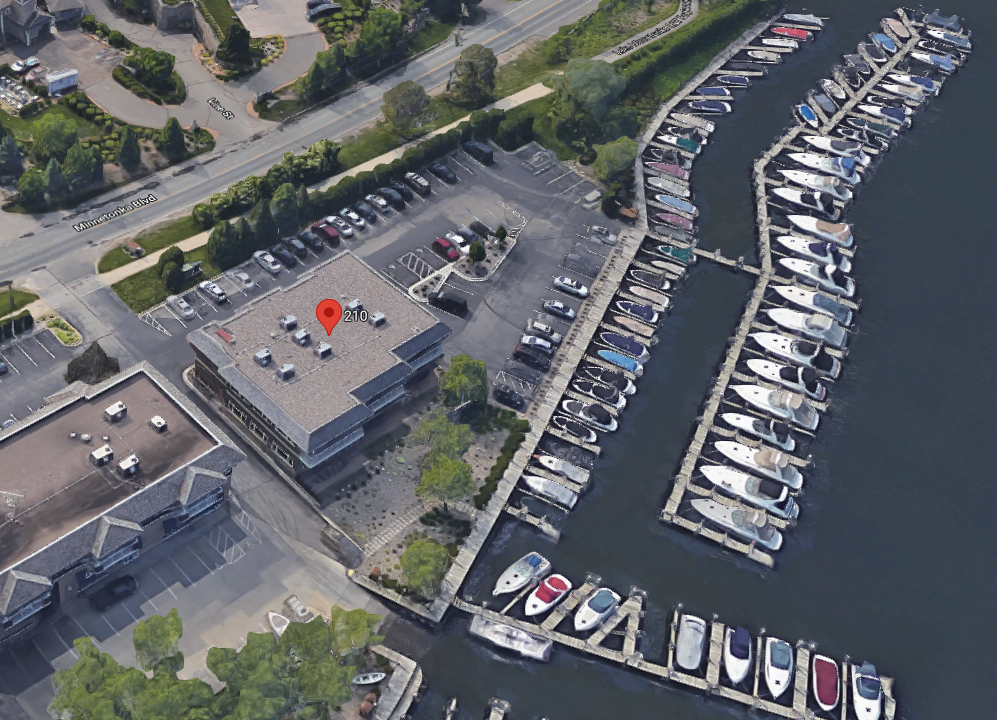
- The Excelsior Energy link I’m using is compliments of waybackmachine. Note that now, if you plug in “excelsiorenergy.com” it becomes “excelsiorcapital.com (Excelsior Energy Capital).” essentially at a marina at 21960 Minnetonka Blvd.! Related?

Anyway, there was a presentation back in 2002 about the greatest thing since sliced bread (NOT!), a coal gasification project proposed for “somewhere” on the Range. Here’s what they presented:
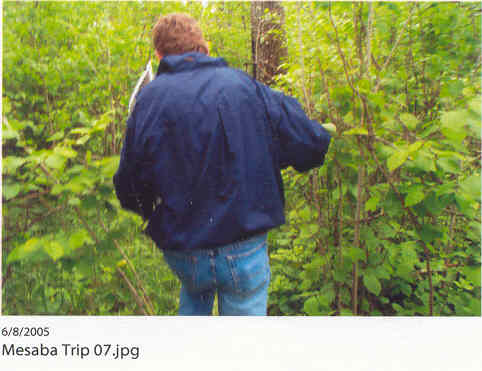
Note the parts about “brownfield” and “existing infrastructure.” LIES, it’s that simple. Here’s what their site looked like, this was at the DOE and locals site visit in 2005:

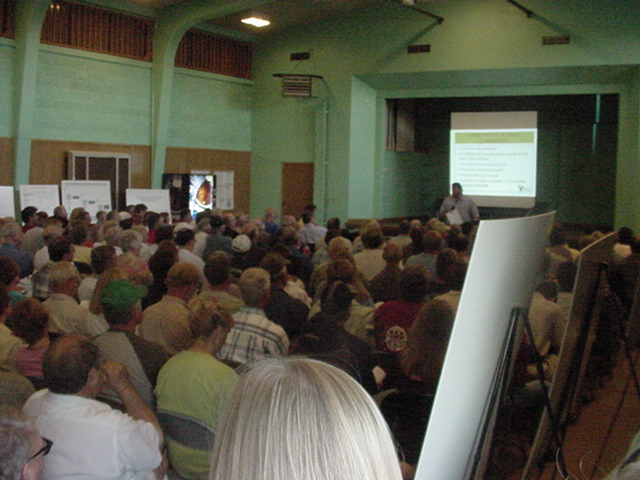
Starting in 2005, I was representing “mncoalgasplant,” landowners and residents near the proposed project, joined in tandem by Citizens Against the Mesaba Project (CAMP) (site circa 2013 with live links, thanks waybackmachine!). We had such active folks, every hearing was PACKED, and eventually the project faded, never formally declared dead, but piece by piece, it went away.
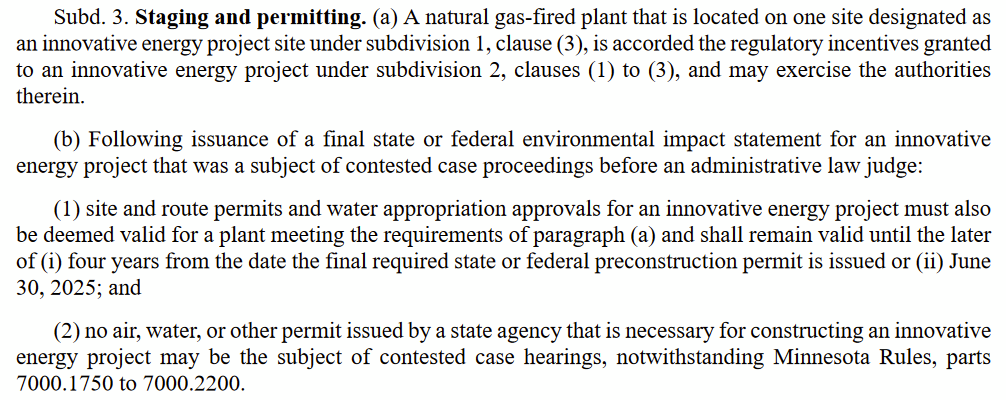
HOWEVER, Excelsior Energy did manage to get an save passed by the legislature for a natural gas plant:
Week before last, I picked up files from a cohort who shall remain unnamed, and am scanning in boxes of files, to post here, and recycle hard copies for biomass (UGH, but that’s what Red Wing does. Thanks, Xcel Energy!). I’ll be posting them, some interesting stuff if you’re into energy and political and capital intrigue, some purely inside baseball that no one will care about.
MONEY TRACKING – Spreadsheets and invoices to IRRB for reimbursement
Various Contractor Invoices (some redacted)
What a pain in the patoot that was — TWO ENTIRE WASTEBASKET OF SCANNING!


Annual PPSA Hearing – November 9!
October 22nd, 2022

Just got notice of the Minnesota Public Utilities Commission‘s Power Plant Siting Act annual hearing:
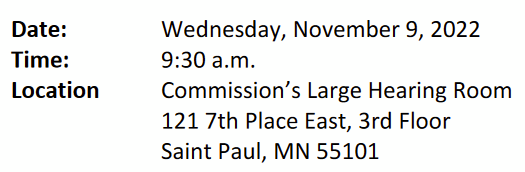
This happens every year, and it’s important to spread the word around. One change that is very good is that the Commission is doing a good job of serving notice of the hearing — there are ~ 128 pages of recipients of this notice! GOOD! Love the interwebs, makes it so easy to let people know what’s happening.
The “Power Plant” aspect is very broad, this includes not just “power plants,” but transmission lines, wind projects, and solar too. This is the opportunity to tell the Public Utilities Commission, and the state generally, what works and what doesn’t work about the procedures for siting electric utility infrastructure, ideally based on your experience.
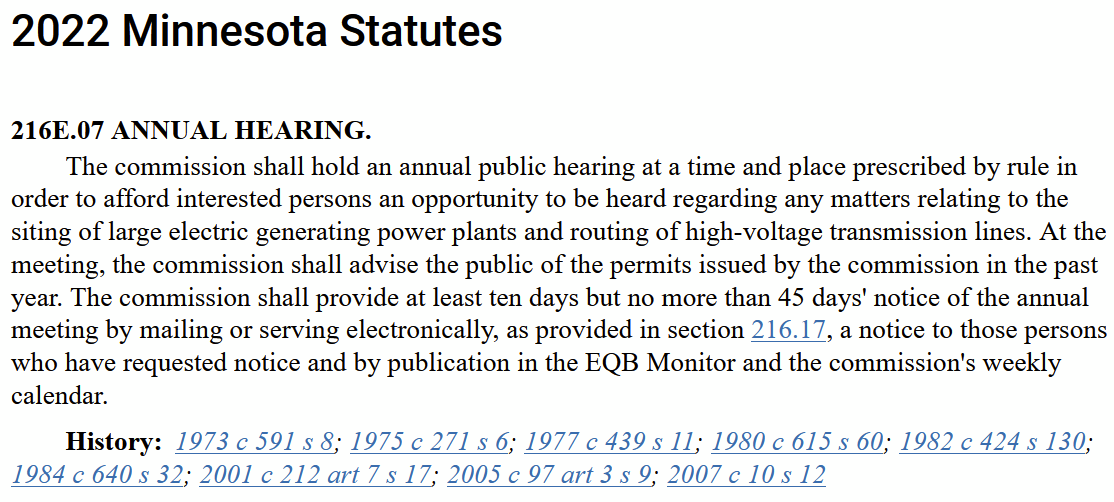
One positive aspect of COVID is that hearings are now held in “hybrid” format, both in person and online via Webex:

It is best if using Webex (http://mn.gov/puc/about-us/calendar/ and click on “November 9, 2022” to get to “webcast”) to have video on your computer and to use the phone for audio, whether listening or making comments — that’s the best way to avoid feedback (using headphones helps too). The webcast link usually goes live 10 minutes or so before the hearing starts.
What to comment about? If you’ve had experience with a Public Utilities Commission siting docket, if there were issues that made it difficult to participate, things needing clarification, rules and/or procedures that need changing, this is a way to bring it to the Commission’s attention. Over the 27 years that I’ve been dealing with utility siting issues, oh, the horror stories I can and do tell. The system needs work, and siting infrastructure is a constantly evolving process, sometimes very good changes are made, and sometimes, no matter how much we petition (formally and informally), challenge, cajole, demand, they just won’t take responsibility, won’t do their jobs, and won’t even promulgate necessary rules.
A main point of holding this hearing, as above, is hearing from “the public.”
In addition to the public participation issues exposed in this report (about which not much, not enough, has been done), a few things that I’ll be bringing up, orally or in writing:
- The Office of Legislative Auditor investigated the Public Utilities Commission‘s practices, and this report had recommendations, most of which have not been addressed:
OLA-Report_PUC Public Participation 2020
- The Public Utilities Commission has not, in the decades I’ve been participating in the PPSA Annual Hearing, EVER brought up the PPSA for discussion and ACTION on issues raised.
- Wind siting “guidelines” were adopted via Commerce-EERA without public notice or opportunity for input: Large Wind Application Guide.2
- Notice has not been provided to landowners on transmission line routes where “alternate” routes are proposed, and sometimes landowners have not discovered their land may be affected until the public hearing, very late in the process.
- Power Plant Siting Act rule revisions, due after the 2005 Power Plant Siting Act legislative changes, have not been promulgated, despite a years long process, NINE YEARS, many committee meetings, and a lot of work by a lot of people. The Public Utilities Commission just dropped it… no action… sigh… Minn. R. ch 7849 & 7850 Rulemaking? DEAD!
- Despite 2 rulemaking petitions to the Public Utilities Commission, there are no wind siting rules! The Commission refuses to promulgate wind siting rules, instead using Small Wind Standards:
There’s no end to the issues to raise.
In addition to the public hearing, comments may be submitted in writing:
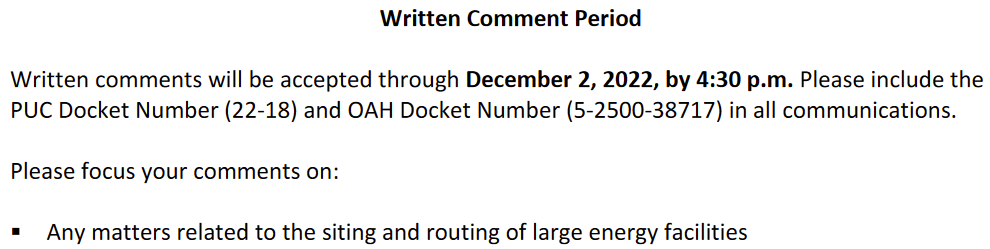
Get to it! Register your experience with the Public Utilities Commission, and let them know what needs work.
Too diverse for Sviggum!
October 17th, 2022
UPDATED UPDATE: Sviggum voids apology with additional comments:
University of Minnesota regent resists calls to resign
It’s “Alpha News” of course, but here’s part of what he’s saying:
… and…
UPDATE: Sviggum “apologizes.” The “apology” and full STrib article below.
Steve Sviggum, now “representing” District 2 on University of Minnesota Board of Regents, shows his true colors:
He was claiming to have received 2 contacts from “friends” whose children wouldn’t go to Morris because it’s “too diverse, that they wouldn’t feel comfortable there.” Earth to Sviggum, this is the opportunity, particularly as a face of the University of Minnesota, and supposedly representing the 2nd District, to suggest to your friends that maybe, just maybe, this is exactly the experience and environment that your “friends’ children” need in the 21st century! Maybe it’s the perfect opportunity to suggest to your “friends” that they too need to get out into the world and out of their white bubble. And maybe it’s time for YOU to get out of your bubble. For sure it’s time for you to be off the University Board of Regents.
What’s really interesting is the composition of the student body now. Per the STrib (University of Minnesota Regents Vice Chair Steve Sviggum asks if Morris campus is ‘too diverse’):

“32% Native American – and is that what’s so objectionable? Or is it those likely more visible 3% black students? 4% Hispanic, which should be higher given the increasing Hispanic population in the area? Or is it that someone just saw those oh-so-scary numbers and ran back to their bubble?

Click HERE for the “Contact” page for the University’s Board of Regents. You know what to do.
Here’s a response from U of M Morris’ Student Association President:
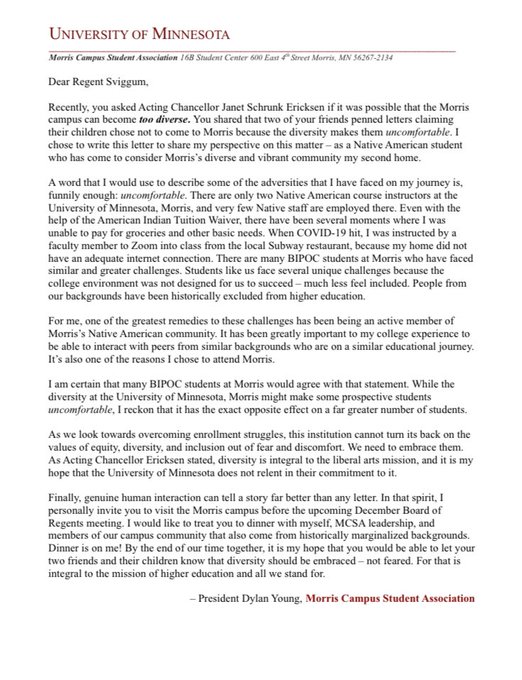
And this from Chair of Regents:

FYI, Regents are elected by the Legislature — see this from House Research:
Election of Regents
And it gets interesting, because his term does end in 2023, and he’s “representing” CD2, and much of CD2 (my part, in Red Wing too) is becoming CD1, not exactly something I’m excited about. Anyway, I’d think that CD2 residents would be particularly upset about his comments.
++++++++++++++++++++++++++++++
UPDATE: The “apology” here:
Last week, during University of Minnesota Morris Interim Chancellor Erickson’s presentation on MPact 2025 enrollment goals at Morris, I posed a question regarding the diversity of the student body and whether that diversity was—in any way—linked to the recent enrollment challenges.
Let me unequivocally apologize for my questions, and especially for the unintended hurt my questions may have caused. They were not intended to cause harm, but my intent does not matter. For those whom I have harmed or offended, and for all of those associated with our great university, I am truly sorry. I have only respect and admiration for any individual who seeks to better themselves through higher education, whether at Morris or at any of our wonderful campuses. Minnesota benefits from our many amazing students from all walks of life who make incredible contributions to our community, and their work strengthens the great state of Minnesota. I hope that all of our graduates elect to stay in Minnesota after graduation and work, every day, for the betterment of our state.
My intent – recognizing that my words matter – was to foster discussion around the consistently declining enrollment at Morris, which is not a one-year trend or even a concern that has emerged out of the COVID pandemic. Rather, student enrollment has been declining for years (down 50% from its peak) and the future of this great campus depends on finding solutions to reverse that trend.
I have been blessed throughout my life as a farmer to work with a diversity of people across our state and our nation from all backgrounds. As a layperson in my church, I have shared the joys and heartbreaks of so many of my fellow parishioners. And as a proud Regent, I have been given the incredible opportunity to help our institution, our president, and our students, staff, and faculty who set a very high bar for the rest of us.
Again, I offer my sincerest apologies. I clearly have more to learn to better understand the strength that diversity brings to our institution, and I look forward to taking those who have reached out to me up on their offers to meet and to hear their perspectives and learn from them. I am willing to learn and I must do better—and I will.”
STrib article:
Sviggum ‘unequivocally’ apologizes for asking whether Morris campus is ‘too diverse’
The former Minnesota House Speaker issued a written statement amid calls for his resignation.
By Rochelle Olson Star Tribune October 19, 2022 — 9:14am
Glen Stubbe, Star Tribune fileUniversity of Minnesota Regents Vice Chair Steve Sviggum said he is “truly sorry” to those whom he harmed or offended.
The vice chairman of the board that oversees the University of Minnesota system apologized “unequivocally” for asking whether enrollment at the Morris campus was “too diverse.”
In a five-paragraph statement issued through the public relations office on the Twin Cities campus late Tuesday, Steve Sviggum said he’s willing to learn and must do better.
Sviggum wrote that his intent was to encourage discussion about the ongoing decline in enrollment at the Morris campus, which is down 50% from its peak. “The future of this great campus depends on finding solutions to reverse that trend,” he wrote.
At a regents meeting last week, Sviggum asked acting Morris Chancellor Janet Schrunk Ericksen whether diversity was linked to declining enrollment.
“I’ve received a couple letters, two actually, from friends whose children are not going to go to Morris because it is too diverse,” Sviggum said at the meeting. “They just didn’t feel comfortable there.”
Ericksen responded that minority students on the campus often feel isolated and that from their perspective, no, the campus would not be too diverse. The question sparked backlash and calls for his resignation from the volunteer position. A Native American student leader at the Morris campus invited Sviggum for a meal and circulated a petition that received 200 signatures.
Regents Chair Ken Powell released a statement calling diversity a “strength.” The Teamsters Local 320, which represents 1,500 workers across five campuses, called his comments racist and part of a pattern.
Former regent Michael Hsu, who said Monday that Sviggum’s time had passed and he need to resign, was dismissive of the attempted apology. “He should be gone already,” Hsu said.
In his statement, Sviggum said he is “truly sorry” to those whom he harmed or offended. “Let me unequivocally apologize for my questions, and especially for the unintended hurt my questions may have caused,” he wrote. “They were not intended to cause harm, but my intent does not matter.”
He said he respects and admires everyone who seeks to better themselves through higher education. “Minnesota benefits from our many amazing students from all walks of life who make incredible contributions to our community, and their work strengthens the great state of Minnesota,” he wrote.
The former GOP House speaker and state administrator from Kenyon said he’s been “blessed” to work as a farmer with a diversity of people. He talked about sharing joy and heartbreak with parishioners as a layperson at his church.
“I clearly have more to learn to better understand the strength that diversity brings to our institution, and I look forward to taking those who have reached out to me up on their offers to meet and to hear their perspectives and learn from them,” he wrote.
In numerous media interviews after his comment became public, Sviggum initially was unapologetic. He said he was posing a question, not making a statement.
Currently, Morris has 1,068 students. Of those, 54% are white and 32% are Native American. Overall, 41% are Black, Indigenous and people of color.
The goal for the Morris campus is 1,700 students, a target set in 2019 before the pandemic. The campus hasn’t had that many students in at least five years, and colleges across the country are struggling with declining enrollment.
In an interview Monday, Sviggum noted that overall enrollment at Morris had decreased by 40% as the enrollment of Black, Indigenous and people of color had increased to nearly 45%. “It’s fair to ask the question: Is there a relationship?” Sviggum said.
Dylan Young, president of the Morris Campus Student Association and a Native American student from Parmelee, S.D., has publicly commented in interviews and on social media. He said he received 200 signatures on a a letter to Sviggum on social media.
Sviggum’s tenure on the board will end in 2023 when the Legislature selects new regents.
From 1979 to 2007, Sviggum served in the state House as a Republican from Kenyon. He became the speaker after the 1998 election when Republicans took control of the House; he lost the top job after the 2006 election.
Another CCS scam bites the dust
October 10th, 2022

Here’s a real DOH! which could have been avoided, but DOE through several administrations keep throwing good money after bad for carbon capture and storage pipedream:
The ill-fated Petra Nova CCS project: NRG Energy throws in the towel
NRG’s Petra Nova project $$$:
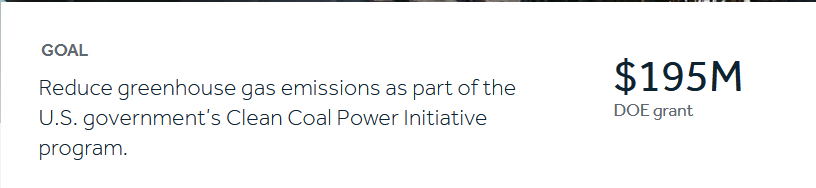
Short version? FAIL! From the article:

Following this FAIL, the understatement of the century, from the article:

Yet CCS is a big part of the latest federal energy efforts. It’s also a huge boondoggle for not just outfits like NRC, but for certain “non-profits” like Great Plains Institute:
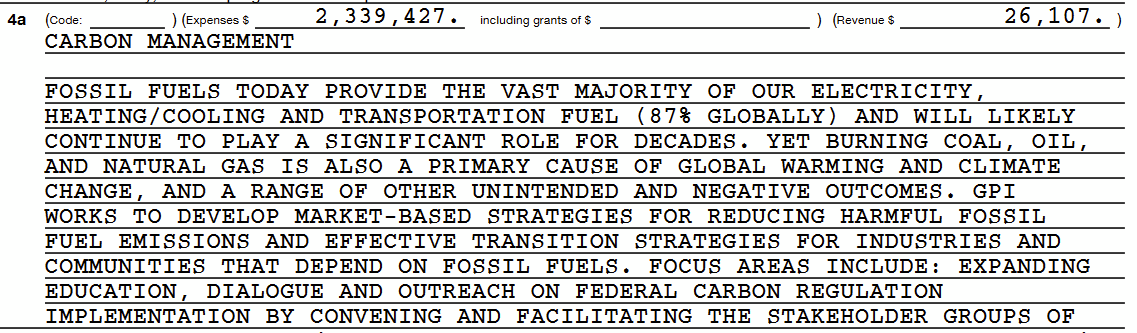
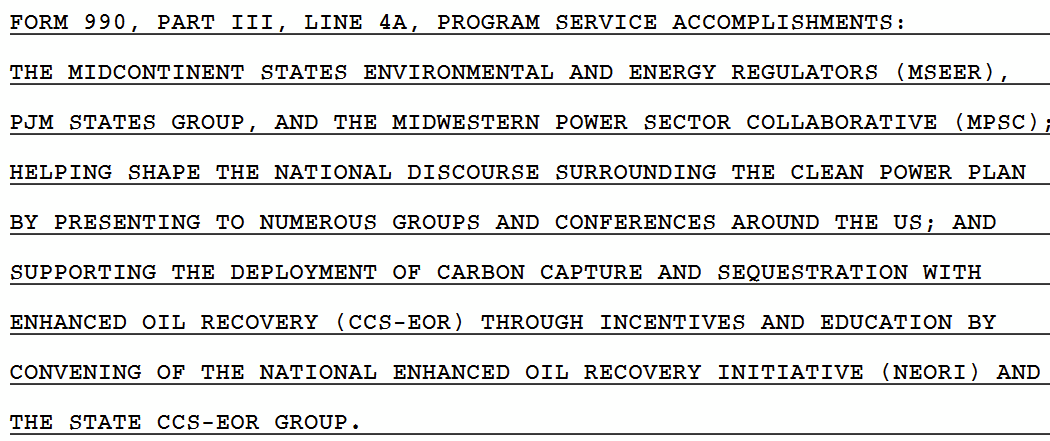
And check out these salaries:
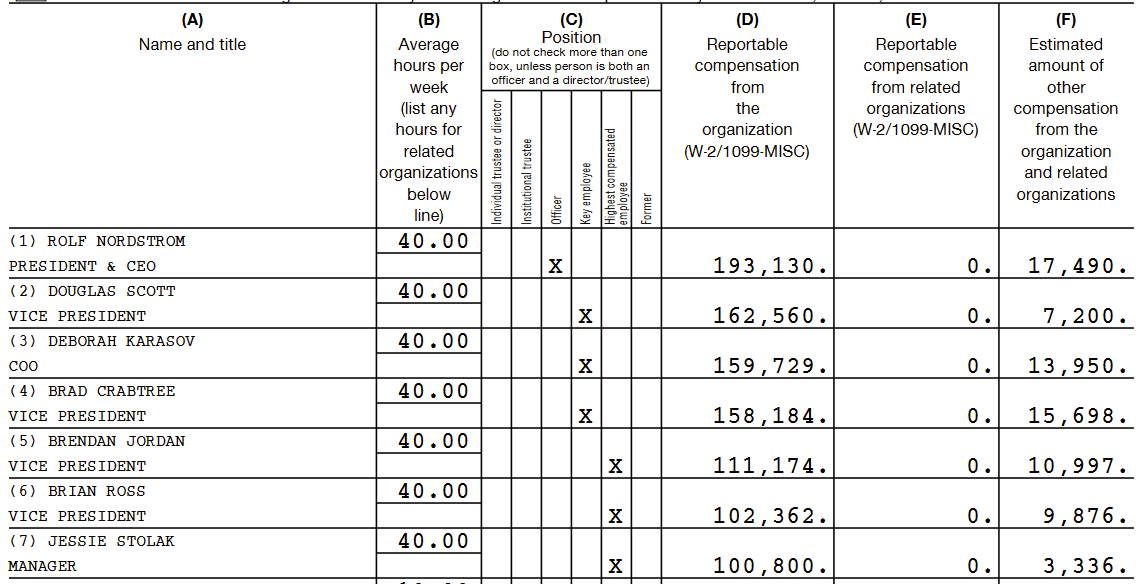
Great Plains Institute helped push coal gasification, for extreme amounts of money…
Great Plains Institute – is Joyce getting their $$ worth?
January 18th, 2007
… but that pales in comparison for the dollars for this recent round of “carbon capture” promotional funding. Unreal…
Once more with feeling — carbon capture is not real, is not workable, is a waste of $$ and effort.
BERNIE!
October 7th, 2022
