Bluster blather from Kenyon Wind
December 31st, 2010

Oh, man, I am really scared now!!! See something new every day… John Daniels has filed the following “Notice of Intent” letter on behalf of Kenyon Wind, LLC:
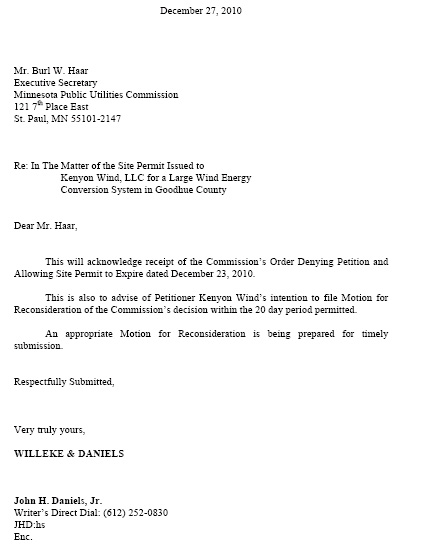
EH? Oh, OK, ja, sure, whatever… I’ll just shake and quake in my boots until the Motion for Reconsideration is really filed… Notice of Intent? WTF? Never seen one of those before!

 …. yawn….
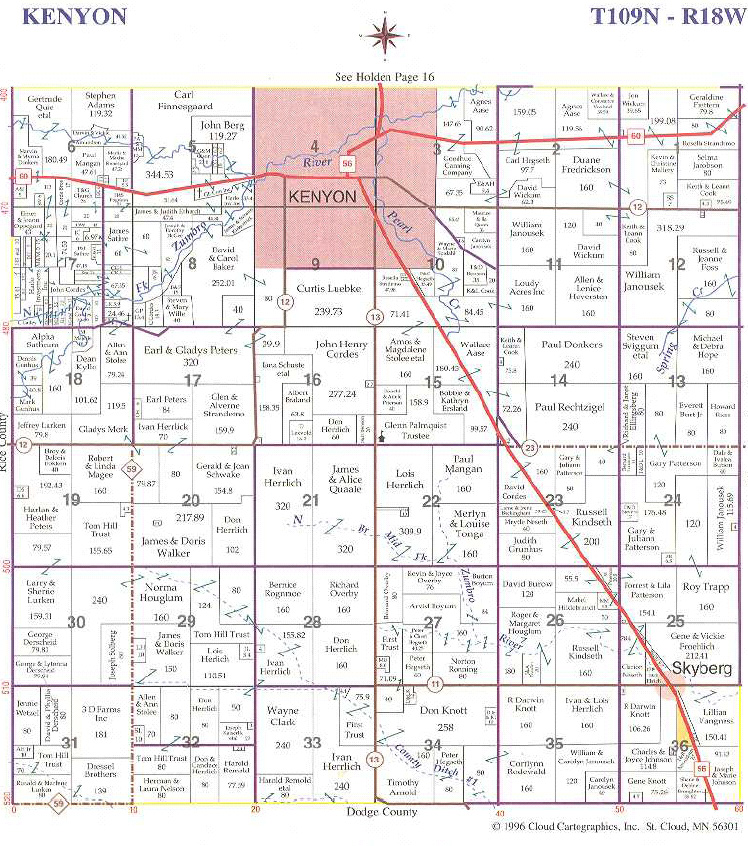
Remember, Kenyon Wind was the first C-BED project out of the chute, oh, excuse me, not THAT C-BED, but THIS C-BED, the statute. Kenyon Wind was a wind project promoted by the principals of non-profit Windustry, and Kenyon Wind was the wind project that planned to put a turbine and substation on former Speaker Steve Sviggum’s land (see Section 13 on the R)…

…and I’m sure you all remember how helpful the Speaker was in passing the 2005 Chapter 97 – Transmission Omnibus Bill from Hell that gave birth to C-BED and gave the utilities everything they every wanted and more to be able to go forward with CapX 2020 transmission criss-crossing the state with transmission for export:
In the meantime, see the following (the one posted just above this) post on how it’s done. Todd Guererro, on behalf of AWA Goodhue Wind, has filed one even better, a Notice of Motion and Motion for Summary Disposition. Yup, AWA Goodhue Wind has a disposition problem all right!
2010 NERC Reliability Assessment
December 29th, 2010
In prepping for the PPSA Annual Hearing , I realized that I’d forgotten to post the 2010 NERC Reliability Assessment. How can that be? NERC, the North American Electric Reliability Corporation, has been issuing these for over a decade, and they have the greatest little gems, a must read that comes out usually in October.
SO, making up for lost time, here it is:
2010 NERC Reliability Assessment – Part 1
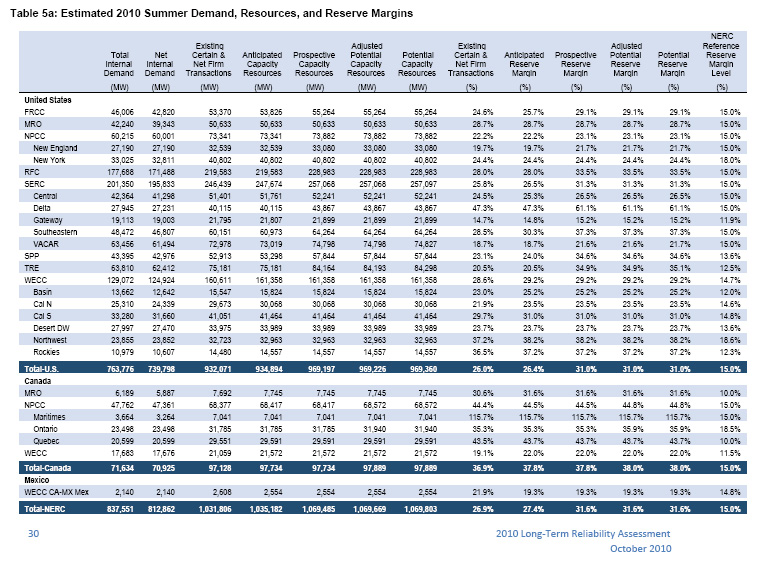
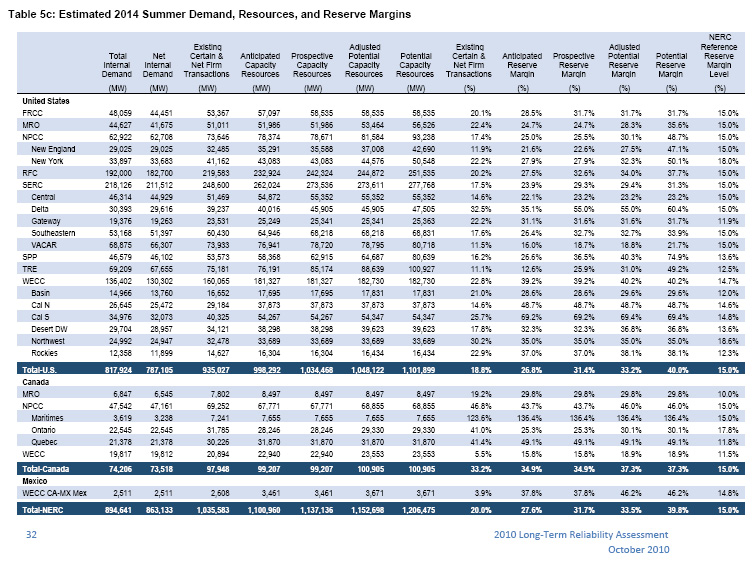
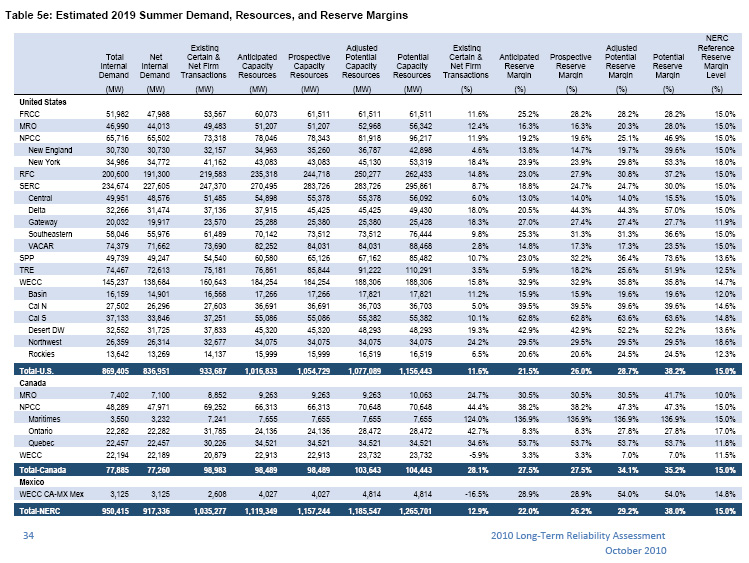
And here’s what I find to be the best part of this — the charts that show the reserve margins going out of sight!
Summer 2010 shows that we’re comfortable, plenty of electricity to go around. But wait, check the 2014 and 2019 projections — in 2019, where we “need” a 15% reserve margin, we have:
Anticipated Reserve Margin – 16.3%
Prospective Reserve Margin – 16.3%
Adjusted Potential Reserve Margin – 20.3%
Potential Reserve Margin – 28.0%
OK, so then let’s look at the East Coast for 2019:
New York
Anticipated Reserve Margin – 23.9%
Prospective Reserve Margin – 23.9%
Adjusted Potential Reserve Margin – 29.8%
Potential Reserve Margin – 53.3%
RFC– includes much of PJM – New Jersey, Delaware, and heading west
Anticipated Reserve Margin – 23.0%
Prospective Reserve Margin – 27.9%
Adjusted Potential Reserve Margin – 30.8%
Potential Reserve Margin – 37.2%
And again, the purpose of all this transmission build-out becomes clear — there’s too much electricity and they need a way to get it from here to there, anywhere to be able to sell it.
Click these charts below for a bigger view.
Estimated 2010 Summer Demand, Resources, and Reserve Margins:
Estimated 2014 Summer Demand, Resources, and Reserve Margins:
Estimated 2019 Summer Demand, Resources, and Reserve Margins:
Pawlenty’s legacy…
December 29th, 2010
It’s on the MN eDemocracy Forum, it’s in the STrib, and his dreams of being President are my nightmare.
From the STrib:
My take is another matter:

Pawlenty’s legacy — I was reminded of it yesterday as I testified for the 13, 14 or15th time at the PPSA Annual Hearing and spent too many hours in prep, reminded of the changes over his tenure.
Pawlenty is the “Green Chameleon,” all the PR of being “green” yet promoting the most environmentally devastating options.“Green Chameleon” for his promotion of the Excelsior Energy Mesaba Project, a coal gasification boondoggle on the range, throwing tens of millions of state (IRRB, RDF, DEED) money at it, illegally because environmental review wasn’t completed;
“Green Chameleon” for his promotion of the biggest and most costly transmission line build-out in Minnesota history, so big that Phase I required notification to over 80,000 landowners;
“Green Chameleon” for his promotion of ethanol as it stunk up St. Paul and drained one southwestern MN city’s aquifer dry;
“Green Chameleon” for the shift of “environmental review” of utility infrastructure projects to Dept. of Commerce under his watch;
“Green Chameleon” for promoting the 2005 Energy Omnibus Bill (Ch. 97) that substituted “regional” need for “Minnesota” need as a criteria for utility infrastructure, allowed transmission only companies (another step of deregulation);
“Green Chameleon” for, in 2006, signing off on the changes to Minn. Stat. 117.189 that exempted utilities from the landowner protective provisions in eminent domain;
“Green Chameleon” for no new taxes and failure to adequately fund agencies during a time of unprecedented number of permit proceedings, including a Commerce Dept. that doesn’t even have an electrical engineer on staff(!);
“Green Chameleon” for ushering in relicensing of Monticello and Prairie Island nuclear plants and increasing dry cask storage of high level nuclear waste on the Mississippi River at Monticello and Prairie Island at a time of unprecedented decrease in demand for electricity, Xcel alone down nearly 1,500MW since the 2006 peak;
“Green Chameleon” for doing everything possible through his agencies to limit, hamstring, thwart and silence public participation and fully informed decisions by Public Utilities Commission.
Can you tell I’m disgusted? I could go on… it’s been a long 8 years. The legacy of his energy policy, agency direction and muzzling of the public should have him aspirating on his aspirations. We shall see…
And unfortunately I’m not confident it will be much different going forward. Again, we shall see…
Carol A. Overland
Attorney representing citizens groups and landowners in utility infrastructure proceedings at PUC and local governments.
Living and officing in City of Red Wing, County of Goodhue, home of the Prairie Island Nuclear Generating Plant, the Goodhue County Wind Ordinance, and two garbage burners
Time to subpoena Mike Bull!!!
December 21st, 2010

Let me see if I understand this… we’ve got Ingrid Bjorklund, a wind industry lobbyist/employee now Commerce employee and Deb Pile, also Commerce, using Affidavits to argue LEGISLATIVE intent based on statements by Mike Bull, Commerce employee working under Pawlenty’s roof now working for Xcel. EH? LEGISLATIVE intent based on industry lobbyist/employee & Exec agency employee hearsay affidavits of Pawlenty’s Energy Boy. Where’s the LEGISLATURE in legislative intent? And what does Mike Bull have to say about this?
Duck and cover, Mikey! Commerce has trained their sights on you!
HUH? What’s going on? Well, we just had a deadline for submittals in response to the First Prehearing Order in the AWA Goodhue Wind contested case regarding application of Goodhue County’s Wind Ordinance. for the whole docket, go to www.puc.state.mn.us and click on “Search eDockets” and search for docket 08-1233.
Here’s the prelude to yesterday’s filings:
Staff Chart of Differences between Goodhue Ordinance & State Standards prepared for PUC Chair Boyd
After a Prehearing Conference and the ALJ’s request for our positions in this case, we submitted memos and then the ALJ issued a Prehearing Order:
In that order we were asked to set out the differences between county and state standards; whether county ordinance is a conflict, supplement, or something new; whether it should be applicable to this project; material facts regarding this issue; and what evidence we’d introduce. and here’s what was filed — where’s everybody else? Anyway, read the Deb Pile and Ingrid Bjorklund Affidavits and note who’s sayin’ what, whose interests are at issue, whose intent is couched as “LEGISLATIVE” intent, and while you’re at it, ask just what role they had at that time. Seems to me they’re putting it all on Mikey Bull. Hey Mikey?!?! Get ready!
Goodhue Wind Truth 2nd Prehearing Memo
Belle Creek Township 2nd Prehearing Memo
MOES Comments – PUC Briefing Papers on Goodhue
Private company can’t condemn for transmission line
December 14th, 2010
It’s about time… a judge in Montana has declared that a private entity that is building the MATL transmission line does NOT have the power of eminent domain! Well DUH a lot of us will say, this is a PRIVATE company, they’re not a regulated utility, so of course they wouldn’t have power of eminent domain.
But wait… what about CapX 2020, and their transmission plans from hell across the Midwest. Let’s be clear — there is NO entity organized under the laws of the state of Minnesota named “CapX 2020,” and they have NOT declared, and refuse to declare what entity will own it. At the same time, the Minnesota PUC agenda lately has had Xcel transferring its transmission assets to ITC. So, what do you think they’ll do with CapX 2020 transmission after it is built USING THE POWER OF EMINENT DOMAIN TO DO IT? $50 says they’re transferring it to ITC, or TRANSLink or whatever transmission only company they can find. It’s a shell game, we know what they’re doing, but try to get the PUC to care!

Judge denies MATL use of eminent domain
By KARL PUCKETT • Tribune Staff Writer•
December 14, 2010A district judge in Montana ruled Monday that a Canadian developer of a high-voltage power line has no authority to condemn private property for the project.
The decision, filed Monday, is a victory for landowners trying to limit the impact of the Montana Alberta Tie Line. It also could carry ramifications for other developers proposing transmission projects to meet demand from wind developers asking for additional shipping capacity.
“Larry Salois only wanted to protect his mother’s property from the transmission line going through historic Indian archaeological sites,” said Salois’ attorney, Hertha Lund. “He never wanted a legal battle.”
Salois is the guardian of his mother, Shirley Salois, the property owner. They live east of Cut Bank.
In July, a Montana subsidiary of Tonbridge Power Inc. of Toronto filed a complaint to condemn their land in Glacier County District Court after Salois argued the proposed route should be adjusted across his property farther from tepee rings and a wetland.
Lund argued Tonbridge could not exercise the right of eminent domain because it is not an agent of the state that has been given express legislative authority to acquire private property.
District Judge Laurie McKinnon agreed and granted Salois’ motion to dismiss the company’s condemnation complaint.
“No judicial decision that this court is aware of provides authority for MATL’s position that a private merchant transmission line, without express or implied authority for condemnation, may pursue eminent domain proceedings,” she wrote.
The Legislature’s grant of eminent domain power to governmental bodies must be strictly construed, the judge said.
Private individuals and corporations, like state agencies, have no inherent power of eminent domain, McKinnon said, and their authority to use it must be derived specifically from the Legislature.
Years ago, condemnation by a public utility for the purpose of constructing electrical power lines was authorized by legislation, the judge said. That authority allowed the former Montana Power Co. to acquire property by eminent domain.
But that legislation has since been repealed “and MATL can cite no legislative authority for its pursuit of land acquisitions by eminent domain, either expressly or by necessary implication,” the judge said.
Tonbridge had asserted that an electrical transmission line is a public use, giving the company the right of eminent domain. Three wind farm developers have purchased capacity on the line. Poles started going in the ground in August with the company working around the Salois property.
Bob Williams of Tonbridge said the company was surprised and disappointed with the decision. Tonbridge is considering an appeal, he said.
Voluntary deals with landowners remain the company’s goal, he said. The Salois complaint was the company’s first condemnation action in Montana.
“That said, projects such as this that are in the public interest have to be able to fall back on eminent domain as a last resort,” Williams said.
“Even when we have exhausted all other options, it still means that landowners are compensated fairly.”
The MATL project was permitted under the Major Facilities Siting Act and the public need for it was determined during the review process, said Johan van’t Hof, Tonbridge’s CEO.
He argued the judge’s decision “doesn’t square with the reality” of private companies building cable, telephone, transmission and pipelines.
As a result of the decision, Lund, Salois’ attorney, expects other businesses planning transmission lines to seek a “legislative fix,” giving companies the power to condemn land for transmission lines.
NorthWestern Energy, the state’s largest utility, is planning the $1 billion Mountain States Transmission Intertie, which also would ship wind power. Tonbridge and renewable energy developer Gaelectric are jointly planning the “Green Line” between Great Falls and Townsend.
“I hope the Legislature protects the interest of the landowner and the small guy in this process,” Lund said.
The 215-mile transmission line will connect the electricity grids in Montana and Alberta between Great Falls and Lethbridge, Alberta.
Tonbridge still is negotiating easements with landowners along the southern half of the project from Cut Bank to Great Falls, where construction has yet to begin. Lund also represents 20 landowners along that stretch in easement negotiations. Those landowners have been pushing for tweaks in the line as well.
“This obviously puts them in the driver’s seat,” Lund said of the Salois decision.
Salois pushed the company to alter the location of poles planned for his property, outside of the 500-foot approved corridor, because he said the line was planned too close to Blackfeet tepee rings and a wetland.
In October, the Blackfeet Business Council agreed to write a letter in support of Salois’ efforts. The council said the land involved was once Blackfeet land and told Salois that he had the support of the nine-member council “in your efforts to fend off this incursion by a multinational company.”
“For now, things are protected,” Larry Salois said.
Tonbridge initiated settlement discussions with Salois a few weeks ago and hopes to reach an agreement before Christmas, van’t Hof said.