Will the Mesaba Project never die?
February 21st, 2011

The most bizarre bill has been introduced that seems to be trying to breathe life into the most unreal project that ever existed, and the project that refuses to die, have they no shame?

Here’s the poop:
Senate authors are Tomassoni, Senjem, Michel and Saxhaug
WRITE TO COMMITTEE MEMBERS — TELL THEM TO PUT A STAKE THROUGH ITS SLIMY HEART!
Referred to Senate Energy, Utilities and Telecommunications
House authors are Beard, Dill and Fabian
Referred to House Environment, Energy and …
What on earth are they trying to do
Landmark Stray Voltage Case!
January 27th, 2011
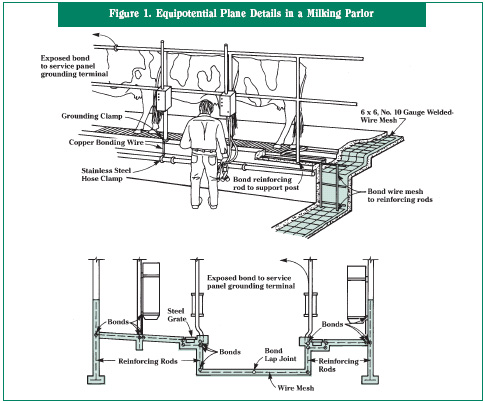
Yesterday, the Minnesota Supreme Court released a landmark stray voltage opinion, clarifying the breadth of the “filed rate” and “primary jurisdiction” doctrines declaring that they do not limit suits for stray voltage damages against utilities. This has been a six year lawsuit for the Siewerts so far…
Here’s the STrib’s article — hmmmmm… no comments allowed! I wonder why that is?
Supreme Court rules for farmers in stray-voltage case
Last update: January 27, 2011 – 10:03 AM
“We’re very pleased with the Supreme Court’s decision,” said Greg Siewert, who farms with his father, Harlan, in Zumbro Falls. The Siewerts first filed suit against Northern States Power Co., a subsidiary of Xcel, in 2004.
Read the rest of this entry »
From Colorado’s San Luis Valley
January 20th, 2011

Here’s my “Day 2” presentation at Alamosa, Colorado last Wednesday (a week ago already? How can that be?):
And a report from the Valley Courier:
Proposed transmission line gets a little TLC
Posted: Friday, Jan 14th, 2011
TLC is opposed to the proposed new power line, and the speakers during
the Wednesday forum questioned the motives and rationale behind the
proposal. They questioned that the line was necessary and encouraged
attendees to seek legislative action, pursue the NEPA (National
Environmental Policy Agency) process and “get loud” in their opposition
to the line.TLC plans to host another forum in the Valley on April 20 with the utility companies as guest speakers.
Fort Garland resident Sally Keller described TLC as a coalition of
concerned citizens and independent member groups who support
environmentally sound alternatives that rely on upgrades to the existing
corridor.“We do not support the transmission line,” she said.
TLC encompasses such groups as the Land Rights Council, Save La Veta
Valley, SLV Ecosystem Council, Sangre de Cristo Homeowners Association
and Majors Ranch Homeowners Association as well as individuals.Keller reminded the group of some of the history of the line and efforts
to oppose it and said several matters are pending right now so “stay
tuned.”Carol Overland, author of “Transmission Lies” and legal counsel
representing groups opposing transmission lines in the Midwest and East
Coast, questioned the need for new transmission lines anywhere in the
U.S. because demand has decreased.“Demand is way down,” she said. “If demand is down, what’s the driver?”
She said one of the reasons power demands have decreased is the loss of big industry in this country.
“That kind of need is not coming back anytime soon,” she said.
“I have never met a transmission project that was for the reasons they say it is,” she said.
“The biggest lie of all is that we need it.”
Overland said she was not as familiar with Colorado processes and the
Valley’s proposal as she was with those in the Midwest where she works,
but she encouraged the audience to question the stated purposes for the
new line here. She said completing the circuit is a legitimate reason
but there might be other ways to accomplish that other than a new line.She suggested upgrading existing corridors and infrastructure rather
than building new, and she advocated replacing fossil-fueled power with
renewable energy. As utility companies are required to implement
renewable energy standards, at the same time they should be backing off
from traditional power sources, she said.Overland said new transmission lines are being constructed not to address need or renewable energy mandates but to sell power.
She encouraged Valley residents to push for legislation that allows them
to become part of the public input process early on (“typically the
public does not get involved until too late”) and that requires utility
companies to consider the people who are directly affected by proposed
transmission lines, such as the landowners over whose property the lines
will cross.“It’s built on the backs of landowners … and on the backs of ratepayers.”
Overland also said just because an area might provide the best resource
for renewable energy such as solar does not mean it should be used over
an area that might provide adequate resources and less disturbance to
landowners.“This isn’t rocket science,” she said. “It’s only electrical.”
She urged local residents to “get loud,” “raise hell” and become involved politically and publicly.
“Get active at all levels,” she said. “You’ve got to be proactive. They are not going to come to you.”
Colorado Open Lands President Dan Pike urged utilization of the NEPA
process in connection with this project. He said he has never seen a
better, more comprehensive process. NEPA looks at both sides of an
issue, benefits and drawbacks and considers all types of impacts from
economic to environmental, he said.Pike, whose organization holds 20 conservation easements in the
transmission line study area (the largest of which is on Trinchera
Ranch), described processes and players involved in transmission line
projects and said it can be very complicated, with decision makers
involved at all levels from local to federal levels.“The day of utilities making proposals for transmission lines in isolation is about over,” he said.
Pike said environmental analysis decisions could be appealed first
administratively and ultimately legally if necessary. The latter is
something most government agencies want to avoid, he said, so they want
to make sure the process is conducted properly.He said as it stands now, environmental analyses have not been
comprehensive enough, and if more information and more impacts are not
considered, “they have got an imminently challengeable decision.”Going back to NEPA, he said, “I am really a fan of NEPA as a decision
making tool … It requires you have the adequate information to make
decisions. I don’t think we have got the adequate information.”The third speaker at Wednesday night’s TLC forum was Gary Graham, Ph.D.,
transmission project director for Western Resource Advocates, an
environmental group that came out in support of the La Veta line. His
main focus was climate change, and he talked about warming trends and
the effect on wildlife habitat, particularly at higher elevations.Graham advocated replacing “dirty energy” with renewable energy, with that energy requiring transmission.
“We don’t know how much renewable energy is going to be needed,” he said.
Unfortunately, Graham did not disclose that in the last two Energy Foundation grant cycles, Western Resource Advocates received ~$500k to advocate FOR transmission, a la Wind on the Wires (linked HERE). Look what they have to say about High Plains Express (HPX):
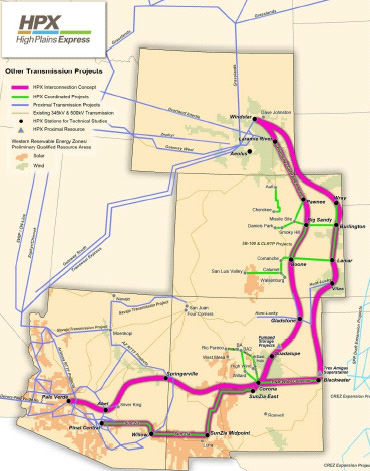
Hs should have, and I should have outed him then, because what their transmission advocacy only increases ability of utilities to move that coal generated electricity around — they are NOT advocating to shut any plants down to make room for renewables! Of course, they’re advocating the same pro-transmission positions as the Izaak Walton League’s “Wind on the Wires” which is no surprise because the $$$ comes from the same place! They’re assuming transmission is necessary and promoting federal authority and NIETC designated transmission corridors, and rather than shut down coal, saying that emissions should be “captured and sequestered” and use the same corridor for a CO2 pipeline! Obviously they did not know/admit what we all in Mesaba Project land knew about the farce of “sequestration.” (click HERE for search of Legalectric on “gasification” for info on IGCC and carbon capture) Once more with feeling — CO2 capture and storage is NOT happening, case on point is the recent release (snort!) of information about the leaking CO2 experiment with “Enhanced Oil Recovery” by piping CO2 into the ground in Weyburn, Sask. It is NOT happening, and the DOE admits that in their environmental review for these projects. And transmission “for renewables” is not, it’s all about export, the San Luis Valley line and particularly the HPX line which starts at the Dave Johnston coal plant in Wyoming, tying into Xcel’s Comanche plant, which the San Luis Valley line would connect into as well. Yes, it’s all connected… transmission, the foundation grants… maybe it’s time to concertedly expose those Energy Foundation grants for what they are?
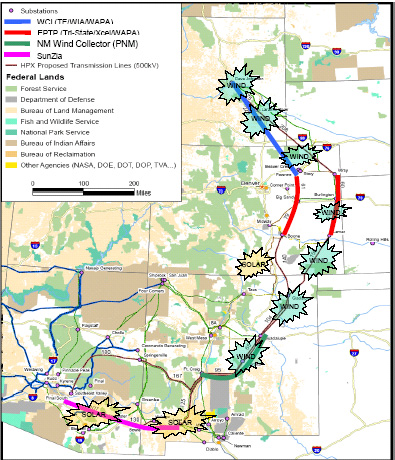
And exactly a year earlier, look what was happening in New Mexico:
Xcel’s $$$ strategy approved
January 17th, 2011
This came up when our house deal was making life complicated, and then I was off in Colorado, so I didn’t get it posted, now it’s time to catch up!
Xcel went to the PUC for changes in its Capital Organization wiggle-room, and got what they wanted, with some additional reporting requirements.
What I’m noticing is that something like this that ‘s SO important, like the Otter Tail Power “Standstill Agreement,” and like the Otter Tail Power “Standstill Agreement,” there’s enviro silence. Nobody is on this… why?
Xcel Request – 2011 Capital Organization – Part I
Xcel Request – 2011 Capital Organization – Part II
Thankfully Bob Geiger, Finance & Commerce, was:
Utilities fielding $2B in projects for 2011
Posted: 5:17 pm Fri, January 7, 2011
By Bob GeigerWind, transmission line projects part of busy year for power providers
According to documents filed with the MPUC, Xcel plans to pay for the capital projects with short-term debt and multiyear credit agreements, a $300 million long-term debt issue in the third quarter and $190 million in cash.
Read the rest of this entry »
AWA Goodhue Wind files Motion for Summary Disposition
December 31st, 2010
Check the PUC filings yesterday — there goes Todd Guererro with his disposition problem!
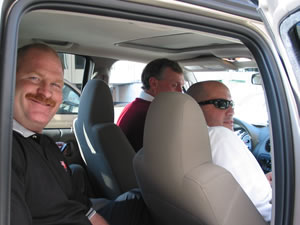 (Todd & cronies checking out an electric car at the fair! Or was it Living Green Expo?)
As you know, the PUC issued an PUC’s Order – Referral to OAH in which the AWA Goodhue wind project was sent to an Administrative Law Judge to address the following issues:
1. The ALJ assigned to this matter is requested to develop a record on every standard in Article 18 that is more stringent than what the Commission has heretofore applied to LWECS and make recommendations regarding each such standard whether the Commission should adopt it for Large Wind Energy Conversion Systems in Goodhue County. The Commission has identified two such standards in this Order (Section 4 and Section 6) but is not by this Order restricting the ALJ from developing the record and making recommendations regarding additional standards in Article 18 that upon further examination meet the “more stringent” qualification.
2. The ALJ assigned to this matter is requested to allow the parties to develop a factual record on the question of “good cause” as that term appears in Minn. Stat. § 216F.081 and to provide recommendations on whether, with respect to each standard in Article 18 identified in the course of her review as “more stringent” than what the Commission has heretofore applied to LWECS, there is “good cause” for the Commission to not apply the standard to siting LWECS in Goodhue County.
3. As the ALJ addresses the issues identified in the previous two sections, the ALJ is requested to include (but not limited to, by this Order) whether there is sufficient evidence regarding health and safety to support a 10 rotor diameter set-back for non-participating residents and the stray voltage requirements.
AWA Goodhue is not happy about this, and have filed this:
Here are a couple snippets for the gist of their argument:
We have to respond by January 14, 2010!
To check out the full docket, go to www.puc.state.mn.us and then to “Search eDockets” and search for docket 08-1233.