PEPCO is falling down on the job
December 12th, 2010

Nearly two years ago, I attended a hearing for the Delmarva Power Integrated Resource Plan, which was the most bizarre hearing I’ve ever experienced. At that time, I raised issues about decreasing demand, entered into the record the PJM demand documents that we’d used in the Susquehanna-Roseland transmission docket in New Jersey (also PJM), and raised concerns that no SAIDI, SAIFI and CAIDI reliability info was reported. After that meeting, I presented Delmarva Power’s attorney Todd Goodman with a well-deserved “Horse’s Ass” award for his performance at that meeting. The points I’d raised at that meeting about what was missing in their “IRP” were oh-so-valid:
It took a while, but last week, the Washington Post featured an article showing that PEPCO, utility in D.C. and Maryland, and the corporate parent of Delmarva Power, has an inexcusably miserable record for outages. That’s something that’s demonstrated in the SAIDI, SAIFI and CAIDI reports! And folks, don’t go conflating transmission with distribution as the cause for the outages, as utilities would have you do. Anyway, here’s that article:
Washington Post Analysis: Why PEPCO can’t keep the lights on
As you read the article, note there’s not a word on D-E-R-E-G-U-L-A-T-I-O-N as a contributory factor, much less the primary reason.
Washington Post analysis: Why Pepco can’t keep the lights on
Moreover, Pepco has long blamed trees as a primary culprit for the frequency and duration of its outages, implying that the problem is beyond its control. But that explanation does not hold up under scrutiny, The Post analysis found. By far, Pepco equipment failures, not trees, caused the most sustained power interruptions last year.
Read the rest of this entry »
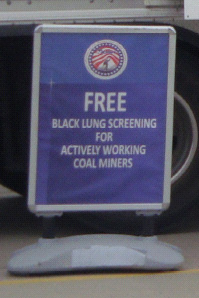
Seen on a North Dakota highway!
December 8th, 2010
Yes, it’s a roadside black lung testing station:

Dr. Gary Carlson’s wind Commentary in STrib
November 9th, 2010

In yesterday’s STrib there was a Commentary written by Dr. Gary Carlson, of Northfield. He gave a very accurate impression of what it is to go to a Rice County Planning Commission meeting. FRUSTRATING! To put it mildly. He also has started digging into health impacts of wind. He’s put himself out as a canary:

Here’s his Commentary:
Gary Carlson: Wind energy’s ripple effects
Once I learned how turbines can affect people, I had to speak up.I know environmental sensitivity; these are the patients I take care of every day.
We lost four and tied one (tabled for now). I felt devastated.
Nuclear? I don’t think so…
November 6th, 2010

A little birdie sent this about “our Stevie,” former Minnesota Asst. A.G. Steve Corneli, now a Senior V.P. at NRG, is in the news.

Steve Corneli — he was the one who “clarified” that nuclear stranded costs (BIG BIG $$$$ which Northern States Power was claiming were due in the event of deregulation which they were fighting for) was really stranded ASSETS! Yes, dear readers, you’ve heard this before, but if you haven’t read this report, from the dark ages of 1997, please do, because incorporating this shift in perspective on stranded costs can free your soul!
And you may remember that dreadful idea on his watch that NRG should put an IGCC (coal gasification) plant in Delaware at its Indian River site with THIS, below, as a site plan, I kid you not:
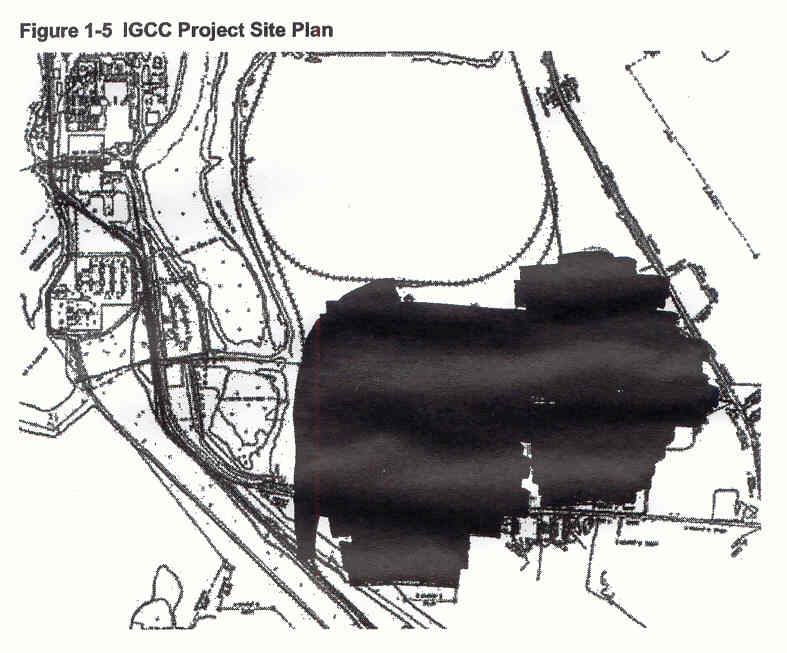
Oh, my, that instills confidence, doesn’t it!
And so what’s he up to now? He’s pushing nuclear power, and next to him, there’s the Obama administration pushing nuclear power… and they wonder why we’re “disappointed?”
The fate of nuclear power after midterm elections
by Brian Wheeler, Associate Editor, Power-Gen Worldwide
In the largest shift of power since 1948, Republicans took over the U.S. House on midterm election night. And the nuclear industry could benefit from the Republican takeover as part of the clean energy legislation.
In a statement released the morning of Election Day, Don Gillispie, CEO of Alternate Energy Holdings, Inc., said that if Republicans won, the other big winner would be nuclear power. Well, we do know that Republicans have won the House and have made up ground in the Senate as well, even though Democrats still hold the majority.
Historically there has been more support from Republicans for nuclear power. But Steve Corneli, senior vice president of market and climate policy for NRG Energy, said there is an increasing awareness from Democrats that nuclear power can be an important part of energy independence and a zero-carbon emission future.
Michigan representative Fred Upton, like many Republicans, is a supporter of nuclear power in the U.S. Upton is also a strong contender to head the House Energy and Commerce Committee; the committee that sees over the national energy policy.
“Through a greater commitment to nuclear, we have a unique opportunity to cut greenhouse gases, provide stability to our electrical supply and create jobs,” Upton told Reuters.
John Boehner (R-OH) is expected to take over as the new Speaker of the House and is also a strong proponent of nuclear power.
“The new Congress will be more pro-nuclear than any Congress we’ve seen in decades,” said Gillispie.
And President Obama continues to promote nuclear power, too.
“There’s been discussion about how we can restart our nuclear industry as a means of reducing our dependence on foreign oil and reducing greenhouse gases,” Obama said during a speech the day after the midterm elections. “Is that an area where we can move forward?”
As of now, that seems to be possible. The White House has requested an additional $36 billion in federal loan guarantees for new nuclear plants and it seems that Republicans are likely to support the measure, even with a big focus during the campaign on reducing government spending.
But Corneli said the interesting part is that the important policy measures that are needed to help jump start the nuclear renaissance are the ones with the lowest cost to federal treasury, and those are the federal loan guarantees, “which really don’t cost the treasury anything.”
“Essentially it is self-financing,” he said. “It seems like the stars could be lining up right now for a boost in nuclear power development.”
Corneli said nuclear is established and the existing fleet of nuclear reactors provide the lowest cost power currently on the grid, but there hasn’t been a new plant built in roughly 30 years.
“We actually think that nuclear power has the potential to be the real foundation of clean energy technology,” he said.Gillispie seems to agree.
“When the history of nuclear power is written, Nov. 2, 2010 will be a major turning point for the industry,” said Gillispie. “It will mark the beginning of a dramatic resurgence for nuclear power.”
Leslie Glustrom featured in High Country Press
November 1st, 2010
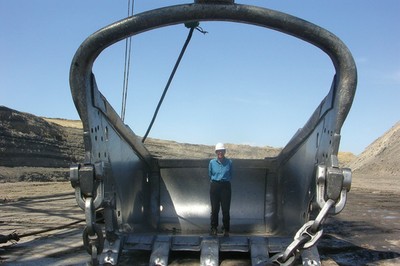
Last week, Lesie Glustrom, a cohort via “No New Coal Plants,” was featured in a big spread in her home state:
The last word is action
by Nathan Rice – High Country NewsName: Leslie Glustrom
Age: 55
Vocation: Mother of two, founding member of the nonprofit group Clean Energy Action
Past Jobs: Biochemist, science teacher, science writer
Favorite activity on her half-day weekends: “Being in the woods alone, talking to the trees.”
Favorite sport: Ice hockey
Thoughts on coal: “I’m a climate change activist who is worried that we don’t have enough coal. That’s an ironic place to be.”Few people get excited about public utility meetings. But at the Tri-State Rural Electric Co-op in Westminster, Colo., on a spring night, Leslie Glustrom is squirming in her seat. Eager to address the Tri-State executives, she scribbles notes about obscure energy data, her brown hair short above broad shoulders.
“Tri-State is sitting on top of world-class wind and solar resources,” Glustrom says. The co-op powers rural electric utilities in Colorado, New Mexico, Wyoming and Nebraska — “the Saudi Arabia of wind and solar,” she says, gesturing emphatically. Glustrom, a clean energy advocate, believes it’s Tri-State’s duty to exploit those resources.
In the circular boardroom, about 40 advocates and industry representatives in business attire mingle under fluorescent lights, munching donuts and drinking coffee. Glustrom offers firm handshakes but abstains from refreshments. “I want to maintain my independence,” she explains. Tri-State’s managers sit behind a row of microphones, lending a diplomatic air to the co-op’s first attempt at officially inviting the public to comment on its planning process.
Read the rest of this entry »