Flyway Rest Stop in Goodhue County
March 31st, 2013
Just yesterday, I went for a drive in Goodhue County, wanted to get an eyefull of the area of Significant Biodiversity on the north end of the Goodhue Wind Project footprint, the part they’ve left out of all their surveys so far — it’s the purple area on the map below, pretty much along White Rock Trail (this is two maps combined to show biodiversity areas within footprint). The blue stars are new nests, three of which could be new eagle nests):

Map above: The red line is the boundary of the Goodhue Wind Project footprint. The dashed line is the area that’s supposed to be included in their surveys, the green diagonal lines are the Richard J. Dorer Memorial Hardwood Forest, and the purple are the areas of Significant Biodiversity.
When we were cruising around, we went into a little dip with running water on both sides in the ditch and lightly wooded, scruffy trees that were new growth, and along the ditches, in the trees, on the shoulder and even on the middle of the road were hundreds and hundreds of robins. I’ve never seen that many before, everywhere there were robins and they were singing up a storm.
Turns out Marie McNamara was driving around the same area, and found… are you ready?
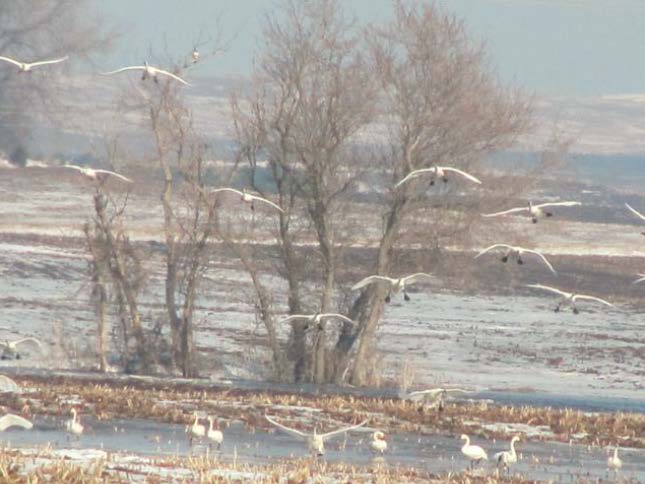
YES!!! TRUMPETER OR TUNDRA SWANS!
With any luck, the DNR will get out there and figure it out!
Goodhue Order is OUT!
March 29th, 2013
The Public Utilities Commission Order on the Goodhue Wind Project is out, well, it came out a while ago and so much has been going on that I didn’t get it posted! But it’s sure worth the wait:
Just after the meeting, based on the comments, particularly of Chair Heydinger, regarding “parties” and that there were no parties, I sent in yet another Petition for Intervention — almost exactly three years after the first one, which was denied:
And that was granted earlier this week, no one objected:
Well, now there is at least ONE party. So back to the PUC’s Order… like wow… we’re supposed to address a few questions:
II. Issues to be Addressed
C-BED Status
• Has New Era Wind Farm, due to ownership changes or for any other reason, lost the C-BED status the Commission found to exist in its April 28, 2010 order?
• If New Era does not meet the criteria for C-BED status at this time, what is its factual basis for asserting that it will meet the standard by its proposed in-service date?
• Does the project meet the requirements of the certificate of need statute and certificate of need rules without C-BED status?
• Do the revisions to the C-BED statute enacted in 2010 affect the project’s ability to meet the requirements of the certificate of need statute and rules without current C-BED status?
• Did the change in ownership of the limited liability company that owns the project violate the anti-transfer provisions applicable to C-BED projects under Minn. Stat. § 216B.1612, subd. 3 (c)? If so, what action should the Commission take?
Other Changes in Circumstances
• Does the project’s loss of financing, the absence of turbine purchase agreements, or the unsettled status of the power purchase contracts affect the certificate of need determination?
• Does the project currently have in hand the land leases, easements, and wind rights required to construct the 78-megawatt wind farm for which it received a certificate of need? How does the answer to this question affect the certificate of need determination?
• If the project currently lacks the land leases, easements, and wind rights required to construct the wind farm as originally certificated, what alternatives are available for consideration? What is the likelihood of changes to the size of the wind farm or the size, type, or configuration of the turbines? What is the project’s projected time frame for making these determinations and then for proceeding? How do the answers to these questions affect the certificate of need determination?
• How would changes in the size of the wind farm or in the size, type, or configuration of the turbines affect the environmental and wildlife protection considerations made in the certificate of need determination? How would they affect the certificate of need determination itself?
• Would accommodating the concerns of the Minnesota Department of Natural Resources or the U.S. Fish and Wildlife Service require changes in the size, type, or timing of the wind farm or in any of the substantive provisions of the certificate of need or the site permit? If so, does the project intend to make these accommodations? How do the answers to these questions affect the certificate of need determination?
• If changes in the size of the wind farm or in the size, type, or configuration of the turbines were proposed – raising new environmental considerations – how would the project engage and collaborate with the Minnesota Department of Natural Resources and the U.S. Fish and Wildlife Service?
• What is the current in-service date for the project? What is the expected in-service date, or, if the date is not known, when do the parties anticipate the conclusion of the negotiations between the Applicant and Xcel regarding the power purchase agreements?
• Does the new project owner stand behind all representations made in the application for the certificate of need and in the application for the site permit? Is the new owner willing and able to comply with all terms and conditions in the certificate of need and the site permit?
Other Issues
The list above does not include every issue that could affect this certificate of need decision, and the Commission invites parties, participants, and members of the public to raise any other issues they consider material during the initial comment period established below. Newly raised issues will then be addressed during the reply comment period.
Finally, the Commission requests comments on what process it should use going forward to resolve the issues identified above and any additional issues raised in the course of this proceeding
Wow, that does go on. Could it get any better than that? Well, yes, it could. It’s about time the Public Utilities Commission said “ENOUGH” and pulled the plug on this vaporware project. Oh well, on to writing comments, due within 14 days.
If you have Comments, there are 14 days to file them, so April 3, 2013. Reply Comments are due 14 days after, that, on April 17th, so Monday April 18, 2013. Either eFile Comments to eDockets (eDocket 09-1185; 09-1349 and 09-1350), or email them to ??? I guess burl.haar@state.mn.us with the docket numbers (09-1185; 09-1349 and 09-1350) in the subject line and in the body of the email. KEEP YOUR COMMENTS TO THE ISSUES RAISED ABOVE. I’d quite the issue you want to comment on, and then elaborate as best you can, and attach any documentation to support your comment. Have at it!
Climate Change @ Mayflower Church
March 15th, 2013

The rain has just turned to snow, the mess is heading south… at the “Environmental Congress” right now, and Gov. Dayton must be here because there’s a big police presence… well, for Bloomington, that is.
Last night was “Getting Real About Climate Change” at Mayflower Church, part of the 2013 League of Women Voters Minneapolis Health Legacy Forum. It was very well attended, though heavy in the silver-haired crowd.
I grew up at Mayflower, that’s where I learned about the importance of participation and a sense of stewardship, some responsibility for this world and conditions of life in it. My parents were both very involved for over 50 years, and I called the organizers of this event, and emailed too, about getting a booth. The organizer left a message, I called back, we had a positive chat, and explained some about who I am and what I do, Legalectric and No CapX 2020, and it was no problem, asked about cost and there was none, and I got to drafting handouts, getting a poster printed. Got there and, well, funny how that works… the bottom line was that I was told that someone talked to someone and suddenly I was not welcome, amid a couple rounds of caning and assumptions, and though the source was not identified, this is not rocket science…
Well, Rev. Sarah Campbell was indeed welcoming, it was good to see her again, a joy as always. I can see why my mother thought so much of her.
And never mind the LWV bottom line — we had a table in the van and got set up right inside the dining room door. Handed out more than a few flyers, 200 minus about 6 left over of my Grist piece:
Transmission Lies – published in Grist 2/3/2009
Minnesota land is being taken by Xcel and landowners pay the price
And while we’re talking about “getting real about climate change,” what is it going to take to tie the Renewable Energy Standard to closing down coal plants? As of now, there’s no connection, and the RES has zip, squat, to do with production of CO2. Second, now that through CapX 2020 transmission we’re locked into 50 years of central station coal, how will anything have an impact? Since we’ve given them access to market, why would they shut down those big existing coal plants?
Issues to be raised upstairs at the break out session. Back to it… almost LIVE from the Ramada in Bloomington:

MN Environmental Congress – register NOW!
March 12th, 2013
If you’re interested in going to the Minnesota Environmental Congress, register NOW — and I sure hope that many of those who went to the meetings around the state follow through and keep demanding change!
2013 Minnesota Environmental Congress
Friday, March 15, 2013 8:00 AM – 5:00 PM
2300 East American Boulevard
Bloomington, MN 55425
952-854-3411
Registration Questions:
Catherine Dubbe
GTS Educational Events
cdubbe@mngts.org
This was originally INVITATION ONLY! Can you believe it! Yours truly didn’t make the cut, I can’t imagine why… and now, it’s thrown open to any ol’ body, so I guess that means us.
And the AGENDA for Friday.
For those of you who went to the meetings, or are curious about what happened, here are the reports:
Suffice it to say, the standing room only attendance at all of the sessions was a surprise to the organizers. The people of Minnesota are more than a little upset about the state’s failure to protect Minnesota’s environment.
It struck me as hilarious that on the opening page, they cite the Minnesota Environmental Policy Act:
Minnesota law directs the EQB to host an annual Environmental Congress. Read MN Statute Ch. 116C Sec. 04 to learn more about the statutory role of the EQB.
Now’s the time to keep that message hammering home… Best read both the Minnesota Environmental Policy Act and the Minnesota Environmental Rights Act.
Shale Gas bubble about to burst?
February 22nd, 2013


Big thanks to Common Dreams and DeSmog Blog for getting word about these two reports:
Drill, Baby, Drill: Can Unconventional Fuels Usher in a New Era of Energy Abundance?
Shale and Wall Street: Was the Decline in Natural Gas Prices Orchestrated?
What are we getting into? Lots of drilling, lots of fracking, plus lots of frac sand mines already running in Wisconsin and a few mines and many mining proposals here in Minnesota… I’ve seen the problems with contamination of wells from fracking, and with earthquakes in Ohio from injection of fracking waste water. From here, it seems likely that the destruction will catch up with the gas extractors and it will all blow up.
But in addition to the no-longer-possible-to-ignore physical problems of water contamination, earthquakes, and empoundment failures, there are economic problems too. Electrical costs follow natural gas prices, and I’ve been watching this for a while, as gas prices drop, as electric prices drop into the toilet, i.e., Electric Monthly Update (next one due out Feb. 25, 2013). It’s not just decreased demand sinking the electrical prices, there’s the impact of natural gas prices due to overproduction.
Now two reports have come out that you should put on your “MUST READ” list:
Drill, Baby, Drill: Can Unconventional Fuels Usher in a New Era of Energy Abundance?
And another:
Shale and Wall Street: Was the Decline in Natural Gas Prices Orchestrated?
This is important stuff — particularly if, indeed, it’s a bubble about to burst. From this spot on the planet, it’s hard to imagine otherwise.
The “Key Takeaways” of Drill, Baby, Drill: Can Unconventional Fuels Usher in a New Era of Energy Abundance? (really, that’s how the author put it… “Key Takeaways”… editor, anyone?):
KEY TAKEAWAYS
- World energy consumption has tripled in the past 45 years, and has grown 50-fold since the adventof fossil oil a century and a half ago. More than 80 percent of current energy consumption isobtained from fossil fuels.
- Per capita energy consumption is highly inequitably distributed. Developed nations like the United States consume four times the world average. Aspirations of growth in consumption by the nearly 80 percent of the world’s population that lives with less than the current per capita world average will cause unprecedented strains on the world’s future energy system.
- Oil is of particular concern given the geopolitical implications of the concentration of exporters in the Middle East, Russia and West Africa and the dependency of most of the developed world on imports.
- In the next 24 years world consumption is forecast to grow by a further 44 percent—and U.S. consumption a further 7 percent—with fossil fuels continuing to provide around 80 percent of total demand. Fuelling this growth will require the equivalent of 71 percent of all fossil fuels consumed since 1850— in just 24 years.
- Recent growth notwithstanding, overall U.S. oil and gas production has long been subject to the law of diminishing returns. Since peak oil production in 1970, the number of operating oil wells in the U.S. has stayed roughly the same while the average productivity per well has declined by 42 percent. Since 1990, the number of operating gas wells in the U.S. has increased by 90 percent while the average productivity per well has declined by 38 percent.
- The U.S. is highly unlikely to achieve “energy independence” unless energy consumption declines very substantially. The latest U.S. government forecasts project that the U.S. will still require 36 percent of its petroleum liquid requirements to be met with imports by 2040, even with very aggressive forecasts of growth in the production of shale gas and tight oil with hydraulic-fracturing technology.
- An examination of previous government forecasts reveals that they invariably overestimate production, as do the even more optimistic projections of many pundits. Such unwarranted optimism is not helpful in designing a sustainable energy strategy for the future.
- Given the realities of geology, the mature nature of the exploration and development of U.S. oil and gas resources and projected prices, it is unlikely that government projections of production can be met. Nonetheless these forecasts are widely used as a credible assessment of future U.S. energy prospects.
- Future unconventional resources, some of which are inherently very large, must be evaluated not just in terms of their potential in situ size, but also in terms of the rate and full-cycle costs (both environmental and financial) at which they can contribute to supply, as well as their net energy yield.
And it continues along this vein in the Shale and Wall Street: Was the Decline in Natural Gas Prices Orchestrated?
- Wall Street promoted the shale gas drilling frenzy, which resulted in prices lower than the cost of production and thereby profited [enormously] from mergers & acquisitions and other transactional fees.
- U.S. shale gas and shale oil reserves have been overestimated by a minimum of 100% and by as much as 400-500% by operators according to actual well production data filed in various states.
- Shale oil wells are following the same steep decline rates and poor recovery efficiency observed in shale gas wells.The price of natural gas has been driven down largely due to severe overproduction in meeting financial analysts’ targets of production growth for share appreciation coupled and exacerbated by imprudent leverage and thus a concomitant need to produce to meet debt service.
- Due to extreme levels of debt, stated proved undeveloped reserves (PUDs) may not have been in compliance with SEC rules at some shale companies because of the threat of collateral default for those operators.
- Industry is demonstrating reticence to engage in further shale investment, abandoning pipeline projects, IPOs and joint venture projects in spite of public rhetoric proclaiming shales to be a panacea for U.S. energy policy.
- Exportation is being pursued for the differential between the domestic and international prices in an effort to shore up ailing balance sheets invested in shale assets.
So now that you’ve read these short snippets, think you or anyone else will be putting any money into the gas boom?