Homework for PUC rulemaking
May 26th, 2013

There’s a meeting, the first meeting, this week of the Advisory Committee for the Public Utilities Commission’s rulemaking, Chapters 7849 Certificate of Need, and 7850 Routing.
Rule changes are something I’ve been trying to make happen for what, decades?!?!?! I’d finally begun filing rulemaking petitions back in 2010, note what I’d suggested for Minn. R. Ch. 7849 back then — NOTHING — I didn’t get Ch. 7849 done! Well, drat, 1400, 1405, 7829 and 7850 but no 7849:
So back to the meeting. Look who all is on the committee, and look who is not:
And here’s what the Commission is proposing for Minn. Rules Ch. 7849, be sure to check carefully to get a handle on what they’re adding and what they’re taking out:
And then be sure to compare the 7849 with the Certificate of Need statute to make sure it’s consistent with black letter and intent:
Where’s their proposal for 7850, Routing?
Delaware prepares for sea level rise
May 24th, 2013
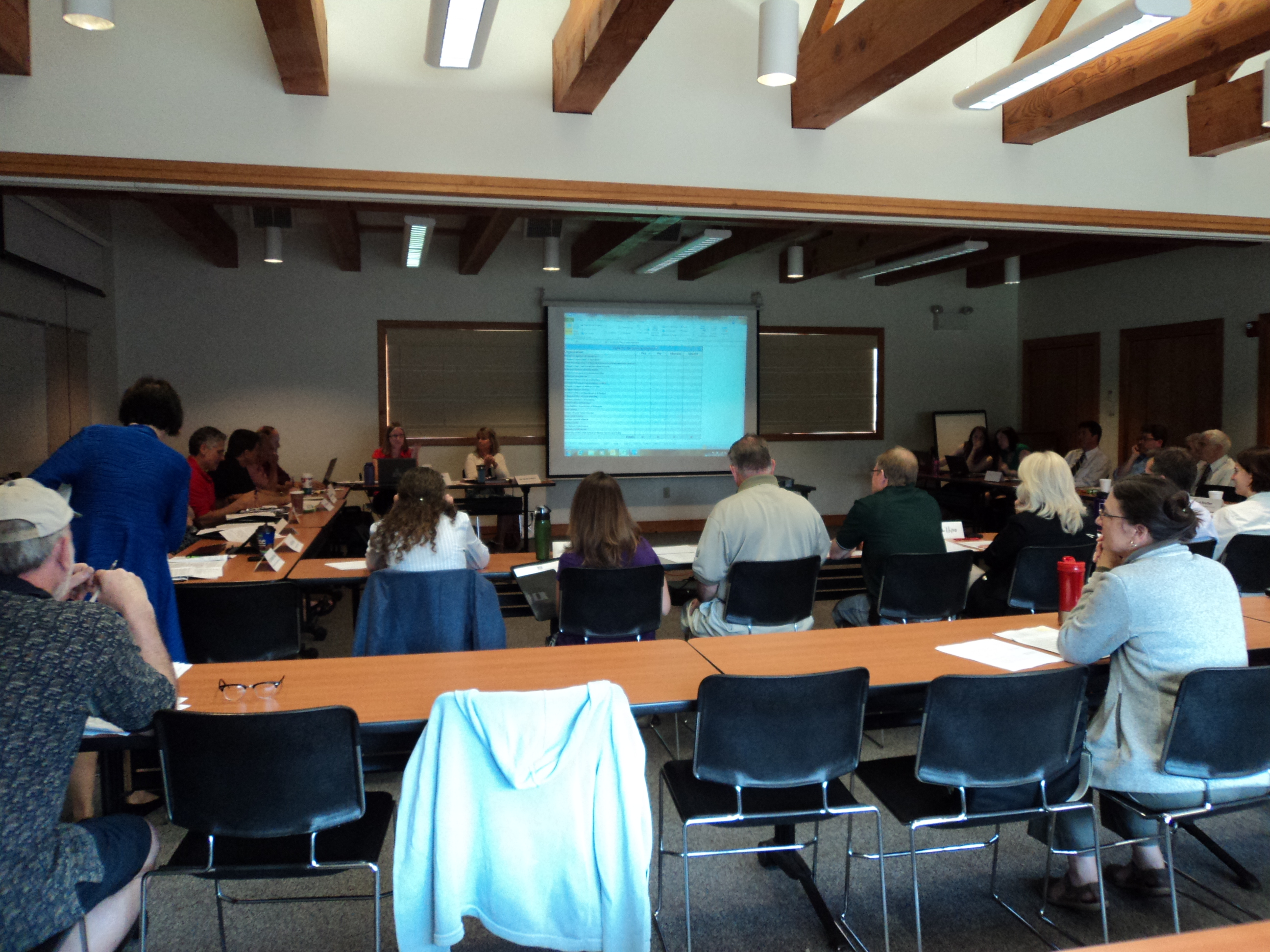
Yesterday was a meeting of the Delaware Sea Level Rise Advisory Committee at Kitts Hummock, by Dover. Their charge is broad:
“…potential solutions to reduce risk to sea level rise impacts…” but they’re missing the boat in at least one obvious area…
The reality of sea level rise is apparent every time I head up to Delaware City, because Route 9 is underwater, from 1/3 to 2/3 of the southbound lane. When we headed to Kitts Hummuck (what’s a hummuck? “It’s like a tussock, but bigger,” Alan says.) and there was water on Route 9 south of Port Penn, too. Delaware is SO flat, and Port Penn’s development has moved back from water’s edge:

In looking at the draft report, the first thing I noticed was that there was nothing about preparation about how sea level rise would affect utility infrastructure (the love of my life!). During a break, the DOT rep at the meeting let me know that they’d done a “Vulnerability Study” that addresses that, and here it is:
.. and no, there’s nothing about electrical infrastructure, ranging from generation, to transmission, to distribution. A search shows only one reference to electrical:
Data Collection
In order to conduct an in-depth vulnerability assessment, geographic datasets are necessary. Geographic datasets are a special type of dataset that contains information so that it can be placed on a map. Delaware Coastal Programs staff spent considerable time and effort compiling geographic datasets that could be utilized
with the sea level rise scenario maps to determine the location and numbers of resources at risk from sea
level rise. Datasets like roads, railways and public safety facilities were relatively easy to obtain as they are
maintained and routinely updated by a state or county agency. Many datasets were out of date or lacked
appropriate documentation as to when the data was collected or how it was collected (metadata). A few
datasets were unable to be used for this assessment due to privacy or homeland security concerns (electrical
substations for example). In many other cases, the desired data did not exist or was so out of date that it could
not be used.
Oh my… ummmmmmm… what a bunch ‘o crap! They need to look at this stuff, and for sure they have access. They are a government entity doing planning. EARTH TO MARS — all they have to do is sign a form, and if they don’t want to do that, they can look at google maps. THERE IS NO EXCUSE FOR THIS.
Why does it matter whether they consider electrical infrastructure? Well, electricity is deemed an essential service, and if it’s underwater, they’re gonna have problems, to put it mildly. Power plants are typically located on water, Indian River is a perfect example, sited on the Indian River Bay, just off the ocean, and about a foot above the water level:

What do they say about the Indian River power plant? This is it:
The Indian River power plant is the only heavy industrial facility permitted by the Coastal Zone Act in Sussex
County. This facility’s disposal area, shoreline, and intake structures are within areas that will be inundated by sea level rise, but the power plant itself is not within a potential inundation area.
Otherwise, power plants are addressed only in terms of impact of loss of rail service. Great…
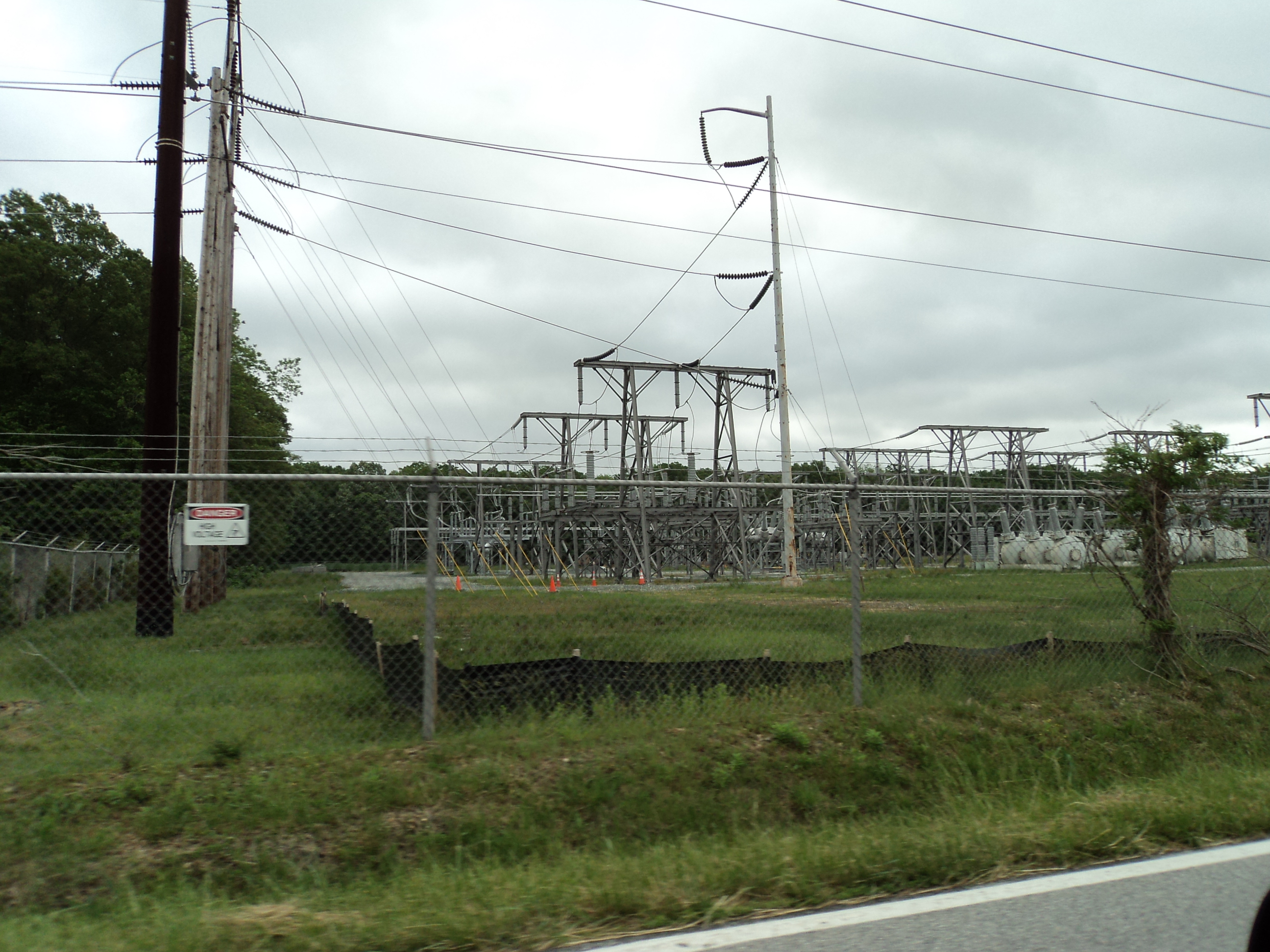
Here’s a photo I took of one of the substations they’re ignoring — took this photo while flying by on Route 9, close to Kitts Hummock. I saw this substation, there’s no reason they can’t, and when this substation goes underwater, then what? A state with homes as old as ours should have an understanding of long-term planning (it looks to me that this was built in anticipation of MAPP, it’s huge and has a lot of empty positions:
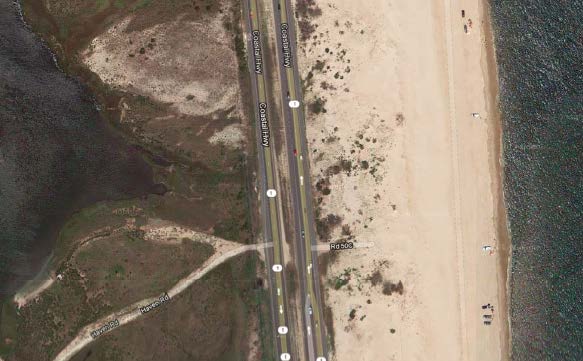
The only transmission considered is disease transmission. An example of transmission facilities at issue is the one along Hwy. 1, by Indian River, pictured here where the Bay is on the west (left), the transmission line is immediately adjacent to the southbound lane of Hwy. 1, and the ocean is east of Hwy. 1:
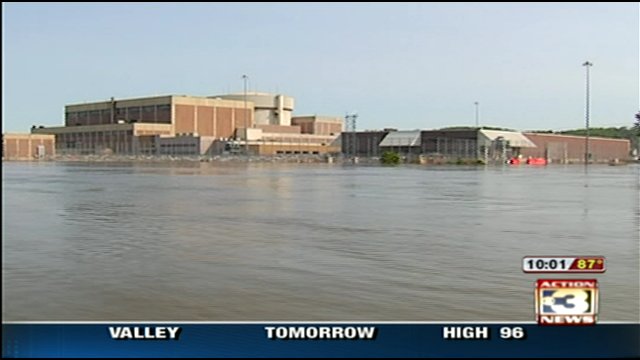
Nuclear is not mentioned, despite the three reactor Salem and Hope Creek plant just across the Delaware Bay. With sea level rise, it will soon look like Ft. Calhoun:
Here’s what they have to say about pipelines, p. 101 of Vulnerability Assessment — they’re not concerned:
Underground Pipeline Utilities: This resource includes natural gas and petroleum pipelines. Workgroup
members also initially considered water and sewer pipelines; however, data was unavailable due to privacy and homeland security concerns. Between 4% and 6% of pipeline utilities throughout the state are within an area that could be inundated by sea level rise by the year 2100. While sections of pipeline are exposed in all three counties, the highest concentration is found in New Castle County. The results from the analysis showed that major supply lines will not be affected; however, distribution along with pipeline corrosion may become issues in the future. Due to these considerations, inundation of underground pipeline utilities is of low concern at this time.
Despite the significant omissions, look at all the Delaware organizations that supported it:
Anyway, then yesterday, they approved the recommendations, with a few minor changes. And those recommendations are not posted — the most recent minutes are from March… sigh…
So rough and quick and dirty review of what they did:
- Approved the lion’s share of the recommendations;
- Deleted #17, which was focused on financial assurance to minimize the state’s liability. GRRRRRR!
- Approved #35 which shifts the burden of notice/disclosure to a home buyer, rather than on a seller and/or realtor. This is SO WRONG!
- Sussex County rep was worthless, sat there silently except to abstain from voting. ?????
From the News Journal:
Saving Delaware’s coast from sea-level rise
Sussex declines to vote on proposed sea-level rise responses
Goodhue Wind winds down… slowly…
May 14th, 2013
A little birdie tells me that my site is a snooze.

That’s true. I’ve been getting some domestic projects done that I’ve been ignoring, and I’ve started a big project that requires lots of research… zzzzzzzzzzzzzzzzzzzzzzzzzz… believe me, that’s more of a snooze than my blog, and I hope worth the wait.
So what else is happening?
The Goodhue Wind project was taken off the May 2 Public Utilities Commission agenda and “temporarily” rescheduled for June 20, 2013. But there’s a new filing provided by Xcel Energy that got me snortin’ recently, dig this:
And no hints – you’ve got to read the whole thing. Peter Mastic is more than a little bruised after this letter!
2012 NERC Long Term Reliability Assessment
May 7th, 2013
The North American Electric Reliability Corporation (NERC) released its 2012 Long Term Reliability Assessment last November. This rates a BIG SIGH, I have yet to post it. How can that be? Well, November was a hectic time, to put it mildly, but then I look and it’s the same thing last year. Anyway, here we go!
And in case you missed it:
Now, as to some of the specifics in the 2012 Reliability Assessment. I was recently asked about “wind replacing coal” which is a popular fallacy, because it doesn’t replace coal, not physically, not electrically, not legally, no way, no how.
From the NERC 2012 Long Term Reliability Assessment, p. 103-104 (click for larger version):


And NERC Report p. 107 – Retiring coal plants are the old small ones (divide the MW by units)
When you’re hearing people crowing about less coal generation, about using less coal, and about generating less CO2, that’s all because there’s less demand, they’re not needing the old, expensive smaller coal plants to meet demand.

Another view of retirements –dispatch is on “economic” basis, meaning cheapest first. That means big coal. The old small coal plants are very costly to run and usually don’t. What this means is that they can shut down the small inefficient and uneconomic plants without suffering because they don’t need them for demand, and they’re high priced to operate and usually sit idle anyway. Now that natural gas is so cheap, it also means natural gas, although in Midwest, they don’t use gas for baseload, as they do on east coast. So the gas here is peaking power, and is usually more expensive because it’s owned by IPP and under Power Purchase Agreements for peaking (high price). Though Xcel owns its own gas now, remember it repowered a couple old coal plants, and they probably could use that more often and don’t have to pay the higher prices of peaking PPAs. See Retirements, NERC Report, p. 8 of 335:

And remember, not one Renewable Energy Standard “replaces” anything. It is a mandate to generate more electricity ON TOP OF the surplus. And the mandate is needed because there is no market. It’s adding surplus to surplus. Not one RES in the nation says “generation X MW of renewable and decrease fossil by X or X-Y or ?.” There is no replacement intended or accomplished. Further unlike solar, wind is off peak, when they’re doing their market transactions, selling all the coal they can. How much can they sell? Well, it’s not reported in the MISO section of the NERC report, which states that only internal transactions MISO are reported (again, click for larger view):

Anyway, bottom line is that reserve margins are twice what they need to be (click chart for the big picture):

Respect for the Earth and its residents
April 26th, 2013

They did change the headline, but the Red Wing Republican Eagle (“the Beagle”) printed my Commentary on Wednesday (the same day that the Public Utilities Commission postponed the Goodhue Wind May 2nd agenda item until June 20th!):

Commentary: Respect blows strong for Earth and citizens
By: Carol Overland, The Republican Eagle
Why pull the plug? The project has fallen apart.
The Public Utilities Commission has asked reasonable questions, and New Era has not answered.
Wind must be sited correctly, because turbines aren’t easily moved.
This is Earth Day. It’s not about “being right” but about “getting it right.”
Carol A. Overland of Red Wing is the attorney for Goodhue Wind Truth.