nyri

TRANSMISSION INTERRUPTUS

The New York Regional Interconnect has been withdrawn… withdrawn in the middle of cross-examination… like WOW!

This from a missive from Troy Bystrom, Project Manager for Communities Against Regional Interconnect (CARI) just a bit ago:

WE WON!!!  NYRI PROJECT WITHDRAWS APPLICATION!!!

Today following a mid-day break in the Article VII certification proceeding, NYRI announced it will withdraw its application from consideration by the Public Service Commission.  Counsel for NYRI explained that in the wake of a decision by the Federal Energy Regulatory Commission earlier this week, NYRI’s investors decided to end their pursuit of an Article VII Certificate of Environmental Compatibility and Public Need. Earlier this week, FERC denied NYRI’s request for rehearing in a proceeding relating to the recovery of transmission system upgrade costs.

The announcement that NYRI is withdrawing its application occurred in the midst of cross examination of NYRI Witnesses and immediately following CARI’s cross examination on demand side management and economics.

The presiding officers asked NYRI to confirm in writing their withdrawal no later than Monday, April 6, 2009.  The Judges also made clear that if NYRI were to seek approval for a similar project in the future, NYRI would be required to once again start at the beginning of the Article VII process.

Communities Against Regional Interconnect, on behalf of the counties of Sullivan, Orange, Delaware, Broome, Chenango, Madison, Oneida, Herkimer, Otsego and the Upper Delaware Council, Stop NYRI, Upper Delaware Preservation Coalition, Say No to NYRI and the Upstate New York Citizens’ Alliance, would like to thank all of those who participated in opposing this ill-conceived Power Line Project in our region.

Thank you to everyone who sent donations, wrote letters, provided testimony, attended public meetings, County planning departments, communities, legal experts, the Attorney General’s Office, DEC, Department of Public Service, consultants, media, organizations, activists, local, state and federal elected officials who all participated in this unprecedented regional effort.

Together, we made a difference. However, the work is not over! We must secure intervener funding to protect the public interest if similar projects are proposed in the future and make sure the 4th District Court’s decision regarding FERC’s authority is not overturned!

And from Scott Olson, of Susquahanna-Roseland “Route B” fame, here’s a collection of today’s news flashes about it:

* APRIL 3, 2009, 4:21 P.M. ET

NY Regional Interconnect Suspends 190-Mile Transmission Project


-By Ian Talley, Dow Jones Newswires; 202-862-9285; ian.talley@dowjones.com

New York Regional Interconnect, or NYRI, said Friday that it is suspending its participation in a 190-mile transmission project because it was denied a Federal Energy Regulatory Commission hearing request for 13.5% return on equity, the firm said in a press release.

The company said in a statement that FERC’s decision earlier this week to deny a rehearing on the request “would pose an uncertain financial risk for this or any other private investment in infrastructure in New York State.”

The company said FERC’s decision was made at the urging of the New York Independent System Operator, or NYISO, which NYRI said protested the transmission project. NYRI said several of its potential competitors sit on the independent system operators board of directors.

“FERC’s March 31 ruling essentially admits that the process may be biased, but it chose not to intervene,” the company said in a statement.

Officials from FERC and NYISO weren’t immediately able to comment.

… and on the scene, from the Pike County Courier:

NYRI calls it quits — the flying horse is dead


Power line application withdrawal hailed by river council

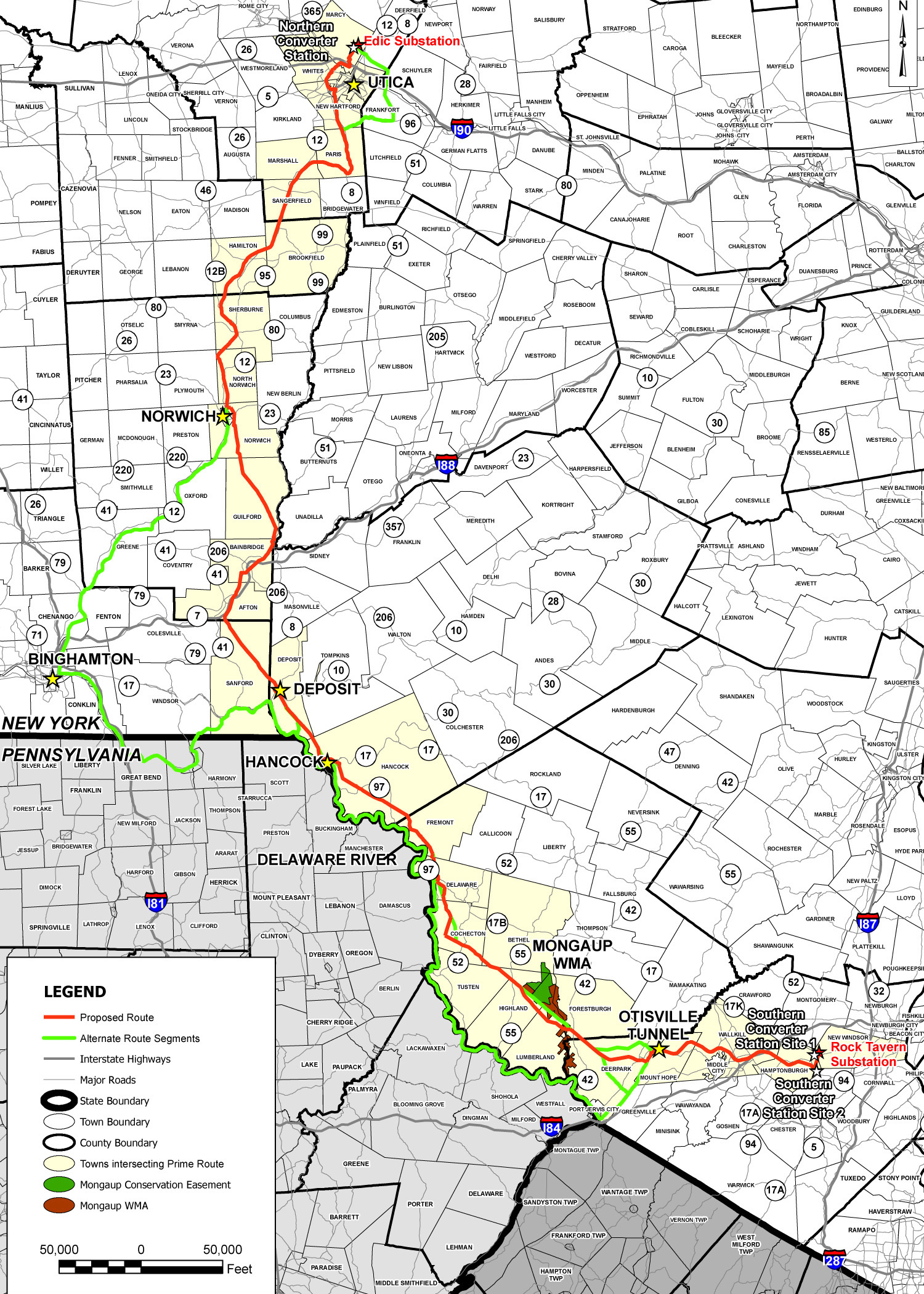
NARROWSBURG, N.Y. — The Upper Delaware Council (UDC) is hailing the Apr. 3 decision by New York Regional Interconnect, Inc. (NYRI) to withdraw its application to construct a high-voltage, direct-current transmission line on a 190-mile path through eight New York State counties between Marcy and Rock Tavern, N.Y.

The decision would end a controversy that has been argued since Canadian developers aired the proposal in 2003. Then called Pegasus, after the mythical winged horse, it originally planned a construction corridor through the federally protected Upper Delaware Scenic and Recreational River. The route then would have run along railway right-of-way in Lackawaxen, Shohola and Westfall townships.

The proposal drew immediate opposition locally, which grew as the proposal made its way through planning and approval processes. In press interviews at the time, project sponsors scoffed at idea of local opposition derailing the project.

NYRI counsel verbally withdrew their Article VII application for a Certificate of Environmental Compatibility and Public Need mid-day through the 15th day of evidentiary hearings before the New York State Public Service Commission (PSC) in Albany.

The UDC participated actively with the Communities Against Regional Interconnect (CARI) coalition of county governments and non-profit organizations since its inception, utilized the resources of a $50,000 state grant secured by Senator John J. Bonacic in 2006 to study and review the impacts of NYRI on the river valley, and vigilantly monitored all NYRI proceedings on a daily basis.

“This has been a long and exhausting fight since NYRI filed its original (formal) application on May 31, 2006, but the UDC has been steadfast in its position that this proposed power line did not belong in the Upper Delaware Scenic and Recreational River corridor,” said UDC Executive Director William E. Douglass.

The surprising withdrawal action followed a March 31 Federal Energy Regulatory Commission (FERC) ruling that denied NYRI’s request for a re-hearing on the question of cost allocation voting procedures by the New York Independent System Operator.

NYRI Attorney Len Singer advised PSC Administrative Law Judges Jeffrey Stockholm and Michelle Phillips on Friday that the private company’s investors felt that the order jeopardized NYRI’s ability to recover the costs of transmissions upgrades, thereby creating too great of a financial risk.

NYRI was instructed to submit a letter of Article VII withdrawal notification by Monday, April 6, to the PSC Secretary, with copies to all of the Interested Parties in this case. NYRI must also make clear in that correspondence whether they intend to re-apply to the PSC or seek certification from FERC for this project at a future date.

If no objections are raised to NYRI’s decision by Monday, April 13, the case will be officially closed.

The NYRI application proposed to site mostly 10-story-tall overhead transmission towers between converter stations in Oneida and Orange Counties on a nominated route that largely paralleled the Millennium Gas Pipeline in this region from Deposit to Cuddebackville. That represented the second generation of a proposal made in October 2003 by NYRI predecessor, the Canadian firm Pegasus Power Systems, Inc., to transport upstate electricity to metropolitan markets downstate. Pegasus proposed to use the railroad rights-of-way alongside the Upper Delaware River for its route.

The River Management Plan for the Upper Delaware Scenic and Recreational River (1986) states that new, major electric lines are an “incompatible use” and present a “clear and direct threat” to the river corridor.

In addition to believing that NYRI would have violated the National Wild and Scenic Rivers Act, the council was concerned about the company’s potential use of eminent domain to acquire private property for this line, its impacts on the local environment, loss of property values, and detrimental effects on tourism.

Working in partnership with the National Park Service since 1988, the UDC is the non-profit organization responsible for coordinated implementation of the River Management Plan. For more information, call 845-252-3022, or visit www.upperdelawarecouncil.org.

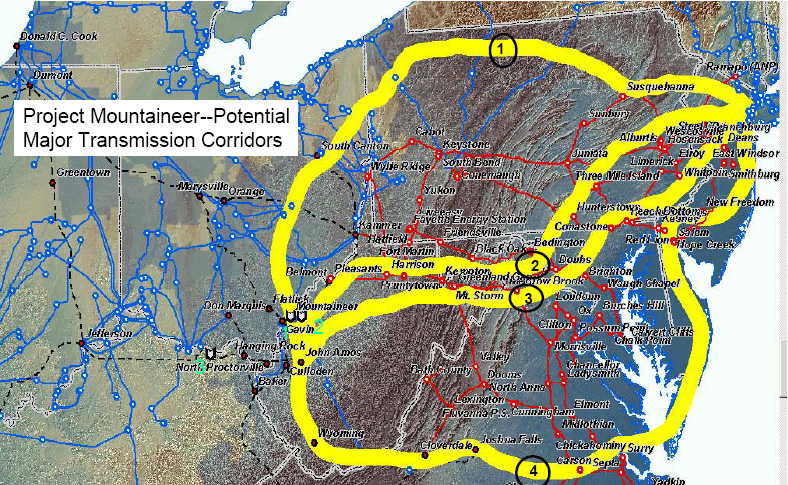
Susquehanna-Roseland is but a small part of a much bigger plan:
projectmountaineermap

For more information on the Ssuquehanna-Roseland transmission line, see:

STOP THE LINES

The National Park Service seems to be taking a rational approach — a thorough review of impacts on public lands:

National Park Service plans power line study


By BRUCE A. SCRUTON

bscruton@njherald.com

The National Park Service wants a full environmental impact study done on how construction of new 500-kilovolt electric transmission lines will affect the Delaware Water Gap National Recreation Area, the river itself and the Appalachian Trail, a designated national heritage trail.

Just more than four miles of the proposed route crosses through the recreation area on its way from Susquehanna, Pa., to Roseland in Essex County. The Pennsylvania section is being proposed by PPL and the New Jersey section would be built and owned by Public Service Electric & Gas, the state’s largest power utility.

The National Park Service had the option to cede oversight to the utility-regulating agencies of the two states, but announced that “the NPS will adhere to its own regulatory and approval process” regarding the lines.

The proposed route follows an existing right-of-way which contains 230-kilovolt lines which were built in the late 1920s and pre-dates the recreation area. But when the federal government purchased the properties, it also became the party to the rights-of-way. In addition, to construct the new towers, the utilities will need additional, temporary rights-of-way.

Construction over environmentally sensitive areas along other parts of the route has given rise to much of the public opposition to the project.
Read the rest of this entry »

Art Hughes has died…

March 31st, 2009

I’ve just received a missive from Iowa that Art Hughes, Ph.D. in Power Engineering, died last month, February 17, 2009.

Monday, March 1, 2009

Bernard A. Hughes

PEOSTA, Iowa — Bernard Arthur “Art” Hughes, 63, of 7995 New Melleray Road, Peosta, formerly of Texas and Canada, died at 3:30 p.m. Tuesday, Feb. 17, 2009, at home.

Services will be at 4 p.m. Monday, March 2, at Leonard Funeral Home & Crematory, 2595 Rockdale Road, with the Rev. Kathleen Milligan, rector of St. John’s Episcopal Church, officiating. Burial will be in Mount Olivet Cemetery, Key West. Friends may call from 3 to 4 p.m. Monday at the funeral home.

He was born on April 3, 1945, in Hereford, United Kingdom, son of James R. and Sara (Price) Hughes.

Art was a brilliant electrical engineer and did consulting work. He had earned his PhD in electrical engineering and was currently working on tracking stray voltage and electrical and magnetic fields and their effect on livestock production.

There are no known survivors.

Art died just a few days after this photo was taken.  He was making comments at a public meeting about an ITC transmission line through his Peosta, Iowa neighborhood:

Wednesday, February 11, 2009

Hearing generates electricity

Dubuque County landowners express concern about ITC transmission line


By MICHAEL SCHMIDT TH staff writer

arthughes

Photo by: Jessica Reilly
Art Hughes, of Peosta, Iowa, addresses concerns about the construction of electric transmission lines in the area during a public information meeting Tuesday at the Peosta Community Centre.

PEOSTA, Iowa — Jack Ludescher has second thoughts about his retirement home.

The retired Dubuque junior high teacher is mulling whether to use property on Asbury Road, west of Dubuque, should ITC Midwest follow through on its proposed 81-mile electric transmission line in Dubuque County.

“We don’t know if we want to do this if a power line is going over,” Ludescher told the TH Tuesday following the Iowa Utilities Board hearing on the plan at the Peosta Community Centre. Nearly 100 people turned out for the meeting.

For about 90 minutes, ITC Midwest officials and property owners discussed the merits of a proposed new 345 kilovolt transmission line between its Salem Substation in Dubuque County and its Hazleton Substation in Buchanan County.

The proposed line would be built along the route of an existing 161 kV line and add a circuit on a 100- to150-foot right of way.

Poles would extend between 105 and 155 feet into the air and be spread 800 feet apart. ITC is in negotiations with property owners for new rights-of-way along the proposed line.

Construction is slated to begin in 2010, with completion by the first quarter of 2012, ITC officials said.

“This is a major construction project that will support the area for years to come,” said Dick Coeur, ITC general manager for community and customer relations.

ITC officials cite the need for strengthened energy reliability and decreased power losses on the system.

The Midwest Independent Transmission System Operator has identified eastern Iowa as a trouble spot for energy bottlenecks, and the proposed line would form a loop with existing north-south and east-west transmission lines in the region.

Without a new 345 kV line, there is the potential for voltage problems and energy overloads, officials said.

“(The line) completes the 345,000 volt-system,” said Doug Collins, executive director for ITC. “It’s really more than Dubuque County. This line would continue on to another substation, so if we lose the existing line, power can still come from another direction.”

During the question-and-answer session, property owners voiced their concerns about the project.

Doug Behnke, of Peosta, questioned how energy from the transmission line would be neutralized.

“It comes down to the safety of the line, safety of the people and the animals,” Behnke said. “How will it affect humans? We need to have a standard for human safety. Human and animal safety is not being addressed.”

Bruce Whitney, principal engineer for ITC, displayed a graphic listing the milligauss, or magnetic field, of various household appliances. In comparison, Whitney said the transmission lines would emit less magnetic energy than a hair dryer, electric shaver, blender and vacuum, based on Environmental Protection Agency data.

Behnke scoffed at ITC’s graphic, calling it “distortion.”

“That’s smoke over the household sources,” Behnke replied.

After meeting with landowners, ITC Midwest plans to file a Petition for a franchise with the Iowa Utilities Board. The IUB will then notify citizens of each county — Buchanan, Delaware, Dubuque and Jackson — and determine whether a final hearing will be held.

damags03

How much can we take???  As if the Chisago Project wasn’t enough… here we go again…

The upcoming MISO list of transmission projects proposed has the following three items of interest to those in the Chisago area:

  • Builds 345 kV circuit from Sherbourne County Station to Chisago County Station in Minnesota
  • Builds 345 kV circuit from Hampton Corner Station to Chisago County Station in Minnesota
  • Build 345 kV circuit from Chisago County Station in Minnesota to Longwood Station in Wisconsin

Here’s the short version:

Yellow-highlighted Chisago Projects to come

AAAAAAAAAAAGH!  I’ve got this tune floating through my brain… the hook line, “how can a poor man stand such times and live…”

Thanks to the little eagle-eyed birdie who sent this.

eagleeye

coal

Yes, all this transmission we see, the hard to believe plans of superhighways across the country, MTEP, JCSP, Green Power Express, TrAIL line, Mid-Atlantic Power Pathway, Susquehanna-Roseland, on and on and on, it’s for coal, we know that, but when the truth jumps up and is as in-your-face as it is at this meeting… well, ya gotta read it to believe it.  From the FERC docket entitled PROMOTING REGIONAL TRANSMISSION PLANNING AND EXPANSION TO FACILITATE FUEL DIVERSITY INCLUDING EXPANDED USES OF COAL-FIRED RESOURCES (really, that’s the name…):

FERC Transcript 5/13/05

Here, from p. 61, is a tantalizing snippet from the Pres. of PJM:

PJM is certainly proud of what has been accomplished to date to open up markets to coal, but there is much more that we and others in this region can do to further enhance that use of coal.

It is for this reason that, today, PJM is setting out by example, a new initiative which we have labeled Project Mountaineer — appropriately titled for the state that we’re in — to utilize our regional transmission expansion planning process to explore ways to further develop an efficient transmission super highway, if you will, to deliver the low-cost coal resources in this region of the country, to market.

And to actually build it when people don’t want it over their land, don’t want to look at it, don’t want the EMF impacts?  Well, they say…

About the only answer to that would be some sort of federal siting law that would basically overcome local property rights.

National Interest Electric Transmission Corridors anyone?  This was in 2005… as the CapX Technical Report was about to be published, putting all of this into action… sigh….

To look up the entire docket, go HERE and search for AD05-3, and voila, there it is for your edification and reading enjoyment!

It’s all for coal, we know that, and we’ve got to NOT let them get away with this!