Has a Cedar Falls utility met its “Waterloo?”
July 18th, 2005

It was Saturday morning, one of those times when I’d just as soon ignore the phone, but it was an Iowa number and I couldn’t resist. Good thing, too, it was one of those calls that makes life worthwhile, Bert and Diane Schou called for a consult on a transmission line going past their house. They’d participated in the Iowa Utility Board hearing, and the Order had just come out, and what an Order it was, as it too often is, dismissing all concerns raised and giving the utility just what it wants:
Here’s the Order of the Iowa Utility Board ALJ!
The Schou’s took an approach similar to that of the Power Line Task Force, which brought in scientific experts including cellular specialist Dr. Martin Blank for Direct Testimony and Rebuttal, and Magda Havas, except the Schou’s witnesses were participating by phone and written statement, and the Administrative Law Judge essentially paid no attention.
Meanwhile, Diane is suffering from electrical sensitivity, as are a growing number of people, and is trying to find relief. The DesMoines Register featured the Schou’s struggle earlier this month:
There is a LOT of information out there on EMF, including:
EMF-RAPID report
A pooled analysis of magnetic fields and childhood leukaemia
I’m short on time and can’t find it, but there’s this great HUGE California study… it’s got to be here somewhere…
The best most credible site on EMF, bar none, is Roger Conant and the Power Line Task Force’s Power Line Facts. CHECK IT OUT!
And while we’re on the topic of transmission, David Bly’s just blogged on Electricity: Whiners and Loosers.

Arrowhead Eminent Domain — Transmission Happens!
July 11th, 2005
Eminent Domain has been in the news thanks to the Supremes decision in Kelo, et al. v. City of New London. Compare that with the Minnesota Supreme Court’s Walser case, about public purpose. Now I’m not done wading through Kelo yet, but it seems to me that Kelo plays out no differently than eminent domain as currently operating in Minnesota, that where there’s an umbrella of a deliberate plan by a governmental unit that is “essentially” public purpose, distinct from public use, they can take land and hand it over to a private developer for a private use. The burden is on those whose land is being condemned to prove up an illegitimate purpose, or that it benefits “a particular class of identifiable individuals” (like Mesaba’s Tom Micheletti and wife??).
The only defining clue I see in the decision is the court’s emphasis on this quote from Hawaii Housing Authority v. Midkiff, 467 U.S. 229, 242 (1984):
When the legislature’s purpose is legitimate and its means are not irrational, our cases make clear that empirical debates over the wisdom of takings — no less than debates over the wisdom of other knds of socioeconomic legislation — are not to be carried out in the federal courts.
So in a case, oh, … say, like Mesaba, where it’s an illegitimate purpose and the means are irrational, sounds like the door is wide open!
Another important decision in Minnesota is the Siegel case, holding that Plaintiffs had a valid claim (which they’d have to prove up) and could proceed and enter their evidence that governmental actions that diminished the value and limited their use of their property constitutes a taking:
Although the pleadings state no claim of total worthlessness, the pleadings permit proof that the city’s and the MCDA’s actions left appellants without economically viable rental and development uses for their property and, therefore, that appellants have a right to recovery under the Takings Clause.
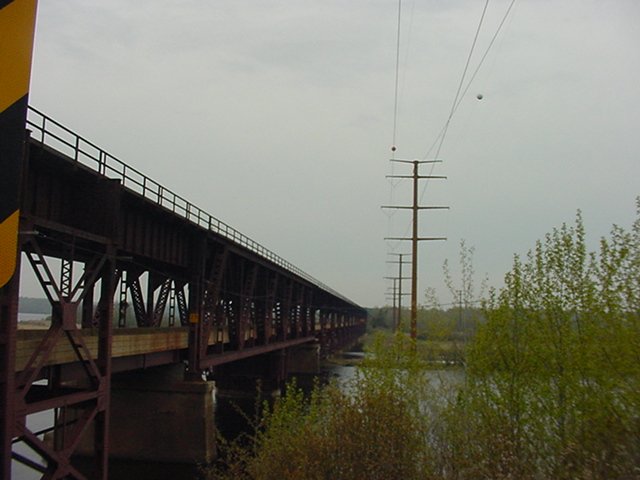
On the subject of eminent domain, this last week, I got a big box of exhibits from Minnesota Power. It’s the documentation requested in the Arrowhead PUC case where Minnesota Power wants to transfer ownership to ATC, and a large part of it was the easement agreements and the Condemnation Orders. It was the Condemnation Orders that were hard to take, because they revealed that the landowners did not avail themselves of the challenges open to them.
There are only a few valid challenges to a condemnation proceeding, which is governed by Minn. Stat. ch. 117, and they focus on the authority of the party taking, and a very narrow look at the “need” and public purpose for the taking. A Certificate of Need is per se “need” for the line, but there was no Certificate of Need for the Arrowhead line because the line fell just under the threshold where one is required. As a part of the EQB proceeding, Intervenors tried to raise the need issue, but after the Chisago project, the EQB stayed far away. There has been no governmental need determination in Minnesota for the Arrowhead Transmission Line. “Need” for the line is in question.
In this case, there was another opening for review, a constitutional challenge that landowners did not receive notice that the Arrowhead Exemption from the Power Plant Siting Act would eliminate their rights under the “Buy the Farm” provision — that because the landowners were not notified of the meaning and effect of the exemption, their waiver of participation was not valid. I’d raised this at the Appellate Court in the Arrowhead appeal, C4-01-1022, and had submitted the transcripts to show this WAS raised before the Board! None of the landowners knew about “Buy the Farm” or that if the project were exempted, “Buy the Farm” would not apply. But during the oral argument, the panel noted a couple of times that this argument had to be raised in the condemnation court.
As we can see in the eminent domain cases above, constructive takings happen when insufficient notice is given and when property value and land rights disappear when governments take action, a need determination must be made and there must be a public purpose for the taking, and landowners must receive proper notice of their rights and whether rights may be lost as a consequence of governmental action. None of these legitimate challenges to condemnation were made in the Arrowhead condemnation proceedings. Instead, the court notes that those defending against condemnation just wanted the condemnation decision delayed until PUC decided on the NAWO and SOUL Complaint to revoke the EQB’s exemption.
Here’s what the court thought of that — the incredulous “look over the top of its glasses” is audible — below is an example of the Arrowhead Orders, one of many, but they’re all identical, it’s broken down into Parts I and II because it’s “too large” to upload, and Part II Memo is the one with the court’s reasoning:
Part I Download filePart II Memo Download file
Here’s the short version of what the District Court said:
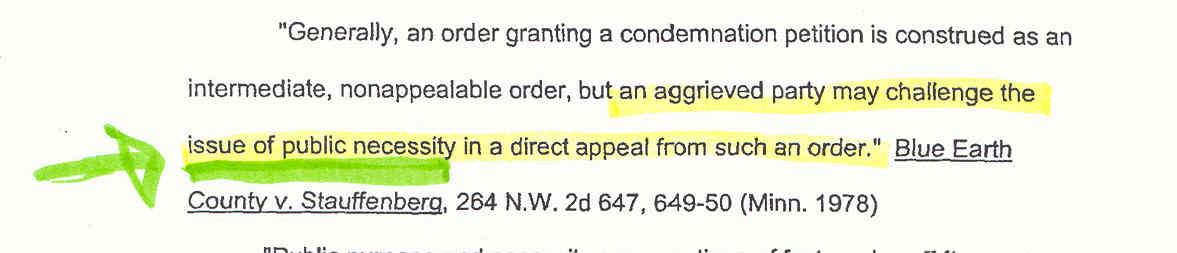
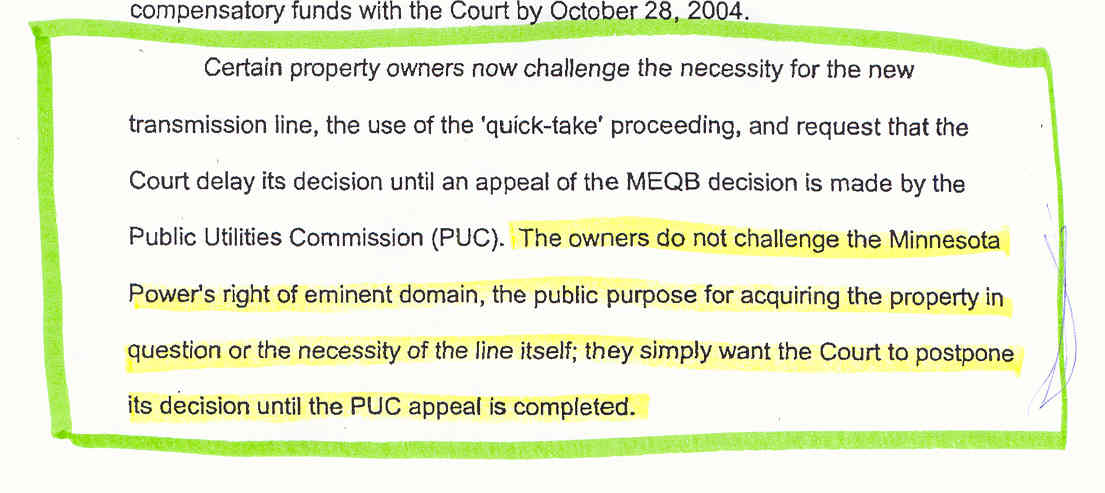
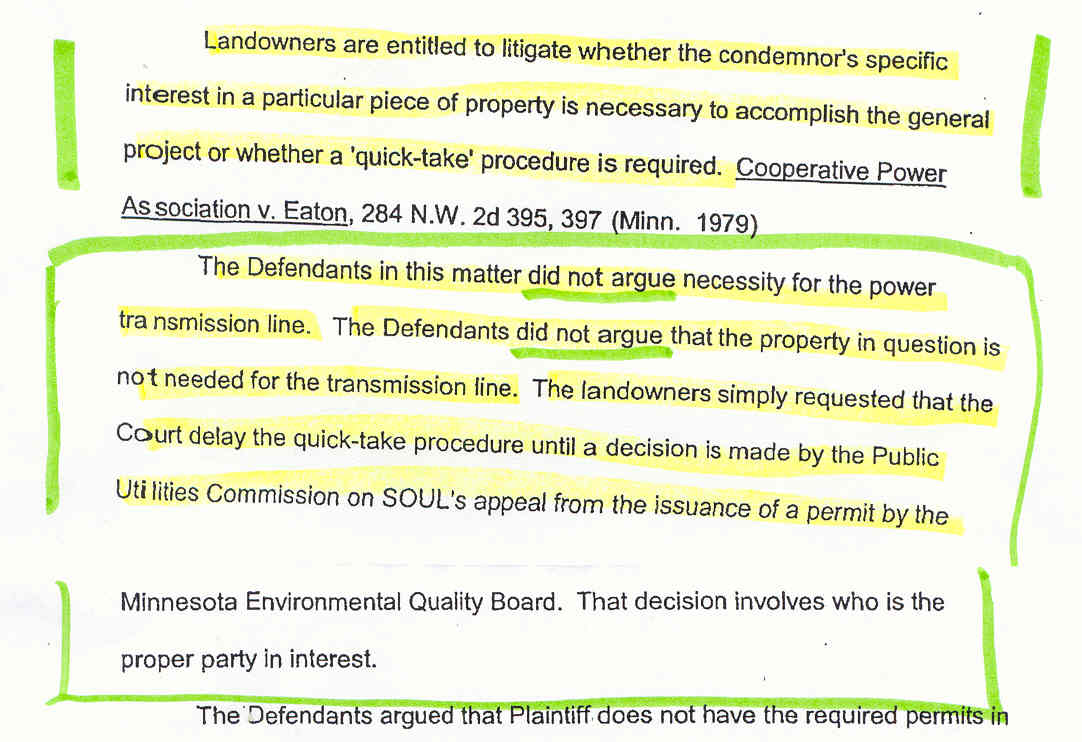
NAWO and SOUL filed a Complaint with the PUC to revoke the EQB’s exemption — asked one agency to overturn the decision of another! Here’s a copy of the PUC Order dismissing that Complaint and telling NAWO and SOUL to bring the request to revoke the EQB decision to the EQB.
They Arrowhead landowners were at the horse track, but ignored the ponies and bet all they had on a rescue greyhound that wasn’t even in the gate! The quick-take condemnation goes forward.
Sigh… Transmission happens!
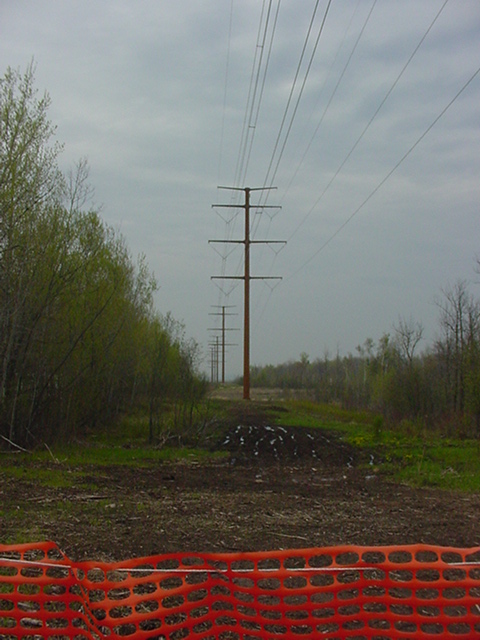
TRANSMISSION FOR DUMMIES #3: Transmission across southern Minnesota — It’s all connected!
July 8th, 2005

Remember Michael Noble?s vision via Northstar Sierra Club?s newsletter:
Instead of planning transmission to serve new coal plants, let’s begin discussing a project that combines the following: renewable energy from wind farms and bio-gas plants, a new high-capacity border-to-border powerline across southern Minnesota and northern Iowa, and as many locally owned energy projects as can be organized along the route. Let’s dub this project Next Generation, a $5 billion project completed within five years. What if this Next Generation project offset the need for two or more coal plants? What if this Next Generation project brought wealth and opportunity to 20+ communities? The stage is already being set.
Is the state really set for a line across the bottom of Minnesota as Michael dreams? This is transmission, a ?grid,? and transmission lines are not built arbitrarily from the middle of nowhere to the middle of anothernowhere.
As we said in Arrowhead, “It’s all connected!”

A: Hypothetically if the line came close to anywhere, it might be connected.
Jones, Tr. at 5913. (Arrowhead WI I, p. 50)
A: If you connected all the systems together, they would be connected.
Jones, Tr. at 5918. (Arrowhead WI I, p. 50)
A: It’s possible if you connected them, they would be connected.
Valine, Tr. at 6747. (Arrowhead WI I, p. 50)
Now let’s connect the dots. Where did that idea of a big honkin? transmission line across southern Minnesota come from anyway?
It started with the WRAO Report, a transmission planners dream of all the transmission that anyone in the world could want. Here’s the map of this early version of the line across southern Minnesota, starting out in South Dakota, and extending to eastern Wisconsin.

Now look at Lignite Vision 21‘s dream transmission to bring coal to market, with a big magenta line from Huron to Sioux Falls to Lakefield Jct., the western part of WRAO 9a:

Then there’s Matt Schuerger’s MTEP03 or Northwest Exploratory Transmission Study Power Point that shows large scale transmission across the middle of Minnesota and also further south in Iowa (too big to upload).
Next is American Transmission Company’s 10 Year Plan, which shows the eastern part of WRAO 9a (are you starting to see a pattern here?) from Lakefield Jct. to Adams, to Genoa to Columbia, in Wisconsin.

And last but not least, the CapX2020 Transmission Plan, that shows that middle stretch between Xcel’s SW MN 345kV Sioux Falls to Lakefield Jct., and connecting to ATC’s Wisconsin part:

As you can see, we’ve been working toward’s Michael Noble’s dream of transmission across southern Minnesota for some time. And all the coal west of western Minnesota could not be built, Big Stone II, Coal Creek upgrade, and all the others in the MISO queue, because transmission would not be built, but for the Transmission Omnibus Bill from Hell“>Transmission Omnibus Bill from Hell.

This is a test: Does this look like our renewable energy future or our irretrievable fifty or more year commitment to fossil fuel central station power? Remember, things electrical are binary!

TRANSMISSION FOR DUMMIES #2: IT’S NOT FOR WIND!
June 25th, 2005

New coal is being built
Transmission ?for wind? from Buffalo Ridge on the 345kV line is at best only 11% of its capacity
Wind energy from Buff Ridge to the metro takes the scenic route through Manitoba and much gets lost along the way!
Remember Michael Noble’s dream as set out in the Sierra Club newsletter?
Instead of planning transmission to serve new coal plants, let’s begin discussing a project that combines the following: renewable energy from wind farms and bio-gas plants, a new high-capacity border-to-border powerline across southern Minnesota and northern Iowa, and as many locally owned energy projects as can be organized along the route. Let’s dub this project Next Generation, a $5 billion project completed within five years. What if this Next Generation project offset the need for two or more coal plants? What if this Next Generation project brought wealth and opportunity to 20+ communities? The stage is already being set.
The stage is indeed set, with great acting, scripted lines on cue. Who does a new high-capacity border-to-border powerline across southern Minnesota and northern Iowa serve? It’s not binary, as we say in transmission, it isn’t either coal or wind, it’s whatever generation is there in the MISO queue waiting for interconnection and can connect. Wind can’t connect to the 354kV line, it’s cost prohibitive and a technical nightmare, and that’s why a web of 34.5kV collector lines is being woven into the lower voltage lines. What type of generation is in large volumes to utilize 345kV lines and is waiting for interconnection to transmission? COAL! And lots of it!
NEW COAL IS BEING BUILT
Here’s the list of proposed coal plants and wind projects listed in the Xcel?s 2001 SW Minnesota study, p. 29, the ones in bold are ones on the way, moving forward to construction:
Entity Approx. MW
GRE (ND Lignite) 500
MDU/Westmoreland (ND Lignite) 500
WAPA Wind (North Dakota) 300
WAPA Wind (South Dakota) 300
WAPA Dakotas wind/Thermal not yet determined, likely thousands of MW
OTP Big Stone (coal) 600 (federal EIS hearing last week)
Unidentified IPP/Study by MidAmerican (SW Iowa) 700-875
SMMPA/Redwood Falls Municipal (diesel) 7
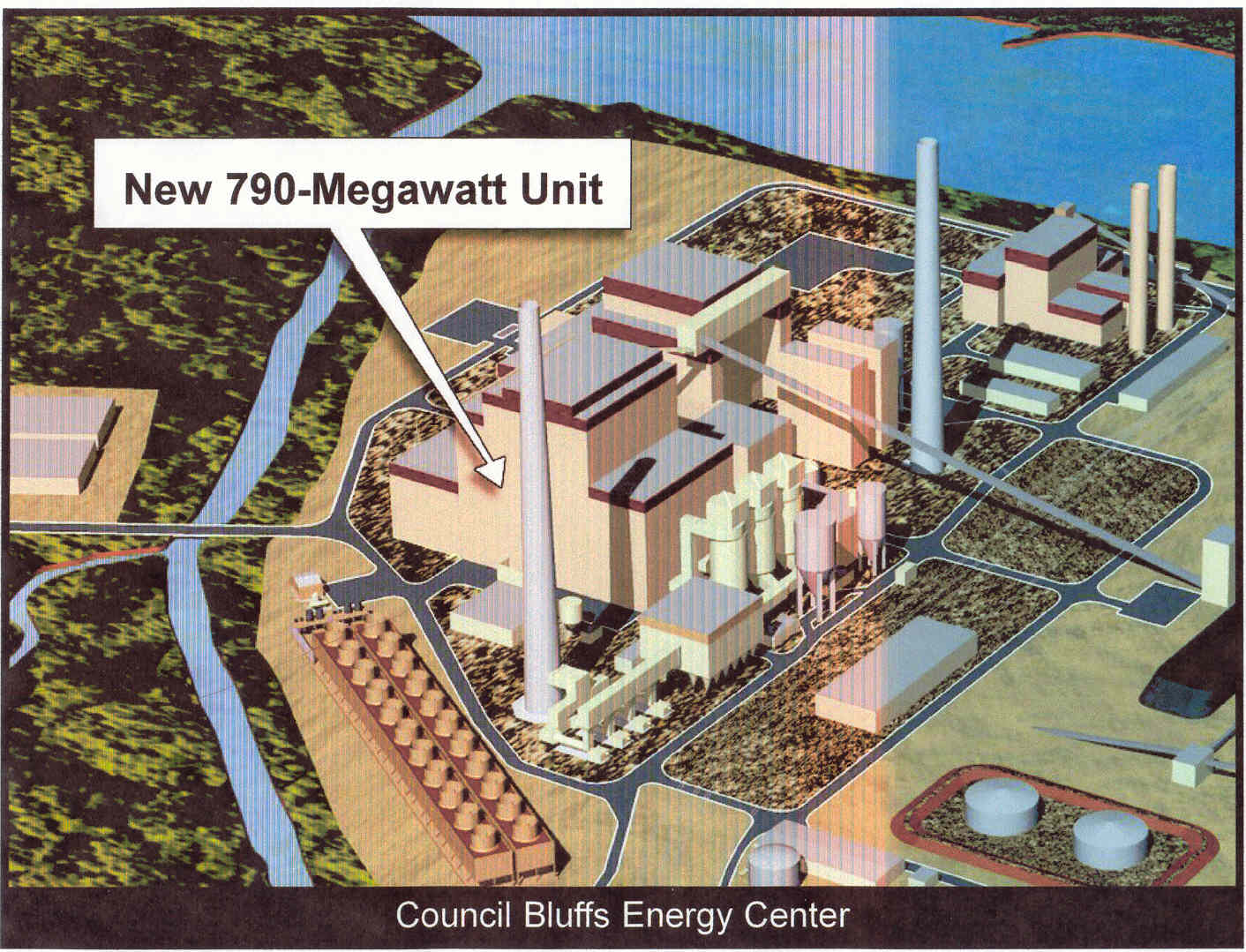
MidAmerican (coal?Council Bluffs, Iowa) 790 (under construction)
MidAmerican (gas?Desmoines) 540
MRES (gas?Watertown, SD) 150
WAPA/Basin Electric NDEX increase 100
Unidentified IPP/study by Alliant (Nobles Co) 340
And don’t forget about that coal plant just south of Adams on the Iowa side of the border that I hear is on again, off again, on again…
According to Xcel’s study, there’s 2,390 MW in the area specifically identified as coal that Xcel anticipates, 1,390MW in the permitting process, 790MW Mid-American plant of that under construction right now. From Xcel’s list, what’s being built and coming on line is coal.
Yet the resulting major transmission line from this SW Minnesota study was the 345kV line, from Sioux Falls (Split Rock Substation) to Lakefield Junction, and a 161kV line extending east from Lakefield Junction to Fox Lake. It’s now permitted by the PUC and EQB and ready to build, look at the maps to see the eastward creep of transmission…
Split Rock to Lakefield Junction 345kv transmission line
— Map – western half
— Map – eastern halfLakefield Jct. to Fox Lake 161kV transmission line
— Map
TRANSMISSION “FOR WIND” FROM BUFFALO RIDGE ON THE 345kV LINE IS AT BEST ONLY 11% OF ITS CAPACITY
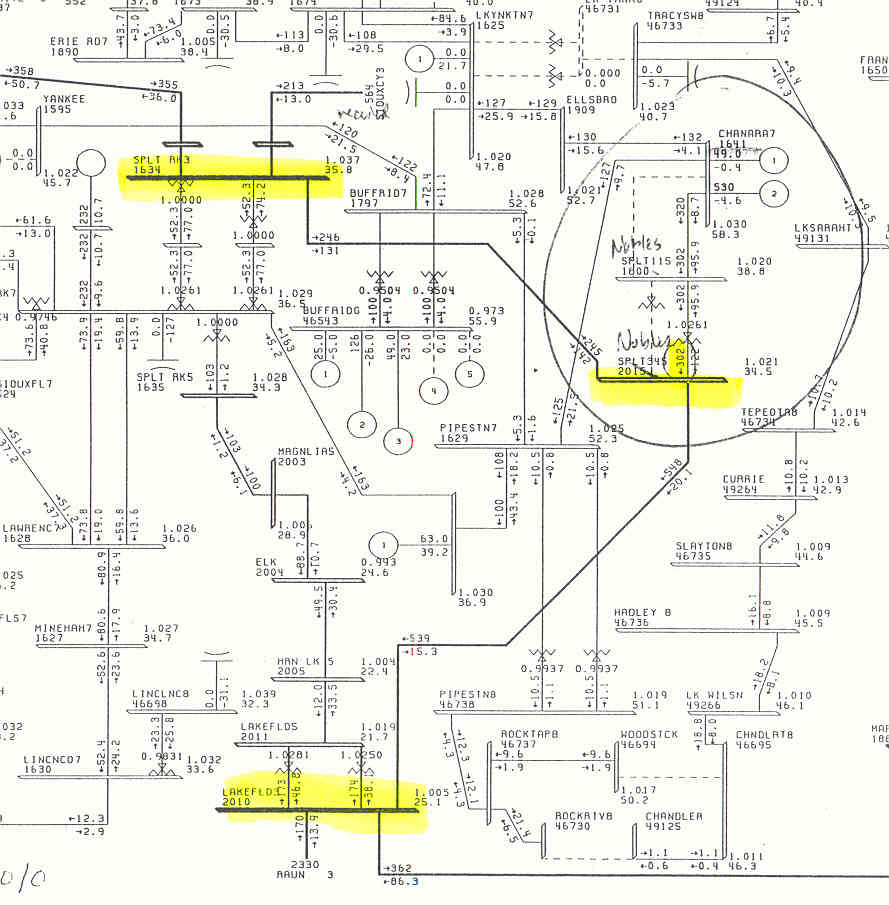
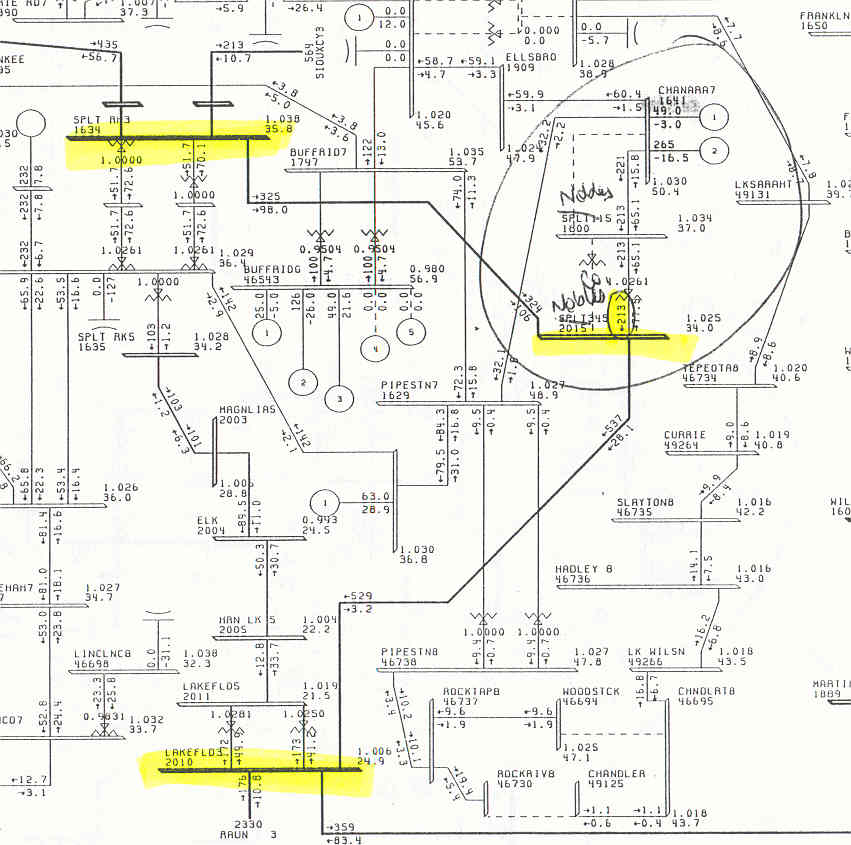
Let?s look at the easier part, what this line doesn?t do. Although some say the line is necessary for wind, it doesn?t serve wind. That is demonstrated in the powerflows, Xcel?s Rick Gonzalez testified about this under my cross-examination during the SW Minnesota 345kV proceeding. The 345kV line goes from Sioux Falls (Split Rock substation) to Lakefield Junction, and there is only one entry point in between where wind energy can get on the 345kV line, at the Nobles substation.
The capacity of the line is 2068-2085MVA. Here’s the chart showing the maximum capacity of a bundled 345kV 954kcmil ACSS line. View image
Xcel?s powerflows show the 345kV line, the Split Rock, Nobles and Lakefield Junction substations, and the power going into the 345kV line at the Nobles Substation. Here they are, see for yourself.
First, there are two powerflow charts, because it was uncertain whether the wind development would be primarily in the south part of Buffalo Ridge or in both south and north. Xcel looked at both, the 100/0 representing all development in the south, and the 50/50 representing a split between south and north. What you will see in these powerflows is that in either the 100/0 scenario (100% of wind to south, none in north) or in the 50/50 scenario (development split between south and north), no more than 15% of the capacity of that line is used by wind off of Buffalo Ridge. In the 100/0 scenario, the rosiest of pictures, 302MW of energy comes off of Buffalo Ridge into the 345kV line. (upload powerflow 100/0). That?s 302 of the 2085 capacity. But the generation development is split between north and south, the 50/50 scenario is reality, so it’s a 213 to 2085 ratio of energy from Buffalo Ridge to the capacity of the line, 213/2085.
Here?s the 100/0 powerflow, below, the scenario that provides more wind energy outlet onto the 345kV line, but that is not representative of the location of wind development, therefore not valid. The substations are highlighted, and the one in the middle is Nobles. The ?302? at Nobles represents the MW coming off of Buffalo Ridge into the 345kV line that has a capacity of 2085MVA. Click here for a full size 100/0 that’s below.View image”
In the 50/50 scenario, below, only 213MW of energy comes off of Buffalo Ridge into the 345kV line, 213 out of 2085MVA. Click here for the full size version of chart below. View image
The 345kV line recently granted a site certificate by the EQB is not even remotely for “Buffalo Ridge wind” ? Buffalo Ridge wind is only a very small part. Then what?s it for? Well, we know there?s plenty of coal coming on line. Transmission capacity goes to those who are up and running with reservations for its use.
Deadline for public comments on EIS scoping for the Big Stone power plant is midnight, July 27. Send input to NEPA Document Manager, Big Stone II EIS (A7400), Western Area Power Administration, P.O. Box 281213, Lakewood, CO 80228-8213.
The Big Stone II is expected to be on line in 2011.
WIND ENERGY FROM BUFF RIDGE TO THE METRO TAKES THE SCENIC ROUTE THROUGH MANITOBA AND MUCH GETS LOST ALONG THE WAY!
*** A discovery in the ongoing Buffalo Ridge Ongoing Incremental Outlet Study, reflected in the modeling, is that the Buffalo Ridge wind energy, because there is not sufficient outlet capacity from Buffalo Ridge, is taking the scenic route to the metro area via Dorsey, Manitoba, then the Forbes substation in Minnesota, down the 500kV line to the Chisago County substation and then, after a circuitous 800 or so mile trip, to the metro area. Here’s a piece of the MAPP map, which shows only transmission lines 115kV and above and substations:
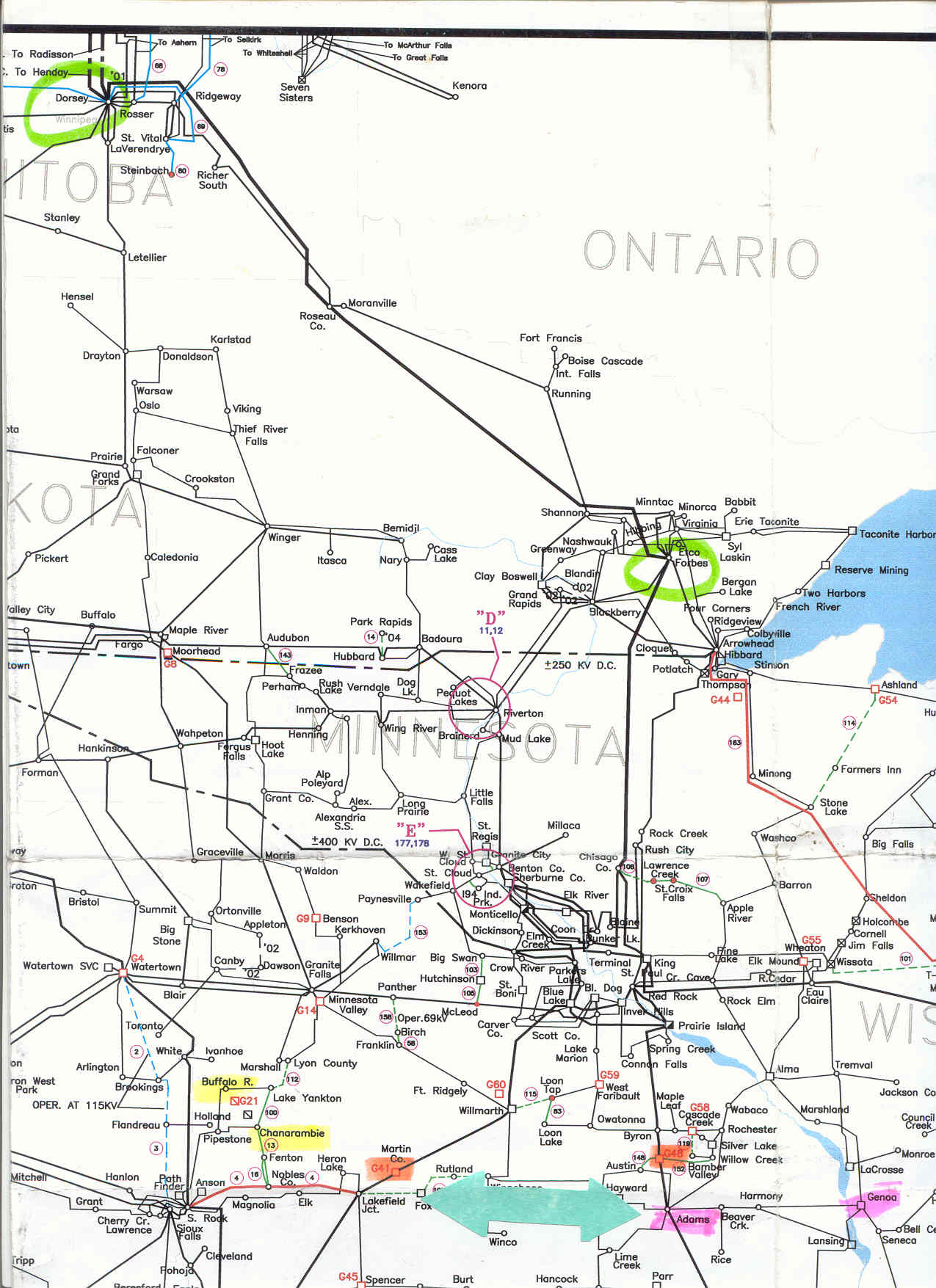
This is the scenic route that some Buffalo Ridge wind energy is taking. It goes from the yellow highlighted substations in the lower left, that’s the Buffalo Ridge and Chanarambie subs on Buffalo Ridge, from there up to the green circle in the far upper left, the Dorsey sub, then down to the right to the other green circle, the Forbes sub, and then down to the metro. How’s that for the long way around?
Potential ways of dealing with this including adding capacitors in Manitoba, increasing the limits on the line so that the increase won’t put it in the danger zone, or, lastly, adding/extending the 345kV line eastward from Buffalo Ridge.
Keep in mind that all of these scenarios and numbers are computer modeling, which is dependent on the base case, what assumptions are made, and this study is more public that the 345kV information, and I think it would be easier to get the specific modeling assumptions than it was in the earlier proceeding.
Line Losses – more on this in a future TRANSMISSION FOR DUMMIES, but in a nutshell, line losses are the energy that is lost by transmitting electricity over lines over long distances, really, over any distance, but the longer the distance, the greater the line loss. For the purposes of the SW Minnesota proceeding, a 30% line loss was assumed (p. 20). Here’s the question. If line losses from Buffalo Ridge to load were presumed to be 30%, what are the line losses associated with a scenic trip through Manitoba, over to Forbes, about 3 times the distance anticipated?
Let’s do some abstract thinking here. The Renewable Energy Standard (HF35) was a mandated stepped increase to 20% generation by renewable sources by 2020. A commonly held conservation goal is 20%. Line loss for Buffalo Ridge wind generation is presumed to be 30%. Wind generation has an inherently low capacity factor because the wind is varialbe, and Waverly Light & Power’s NEG Micon wind turbine, a relatively high producer, has a 36% capacity factor.
Thought for the day: Couldn’t we integrate wind energy, which has low capacity factor, into the mix more effectively by conserving renewable energy by siting it close to load to eliminate or reduce line losses? 30% line losses of a 36% capacity factor generating source doesn’t leave much for use.
FYI, here’s the prefiled testimony, much of it about calculation of line losses, of my expert witness, Dr. Art Hughes, Ph.D.
Xcel SW Minnesota transmission proceedings documents
Here’s the EQB Docket for the 345kV line from Sioux Falls (Split Rock)to Lakefield Jct. and a 115kV line in Xcel’s SW Minnesota plan.
Here’s the EQB Docket for the 161kV line from Lakefield Jct. to Fox Lake in Xcel’s SW Minnesota Plan.
Here’s the PUC docket on Xcel’s SW Minnesota transmission lines. This is the ME3 website for SW Transmission, so scroll down to the PUC section.
Next up – TRANSMISSION FOR DUMMIES #3, which will include the history of this 345kV line across southern Minnesota, from the WRAO study in 1998, the Lignite Vision 21 study in 2001, ATC’s 2004 (and earlier versions too) 10 Year Plan, MTEP 03, and CapX2020, all working toward the same goal. And after that, everything you ever wanted to know about line losses.
TRANSMISSION FOR DUMMIES #1
June 22nd, 2005

Partisan Politics v. Putrid Policy
Ray Cox?s labeling of my substantive energy policy criticisms as ?Partisan Politics? shows that he doesn?t know the difference between partisan politics and putrid policy, and that?s too bad, because he?s up in the legislature voting on these bills. I believe in equal opportunity accountability, holding everyone accountable for their positions and actions. In this case, legislators on all sides voted for SF1368 — it’s hardly a partisan issue.
The Transmission Omnibus Bill from Hell is about our energy future, the path the legislature chose to take, which in this case is a transmission policy disaster. Ray Cox claims to be an ?environmental? legislator, so I expect public statements about energy to reflect that perspective, and to reflect education about transmission issues and the interconnection of energy. I hate to see legislators voting like lemmings ? this transmission bill takes us right over the cliff. What does it take to get the legislature to put the dots together and see where it?s going? What does it take for legislators to do their homework and to be independent thinkers who stand up for the public interest instead of special interests who benefit while the public suffers and is put at risk? What does it take for legislators to understand that even the industry recognizes that we have an electricity glut and the no market for new generation is severely limited? If the industry acknowledges the market glut, shouldn’t the legislators be paying attention?
Putrid policy results from a lack of critical thinking, the transmission line between the faulty end point assumptions is an example. It’s confirmed in the Sierra Club Newsletter this month, the same article Ray Cox raved about. I wish Ray would have read further in Michael Noble?s piece, on page 5, because he discloses our transmission nightmare hell/future just as I?ve described it ? new transmission superhighways roaring across the state. (When you consider transmission, remember that, as Jim Alders of Xcel said testified at the SW MN 345kV hearing, ?electrons don?t know if they?re coal or nuclear or wind,? and transmission cannot discriminate and cannot choose to transmit one type of generation and not another under the FERC rules).
Many of you have been to my Transmission 1001, but let?s review and get down to basics, get more elementary, more pictures:
TRANSMISSION FOR DUMMIES #1: MORE ELECTRICITY — IT?S NOT NEEDED

? We will not swelter without air conditioning in an incubator without a job!
? We will not freeze in the dark on a respirator without a job!
Here?s Michael Noble?s vision via Northstar Sierra Club?s newsletter:
Instead of planning transmission to serve new coal plants, let’s begin discussing a project that combines the following: renewable energy from wind farms and bio-gas plants, a new high-capacity border-to-border powerline across southern Minnesota and northern Iowa, and as many locally owned energy projects as can be organized along the route. Let’s dub this project Next Generation, a $5 billion project completed within five years. What if this Next Generation project offset the need for two or more coal plants? What if this Next Generation project brought wealth and opportunity to 20+ communities? The stage is already being set.

As Michael Noble well knows, coal plants will be served by the transmission lines in SW Minnesota. Transmission reservations are non-discriminatory, and are allocated on a “first come, first serve” basis.
The Transmission Omnibus Bill from Hell confers benefits on special interests. Who will benefit from construction of transmission with minimal and superficial review of projects, who will benefit when the planned new coal plants are built, and who benefits when the infrastructure is put in place and it?s harder to free ourselves from the clutches of central station coal in the Dakotas? New coal plants are coming on line, such as Big Stone and Coal Creek?s additions of 1,100MW, going through the transmission study and state permitting processes right now and made possible only because of the promise of transmission in this bill. These two new coal plants just across our border will drop mercury on us and further pollute Minnesota. Already all, ALL, of the ?impaired waters? in Rice County are contaminated with mercury. Aren?t these new coal plants and mercury polluted waters in Minnesota a problem for all who claim to be against coal plants and mercury in the water? Anyone voting for the Transmission Omnibus Bill from Hell voted to expand coal in the Dakotas. Anyone lobbying and promoting the Transmission Omnibus Bill from Hell promoted expansion of coal in the Dakotas. You all are accountable for this result.
What result? Just take a look — it?s real, it?s here, it?s now. Here are reports on transmission developments that will be making construction and operation of these new coal plants possible — yet ?some people? claim it?s a good thing! What we’re going to get is a lot more of the same!
The Transmission Omnibus Bill from Hell contains many large steps toward turning Minnesota away from distributed and dispersed generation into the pass-through superhighway. Imagine the North Dakota and South Dakota coal plants as one point, and Milwaukee and Chicago consumers as the other point. Where does the line between them take us? Right through Minnesota, and pay particular to southern Minnesota.
The only way to stop the development of coal plants is to keep them off the ?super highway,? by not building it for them. The coal plant developers don?t care if some wind turbines get built along the way as long as they can bring their coal produced energy to market and glean profits at our expense. Michael Noble should know that wind turbines aren’t going to be connecting to a big 345kV transmission line across southern Minnesota anytime soon, it’s cost prohibitive, that’s the whole purpose of the lower voltage underbuild below the transmission line. We can?t take all the mercury out of coal emissions, nor can we put all the soot and sulphurous smoke or greenhouse gas back into the ground.
A state energy plan built on planned integration of intermittant and distributed generation, producing wind power and other renewables close to transmission and point of use would control the development of coal fired plants. But by promoting these bulk power transmission lines, we will assure those many coal plants on the drawing board are built. There is a relationship of what is lost and gained by building the line, and now is the time to hold the line, uncompromising. An irretrievable commitment to construction of transmission infrastructure with financing and useful life of at least 35 years means there is no turning back. There may be jobs created economic growth if it proceeds, but at what cost, and at what point do we stop and say the environmental cost is too great? This mess cannot be cleaned up in retrospect, we need only look to nuclear power as an example. Instead of putrid policy “compromises” where we lose what we have gained, we have to develop energy policy and an energy plan that is based on our best interests and moving toward where we’re headed. There’s no point in trying to accomplish a transition to renewable energy while dragging a ball and chain of COALition compromise. More on that in future TRANSMISSION FOR DUMMIES.
The plan to build massive transmission lines across the state has been in the works for a long time, and I?ll take you through, step by step in Transmission for Dummies #2. But let?s get back to the line between those two points and the fundamentally flawed assumptions. The most important thing to remember in transmission, as in life: ?It?s all connected.? Everything stems from need — if all the plants and all the transmission are to serve the need, let?s logically first look at whether there is indeed a need, and then whether this is the best way to addrss that need — basic energy planning. A look at reliable utility industry publications shows it’s not needed.
During the 2005 legislative session, no different from any other, the hue and cry was that there is a need for 6,000MW of generation in the region, claimed in the CapX 2020 report.
The claim is that we need to build all this transmission to serve that dire need for 6,000MW of new generation. In the CapX2020 report, there is this great map depicting the MISO queue, which is a list of generation projects that are far enough along to have paid serious money to get on the generation interconnection list. How much generation is far enough along in the planning stage to be in line? 16,712 MW. Yes, 16,712MW is in line for interconnection, 6,566MW in Minnesota alone, with generation clustered in areas it would be used.

OK, folks, do the math. 6,000MW is needed by 2020. 16,712MW is in line right now to be built in the near future. Some will drop off and some will be added. Yet even if none is added and even if nearly two thirds drops off for one reason or another, we?re fine! THERE IS NO DIRE NEED! It?s planned, construction is moving forward, and we?re covered, well covered, and most is planned in the areas it’s needed! Generation is on track, and we don’t need transmission across the state.
Still question whether there?s need, even with the MISO queue? Here?s an industry document for you that shows we have more than enough generation to cover need: Check the 2004 North American Reliability Assessment, and look at the reserve margins from p. 31-32, and note that this is a conservative estimate that does not take much of the new generation on the MISO queue into account.
Still question? Here?s another industry document: Check out the 2004 MAPP Load and Capability Report that shows MAPP Region generation and need, more specifically, it shows surplus generation, and again, this is a conservative estimate that does not take into account much of the new generation on the MISO queue.
Still question? Now you’re starting to sound like Speaker Sviggum!
