Prairie Island – LaCrosse transmission line in the news!
October 4th, 2005
Today’s article in the LaCrosse Tribune is a lot different than the last one on this blog, which said “New high voltage line unlikely here.” And keep in mind this is not the work of RPU — it’s been in planning for a long time, since it was Option 2 of the WRAO report. And I’ve learned from Greg Woodworth, Engineer at RPU, that it even goes back to a study in 1978! Look at who the big beneficiaries are of this project, those with the generation that they want to ship long distances… who might that be?

Published – Monday, October 03, 2005
Proposed 345,000-volt line would cut through La Crosse County
By REID MAGNEY / La Crosse Tribune
.
A major new power line might be coming to La Crosse.Several electric utilities want to run a 345-kilovolt power line from eastern Minnesota to northern La Crosse County by 2011, and eventually extend it to central Wisconsin.
Utilities say existing lines are inadequate and they need a high-voltage line connecting Xcel Energy’s Prairie Island nuclear reactor and Wisconsin Power & Light’s Columbia coal plant to meet growing demand in the Rochester, Minn., and La Crosse areas.
“We want to improve the reliability and the stability of the system,” said Chuck Callies, vice president of power delivery for Dairyland Power Cooperative, one of the utilities involved in the plan.
“For long term service to (La Crosse), a 345-kV facility looks like the best value for our customers,” said Don Jones, transmission portfolio director for Xcel Energy.
But watchdogs say the utilities are overbuilding high-voltage lines just so they can sell power generated in Minnesota and the Dakotas to customers in southern Wisconsin and northern Illinois.
Environmentalist Guy Wolf of Stoddard, Wis., said he’s concerned about the 345-kilovolt line “creating an incredible scenario of new dirty coal and old toxic nuclear for our energy future.”
“Do we even need this line? And will this line kill any chance of smaller, renewable energy?” Wolf said.
“We are at a crossroads,” said Carol Overland, an attorney from Northfield, Minn., who opposes the new line. “If they build the transmission lines, the big, polluting generation will come. Is this the energy future we want?”
Transmission plans
Plans to connect Xcel Energy’s Prairie Island nuclear plant and Wisconsin Power & Light’s Columbia coal plant near Portage, Wis., have been on the drawing board for many years, including the Wisconsin power line study that recommended the controversial Arrowhead-Weston line from Duluth, Minn., to Wausau, Wis.
Minnesota utilities, including Xcel Energy, have formed CapX 2020 to plan for the next 15 years of transmission projects. Individual utilities are expected to seek certificates of need for six major projects in the coming year or so.
One of those projects is the estimated $200 million, 345-kV line from Prairie Island to Rochester to north La Crosse. They will file with Minnesota’s Public Utilities Commission for a certificate of need in the first quarter of 2006.
Rochester’s needs
The Prairie Island-Rochester-La Crosse line idea grew out of Rochester Public Utilities’ need for more power and better reliability, said Scott Nickels, senior electrical engineer for the utility.
RPU considered adding another 161-kV line from Prairie Island, but decided to build a 345-kV line because it would meet Rochester’s needs until 2051 instead of 2023, he said.
However, getting a certificate of need for a 345-kV line from Prairie Island to Rochester might be a problem, so RPU decided to make the project regional and include La Crosse, Nickels said.
Even though Dairyland will be involved in the 345-kV project, they will only be using about 15 percent of the line’s capacity, said Dairyland’s Callies. Xcel, RPU and Southern Minnesota Municipal Power Agency also would participate.
Grid needs
The largest high-voltage lines in the Coulee Region now carry 161-kV, and aren’t adequate to move power through the area or handle new generation sources, Callies said.
Much of the La Crosse is served by Xcel Energy, but most of its power comes through 161-kV lines connecting Dairyland’s coal plants in Genoa and Alma, Wis., which will be upgraded in coming years.
Wisconsin’s transmission system is the country’s most congested, which “raises costs,” Callies said.
When Dairyland can’t bring power in from the outside, it has to fire up smaller gas turbines, which produce peak power at several times the cost of coal, he said.
Jones said a connection between Prairie Island and Columbia has been on the drawing board for many years. However, connecting to the Columbia plant isn’t as important as tying into another 345 kV line somewhere in eastern Wisconsin.
Creating such a loop would give the La Crosse area access to lower-cost energy, Jones said.
But Wolf said he’s concerned bringing in power from outside plants will discourage development of smaller, renewable energy sources, such as wind and solar.
“Either it (the state) sides with multinational utilities and transmission companies, importing dirty coal and tons of mercury while continuing to lose good-paying jobs, or it will decide on a future that promises a clean, sustainable energy future, with the promise of locally produced renewable energy that will increase its tax base, build local economies, all while improving the health of its citizens,” Wolf said.
But Callies and Jones said western Wisconsin’s power grid isn’t adequate to handle the kind of local power generation Wolf wants.
“The project will benefit everybody because it will relieve congestion that now prohibits people from doing renewable energy,” Callies said.
The system is so congested now that even small projects have to be reviewed before they can go on line, he said. A 6 megawatt generator powered by landfill gas in Washburn County can only deliver 3 mW because of limited transmission, he said.
Who’s right?
“Both sides are right,” said Charlie Higley, executive director of Wisconsin’s Citizen’s Utilities Board. “It’s well established that the electrical system in western Wisconsin is not as robust as other parts of the state.”
But Higley said Overland and Wolf also are correct that larger power lines would allow utilities to bring in power from coal and nuclear plants.
“We need to build what’s needed and no more,” Higley said. “But what’s the right amount?”
He compared the electric grid to a highway system. “Only so many cars can drive on a two-lane highway before it gets dangerous,” Higley said. “We may need a four-land road.”
The states of Wisconsin and Minnesota need to make sure their utilities are working together on transmission planning, Higley said. And the public also needs to become more involved in monitoring plans.
Reid Magney can be reached at (608) 791-8211 or rmagney@lacrossetribune.com.
Check the sidebar!
Exactly where would the power line go?
And there’s this blog listed as a resource…
PI-LaCrosse – Another transmission LIE
October 2nd, 2005
You’d think I’d be used to it by now, but somehow it still bothers me when utilities lie. Here we go again…
Remember last week’s post about the “Phase I” transmission plans roaring through the state? In a letter dated September 5, 2005, all the big Minnesota transmission utilities had grouped together under the CapX2020 umbrella and said that three groups of projects were going forward, including a line from Prairie Island to Rochester to LaCrosse.

Well, I got a call last week, saying, how is it possible? Just the month before, they’d said “American Transmission Company determined that a new line from Portage, Wis., to Red Wing, Minn., would be too long, too expensive and have a high potential for environmental and land-use impacts.” THEY SAID WHAT??? Here’s the article:
New high-voltage line unlikely here
By REID MAGNEY / La Crosse Tribune
Thursday, August 25, 2005A power line company considered, but isn’t actively pursuing, a high-voltage power line from Wisconsin to Minnesota that could come through the Coulee Region.
American Transmission Company determined that a new line from Portage, Wis., to Red Wing, Minn., would be too long, too expensive and have a high potential for environmental and land-use impacts.
Despite a published report indicating a line could come through the La Crosse area, ATC spokeswoman Annemarie Newman said ATC’s study did not look at routes. La Crosse is not mentioned anywhere in ATC’s filing with the Wisconsin Public Service Commission.
ATC is looking for ways to beef up Wisconsin’s electrical infrastructure, and has asked the PSC for guidance on one major project to pursue.
Newman said they’re concentrating on other new lines that would bring power from northern Illinois and Iowa.
However, Newman said ATC believes connecting the Columbia coal plant in Portage and the Prairie Island nuclear plant in Red Wing would be worth pursuing if utilities in neighboring states were interested.
The 275-mile project would cost $640 million and require 159 miles of new right of way, according to the PSC filing.
Xcel Energy spokesman Brian Elwood said Xcel is working to upgrade its high-voltage transmission line between Stillwater, Minn., and Wausau, Wis.
Improvements to that line will benefit La Crosse, he said.
Reid Magney can be reached at (608) 791-8211 or rmagney@lacrossetribune.com.
And to refresh your memory, we’re talking about the WRAO Option 2, from Prairie Island to LaCrosse to Columbia. The descriptions of the Options are on page 7, and a map is on page 8. Specifics of the project are in Appendix C, page C1-2.
So now who do we believe? Should we believe ATC’s Annamarie Newman saying they “considered” the line but eliminated it? Even though ATC’s 10 Year Plan shows the Wisconsin side of the PI-LaX project — it’s that nearly horizontal line on the left:

Or should we believe the September 6, 2005 letter from William Kaul of GRE, for CapX2020, which includes Central Minnesota Municipal Power Agency, Great River Energy, Minnesota Power, Minnkota Power, Missouri River Energy Services, OtterTail Power, Southern Minnesota Municipal Power Agency and Xcel Energy?
Something tells me we ought to believe the WRAO Report, the written ATC 10 Year Plan and the eight CapX2020 utilities, and believe that the Prairie Island line is going forward. The Rochester study says it’s only a matter of ATC’s decision of whether that line goes east or south from LaCrosse, and again, my money’s on BOTH EAST AND SOUTH!
Lying… I hate it when that happens…
Douglas County Arrowhead Agreement
September 29th, 2005
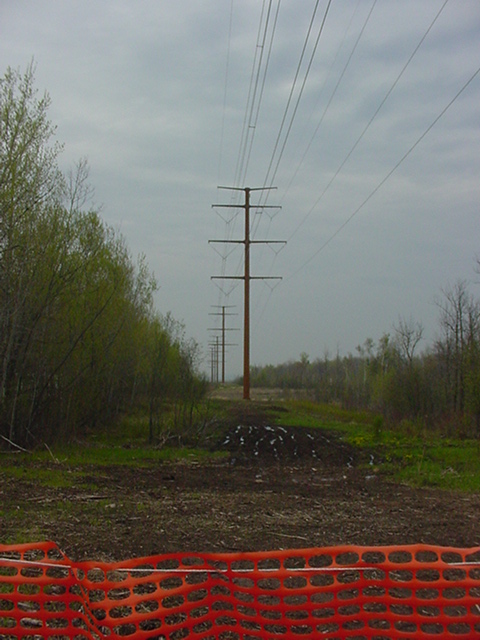
Finally, ATC has forwarded the Agreement it made with Douglas County. ATC had made a Motion to the Wisconsin Public Service Commission to shut down the Arrowhead docket, saying, “we’ve got a deal, game over.” The judge hadn’t even seen the deal!
Here’s the deal between Douglas County and WPS/ATC: Download file
Let’s see if I’ve added this up right:
Market Value of Timber ?
Easement/Appraisal 88,500
Existing Easement 229,500
Impact Fees ?
Legal 15,000
Staff Cost 118,064
Economic Devo Fund 119,000
Community Contributions 40,000
TOTAL: 570,064
Is my math right?
ATC had not filed the agreement with the PSC, so I did, and it was accepted almost immediately. My Reply filing still hasn’t been accepted. Reply Brief: Download file
My goal was to make this deal public. Mission Accomplished.
And Arrowhead Transmission Line again…
September 26th, 2005
It never ends…
Wisconsin’s Public Service Commission has deemed a recent letter from the attorney for American Transmission Company asking the PSC to reconsider reopening the Arrowhead docket a “Motion” and that means we can reply, and have 10 days to do that in under the rules. They want it closed because an Agreement has been reached with Douglas County, Wisconsin that will allow the line to be built. The Agreement, however, has not been filed and was not served with the letter!
Here’s ATC’s missive: Download file
Here’s World Organization for Landowner Freedom’s Reply: Download file
We want the PSC to require that ATC file the Agreement it made with Douglas County and any other parties, serve it on all the Intervenors in the Arrowhead case, and then want the PSC to make a determination as to whether the agreement does indeed equitably address all the issues in the open docket. If so, docket closed, and if not, docket open. It’s that simple!
I asked whether it was filed, if the judge had a copy, and here’s the response from the PSC woman in the know:
Ms. Overland,
To answer your question about the agreement, David Whitcomb has not seen it nor does he believe anyone has asked that it be filed with the PSC.
Adela Felic
Public Service Commission of Wisconsin
PO Box 7854
Madison, WI 53707-7854
Phone: 608-266-1262
Fax: 608-266-3957
Email: Adela.Felic@psc.state.wi.us
Well, it’s been asked for now! We’ll see…
PPBBBBBBBBBFFFFFTTTT! says the Iowa Utilities Board
September 24th, 2005
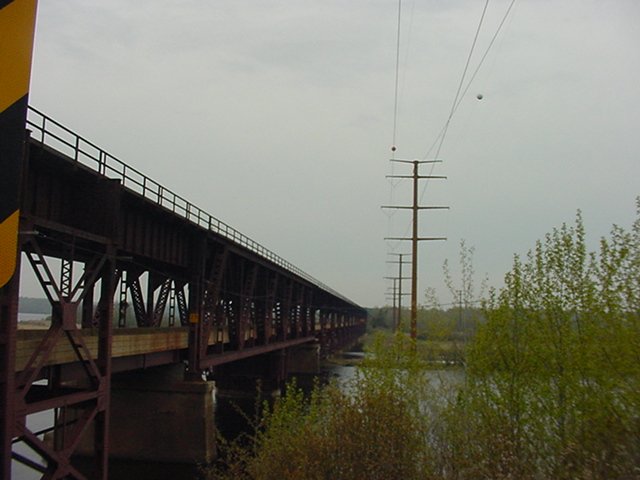
Would you want to live in this house if there’s a 161kV transmission line on the other edge of the road?

The decision on the Schou appeal came down from the Iowa Utilities Board. Here it is, and I’ll refrain from comments now because I’m on the way downtown and probably wouldn’t phrase it with the care that I should!
Decision: Download file
Note that they invited appeal on 7 out of about 10 issues we raised, and they address how many? And the others they said didn’t matter. Oh, right…
Call the welcome wagon for the new neighbors? Not quite yet!!!
