Biennial Transmission Plan Meetings
October 18th, 2006

Here’s the schedule. For more info go to the Minnesota Transmission Owners site at www.minnelectrans.com or contact MTO’s Al Mitchell at amitchell@lindquist.com or the State’s Bob Cupit, bob.cupit@state.mn.us
For the CapX2020 lines, the blue ones and red ones on the maps below, go to the CapX2020 Project page, and then click on the project of interest under “Description.”
Now here’s where we get into the problem. Check out the SW Minnesota Zone, “my” district (how can I limit it so when the state is my oyster??)
SE MN Notice: southeast-zone-notice.pdf
What’s wrong with this? Look at the map:
Nevermind, DON’T!! They sent me THREE, I gave away two, and who knows where it went, I GIVE UP, I CANNOT FIND MY COPY FOR THE LIFE OF ME. So allow me to describe it — it’s a cheezy map, with no proposed transmission lines or corridors drawn, only these funny light dashed lines around some cities, no lines drawn at all…
So what are they planning? LOOK!!!

And on that happy note, we’re having another cycle of Biennial Transmission Plan meeitngs, and I hope you’re all paying attention and passing this notice along to everyone who lives near these blue lines on the map above. Or the red lines on this map below (it shows the Big Stone II line connecting into the SW Minnesota line over to Prairie island):

Notice that there’s a line going into Red Wing from the SW, and then from Red Wing (Prairie Island) it goes straight south. CapX2020 calls it “two lines,” one in and one out, and this is just Phase I. In Phase II, there’s another coming into Red Wing from the North, the Chisago sub, and down to Prairie Island. Three lines — no other community has three lines in the CapX2020 “Vision.”
Here’s the SW Zone map from the Transmission Plan meeting packet, covering the same area as the above map (found after 45 minutes of searching — in the recycling — too many papers):

Here’s a version you can zoom or print: sw-zone.pdf
Who cares about the Biennial Transmission Plan meetings? For starters, any of the 200,00 landowners that the Dept. of Commerce says will be affected by these transmission lines. How about the local governments these lines are going through? How about the legislators whose constituents are affected? These lines have been approaching for years now, but the Notice Plans were approved for the CapX2020 lines and we’re now approaching aplication time.
Why care about the Biennial Transmission Plan meetings? Because they’re planning utility infrastructure, and utility infrastructure is very expensive and lasts a long time, 50 years or so. We are at a juncture where we will either invest billions of dollars in central-station infrastructure, large plants a long way from load, OR, we can invest these same dollars in renewable and sustainable energy. Time to choose, because once we start building these central station coal plants and transmission lines, they won’t be abandoned, mothballed. Do we want to take that road? Not on my watch! And on yours???
Transmission Planning Meeting – SE Minnesota Zone:
Tuesday, October 24 from 3-7 p.m.
International Center
7333 Airport View Dr. S.W.
Rochester
For more information:
Al Mitchell – amitchell@lindquist.com
Be there, or be square — that means you, City of Red Wing and Goodhue County! I see you’re on the email list, and hope to see you there!
Chisago Xmsn line coming soon!
October 3rd, 2006

To get on the Chisago mailing list, email robin.brown@state.mn.us and burl.haar@state.mn.us, give them your name, address, phone and email, and ask to be on the Chisago Transmission list, both Certificate of Need and Siting dockets.
Chisago Transmission Project re-activated, Xcel starts process designating â??needâ??
BY DENISE MARTIN
Four years ago Xcel Energy started the process of seeking state authorization for a system reliability upgrade of its powerline through Chisago County. For a number of reasons Xcel shelved the project, but it has been resurrected.
Grant Stevenson, Xcel spokesperson, said notices are going out re-starting the Chisago County Reliability Improvement Project. The application for Certificate of Need is to be filed prior to the end of this month.
The most recent activity on this took place over the early summer.
The Public Utilities Commission (PUC) reviewed and approved the proposed â??Notification Plan.â? Landowners affected directly by the potential project and adjacent landowners, plus local government units and others on the adopted notice list are to be sent notices directly.
Notification at this point entails making citizens aware of Xcel initiating the â??certificate of needâ? review. This is when the company provides proof it needs the planned powerline upgrade between Lindstrom and Taylors Falls for ensuring reliable electric service to customers. If state regulators determine there is a â??needâ? then the routing application is reviewed. Stevenson mentioned that because the route of the line isnâ??t changing (with minor exception for a new substation) the PUC will probably combine the public hearings for both facets of the project. â??We expect it to take a year for that review,â? Stevenson added.
This improved powerline will cross the St. Croix River (line running atop the hydro-electric structure) to merge with the Wisconsin power grid at St. Croix Falls. Xcel says there are 14 wires at the dam site now and once the upgrade is complete only five will remain overhead the structure.
The Wisconsin equivalent of the Xcel certificate of need has been approved by Wisconsin authorities, Stevenson noted.
No parcel has been acquired, but the general area favored for Xcelâ??s new substation at the west edge of Taylors Falls is somewhere near the wastewater treatment plant.
Stevenson said the project remains substantially the same as what was proposed in 2002; so within the viewshed of the St. Croix on either side (TF and St. Croix Falls) the new line would be buried.
Lines capable of carrying the increased voltage will be installed along the existing route that comes out of the electric station behind Lindstrom Foods, runs down First St. in Lindstrom, across the Chisago Lakes Middle School property, along the highway to Center City; then follows #37 through Shafer and into Taylors Falls.
The entire Washington County-Polk County, Wisconsin and Chisago County region is served by three substations. One north of Amery, Wisc, one in Lent Township on #14 in Chisago County and one in Arden Hills.
The system is 69 kilovolts. Itâ??s being boosted to 115 kv. and In Taylors Falls (out of the new substation) the line will be 161 kv, to connect to Wisconsinâ??s 161 system.
FOUR YEARS??? No, this project has been bumbling along for 10 years, TEN YEARS! It started back in 1996, that’s when I was going up there regularly, together with others from other projects, like folks from Florence Township to help locals learn the ropes of dealing with the EQB, and from Northfield I often went up with Mike (the Powerline expert) and Nancy Casper and Terry Kissner, we had a great crew wanting to share information about the siting process.
The first time out, it went to a contested case, but it all fell apart and NSP/Xcel withdrew its application after there was an agreement struck between NSP and the Cities of St. Croix Falls and Taylors Falls.
Diane Gerth, CRVC’s attorney at the time of the deal, said she was confused about whether I supported or opposed that deal, and to be very clear, I opposed it because it gave everything to NSP, and the Cities got lots of perks (we need more public info on this!) and CRVC got nothing but a transmission line through the area with twice the capacity as the one originally proposed — yeah, some deal. So I’m glad that CRVC didn’t approve that deal despite all those stumping for it, and I’m glad I made the motion that it be rejected! It also never should have been accepted by the cities because I don’t think they had a clue that the capacity of the line was doubled. Did Gerth? Did CRVC? Who involved in this knew that the capacity of that line would be doubled? And what did they all get that made it worthwhile? Let’s get that out into the open.
Here’s the deal (it was too big to include signature pages, if you want them, let me know):
nsp-taylors-falls-st-croix-falls.pdf
Gerth also wants me to be clear about when I represented CRVC, which was in 2002 — I was NOT representing them at the time of this deal, thankfully, and I’m hoping that the details of this deal will now become public as this moves forward. We no longer have St. Croix Falls Mayor Terry Lundgren to kick around, he’s officially a felon now — he pled guilty in 2001 to Theft of Movable Property and Misconduct in Office, so he’s out of office. For that, click on this: http://wcca.wicourts.gov/index.xsl and plug in “Terry Lundgren” and hit search and you’ll get it.
Here’s a 1998 City Pages article about it: Cheesehead Power? And dig this quote from Jimbo Alders: “If additional transfer capacity is found to be necessary in the future, we believe those needs can be accommodated without additional lines.” Yup, and then there’s CapX2020…
Continuing legacy of 2005 Xmsn Bill
September 26th, 2006

I would say that the barn door is open, and the horses are long gone, but with this 2005 Xmsn bill, it’s a lot worse than that. The ripple effects of that bill’s amendments to utility regulatory statutes is immense.
Today is the first prehearing conference on the siting side of Excelsior/Mesaba.
Here’s another impact of that awful bill. In Excelsior/Mesaba, where there has been no determination of need, where we used to be able to argue that in the siting stage they should look at need, well, no more. This statute, as it was before the change, was what made the Chisago fight winnable, and it should have been applied in Arrowhead, but they wouldn’t take it on (the language was not prohibitory, not mandatory, but agency could take on need if it wanted to). We could have used this to oppose Mesaba, the option was there when the Prairie Island/Mesaba bill was passed. Now it’s gone. There’s no looking at need, no option at all.
THANKS!
THIS IS THE CONTINUING LEGACY OF THE 2005 TRANSMISSION OMNIBUS BILL FROM HELL.
Here’s that one little part with a large impact:
Sec. 3. Minnesota Statutes 2004, section 116C.53,
subdivision 2, is amended to read:
Subd. 2. [JURISDICTION.] The board commission is hereby
given the authority to provide for site and route selection for
large electric power facilities. The board commission shall
issue permits for large electric power facilities in a timely
fashion. When the Public Utilities Commission has determined and in a manner consistent with the overall determination of
the
need for the project under section 216B.243 or 216B.2425,.
Questions of need, including size, type, and timing; alternative
system configurations; and voltage are not within the board’s must not be included in the
siting and routing authority and
scope of environmental review conducted under sections 116C.51
to 116C.69.
Here’s the link, again: 2005 Regular Session Chapter 97, SF1368
And of course we all know who’s not at the table in Mesaba, in Capx2020, that speaks volumes…
Thanks…
Xcel & GRE bring CapX2020 to PUC
September 22nd, 2006
CapX2020 moving right along… Here’s the map that wouldn’t load yesterday:
(guess not…)
Technically, it’s Xcel and Great River Energy bringing us this line (GRE’s one of those who also brought us Big Stone)(and then there’s Big Stone Wind, but that’s for another day…), but we know this big web of transmission lines across the state wouldn’t be possible without the acquiescence of those who signed the June 2003 TRANSLink deal and paved the way for the 2005 Transmission Omnibus Bill from Hell. The horse is out of the barn, though we can clearly see the horses’ asses.
OK, look above at that horizontal blue line across the state, just south of the cities? Then it goes down and east? That’s the “Brookings” to “Hampton Corners” (Prairie Island) and then “SE Metro” to LaCrosse” which is really on big export line from SW Minnesota (Big Stone II) to Wisconsin. At the MAPP meetings I go to sometimes (when it’s interesting stuff, they always schedule way far away), this has always been the SW to PI and PI-Roch-Lax, and suddenly it changed to “Hampton Corners” and in the Notice Plan handouts, they tried to present it as two separate lines. Right…
Here’s the maps as they present them now: MAPS
Here’s the map that drives me crazy, the logical link between Hampton Corners and Prairie Island is missing.
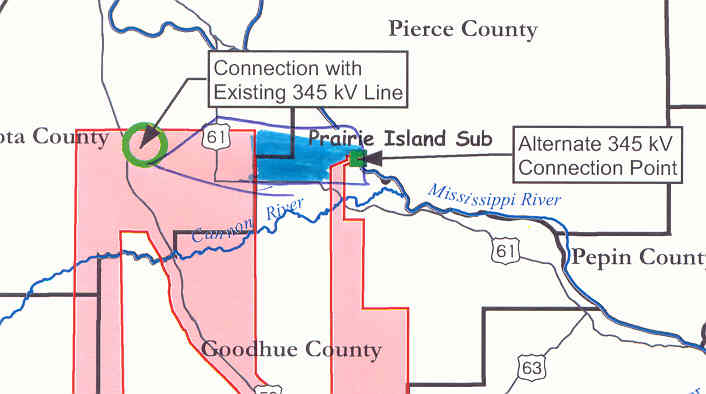
Notice that at the green circle on the Left, it says “Connection with Existing 345kkV line.” OK, so you connect with that line, then what? Well, look at that map above, it goes out to Wisconsin. How do you get to WI from there? You either go southeast, along that new corridor shown on the map along 52, where there is no line, no easements, and which is contrary to Minnesota’s non-proliferation theory where you have to use existing corridors… OR you do the logical link, where at Hampton Corners, they’re connecting with the existing line, well DUH, as they’d said in all prior iterations, it’s a line that connects to PI, so you run along that pre-existing corridor, as requred under the PEER decision, over to Prairie Island. BUT THEY LEFT THAT PART OFF THE MAP, AND LEFT THOSE FOLKS ALONG THAT CORRIDOR OUT OF THE NOTICE PLAN, LEFT THEM OUT OF THE LOOP!!!! So I had a few go-rounds with Koppendrayer, he was very invested in keeping it separate. BUT, thankfully I’d put that map above in my Comment so they could look at it and see the big plan. Nickolai got it and acknowledged it and made the Motion to amend to include that corridor between Hamption and Prairie Island along the existing 345kV corridor.
You know, this isn’t rocket science, it’s just connect the dots. Commerce’s Steve Rakow may think being able to connect the dots is “conspiracy theory,” so he says, but I’d rather be able to track trajectory than live in delusion land. And what does he know — he’s the one who said that the line went through “Red Wing Township” and “Winona Township” and sure didn’t want to hear otherwise. OK, fine, put that in writing! See fn 5 and my Comments on p. 5-6 in the Staff Briefing Papers. Even Xcel agreed it’s CITY OF Red Wing and Winona.
All in all, not a bad time. Got acknowledgement that “it’s all connected.”
And it was very obvious that many parties were missing at the table yesterday — those who did the TRANSLink deal, those who ushered the 2005 Transmission Bill from Hell through the legislature, those who made this CapX2020 nightmare possible. Thanks guys… this legacy, 50+ years of infrastructure commitment down the wrong road, will far outlast you.
Now, how to stop this bulk-power-transfer nightmare? There’s a little time before the application is filed.
That means it’s a good time to read Powerline again for some inspiration and focus… If you don’t have it, there’s usually a couple at www.abebooks.com.
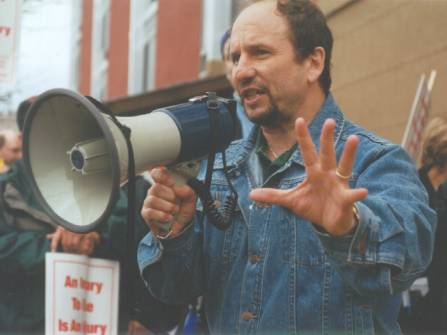
Excerpt from POWERLINE: THE FIRST BATTLE OF AMERICA’S ENERGY WAR
________________
Foreword by Senator Tom Harkin
A local rebellion occurred in several rural countries of west central Minnesota in the mid- to late 1970s over the decision to locate an electric powerline through good farmland there. The campaign of opposition by farmers and their supporters is now an established chapter in state history. Lore about the “bolt weevils” who toppled giant steel transmission towers at night has been passed on as a compelling image of rural people’s resistance against power companies and state authorities. The events of the powerline struggle amount to a noteworthy episode of populist protest, and this book remains that story’s most thorough telling.
The fact is, though, that today we probably read this book mostly because we know that one of the story’s tellers, an activist college professor a the time, Paul Wellstone, eventually became a U.S. senatorâ??a senator who would make unique and dramatic contributions to our country’s history an dpolitical life in his far-too-brief career. After cowriting this book, Paul went on to participate in, teach about, and write on other Minnesota and national political struggles throughout the 1980s. Then, in 1990, he was elected to the U.S. Senate. He promptly carried the kind of fight and values described in the book straight to Washington, where he shook things up for twelve years and rocked the system right up until the terrible day that his life was tragically cut short.
As I’ve said before, Paul Wellstone was my best friend in the Senate. He truly was the soul of the Senate, and no one ever wore the title “Senator” betterâ??or used it less. Staff and citizens alike called him Paul, and he wouldn’t have had it any other way.
Paul was always the same person. As political scientist and teacher, as community organizer, or as representative of the citizens of Minnesota, his method was based in direct and personal connection to people. He blurred the distinction between his life projects. He organized and agitated in the classroom. He encouraged and gave strategic advice to the subjects of his social science interviews. He taught from the floor of the U.S. Senate.
Paul was deeply committed to his political principles. But he was also a keen listener and respected the motivations of the people he spoke with, including those who differed from him. People felt this, and it helped him excel at all three of his professional callings.
Paul worked with a true partner on this book, Barry “Mike” Casper, a physicist colleague and friend at Carleton College who was every bit Paul’s equal when it came to political passion. Mike’s grasp of technology and energy policy helped frame what farmers saw as a fight rooted i their moral obligation to the soil and future. At a key moment during this period, Mike joined one of the protest leaders, Alice Tripp, on a ticket to try to deny the Democratic-Farmer Labor nomination to incumbent governor Rudy Perpich. They gained a suprising 17 percent of the primary vote. Mike became one of Paul’s first staffers in Washington and drafted an alternative national energy policy bill when Paul joined the Senate Energy Committee.
Powerline is about power, both electrical and political, and about justice. It is also a study of political processâ??not the way textbooks say it works, but the way it really happened in Minnesota. Power companies, cooperatives that were supposed to be run by and for their rural customers, used eminent domain and plotted their line according to a dry, numerical “avoidance rating” system. The system assigned the lowest avoidance value to farms. How out of touch could they be? No matter: farmers who resisted the companies’ plans found the process rigged and their state government tilted against them. Local law enforcement was reluctant to use force against those engaged in peaceful civil disobedience, but the bureaucratic hearings would not go farmers’ way. They didn’t win their fight, even though more than 60 percent of Minnesotans supported their cause. They were outmatched by the power companies’ lawyers and technical experts. In the end, state government and the courts took the companies’ side.
The story’s outcome is sadly familiar, but its telling is often inspiring. Many of the accounts here are firsthand, and some are humorous. Hog manure was put to tactical use on more than one occasion. Bullets and deadly dangerous anhydrous ammonia were also used, however, and both sides of this fight considered the stakes to be very high. The interviews that make this book possible could only have happened after the authors gained deep trust from farmers, some of whom at minimum had knowledge of serious illegal acts.
The farmers’ struggle did affect energy policy in the state, though not immediately. Their protests raised questions about a paradigm of remote, unaccountable decision making that led to huge, centralized power production and lines that disrupted the landscape. These questions are around today, and Minnesota, like my home state of Iowa, has since done much to involve communities in energy planning, as well as to diversify sources to include more renewables such as wind and biofuels.
The powerline fight also prefigured later political events. It may even have helped rekindle a Midwest tradition of populist prairiefire that connected urban and rural dissatisfaction. Paul and Mike devoted much of their time and talents in the 1980s to the family farm movement, even while they were deeply immersed in peace activism, organizing the poor, and working on other issues that mobilized the Twin Cities’ large progressive community. Paul helped bring students and labor union members from metropolitan areas to support striking P-9 meatpackers in Austin, Minnesota. By 1988, he was Minnesota chair of Jesse Jackson’s run for the Democratic presidential nomination, and the network he developed in that campaign became the foundation for the ground game of his famous outsider race to the Senate two years later.
Senator Paul Wellstone didn’t emerge suddenly or magically from the powerline fight in west central Minnesota. But he didn’t come from nowhere, either. His approach to politics resonates clearly as he helps to tell the story in this book. That makes it a story worth remembering.
It’s CapX2020 day at the PUC!
September 21st, 2006
drat, computer needs to be burped, it doesn’t want that CapX2020 big picture map == too much for even my machine to swallow.
This is the day where we address their “Notice Plan.” Here’s the link for each of the announced projects, but if you’re not included, don’t worry, there’s more, enough to go have 200,00 landowners on the affected landowners list!
I’ll try to burp the machine and get the map up there.