Transmission in NYT today

February 7th, 2009

Matthew Wald has a good piece in the NYT today, good in that it raises some of the issues, but these issues raised need some more digging, can you dig it?

Check this paragraph from the article:

In fact, energy experts say that simply building a better grid is not enough, because that would make the cheap electricity that comes from burning coal available in more parts of the country. That could squeeze out generators that are more expensive but cleaner, like those running on natural gas. The solution is to put a price on emissions from dirtier fuels and incorporate that into the price of electricity, or find some other way to limit power generation from coal, these experts say.

Not “could,” but WOULD “squeeze out generators that are more expensive but cleaner” and adding externalities to coal generation cost would only stop that, would only be a “solution” if it tacked on HUGE costs, far greater than those anticipated by those advocating either Cap & Trade or Tax.

But those of us in transmission are glad to see the driver for new construction exposed, as it was in the MISO Benefits Study by our good friends at ICF:

RTO operational benefits are largely associated with the improved ability to displace  generation with coal generation, more efficient use of coal generation, and better use of import potential.

Here’s that MISO study, the above quote comes from the conclusions, p. 83, and is also stated in the intro — THIS IS THE REASON FOR TRANSMISSION, THIS IS THE REASON FOR THE MIDWEST MISO MARKET.  Read the study:

ICF’s Independent Assessment of Midwest ISO Operational Benefits

For example, Jose Delgado whining about hwo long it took to get the permit for Arrowhead, what does he expect for a project that was an absurdly obvious ploy for a superhighway for bulk power portrayed as a “local load” need for WUMS?  They put together many options in the WRAO report, and selected one, Arrowhead, “3j,” as the be-all and end-all of transmission.  That was declared the ONE line that would fix Wisconsin.  Then, next thing you know, they still want to do “5” more commonly known as the Chisago project, they want to do “9” in SW Minnesota claiming “it’s for wind” when there’s only 213-302MVA coming off of Buffalo Ridge into the Nobles substation, they do them all because that’s what they want, they can ship bulk power.  It’s been so dishonest…  Utilities have been so dishonest…

And let’s look at the financing of these lines.  CapX 2020 testimony and a powerpoint demonstrate that they don’t have the financing lined up for that $2 billion dollar project.  They were working through Lehman Bros. so what does that say?  The “Cap” of CapX 2020 is “Capital” and they don’t have it.  But because they want it, they’ll make us pay for it.  Is something wrong with this picture?

———————————————–

Hurdles (Not Financial Ones) Await Electric Grid Update

By MATTHEW L. WALD

WASHINGTON — Environmentalists dream of a bigger and “smarter” electric grid that could move vast amounts of clean electricity from windswept plains and sunny deserts to distant cities.

Such a grid, they argue, could help utilities match demand with supply on the hottest afternoons, allow customers to decide when to run their appliances and decrease the risk of blackouts, like the one that paralyzed much of the East in 2003.

The Obama administration has vowed to make the grid smarter and tougher, allocating $11 billion in grants and loan guarantees to the task in the economic stimulus package passed by the House last week.

But it will take a lot more than money to transform the grid from a form that served well in the last century, when electricity was produced mostly near the point of consumption, and when the imperative was meeting demand, no matter how high it grew.

Opposition to power lines from landowners and neighbors, local officials or environmental groups, especially in rural areas, makes expansion difficult — even when the money for it is available. And some experts argue that in the absence of a broader national effort to encourage cleaner fuels, even the smartest grid will do little to reduce consumption of fuels that contribute to climate change.

In fact, energy experts say that simply building a better grid is not enough, because that would make the cheap electricity that comes from burning coal available in more parts of the country. That could squeeze out generators that are more expensive but cleaner, like those running on natural gas. The solution is to put a price on emissions from dirtier fuels and incorporate that into the price of electricity, or find some other way to limit power generation from coal, these experts say.

The stimulus bill passed by the House includes $6.5 billion in credit to federal agencies for building power lines, presumably in remote areas where renewable energy sources are best placed, and $2 billion in loan guarantees to companies for power lines and renewable energy projects. The bill also includes $4.4 billion for the installation of smart meters — which, administration officials say, in combination with other investments in a smart grid, would cut energy use by 2 percent to 4 percent — and $100 million to train workers to maintain the grid.

About 527,000 miles of high-voltage transmission lines stretch across the United States, most installed many decades ago.

Everyone agrees that more lines are needed. But some industry experts argue that the problem of making the grid greener goes well beyond upgrading and expanding the existing power lines. The grid, they say, was set up primarily to draw energy from nearby plants and to provide a steady flow of electricity to customers. It was not intended to incorporate power from remote sources like solar panels and windmills, whose output fluctuates with weather conditions — variability that demands a far more flexible operation.

The experts say that the grid must therefore be designed to moderate demand at times when there is less wind or sun available — for example, by allowing businesses or residential customers to volunteer to let the local utility turn down air-conditioners in office buildings or houses, when hourly prices rise.

An even more significant problem is that utilities increasingly face opposition to expansion and must fight for years for permits.

José M. Delgado, president and chief executive of the American Transmission Company, which operates in four Midwestern states, said his firm’s last major project, a line of about 220 miles from Duluth, Minn., to Wausau, Wis., took two years to build but eight years before that to win the permits. The federal Interior Department took a year to approve the line crossing a wild river and required a $5 million contribution to a national park, but the one-year delay raised costs by an additional $12 million, for a total of $440 million, Mr. Delgado said.

Loan guarantees will not help this problem, he said. “We have had wonderful access to the private bond market,” he added.

The International Transmission Company, a Michigan company, is trying to build a 26-mile line that, had it been in place, would have prevented the great Eastern blackout of 2003, said Joseph L. Welch, president and chief executive. The State of Michigan has approved it, but a homeowner is challenging it in court, Mr. Welch said.

“We burn up three years on a line that will take two months to build,” he said.

But, he added, “We absolutely have no problem — underscore, no problem — financing our transmission grid.”

Other companies said the same, although a few said the loan guarantees in the House bill would be helpful.

As power lines lengthen, the number of approvals they require increases, the complications of dividing the costs become greater and the difference among national interests and local interests becomes starker, said Dan W. Reicher, a former assistant secretary of energy who was a member of President Obama’s transition team.

Policy makers have looked at various models to resolve the conflicting interests in power-line disputes. In the 1930s, the federal government assumed sole responsibility for approving natural gas pipelines, and as a result, gas moves freely from wells in the Gulf Coast states to other areas of the country, with much of it used to make electricity. Gas pipelines are somewhat less objectionable, though, because they are buried.

Another model is the one used to build the Interstate Highway System, with the states using their powers of eminent domain in a system that was centrally planned with state input. But highways were more attractive to many states than power lines would be, electricity officials say, especially if the lines are simply crossing a state without adding much local benefit. A third possibility is a national commission that would present a master plan for thousands of miles of new transmission lines that Congress could approve for the whole country in spite of local objections for individual pieces.

Congress tried to solve the problem in 2005 with a law that gave the Energy Department authority to intervene if states did not approve new lines deemed to be in the national interest, but that has not worked well, said Representative Henry A. Waxman, Democrat of California and chairman of the House Energy Committee. It was criticized as an assault on the traditional control by the states of land-use decisions.

The electric industry is at least planning to better integrate different parts of the grid so that if power is needed in Baltimore it can be imported from Chicago. A group of technical experts, mostly from the Midwest, have been meeting for months to map out new lines, in an effort that industry veterans say is unprecedented in its breadth. But the group’s aim is simply a map of what such a system would look like; it will not seek permission for such lines, or try to finance them or actually build them. The group is scheduled to make an announcement next week.

“We’ve got a real political confrontation that’s going to take place,” said Glenn L. English Jr., chief executive of the National Rural Electric Cooperative Association, who had served as a congressman from Oklahoma for 20 years. “It basically comes down to the question of prioritization. What’s more important to you? Do you truly want to maximize the use of renewable energy?”

mid-atlartistsrendering

WOW!  “Nearly 600” show up for a meeting about transmission.  Good, Delmarva deserves that kind of response for their threat to ram the Mid-Atlantic Power Pathway transmission line through Maryland and Delaware to New Jersey.  They’re so desperate that they’re threatening “rolling blackouts:”

Delmarva Power spokesman Matt Likovich says the region could face rolling blackouts by 2011 unless the power transmission infrastructure is improved.

More transmission lies.  WDMT caught them making the same threats:

Delmarva Power Community and Communications Coordinator Matt Likovich said, “There have been projections that if we don’t do something to improve our infrastructure… we could be faced with rolling blackouts by the year 2011.”

mid-atlmeeting1

Threatening rolling blackouts, saying that’ll happen by 2011, so we need to build this line by 2013… yeah… sure… whatever…  Get a grip, guys, we are not that stupid, we’re not buying your threats — it is SO naughty to do that.

Power lines would relieve congestion

By Andrew Ostroski
Staff Writer

MILLSBORO — Officials from Delmarva Power met with members of the public to discuss a power line project that will cut through the heart of Sussex County, as well as much of the Delmarva Peninsula.

An increase in energy usage on the Shore has prompted Delmarva Power to start the Mid-Atlantic Power Pathway project, 230 miles of interstate electric transmission line. More than 100 miles of the line are slated for Delaware, with 61 miles in Sussex County.

The lines would follow current right-of-ways, crossing the state line west of Delmar, and move northeast across the county through Gumboro and Millsboro to the Indian River Generating Station. Lines are also planned to go north through Milton and into Kent and New Castle counties before crossing the Delaware River to the Salem Nuclear Power Plant in New Jersey. Total cost for construction is estimated at $1.43 billion.

“During times of congestion, we have to call in power plants to provide energy,” said Matt Likovich, spokesman for Delmarva Power. “Those operators charge more for that energy because they know we need it. We could cut those power plants out.”

Nearly 600 people filled the auditorium at Cambridge-South Dorchester High School earlier this week to listen and comment on plans to string the high-voltage electrical transmission lines across Dorchester County from Taylor’s Island to Vienna.

Potential routes for the power lines in Dorchester were presented by Pepco Holdings Senior Vice President William Gausman.

“We have not made any decisions on this project; there is still a long way to go,” he said, presenting a map of the potential routes, including one which follows existing rights-of-way for a Choptank Electric transmission line and the railroad tracks from Bucktown to Linkwood.

He said three meetings are planned this month in Dorchester to review the proposed routes and seek public comment. The meetings are set for Feb. 19 in Taylor’s Island, Feb. 24 in Church Creek and Feb. 26 in Vienna.

“More than 80 percent will be on or along existing transmission lines,” Gausman said. The problem in Dorchester, he said, is that there are no existing high-voltage transmission lines.

Currently, Delmarva Power runs one transmission line. The company would like to build a second to provide an alternate route if one line experiences congestion or malfunction.

MAPP would be the first major high-voltage transmission project executed on the lower half of the Shore in 25 years. The 500 kilovolt line is also slated to cut some costs for consumers throughout the northeast. Vince Maione, MAPP project manager, said the reduced congestion will bring savings to users.

“We see a potential savings from congestion of about 70 or 80 cents per 1,000 kilowatt hours average per month,” he said.

Some residents have expressed concerns about building the 160-foot towers planned for current rights-of-way where power lines already exist. Doris Batdorf, a Long Neck resident, said she is afraid lines will affect her property.

“We just moved here in July, and now we have this coming,” she said. “I just don’t see the cost justifying the means.”

Maione also said the project would be funded by consumers, with an average of 40 cents added to electric bills.

“We have to plan for what the future’s going to bring,” he said. “The electric system has to be reliable. This circuit can bring enough power to serve the customers that are here today, and then plan for the future.”

Tonight is the final meeting in the group scheduled by Delmarva Power about the Mid-Atlantic Power Pathway, transmission through Delaware to New Jersey.

Wednesday, February 4 @ 6 p.m.

Millsboro Civic Center

322 Wilson Highway

Millsboro, Delaware

Sussex County:

mapp_gis_county_sussex2

Kent County:

mapp_gis_county_kent1

New Castle County (cutout):

mapp_gis_county_ncastlesalem

For more info on the underlying scheme, see my prior post:

PJM Transmission in Mid-Atlantic


mapptransmissionoverview

Delmarva Power has been hosting meetings about its proposed Mid-Atlantic Power Pathway.   The next meeting is:

Wednesday, February 4 @ 6 p.m.

Millsboro Civic Center

322 Wilson Highway

This is an electrical superhighway through Delaware, the map makes that much clear.

What’s interesting is that Rep. Tom Carper seems to be taking an enlightened and informed position on this:

Carper said the question of the power line needs to be considered in a larger context. He harkened back to the construction of Del. 1 to handle an increase in north-south travel, noting that along with the new road came a look at expanding public transit, car-pooling, and other alternatives to driving.

“Upgrading power lines on the Delmarva Peninsula may be necessary, but I hope Delawareans will take this opportunity to look not only at where a power line might go, but also at how they could help reduce the need for a new line in the first place,” Carper said.

Today, there’s a long piece in the News Journal about it, with the above quote from Carper:

Power-line plan stirs environment fears

Bluewater Wind hails pathway for clean energy

By AARON NATHANS
The News Journal

Environmentalists are divided over the merits of a Pepco Holdings plan to string a 500-kilovolt power line through the heart of Delaware to better connect southern power plants with growing demand in the mid-Atlantic region.

Pepco’s proposed Mid-Atlantic Power Pathway would be like an interstate highway of electricity, designed to make more space on the often-choked power grid for electricity to flow to growing population centers on the East Coast.

Clean-air advocates say it could help carry clean wind power to the homes and businesses that need it, even as they worry it will also import dirty coal-fired power from the South and Midwest.

Wildlife and property-rights advocates are afraid the line will be a blight on the landscape, running through fragile areas along the Delaware River and Bay.

The most controversy in Delaware about the power line, which is now being examined by the public in a series of public hearings, is likely to focus on an eight-mile stretch of land in southern New Castle County.

The utility would need to acquire an easement through an area near the Delaware River that includes many wetlands and state-designated critical natural areas.

Officials at Pepco Holdings, the parent company of Delmarva Power, said the specific path there has not yet been chosen.

The planned power line would start in Dumfries, Va., cut through Maryland and across the Chesapeake Bay, then run through southern Delaware to the Indian River Power Plant. The line then would continue up the length of the state and across the Delaware River, ending in Salem, N.J.

It’s one of several large lines planned in this region to shore up electrical reliability. Utility officials say it’s especially needed on the Delmarva Peninsula, where power lines currently run only from the north. This would add a second path from the west.

Although power demand is down because of the recession, utility representatives say that won’t last, and demand will one day overtax the existing grid.

By connecting three regional nuclear power plants, the new high-capacity line will spread power along the coast as well as bring in power from the coal-rich Midwest.

The $1.425 billion line is expected to add 40 cents to the average residential monthly electric bill. The costs would be borne by all electric users in the 13-state PJM Interconnection regional power grid.

The immediate need for the line is to move current through Delaware, but it also could be a useful outlet for the thousands of megawatts of renewable electricity that could one day be generated by wind turbines off the state’s coast, said Joseph Minott, executive director of the Clean Air Council, an area environmental group.

Bluewater Wind plans to build a small wind farm off Rehoboth Beach and sell the electricity to Delmarva Power, but the firm also hopes to expand that farm in the future to feed more power to the grid.

If the transmission grid is strong enough, Delaware could export power throughout the region, Minott said, explaining why he favors the project.

“If you’re going to create a vibrant market for wind energy, you need to be able to transmit it further than the town at the end of the beach,” said Minott, who added that he had “trepidation and concerns” about the lines being used also to expand the reach for coal-generated power.

Rob Gramlich, policy director for the American Wind Energy Association, said a better transmission system is needed for onshore wind farms to carry their output to the wider populace.

Offshore wind is different, he said. Although it’s more expensive than onshore wind, its appeal is in its proximity to population centers, he said. It doesn’t take very many miles of transmission to get the power where it’s needed, he said — a problem for generators of wind power in the nation’s more sparsely populated heartland.

Nick DiPasquale of Delaware Audubon said he would rather see small, localized, mainly renewable power sources instead of big lines that carry power from big coal-burning power plants. He’s concerned about where the Power Pathway would go.

“If it means converting protected land to developed land — even if the profile is relatively small — I would find that a very troubling precedent,” he said.

Utilities lose power when current is transmitted over long distances, said Carol Overland, a Minnesota attorney and electrical consultant who has been active on Delaware environmental issues. She said conservation and renewable-energy projects, using the existing power grid, should be sufficient.

State Sen. George Bunting, D-Bethany Beach, expressed concern that electromagnetic force, or EMF, from power lines has been investigated as a cause of childhood leukemia.

In a letter to Sen. Tom Carper, D-Del., he wrote, “There is a grave concern amongst many Delawareans” about the line.

The Centers for Disease Control and Prevention says there is no scientific consensus on the health effects of EMF.

Pepco Holdings owns the rights to much of the land it needs. It’s planning to build the larger line along a right of way that already features smaller power lines.

But within the section of the line that runs from Indian River north to Salem, there will be areas where the right of way needs to be widened, the utility has said.

And there’s a yet-to-be-specified section in southeast New Castle County where the Pathway would break from the existing power line along Del. 9 and head toward the Delaware Bay, where it would cross and connect with the Salem/Hope Creek nuclear plant.

That will require Pepco Holdings to acquire eight miles of new right of way, company officials said last week.

“Whether it’s dry land, wet land, high land, I wouldn’t want to answer that question right now,” said Vince Maione, pathway project manager for Pepco. He added that the company wants to minimize impacts on the environment and the population.

PJM is still reviewing Pepco Holdings’ application for the portion of the line running north from Indian River. Once that confirmation comes, Pepco Holdings will develop the path in greater detail, Maione said.

To cross the Delaware River, the utility wants to build a second overhead crossing, about six to eight miles south of its current line.

The company has not been in touch with Delaware landowners regarding easements, said Matt Likovich, a Delmarva spokesman.

Delaware state government has little control over the portions of the line for which Delmarva already has rights of way. Unlike in Maryland, this state’s Public Service Commission does not have the authority to approve the location of a transmission line.

One of the few categories where state government has oversight is where a planned power line would cross natural areas like bodies of water and wetlands. Pepco Holdings has not been in touch to request a permit, said Philip Cherry, a state Department of Natural Resources and Environmental Control policy manager.

But Delmarva lacks leverage, at least on the state level, when it comes to expanding beyond its rights of way.

The state eminent-domain law doesn’t give the utility the right to seize land for a power project. Likovich said if the company can’t reach an agreement with a landowner, “we will have to construct the line by going around the property in question.”

But the utility may hold a trump card: the U.S. Energy Department last year designated Delaware part of a region where the federal government can order an electricity project finished if states fail to do so.

Delmarva officials say they’ll work hard to negotiate with landowners to avoid the issue of eminent domain.

“It doesn’t benefit anyone to take anyone’s land,” Maione said. Pressed about whether the utility would be OK with the government seizing land for the project, he said, “We’ll have to cross that bridge when we come to it.”

Meanwhile, in Sussex County, Pepco Holdings held a community meeting in Gumboro on Thursday night, attracting 50 members of the public. The next meeting is Wednesday night in Millsboro.

Carper said the question of the power line needs to be considered in a larger context. He harkened back to the construction of Del. 1 to handle an increase in north-south travel, noting that along with the new road came a look at expanding public transit, car-pooling, and other alternatives to driving.

“Upgrading power lines on the Delmarva Peninsula may be necessary, but I hope Delawareans will take this opportunity to look not only at where a power line might go, but also at how they could help reduce the need for a new line in the first place,” Carper said.

He said that could come by saving electricity, installing solar panels on their homes, adding insulation, purchasing Energy Star appliances, or taking other steps to save electricity.


Additional Facts
IF YOU GO

The next community meeting about the power line will be held Wednesday at the Millsboro Civic Center, 322 Wilson Highway, 6 p.m.

xcel-logo

Poor Xcel, getting picked on… a City of Minneapolis resolution to delay the route application for the Hiawatha Project transmission line, and a unanimous preference for undergrounding if it should be built.  SNORT!

LET’S SEE THE SOUTH MINNEAPOLIS LOAD SERVING STUDY (which the Hiawatha Project is supposedly based on) and the SOUTH MINNEAPOLIS ELECTRIC RELIABILITY PROJECT STUDY which is shooting in a 345kV line from Hwy. 280 to the new Hiawatha substation… “100 MW need” my ass…

Here are 16 questions posed by Midtown Greenway to Xcel and 9 answers:

List of 16 Questions for Xcel

9 Answers from Xcel

Piecing together studies found on line, here’s what I think Xcel is up to:
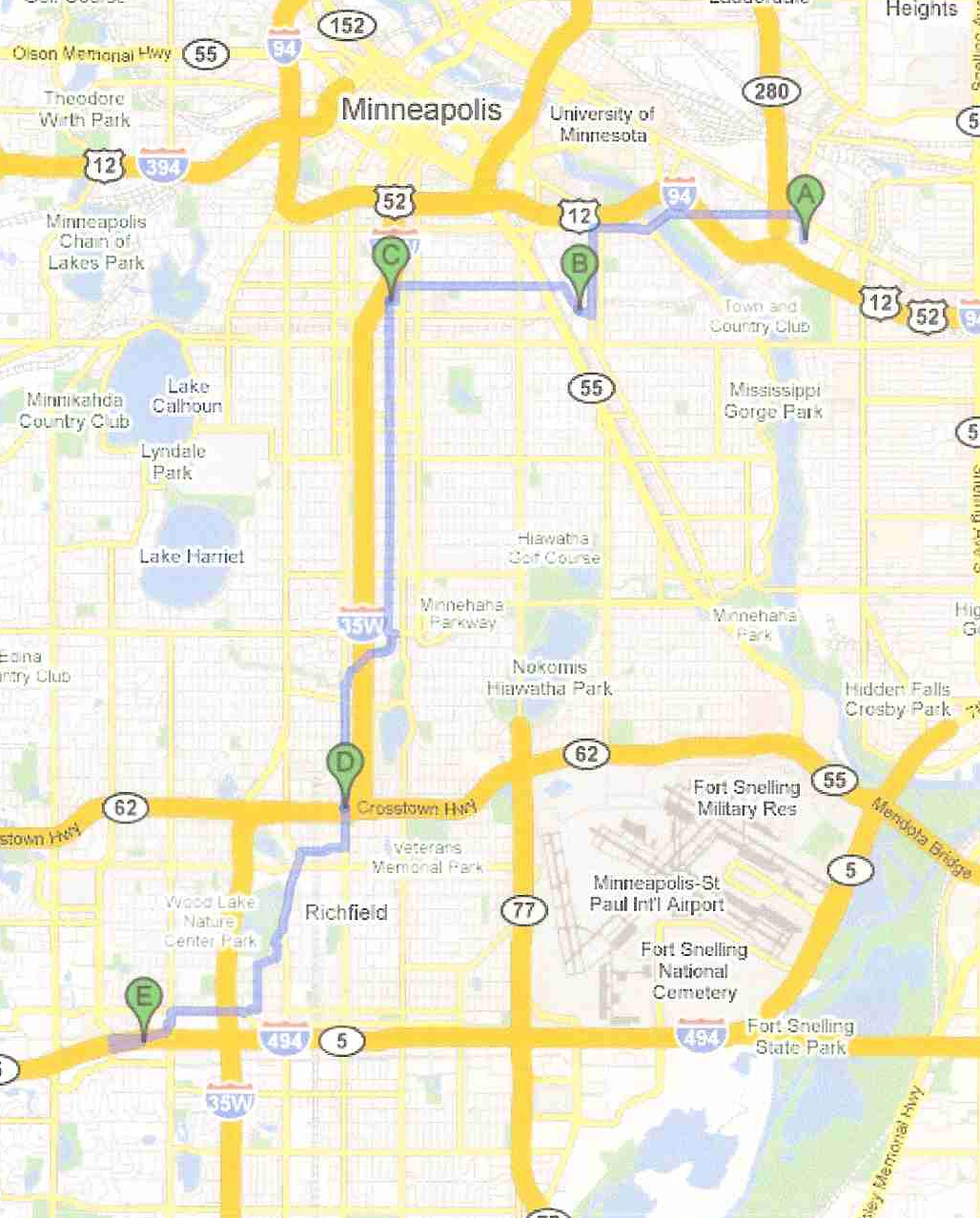
hiawathaprojectplusmap-31

Xcel’s plans for power line run into opposition

By STEVE BRANDT, Star Tribune

January 26, 2009

A resolution asking Xcel Energy to delay its proposed high-voltage transmission line in south Minneapolis and offering an alternate route advanced Monday at City Hall.

The resolution sent to the full council is a rebuff to Xcel’s preferred route for the power line along the rim of the Midtown Greenway recreational corridor.

It was approved without opposition by the council’s Health, Energy and Environment Committee and is due for a Feb. 6 council vote.

The language approved Monday asks Xcel for more study of electrical needs in the central Lake Street corridor that the line would bisect and urges that alternative ways to supply those needs be investigated.

Bury the line?

But if the line is needed, it should be buried under E. 28th Street, according to the resolution by Council Members Gary Schiff, Robert Liligren and Cam Gordon. Xcel has said burying the line would add nearly $16 million to the cost.

Xcel spent much of its presentation arguing that localized power-generation projects or conservation measures alone won’t come close to negating the need for an additional 100 megawatts of power to the area to assure reliable service.

The utility proposes to build the line mostly on the south rim of the greenway, crossing its bike and walking paths four times.

The $15 million project would also include a substation on the east side of Hiawatha Avenue at 28th, where an existing transmission line now runs, and another on Oakland Avenue.

The Midtown Greenway Coalition, an advocacy group for the corridor, also has opposed Xcel’s preferred route and has sought more study of alternatives.

Betty Mirzayi, Xcel’s project manager, said the company forecasts growth in demand for electricity of 1.5 percent annually for the area to be supplied by the proposed line.

She called the proposed line essential to meeting demand caused by redevelopment in the area that has “stretched our capacity to the limit.”

Wanting more proof

But speakers among the many residents who appeared in support of the resolution said they want more proof that the power line is the only way to improve service.

They also argued that the line would stunt planned housing development along the greenway because potential residents would be leery of living near the line.

One legislator, Rep. Karen Clark, DFL-Minneapolis, said later Monday she’s considering legislation that would require additional analysis by the state and Xcel of any health effects associated with the high-voltage line in areas with high poverty or high minority concentrations, which describes portions of the proposed route.

Mirzayi said the permitting process, which will be under the authority of state agencies, provides an arena for analysis of the issues raised by those opposed to the line. Xcel plans to submit its proposal to the Minnesota Public Utilities Commission by the end of March and wants to begin using the new facilities in the first half of 2011.

Take your transmission line and go home, Xcel…

midtown_greenway-11