Ethanol – Advanced BioEnergy’s SEC filings
January 12th, 2007
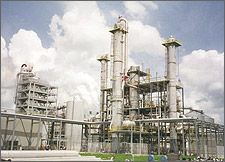
(Note that an ethanol plant doesn’t look all that different from a coal gasification plant? It’s like a refinery in a corn field…)
There’s lots of talk around town about the Advanced BioEnergy ethanol plant that’s been proposed for the south side of County Road 8 by Dundas, between Hwy. 3 and Interstate 35. Bridgewater Township has instituted a moratorium and is doing local planning, and I sure hope doing some looking into what Advanced BioEnergy is about. There’s info out there on the internet — what would we do without it! The internet sure is the Great Equalizer, and the Great Organizer too!
A coal cohort did a little digging and found some GOOD STUFF!
See link for full document — as of Nov 2006 looks like Advanced BioEnergy (ABE) is in the works to sell out to a South Dakota connection (with the understanding that the â??Marketing Agreementâ?? holds) and note the NO PUBLIC ANNOUNCEMENT, and hey, I’m not a party to the agreement!
Section 6.2 No Public Announcement.
None of the parties to this Agreement shall make any public announcement concerning this Agreement, without each other partyâ??s prior written consent (which shall not be unreasonably withheld); provided, however, that any of the parties, but only after reasonable consultation with each other party, may make disclosure if required under applicable law or the rules and regulations of the SEC or any listing agreement with a national securities exchange; and provided further, however, that following execution of this Agreement or consummation of the Closing, ABE may, in its sole discretion, make a public announcement regarding the transactions contemplated by this Agreement and the integration of the HGFâ??s business into that of ABE.
And another very interesting tidbit! ABE, in its filings with SEC, HERE’S LINK,reported that:
â??We will depend on others for sales of our products, which may place us at a competitive disadvantage and reduce profitabilityâ?¦â?We expect to hire a third-party marketing firmâ?¦â?
Excerpt from link above:
Section 6.1 Consent; Waiver.
â?¦..(b) By execution and delivery of this Agreement, (i) HGF and Aventine agree that, notwithstanding Section 1.A. of the Ethanol Marketing Agreement by and between HGF and Williams Ethanol Services, Inc. d/b/a Williams Bio-Energy, dated November 30, 2000, including an Amendment effective April 2, 2003 (the â??Marketing Agreementâ?), the Marketing Agreement shall not terminate as a result of the transactions contemplated by this Agreement, but shall remain in full force and effect on and after the Closing Date according to its existing terms and conditions (except for Section 1.A.) until amended or terminated by HGF and/or Aventine, and (ii) Aventine waives any and all rights and claims under Section 1.B. of the Marketing Agreement that may arise from the transactions contemplated by this Agreement.
Section 6.2 No Public Announcement. None of the parties to this Agreement shall make any public announcement concerning this Agreement, without each other partyâ??s prior written consent (which shall not be unreasonably withheld); provided, however, that any of the parties, but only after reasonable consultation with each other party, may make disclosure if required under applicable law or the rules and regulations of the SEC or any listing agreement with a national securities exchange; and provided further, however, that following execution of this Agreement or consummation of the Closing, ABE may, in its sole discretion, make a public announcement regarding the transactions contemplated by this Agreement and the integration of the HGFâ??s business into that of ABE.
Click HERE for a link for document filed by South Dakota Wheat Growers Ass.
which says:
Filed by South Dakota Wheat Growers Association
pursuant to Rule 425 under the
Securities Act of 1933, as amendedSubject Company: Advanced BioEnergy, LLC
Commission File No.: 333-125335November 7, 2006
Dear SDWG Member:
Your South Dakota Wheat Growers Board of Directors, together with the Board of Managers of Heartland Producers, LLC, has approved an agreement with Advanced BioEnergy, LLC (ABE) to exchange the partnership interests in Heartland Grain Fuels, LP (HGF) held by South Dakota Wheat Growers and Heartland Producers for cash and equity of ABE.
Under the terms of the transaction, the partners of HGF will receive approximately $16.8 million in cash and approximately 2,631,000 newly issued units of ABE. In addition, HGF intends to make a special distribution to its partners of approximately $8.65 million of earnings prior to the initial closing of the transaction with ABE. Wheat Growers currently owns approximately 48% of HGF and will receive its pro rata share of the consideration from the transaction. In addition, Wheat Growers will continue supplying corn to the HGF facilities.
ABE is a development-stage company specializing in ethanol production. It currently is building a 100-million gallons per year dry mill corn-processing ethanol plant near Fairmont, Nebraska and has letters of intent to build similar plants in Indiana and Minnesota.
Wheat Growers Board believes this business relationship with ABE will provide the following benefits to the HGF investors and the agricultural producers in this area:
a. Heartland Grain Fuels investors will become part of a company with plans to become a larger ethanol producer: By being part of a larger ethanol production company, HGF can achieve additional economies of scale that are difficult to achieve with just two plants in North-Central South Dakota.
b. Heartland Grain Fuels investors will achieve greater geographic diversity: By being part of ABE which is building plants in other Midwest states, risks associated with drought and marketing should be mitigated.
c. The transaction will allow Heartland Grain Fuels investors to obtain cash from present operations: Ethanol prices have been at historical highs and this transaction allows HGF to return cash to its investors based on its recent performance.
d. This transaction will allow Heartland Grain Fuels investors to maintain an investment in an ethanol production company: Heartland Grain Fuels investors will retain their investment in an ethanol production company through the ABE Units they will receive in the transaction.
e. The transaction will allow Heartland Grain Fuels to maintain business relationships: The planned Aberdeen plant expansion will be completed, and current supply and marketing relationsips will be continued.
Prior to Heartland Producersâ?? closing on this business relationship, the transaction must be approved by Heartland Producersâ?? membership. Wheat Growersâ?? membership is not required to vote on the business relationship due to Wheat Growersâ?? cooperative structure and will complete its portion of the transaction prior to the vote by the Heartland Producers members. The Board of Managers of Heartland Producers has passed a resolution requesting Wheat Growers to close on this business relationship prior to the vote of Heartland Producersâ?? membership.
With the rapid changes occuring in the ethanol industry, the Wheat Growersâ?? Board believes this cash and equity exchange will allow the investment of HGF owners to grow beyond just the Huron and Aberdeen facilities, while continuing the local connection of your corn production to ethanol. If you have any questions, please donâ??t hestitate to contact Dale at 605-225-5500, extension 101 or dlocken@sdwg.com.
Sincerely,
Hal Clemensen, SDWG Board President Dale Locken, SDWG Chief Executive Officer
In connection with the transaction, ABE will file a registration statement that contains an information statement/prospectus with the U.S. Securities and Exchange Commission and relevant state securities regulatory agencies. HEARTLAND PRODUCERSâ?? MEMBERS AND OTHER INVESTORS AND SECURITY HOLDERS IN ABE AND HGF ARE ENCOURAGED TO READ THE REGISTRATION STATEMENT, WHICH WILL CONTAIN INFORMATION ABOUT THE TRANSACTION AND THE MEETING OF THE HEARTLAND PRODUCERSâ?? MEMBERS THAT WILL BE CALLED TO VOTE ON THIS TRANSACTION, BECAUSE IT WILL CONTAIN IMPORTANT INFORMATION ABOUT THIS TRANSACTION. You will also be able to obtain the documents free of charge at the SECâ??s web site, www.sec.gov, and from ABE on its web site at www.advancedbioenergy.com or by contacting Bill Paulsen, at (605) 225-0520.
And thereâ??s more on ABE, and specifically ABE LLC Northfield. This explains the monumental RISKS with this company and this project! Bridgewater Township is on the right grack in initiating the 1-year moratorium. The township supervisors then have a chance to do the â??due diligenceâ?? to protect the township.
Click here and check out this 10KSB Fiscal Year End Sept 30th 2006 â??tell allâ?? REPORT.
The first page or two gives you plenty, then you can use FIND on the tool bar to get to Minnesota information.
Lots of conflict of interest, no experience, little to NO guarantees either from ABE OR the designers, builders AND hints of expenses to come if environmental investigation and/or changes in rules and regulationss occur. That’s an opening for future compliance problems and â??decommissioningâ? issues if plant is abandoned or goes belly up. Seems similar to the operating plants in Aberdeen and Huron, where waste disposal is an issue, not to mention Aberdeen after the expansion will use 500,000 gal daily, Huron 300,000 gallons dailyâ?¦ and many of these plants are tied to city water!
Q: WOULD ABE EXPECT TO BE CONNECTED TO DUNDAS CITY WATER SYSTEM? THAT WOULD NOT BE ALLOWED UNDER THE AGREEMENET WITH NORTHFIELD.
There’s enough here to give the Township supervisors something to think about…
Renewable Energy is EVERYWHERE!
December 29th, 2006

Fair Use lift from West Central Tribune, photo by ChervenyÂ
Every day, Rep. Al Juhnke sends around links to outstate papers reporting on issues and legislators. This is SO valuable, I hope he knows it, but it couldn’t hurt to tell him at rep.al.juhnke [at] house.mn — this is a major community service! One featured today was from the West Central Tribune, where a group had met with local legislators and the discussion focused on renewable energy. I’m concerned about what might come up this session because Rep. Aaron Peterson was one of those pushing for the 2005 Transmission Bill from Hell that opened up the doors for new coal plants, like the Big Stone II plant now permitted in South Dakota — but for the changes in transmission law, that wouldn’t have happened, because without transmission, it wouldn’t be built! Now, with the CO2 momentum building, will they take action to reduce CO2 emissions or pass legislation that only mandates commodification of CO2 and enrichment of those participating in and controlling the CO2 market? Will they pass a renewable electricity mandate, and if they do, will they require community development and will they count hydro as renewable? We’ve got a lot of work to do this session! Here’s the report of the meeting:
A â??greenâ?? agenda now comes with lots of energy
Tom Cherveny
West Central Tribune – 12/29/2006MONTEVIDEO â?? Put three dozen people together with an interest in clean water and the environment, and where does the discussion lead?
Straight to renewable energy and the prospects that the Minnesota Legislature will take steps to encourage its development in western Minnesota.
â??The public interest is there, the public is behind that,â??â?? said Sen. Gary Kubly, DFL-Granite Falls, as he and Reps. Lyle Koenen, DFL-Clara City, and Aaron Peterson, DFL-Appleton, joined for a meeting on environmental issues for the upcoming session. They met Wednesday at the Milwaukee Road Depot in Montevideo for a session sponsored by the Minnesota Environmental Partnership, which represents more than 80 environmental organizations in the state; and local sponsors including Clean Up our River Environment and the Land Stewardship Project.
Although the session has yet to begin, the three legislators said renewable energy already has wheels. They expect a host of bills and amendments to be considered during the session.
Much of the debate will focus on whether the state should set renewable energy objectives, as Gov. Tim Pawlenty wants, or hard and fast standards. Kubly, who is soon to be announced as the chairman for the Senateâ??s energy subdivision of the Energy and Natural Resources committee, said he favors standards.
â??I am just not sure anybody can do it without a mandate,â??â?? he said.
Like the stateâ??s experience with ethanol, the three legislators also voiced their support for bills that would encourage local or community ownership of wind and other renewable energy projects.
Koenen said it is â??very important to himâ??â?? that renewable energy development remains focused on local ownership.
Both Kubly and Peterson emphasized the economic importance of a renewable energy industry to their rural districts, and the state as a whole. A potential â??multibillion-dollar joltâ??â?? is how Kubly described the development of wind and other renewable energy sources on the scale being promoted. The governor called for producing 25 percent of our electric power from renewable sources by 2025. There are other proposals calling for 20 percent by 2020.
â??It would be the biggest economic development thing weâ??ve seen,â??â?? said Kubly.
Despite their enthusiasm, the legislators cautioned that renewable energy proposals face major challenges this session. Rural Electric Associations and municipal utilities have already made known their opposition to renewable energy mandates, they noted.
They also anticipate legal challenges to measures that would favor the development of Minnesota-owned renewable energy projects. The legislators are well aware of wind-power developments in South Dakota that are targeting Minnesota electrical markets. Theyâ??d like to see community-based or Minnesota-owned projects given preference, despite possible conflicts with interstate commerce law.
There are also marked divisions among proponents of renewable energy. Peterson noted that Xcel Energy wants hydroelectric power it purchases from Manitoba, Canada, counted toward the renewable energy standard or objective. He said that he suspects that the governor may want to include these and other out-of-state sources as well. â??What are we going to count?â??â?? he asked.
There may be lots to overcome, but Kubly suggested that renewable energy has the momentum needed to move forward. â??Because the people support it,â??â?? he said.
For the very same reason, the Kubly said he believes that legislators will start asking the stateâ??s utilities to look at how they can reduce their emissions of carbon dioxide and other greenhouse gases. He believes it is only a matter of time before greenhouse gas emissions are regulated in some manner, perhaps through the carbon trading model proposed by Gov. Pawlenty. â??I think it is going to happen because the people want it,â??â?? he said.
And here’s where you can add your comments — I couldn’t resist: COMMENT HERE
Pawlenty Energy Plan – send in the shovels
December 14th, 2006
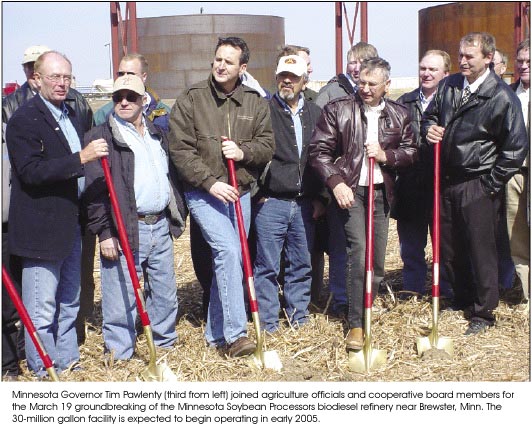
Pawlenty shoveling it at MN Soybean Growers biodiesel plant – stolen from Ag Innovation News
First, a little background. The Midwest Ag Energy Network Summit was the handiwork of the Joyce Foundation funded Great Plains Institute. The Great Plains Institute, as you may recall, have their “Coal Work Group” to promote coal gasification, and their junkets for coal gasification in 2003 and 2005.
And so you’ve got Gov. Pawlenty introducing his “Next Generation Energy Initiative” at the same time that the Great Plains Institute is delivering its propaganda about … well, take a guess:
A great meal with a huge side of IGCC propaganda. Surprise, surprise, in the Coal part of the meeting, they deliver a rah-rah coal gasification, and at the Brookings meeting, thankfully there was a Russian present who had worked on coal gasification and knew they didn’t have a clue what they were talking about and knew they had no business presenting it as a panacea. Funny how that works. But the problem is that at these Great Plains Institute “Town Hall Meetings” where they SAY they want input from the public, well, they really don’t, and they’re pushing that coal gasification agenda without regard for the actual costs and environmental detriment of IGCC, oh, but wait… remember that Joyce Foundation funding? What did they get that $$$ for? Oh, yeah:
Great Plains Institute for Sustainable Development
Minneapolis, MN $437,500
To support the efforts of its Coal Gasification Working Group. (21 mos.)
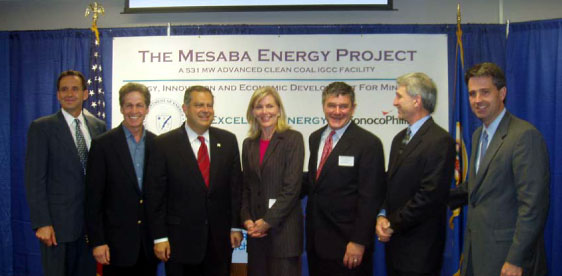
PROMOTION OF COAL GASIFICATION. $427,500 buys a few junkets to Europe, a few Town Meetings (Spirit Lake, Iowa tonight) and an Ag Energy Summit or two… and here they are promotiing it, and haven’t incorporated the information from Mesaba that shows that not only is it $6.38/kWh WITHOUT capture and sequestration, but that the overnight cost is $3,259/kW, ummmm… hello, earth to mars, this doesn’t sound like a good idea. So be sure to check out the “Center for Climate Strategies” promotion of coal gasification — search the doings in the states listed, and you’ll see IGCC — not in MY state!!!
… and so anyway, now there’s Pawlenty and his “Next Generation Energy Initiative” and it makes me wonder if there are naming rights for the Gov’s policy packages, sort of like the way there are with legislation, i.e., C-BED the legislation and C-BED the Crocker entity that puts up a different front on the C-BED website.
Pawlenty and Coal Gasification — rumor has it he has said that under the terms of his Next Generation Energy Initiative, Excelsior’s Mesaba project may have to be “grandfathered in.” Oh, so then if that’s the case, doesn’t that mean that the Mesaba Project defacto does not produce the benefits that they’re touting? If it has to be “grandfathered in,” what’s the point? Hmmmmm…. somebody better check that out at the public hearings next week, eh?
Excelsior’s Mesaba Project is contrary to the basic points of Pawlenty’s plan, which focuses on more renewables, increase conservation, and aggressive cuts to CO2 emissions. The Mesaba Project isn’t renewable, it’s construction generation and making Xcel buy electricity it doesn’t need and that we don’t need, and each year it spews over 6,300,000 tons of CO2 into the air.
Somebody better let Pawlenty know that the Excelsior Project isn’t a happenin’ thang… and clue him in on the political consequences of association with this boondoggle… if you have any doubts, just check the Mesaba Project Siting Docket. zzzzzzzzzzzz, shhhhh, don’t wake it up!
———————————————-
GOVERNOR PAWLENTY INTRODUCES NEXT GENERATION ENERGY INITIATIVE
— December 12, 2006
Governor Pawlenty today announced his Next Generation Energy Initiative that will result in more renewable energy, more energy conservation, and less carbon emissions for Minnesota.
In an address to the Midwest Ag Energy Network Summit today in St. Paul, the Governor outlined his proposals that will build on Minnesotaâ??s nation-leading per capita renewable fuel use, while increasing energy cost saving measures and developing a sound approach to emissions.
More Renewables
In his remarks today, the Governor announced his proposal to move the state closer to his 25xâ??25 strategic goal – 25% of all types of our energy will come from renewable sources by 2025.
* Expand and improve the stateâ??s Renewable Energy Objective (REO)
Under the current REO, Minnesota electric utilities to are expected to generate at least 10% of the electricity they supply consumers to come from renewable resources by 2015. Governor Pawlenty is proposing that the REO increase to 25% of the electricity Minnesotans use should come from renewable resources by 2025. In addition, a financial penalty for non-compliance would be imposed if the goal is not reached.
â??The obligation should be firm enough to ensure we reach our goals, but flexible enough to allow utilities and regulators to respond to changing markets, consumer demand and regulatory conditions,â? Governor Pawlenty said.
* E85 Everywhere
To continue Minnesotaâ??s leadership in E85, Governor Pawlenty is proposing the E85 Everywhere program which would quintuple the number of E85 pumps in the state by 2010, an increase from 300 now to 1800 in four years. In addition, the Governorâ??s proposal will help retail station owners with grants to partially offset the cost of E85 pump installations.
* Promote the development of cellulosic ethanol and advanced biomass technologies in Minnesota
Financial resources should be available to assist and encourage the growth of Next Generation biofuels, such as cellulosic ethanol, and advanced bio-gas (gasification of biomass) technologies to offset natural gas use in the state, with a special focus on farmer ownership.
â??I believe this will be Minnesotaâ??s next bio-energy home run,â? Governor Pawlenty said.
More Energy Conservation
â??We have among the nationâ??s best conservation and energy efficiency programs in the country. We can build on this success and save significantly more energy in the coming years,â? Governor Pawlenty said. â??Energy conservation saves Minnesotans real money on their energy costs, while reducing the environmental impacts of our energy use.â?
* Reduce Minnesotaâ??s fossil fuel energy use
Governor Pawlenty set an aggressive energy saving goal for Minnesotans to reduce use of fossil-fuel energy by 15% by 2015. The Governor said that the goal is achievable through increases in energy efficiency and renewable resources.
* Transition the Conservation Improvement Program (CIP) from a spending requirement program to â??energy savedâ? program
The amount of electricity and natural gas we save each year can be significantly increased through additional energy efficiency and conservation measures. Governor Pawlenty is proposing to change Minnesotaâ??s utility energy conservation program from a spending program to an energy savings program and by requiring utilities to reduce their retail sales by 1.5% annually.
â??We should also increase the accountability and transparency of utility conservation activities,â? Governor Pawlenty said. â??Together, these reforms will effectively double the amount of electricity we save and increase natural gas savings by 50%.â?
* Set as a goal of 1,000 Energy Star commercial buildings in the state by 2010
Currently, Minnesota has 87 schools, office buildings, and churches that have received the Energy Star award. Governor Pawlenty is proposing that 1,000 building become Energy Star certified throughout the state.
â??More Energy Star rated buildings will save money, improve the environment and make working in them more enjoyable,â? Governor Pawlenty said.
Less Carbon Emissions
â??Our global climate is warming, at least in part due to the energy sources we use,â? Governor Pawlenty said. â??Minnesotans did not create this problem, nor can we solve it by ourselves, we need an effective national and international effort. That said, we should identify and take a number of reasonable and fair steps that will reduce our greenhouse gas emission, just as we did with our nation-leading mercury emissions reduction legislation.â?
* Establish stakeholder process
Governor Pawlenty is inviting the nationally recognized Center for Climate Strategies to Minnesota to conduct a wide-ranging and inclusive stakeholder process and to develop a plan to aggressively reduce greenhouse gas emissions in Minnesota over the coming years.
* Utility offset
â??Minnesotaâ??s electric utilities should prepare for the future by offsetting carbon emissions from new fossil-fuel generation sources,â? Governor Pawlenty said. â??As we look to reduce our greenhouse gas emissions, we should not make the situation worse while we try to make it better.â?
* Climate Exchange
Governor Pawlenty is proposing that the State of Minnesota join the Chicago Climate Exchange (CCX) or some other national registry that will helps reduce greenhouse gas emissions from state operations. The CCX is a greenhouse gas (GHG) emission registry, reduction and trading system. Members make a voluntary but legally binding commitment to reduce GHG emissions.
â??The Next Generation Energy Initiative provides the pathway to that better energy future,â? Governor Pawlenty said. â??Taking these steps will be good for the environment, good for rural economies, good for national security, and good for consumers.â?
—————————————
The test question: Who put together the Chicago Climate Exchange? Who benefits from commodification of CO2 and its trade in this market?
Bonus question: How does trading a) shift emissions and b) reduce emissions?

Is Utility Personal Property Tax Deal a Deal?
November 11th, 2006

Letter: Will Xcel deal preserve our fair share?
Carol Overland, Red Wing, The Republican Eagle
Published Saturday, November 11, 2006
To the Editor:
Decades ago, NSP built the Prairie Island plant, and it was welcomed in large part because of the economic benefits.
Tax revenue for this plant has been slashed by over 60 percent in the last decade. What happened to that deal?
There’s a new utility personal property tax deal between Xcel, Goodhue County and Red Wing. Is this a good thing? I’ve represented clients who’ve successfully preserved their tax base. I’ve also represented parties regarding NSP/Xcel deals because my clients suffered consequences, i.e., the “stick it to Goodhue County” nuclear waste in Florence Township, the Chisago transmission line redesigned at twice the capacity originally proposed, the TRANSLink deal and its codification as the 2005 Transmission bill which brings three 345kV transmission lines to Red Wing. I’m skeptical of any deal.
Utility personal property tax is an arcane tax paid by all utilities owning infrastructure to all local governments across the state. All jurisdictions are affected by the 60-percent tax rate cuts.
These cuts were a peripheral issue in the campaign: Candidates were asked about the dwindling tax base, but not what they would do to restore revenue. Only one spoke about her successful experience in negotiating with the utility. Potential solutions range from influencing the Department of Revenue rule change; stepped restoration of utility tax rates; production tax on all generation; elimination of blanket exemptions coupled with a Host Fee Agreement. Local governments must act in concert. Will they?
That’s my concern. This community has been held hostage by a “good neighbor” utility which showed its appreciation for the 1994 lobbying effort “to protect the tax base” by gutting that base as local governments cower. What’s encouraging is that there’s recognition that it’s time to protect our interests. What’s Xcel going to do if challenged, take its nuclear plant and go?
Those working on this deal have pledged to act to protect the tax base and made strenuous assurances that this deal is premised on legislative change. This deal is “a floor, not a ceiling” to preserve the status quo while legislative efforts go forward. That’s reasonable to restore the diminishing tax base, whether legislatively, administratively, or legally, is to enforce the original premise. We’ve got to support local government in its fight to preserve our fair share.
Carol Overland
Red Wing
City Council race in Red Wing
October 26th, 2006

Two candidate forays in one day!
There are times when this all drives me insane and I want to pack up the doggies and split to Costa Rica, where even if it’s as bad, at least I won’t understand it until I”m fluent! This “candidate forum” process, which does not allow for redirect, and lets candidates get away with non-responsive and non-sensical mumblings and strongly worded statements — no follow up at all — aaaaaaagh, it’s just all too much! It was all I could to do keep from jumping up, “OBJECTION!!!” And then there’s “assumes facts not in evidence.”
Yeah, I’ve got a bee up my bonnet. It’s about Utility Personal Property Tax. Why? Well, better read my Primer, which has links to a lot of good information and primary documents on this: Utility Personal Property Tax for Local Governments Because Xcel continues in its dogged persuit of nothing short of elimination of this tax in one way or another. I’ve reviewd this “agreement” between NSP/Xcel and the City, I’ve experienced several other agreements with NSP/Xcel where there was something else, something more, going on. I’ve had numerous conversations over the years with Brad Johnson, former County Auditor, about personal property tax. Earlier this week, I had a good chat with Marshall Hallock after approval of the agreement was delayed because they didn’t have it all there for the public to review for the hearing, all the odd pages were missing! Anyway, my talk with Marshall allayed my fears… until today…
For City Council candidates, here’s what I want each of them to ANSWER, not blather, but ANSWER:
Do you support restoration of Utility Personal Property Tax?
If no, why, and how would you replace this revenue?
If yes, why, and what would you personally do to restore it?
Why am I disgusted? First, when this question is not asked, the implicit assumption is that the tax rates will go down and we’ll get screwed — NSP will again unilaterally finagle this tax cut and leave the City (and County and School District) high and dry. One candidate, Joe Kruger, went so far as to say that he doesn’t know of any other community faced with such a dilemma — EARTH TO MARS — this has an impact on ALL communities across the state, and ones like Becker are affected even more severely than Red Wing! Utilities are regulated, and they generate not just electricity, but profits. More important, they built this nuclear plant after making a deal with the community, that they would pay utility personal property tax. In 1994, they pile people in busses to go up to the capital and lobby and lobby for “keeping the plant open” and “keeping the tax base.” Before the ink is dry on the 1994 dry cask legislation, they’re in court fighting to cut that very same tax. Then over the last decade, they’ve been trying and succeeding in cutting it legislatively, and they’ve been trying and succeeding in cutting it through the Dept. of Revenue rules. Here’s the Rules: Minn. R. Ch. 8100. And once more with feeling, here’s a “must read,” the House Research Primer on Utility Personal Property Tax, written by Mikey Bull, and others (OH, NOOOOOO, it’s been changed, revised, and no Mikey, damn, can’t post his photo with Ray for target practice), anyway, here’s the NEW & REVISED PRIMER ON MINNESOTA’S PROPERTY TAXATION OF ELECTRIC UTILITIES.
What is so difficult to understand about the fact that utiltiies remain regulated? THAT HAS NOT CHANGED!
OK, City of Red Wing council candidates, I’m going to leave messages with all of you to determine:
Do you support restoration of Utility Personal Property Tax?
If no, why, and how would you replace this revenue?
If yes, why, and what would you personally do to restore it?
What’s so hard about these equations:
Plant = Tax
Build Plant = Pay Tax
Extend Life of Plant = Pay Tax
Eliminate Tax = Shut Down Plant
I mean really, who has the power in this situation? They want to relicense this plant because it is very, very profitable for them. What gives them the right to unilaterally change the deal? What will they do, move it somewhere else (please!)? Each time we help them keep it open, help them get more casks, help them relicense, and letting them operate in our community, each time they’re screwing us over by cutting that tax.
Hey, NSP, we do indeed get it. We’re getting screwed, and we’re not getting off!
Nope, this sorry state of affairs will not do!
Now, will these folks collectively stand up?
