Annual NERC Reliability Assessment is out
October 16th, 2006

OH, NOOOOOOOOO, WE’RE GOING TO FREEZE IN THE DARK ON A RESPIRATOR WITHOUT A JOB!!!!!!
That’s “Utility Panic Propaganda Piece WGTFITDOARWAJ” and we’ve heard it before… sigh…But our electrical grid is not broken the way they’d like us to believe, yet it’s assuredly cracked and can’t be fixed. That is, it can’t be fixed with more transmission and more central-station generation! But we can indeed fix it in a way we can live with. It’s our job to do that. But folks, you have to actually look at the report, read it, CAREFULLY, and take in what it says, and note what is missing (hint: new generation).
The NERC 2006 Long-Term Reliability Assessment is out, the report that comes out this time every year. Light years ago, up in Duluth on a transmission case, an engineer in the know handed me a copy of the NERC 1999 Long-Term Reliability Assessment as if it were the Holy Grail, “Here, you need this,” and I took that very seriously and read it. Since then, I’ve used each years’ version, entered it in every proceeding, every time I testify about whatever, because this industry report shows that we do not need electricity the way utilities would have us believe. So what does that mean? What am I basing that on?
Check this map about new generation:
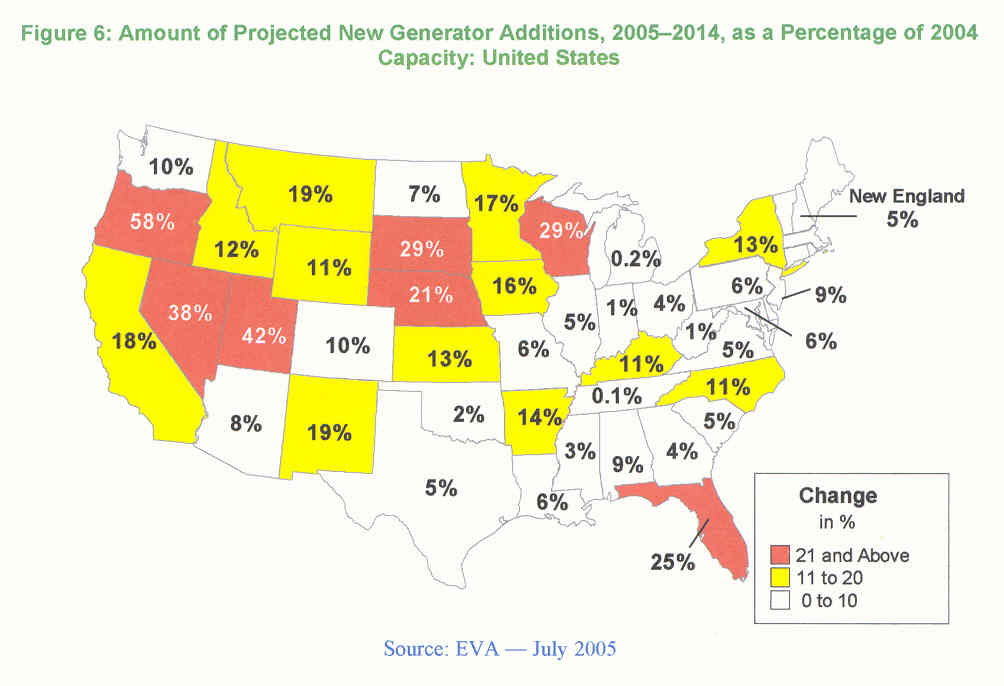
Note the 17% for Minnesota, and 39% for Wisconsin. The capacity margins for MRO (which we know affectionately as MAPP) are way more than adequate, sometimes twice over. The 2005 report states specifically:
Energy
The MRO tracks annual electricity use by both region and subregion:
â?¢ Annual electricity usage for the entire MRO region in 2004 (195,528 GWh) was 0.6% above 2003 consumption (194,286 GWh) and 3.0% below the 2004 forecast (201,605 GWh).
â?¢ Annual electricity usage for MRO-U.S. in 2004 (154,053 GWh) was 1.1% above 2003 consumption (152,310 GWh) and 3.7% below the 2004 forecast (159,932 GWh).
â?¢ Annual electricity usage for MRO-Canada in 2004 (41,475 GWh) was 2.7% above 2003 consumption (40,369 GWh) and 0.5% below the 2004 forecast (41,673 GWh).
2005 NERC Long-Term Reliability Assessment, p. 57. Go figure, for some odd reason, in the 2006 NERC report, they do not include that graphic little map, nor do they address the overstatement of utility “need” as specifically or accessibly as they do above. There is not one reference to the MISO queue which has so many thousands of megawatts of generation at various stages of development waiting in line to be interconnected. To find the real poop, you’ve got to really be looking for it. And when it’s hard to find, having to read between the lines, why, we end up with articles like this in the NY Times, and if it’s in the times, it has to be true, eh? GRRRRRR Let’s see, how can we interpret overestimation of need and how can we fail to consider and include thousands of megawatts of new generation? Here’s what happens when a non-critical reader and writer lets loose — what we get is a creative take on it that distorts the reality of our secure and reliable grid, one meant to generate fear rather than convey the content of the report:
By MATTHEW L. WALD
WASHINGTON, Oct. 15 â?? Companies are not building power plants and power lines fast enough to meet growing demand, according to a group recently assigned by the federal government to assure proper operation of the power grid.
The group, the North American Electric Reliability Council, in its annual report, to be released Monday, said the amount of power that could be generated or transmitted would drop below the target levels meant to ensure reliability on peak days in Texas, New England, the Mid-Atlantic area and the Midwest during the next two to three years.
The council was established in 1965 after a blackout across the Northeast, and has since set voluntary standards for the industry. After the blackout of 2003, which covered a vast swath of the Midwest, Northeast and Ontario, Congress set up a process that would eventually give the council the authority to fine American companies that did not follow certain operating standards. It is seeking a similar designation in Canada, since â?? electrically speaking â?? the border is irrelevant.
For years, the council has produced often-gloomy annual reports, but this is the first to be officially filed with federal agencies, and to recommend specific action.
The report says, for example, that utilities should be encouraged to pursue financial incentives for customers to cut use during peak hours, thereby lowering demand for new power plants and transmission lines. Financial incentives could reward customersâ?? installation of more efficient equipment or, more drastically, reward a factory for closing on a day when electricity supplies are expected to be tight.
The president of the council, Rick P. Sergel, said in a telephone interview, â??The situation has existed for a long time, but we cannot let it continue.â?
Planning for adequate capacity has become more difficult with the restructuring of the electric industry. Where a handful of top-to-bottom companies once generated power, transmitted it and delivered it, hundreds of companies are now involved in only one or two phases of the process. At the same time, getting permits to build new power lines has become more difficult.
The actual balance between supply and demand depends in part on changes in technology. Grid operators can now push more power through existing lines, plant operators have found ways to make generators more reliable and sharp increases in the efficiency of how electricity is used could slow demand.
The report predicts that demand will increase by about 19 percent over the next 10 years in the United States, and slightly less in Canada, and that the construction of power plants and transmission lines to carry that load will fall far short of what is needed. In this country, utilities have contracts with new power plants for only about a third of the capacity that will be needed; in Canada, the number is about two-thirds.
The number of miles of transmission lines, which can help redistribute supplies, will increase by only about 7 percent, the report said.
Deregulation = Failure – DUH!
October 15th, 2006
The New York Times’ David Cay Johnston is at it again! His byline makes my day (for another view, check this), and that he’s on to “deregulation” gives me a glimmer of hope. Johnston’s the guy who wrote Perfectly Legal: The Covert Campaign to Rig Our Tax System to Benefit the Super Rich–and Cheat Everybody Else — writer and digger extraordinaire. It’s not so much that he finds it all, but that he’s connecting the dots and stating the result, in a time where establishing these connections exposes the myths, fictions and abject lies.

First, I’ll signal my turn — this is about STRANDED ASSETS. I remember way back when, when “deregulation” was pushed by NSP/Xcel, when there was a big effort by NSP and the MN Chamber of Commerce to eliminate utility personal property tax in anticipation of certain deregulation. I remember being aghast at the enviros’ capitulation and acquiesence, assuming deregulation would happen, and I got into more than a few fights about that, knowing that if we rolled on that, it’s all over. I had a great talk with Steve Corneii, then of the A.G.’s office, outside some Senate hearing room, and I really got down on him about acquiescing, that if we acquiesced, well duh, we deserve what we get, and we’d damn well better stand up, he’s representing the state, and he more than anyone has to be standing up… well, a friend observing said I had him up against the wall and she was worried… sigh… some just don’t understand spirited repartee. Anyway, about six months later, an A.G. report was issued on deregulation, authored by Steve Corneli, which is really important, so here it is:
What’s important about this is that while utilities, NSP in this case, were claiming that ratepayers would have to pay the utilities for “stranded costs,” what we have in Minnesota was “stranded assets,” to the tune of $764 million. $764 million in stranded ASSETS, not stranded COSTS! Logically, then, if utilities would be paid by ratepayers for “stranded costs,” then conversely, utilities would have to pay ratepayers for STRANDED ASSETS! DUH! Well, for some odd reason, talk of deregulation in Minnesota started waning, and by the time Hatch’s Deregulation Report, “The Electricity Deregulation Experience” was issued, deregulation was dead in the water. From here, I’d say it turned on stranded assets, and exposure of the utilities attempt to screw us over. Or as put by Corneli:
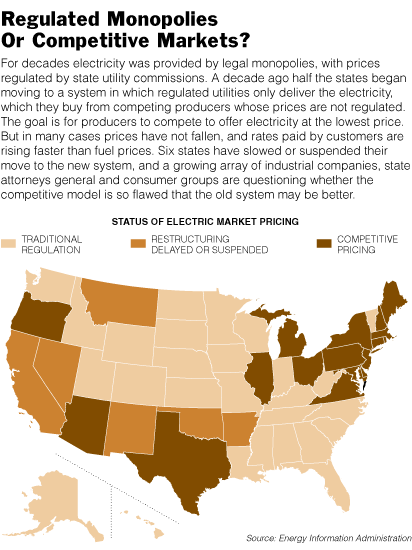
What happens if we apply the same deal to Minnesota? If Minnesota consumers get to buy from alternative providers, many of whom have higher costs of production, at higher market clearing prices, there is no consumer benefit. There is consumer harm, at least to the residential and small business customers who don’t have the buying power to sign rock-bottom price contracts with low cost producers. By the way, why would huge international firms like USX be signing these long-term contracts with Minnesota Power if they don’t expect higher prices from deregulation? And while consumers will be harmed by higher electricity prices, the same higher prices will make the value of generating assets increase for shareholders. They will get windfall profits, while consumers get higher prices. That’s what the map shows. That’s the deal that could result from enacting a policy in Minnesota that is pro-consumer in Illinois.
What does any of this have to do with building new coal plants on the eve of further regulation? HELLO! It’s all connected! By building new coal plants today, we could very well be creating “stranded costs” because of imprudent expenditures on generation without a future, and setting ourselves up for massive payments to utilities for their imprudent investments. Is anyone paying attention? At least one of the reports I’ve read on CO2 capture and sequestration notes this potential, so methinks it’s a lot more than a little sidebar in a huge report. Utility expenses will be covered by ratepayers, but the PUC has the responsibility to assure that it is a prudent investment, that’s their charge. Are they considering this as they go forward with new coal plants? Is anyone raising this issue? And remember, what do utilities care? As long as the PUC approves it as a prudent investment, they’ll be covered, and we’ll pay.
I wish Johnston would dig into the impact of wholesale deregulation in regulated states, because we’re ending up with defacto deregulation, the regulated parts are drowning under the weight of wholesale transactions that are the utility priority.
So back to David Cay Johnston — he’s speaking the truth about deregulation, the utilities just think it’s hell. Are we paying attention?
Competitive Era Fails to Shrink Electric Bills
October 15, 2006
By DAVID CAY JOHNSTON
A decade after competition was introduced in their industries, long-distance phone rates had fallen by half, air fares by more than a fourth and trucking rates by a fourth. But a decade after the federal government opened the business of generating electricity to competition, the market has produced no such decline.
Instead, more rate increase requests are pending now than ever before, said Jim Owen, a spokesman for the Edison Electric Institute, the association for the investor-owned utilities that provide about 60 percent of the nation’s power. The investor-owned electric utility industry published a June report entitled “Why Are Electricity Prices Increasing?”
About 40 percent of all electricity customers, those in 23 states and the District of Columbia where new competition was approved, mostly paid modestly lower prices over the past decade. But those savings were primarily because states, which continue to have some rate-setting power, imposed cuts, freezes and caps at the behest of consumer groups that wanted to insulate customers from any initial price swings.
The last of those rate protections expire next year, and the Federal Energy Regulatory Commission and other federal agencies warn in a draft report to Congress that “customers may experience rate shock” as utilities seek to make up for revenue they did not collect during the period of artificially reduced prices and to cover higher costs of fuel. They warned that “this rate shock can create public pressure” to turn back from electricity prices set by the market to prices set by government regulators.
The disappointing results stem in good part from the fact that a genuinely competitive market for electricity production has not developed.
Concerned about rising prices, California and five other states have suspended or delayed transition to the competitive system.
And voters around two California cities, Sacramento and Davis, will decide next month whether to replace investor-owned utilities with municipal power in hopes of lowering rates. Drives are under way to expand public power in Massachusetts. In Portland, Ore., the city council tried and failed to buy the local utility company.
Electric customers in other states are facing rude surprises.
In Baltimore, an expected 72 percent rate increase in electricity prices has aroused so much protest that the state legislature met in special session, where it arranged to phase in the higher costs over several years. In Illinois, rates are about to rise as much as 55 percent.
The three New York area states opened their electricity markets to competition, with different results.
In Connecticut, residential electric rates rose up to 27 percent last year to an average of $128 a month, and are expected to go up as much as 50 percent more in January.
In New Jersey, rates rose up to 13 percent this year, and are poised to go much higher.
New York residential customers, by contrast, paid an inflation-adjusted average of 16 percent less in 2004 than in 1996, a state report said. It is not known how much of that is attributable to government-ordered rate cuts, but the state benefited from huge increases in power generated by its nuclear plants and by buying power from New England plants that, starting next year, may have less electricity to sell to New York.
The Federal Energy Regulatory Commission and five other agencies, in the draft of the report to Congress, are unable to specify any overall savings. “It has been difficult,” the report states, “to determine whether retail prices” in the states that opened to competition “are higher or lower than they otherwise would have been” under the old system.
Joseph T. Kelliher, the commission chairman, said Friday that eventually “market discipline will deliver the best prices” and noted that every administration and Congress since 1978 had pushed the industry toward competition. He added that the commission recognized a need for “constant reform of the rules.”
Under the old system, regulated utilities generated electricity and distributed it to customers. Under the new system, many regulated utilities only deliver power, which they buy from competing producers whose prices are not regulated. For example, Consolidated Edison, which serves the New York City area, once produced almost all the power it delivered; now it must buy virtually all its electricity from companies that bought its power plants and from other independent generators.
The goal is for producers to compete to offer electricity at the lowest price, savings customers money.
Independent power producers, free-market economists and the Clinton Administration cheered in 1996 when the federal government allowed states to adopt the new system. The new rules “will benefit the industry and consumers to the tune of billions of dollars every year,” Elizabeth A. Moler, then chairwoman of FERC, said at the time. She said the new rules would “accelerate competition and bring lower prices and more choices to energy customers.”
But that has not happened. A truly competitive market has never developed, and, in most areas, the number of power producers is small. In New Jersey, for example, only six companies produce power, and not all of them sell to every utility.
Some utilities have decided to buy electricity not from the cheapest supplier but from one owned by a sister to the utility company, even if that electricity is more expensive. That has been the case in Ohio.
And if electricity is needed from more than one producer, utilities pay each one the highest price accepted in the bidding, not the lowest. This one-price system, adopted by the industry and approved by the federal government, is intended to encourage investment in new power plants, which are costlier than older ones.
But critics say that, as in California five years ago in a scandal that enveloped Enron, the auction system can be manipulated to drive up prices, with the increases passed on to customers. What is more, companies that produce electricity can withhold it or limit production even when demand is at its highest, lifting prices. This happened in California, and the federal commission has found that it occurred in a few more instances since then. Critics say that more subtle techniques to reduce the supply of power are common and that the commission shows little interest in investigating.
Bryan Lee, a FERC spokesman, said complaints of manipulation are investigated, but only last year did Congress give the commission the legal tools to punish manipulators.
Under the new system there have been some big winners “including Goldman Sachs and the Carlyle Group, the private equity firm” that figured out that there were huge profits to be made in one area of the new system.
Such investors have in some cases resold power plants they just bought, making a large profit. In other cases, investors have bought power plants from the utilities at what proved to be bargain prices, then sold the electricity back at much higher prices than it would have cost the utility to generate the electricity.
Richard Blumenthal, the Connecticut attorney general, said the supposedly competitive market has been “a complete failure and colossal waste of time and money.”
He asked the federal commission to revoke competitive pricing in his state, but the commission dismissed the complaint last Wednesday, saying the state had not proved its case.
Advocates of moving to the new system say that, in time, the discipline of the competitive market will mean the best possible prices for customers. Alfred E. Kahn, the Cornell University economist who led the fight to deregulate airlines and who, as New York’s chief utility regulator in the 1970s, nudged electric utilities toward the new system, said that he was not troubled by the uneven results so far.
“Change,” Professor Kahn said, “is always messy.”
But some advocates of introducing competition to the electric industry have soured on the idea. They include the Cato Institute, a leading promoter of libertarian thought that favors the least possible regulation and that concluded earlier this year that government and electric utilities have made such hash of the new system that the whole effort should be scrapped.
“We recommend total abandonment of restructuring,” Cato said. If the public rejects a greater embrace of markets, Cato wrote, the next best choice would be a “return to an updated version of the old” system.
The conflicting results among the many studies of electric prices stand in contrast to the sharp, unambiguous drops in the prices of telephone calls, air travel and trucking.
One study by the utility economist Mark L. Fagan, a senior fellow at the Kennedy School of Government at Harvard and a consultant to various businesses who favors a competitive system, found that the new system often produces better results. He found that in 12 of 18 states that restructured, prices were lower for industrial customers than they would have been under the old system. But he also found that prices were somewhat lower than his model predicted in seven of 27 states that did not open to competition.
In Virginia, a state that did not move to the new system, a report last month by the agency that regulates utilities found “no discernible benefit” to customers in the 16 states that had gone the farthest and warned that electricity prices in those states “may actually be increasing faster than for customers in states that did not restructure.”
And Professor Jay Apt, a former astronaut who runs the electricity study center at Carnegie-Mellon University, found that savings from introducing competition to sales of electricity to large industrial customers “are so small that they are not meaningful.”
Regardless of the debate over the effectiveness of the new system, electricity prices are expected to rise in the next few years for several reasons apart from any rise in the price of coal, natural gas, oil, uranium and other fuels.
A study issued in June by the Edison Foundation, which represents investor-owned utilities concluded that utilities would have to raise rates to upgrade local distribution systems and to finance long-distance transmission lines, as well as for new power plants. The study found that utility profit margins had thinned and financial strength had weakened. It called for relief in the form of higher rates.
================================================
States that deregulated (stolen from NYT, fair use, eh?):
Snowy Pines solar tour on Saturday!
October 3rd, 2006
Greg Nolan and Marcia Rapatz and family are hosting a solar tour this Saturday. Check out their site here: Snowy Pines Restoration. Maybe they’ll have some of Marcia’s blueberry muffins!!!! Worth the drive!

That’s Greg in the foreground at last year’s Windy River Energy Fair.
Here’s the poop on the solar tour:
Snowy Pines Solar Tour
Date: Saturday, October 7, 2006
Taking Place In: Turtle Creek Township – Browerville, MN
Local Tour Name: Snowy Pines Solar Tour
Presented by: Snowy Pines Reforestation
For More Information: Greg Nolan, 320-594-6317, snowpine@rea-alp.comTour Description: Tour consists of:
1) off grid home (1 kW.)
2) a grid tied solar electric sustainable wood products business (2.4 kW.) with solar hot water for in floor heating and passive solar construction.
3) small solar electric (100 watts) off grid system for lighting in an out building.
4) solar “garden shower” which produces lots of hot water for the garden crew.
It’s Free!
Directions to this Tour: From US 10 (Cushing Mn.) take county Rd.# 16 west for about 7 miles to 321st Ave. Turn left or south and go 1/2 mile. We are on the left side of the road. From US 71 (Browerville) take county Rd # 14 for about 1 mile to the east then turn north of county Rd # 16. Go about 9 miles to 321st Ave. and turn right or south. Go 1/2 mile on 321st and we are on the left. Watch for signs.
Mesaba EIS Public Meeting Tuesday
August 20th, 2006
Excelsior now has radio ads on a station in Duluth! The lengths they’ll go to to promote this thing…
Important meeting coming up:
MINNESOTA DEPT. OF COMMERCE PUBLIC MEETINGS ON
MESABA COAL PLANT ENERGY PROJECT
Tuesday, August 22nd, 2006 at 7:00 pm
Taconite Community Center
26 Haynes Street
Taconite, Minnesota
Wednesday, August 23rd, 2006 at 7:00 pm
Hoyt Lakes Arena
102 Kennedy Memorial Drive
Hoyt Lakes, Minnesota
DOC will conduct two public scoping meetings in which agencies, organizations, and the general public is invited to present oral comments or suggestions with regard to the range of alternatives and environmental issues to be considered in the EIS.
Here’s the DoC Comment Notice.
Here’s a Comment form you can use:Â Â eis_comment_form.doc
Comments are due by August 30. Email (click here) or send to:
Bill Storm
Dept. of Commerce
85 – 7th Place E., Suite 500
St. Paul, MNÂ 55101-2198
August 30 is not that far away! Get your comments in today!
=================================================
And fresh editorials from the Grand Rapids Herald Review:
 Project will affect people’s health
Editor:
There are times when sacrifices made to promote economic development may be appropriate. However, I am troubled by the massive sacrifices that our elected officials are supporting for the handful of permanent jobs proposed by the Mesaba Energy project. In addition to around 100 permanent jobs (a reduction by 900 since the original proposal) there are other â??developmentsâ? Excelsior Energyâ??s IGCC (Integrated Gasification Combined Cycle) plants will bring if built.
Canisteo Lake will be closed for recreational use and a massive pumping station will operate on the lake to serve the plant. One hundred-forty foot transmission towers will impede on private and public land, forcing landowners off in a controversial use of eminent domain. People will become sick as documented in Excelsiorâ??s own literature. Miles and miles of coal trains will travel through Grand Rapids each week. Snowmobile trails will close or reroute to make room for the plant footprint. One thousand two hundred acres of hunting land will now be off-limits. Carbon dioxide will be pumped into the air, contributing to global warming, along with tons of sulfur dioxide, pounds of mercury, and other particulates that cause asthma and other respiratory problems. Children will be exposed to unsafe levels of electro magnetic fields, putting them at greater risk for childhood leukemia. Groundwater aquifers that supply drinking water to nearby communities are at risk for contamination when Canisteo Lake becomes polluted. Millions upon millions of dollars will be bonded by the county, placing us at financial risk and possibly increasing our property taxes. How will schools, health care facilities, and housing developers deal with the glut and then absence of hundreds of imported construction workers? Hire then fire? Build then abandon?
Our health is our wealth. Development that endangers our personal, environmental, and financial health to this extent is too big a sacrifice for us to take on. We should demand better! The carbon dioxide can be captured in IGCC technology but not in this location. More mercury can be captured than what Excelsior is proposing. Technology exists to prevent water pollution. Local dollars do not have to be used to build infrastructure. My hope is that we can promote economic development in a way that achieves balance and addresses the reality of the future.
Kristen K. Anderson
Bovey
-=============================================
Editor:
As I read the information provided in the Environmental Supplement for Excelsior Energy’s proposed coal gasification plant I became very angry. How is it that a power plant with a potential to contaminate our wells and the air we breathe could even be considered for this area when no one has demonstrated the need for the electricity and the power would be sent down to the Cities and beyond anyway. Where are the people that were given the responsibility of protecting our health?
If this plant is built in this beautiful area I will have lost all faith in the system, the checks and balance that were designed to protect our quality of life. We should look at the future results of this and keep in mind that this will effect us a lot more then what they are showing or telling us.
Pam Perry
BoveyÂ
Xcel profits v. “Capitalist Case for Alternative Energy”
August 1st, 2006
.
“Dollar bill, dollar bill, dollar billlllll, it’s all about the dollar bill…”
or is it…
“Nothin’ makes ’em holler, like the almighty dollar…”
and the classic version here…

Ever notice that when they report quarterly financials they NEVER annualize the figure, only report a percentage down or up related to the prior quarter, or a year ago or whatever, it’s always this relative number that is meaningless… grrrrrrrrrrr…. anyway, here’s the scoop on Xcel’s quarterly profits, from the STrib:
Higher rates push up Xcel profits 18%
Xcel Energy Inc., owner of utilities in the Twin Cities and in Denver, said second-quarter profit rose 18 percent on higher rates for electricity and natural gas.
Net income rose to $98.3 million, or 24 cents a share after payment of preferred dividends, from $83.4 million, or 20 cents, a year earlier, the Minneapolis-based company said Tuesday. Sales rose to $2.07 billion from $2.06 billion. Xcel stock rose 16 cents, or 0.8 percent, to $20.20.
For the full year, the company repeated its forecast for per-share profit from continuing operations of $1.25 to $1.35. The company had profit from continuing operations of $1.20 in 2005.
Xcel raised Minnesota electric rates by $147 million in January. The rate increase is subject to refund as state regulators consider the utility’s pricing plan.
BLOOMBERG NEWS
2nd quarter FY2006, 6/30
2006 2005 % chg.
Revenue $2,073.9 $2,064.1 +0.5
Cont. ops. 97.9 77.7 +26.1
Disc. ops 0.3 5.7 -94.1
Income 98.3 83.4 +17.8
Net/cm 97.2 82.3 +18.1
Earn/share 0.24 0.20 +20.0
6 months
Revenue $4,962.0 $4,454.6 +11.4
Cont. ops. 247.7 202.1 +22.6
Disc. ops 1.8 2.7 -33.5
Income 249.6 204.9 +21.8
Net/cm 247.5 202.8 +22.0
Earn/share 0.60 0.49 +22.4
Figures in millions except for earnings per share.
©2006 Star Tribune. All rights reserved.
———————————————————–
And so juxtapose that with this (note it’s “alternative” and not “renewable” though “alternative” does fit better in this context):
The history of capitalism suggests that a transition from today’s petroleum-based economy to a post-oil era is inevitable.
Isaac Cheifetz
« Keeping America competitive requires affordable energy. And here we have a serious problem: America is addicted to oil, which is often imported from unstable parts of the world. »
– George W. Bush, State of the Union address, Jan. 31, 2006
The price of petroleum continues to reach new highs, with crude oil prices hovering around $75 a barrel, and gasoline at the pump in the United States at $3 a gallon. The unrest in the Middle East threatens to push prices even higher.
It is difficult to imagine our modern economy without oil. For the past 125 years, fossil-fuel energy has been as American as apple pie. The automobile, airplane and much of our modern conveniences are enabled by petroleum-based products.
But from a historical perspective, shifts in energy and technology are inevitable. What is the capitalist case for seriously planning for a post-petroleum economy now?
â?¢ National security: Our reliance on a consistently available and reasonably priced supply is inherently risky. But the worldwide search for oil has a secondary negative impact.
Underdeveloped countries with sizable oil resources consistently react like vagabonds winning the lottery, or a decadent hotel heiress. None has leveraged oil wealth to become advanced industrial economies.
Of the international trouble spots, only North Korea is not directly or indirectly funded by petro-dollars. If oil was worth less, these countries might still be troublesome, but they’d be far less of a threat.
â?¢ True cost of oil: Despite today’s higher costs, U.S. oil is inexpensive compared with prices in most Western economies, and compared with historical U.S. prices in inflation-adjusted dollars. But the pump price does not include our indirect costs of militarily ensuring stability in oil producing regions. If the direct and indirect costs of oil from unstable regions were reflected in consumer prices, many alternative energy sources would become more cost effective.
â?¢ The environmental business case: There is a sound business case for being environmentally proactive. The rising expectations of middle-class consumers worldwide are a potential strain on resources, but a certain opportunity.
The essence of capitalism is looking forward, not fighting to maintain the status quo. Capitalism’s success in spurring economic growth is rooted in “creative destruction,” as described by economist Joseph Schumpeter.
The success of Toyota and Honda versus troubled General Motors and Ford is partly attributable to the Japanese firms’ aiming for future markets (subcompacts in the 1970’s, hybrids in the present), while the U.S. firms stubbornly focused on successful profitable products (high-margin gas guzzlers in both eras), and fought attempts to mandate higher mileage standards.
What are the building blocks of the path toward a post-petrol future?
â?¢ Market driven: Government cannot effectively mandate disruptive shifts to energy sources of the future. But it can play a leading role by seeding the landscape, as it did during the Cold War era by funding basic research, which became the foundation of Silicon Valley.
â?¢ Forward looking: Subsidize future technologies, not current political dilemmas. Congressional hearings considering using the Strategic Oil Reserve to stabilize gas prices, or investigating oil company “windfall” profits, are distractions, not solutions.
â?¢ Non-ideological: Both liberals and conservatives must become more rigorous yet flexible in their approach to energy. For the right, glorifying SUV’s as a symbol of liberty is dangerous in an era when we are threatened by oil-producing countries that fund a range of toxic societies and ideologies worldwide. For the left, serious consideration of unpalatable alternatives like nuclear energy and Alaska drilling should be part of the solution.
â?¢ Evolutionary alternatives: It is impossible to predict tomorrow’s energy efficiencies precisely. But a variety of existing technologies have the potential to reduce oil consumption incrementally, and together, they can put us on the path to the post-oil era. Ethanol is one obvious example. And cellulosic ethanol — made not from corn but from carbon-based waste products such as switchgrass, sewage sludge and wood chips — is attracting a lot of investor attention.
â?¢ Revolutionary alternatives: Future generations will consider us wise if we invest additional billions now in basic research, pursuing radical advances in safer nuclear energy production and disposal, cold fusion, batteries, and solar, wind and water-driven energy.
About 150 years ago, the United States was a rapidly growing economic and social force, in the era when coal and whale oil were the energy foundations of our economy, and petroleum was considered nearly worthless. In 150 years, our energy sources probably will make oil the curiosity that whale oil is today.Isaac Cheifetz is a Minneapolis-based executive recruiter who helps companies hire technology-savvy senior executives. His Commerce Chain column focuses on best practices, leadership and trends in business technology. He can be reached at www.opentechnologies.com.
©2006 Star Tribune. All rights reserved.