Advanced BioEnergy needs cash
February 25th, 2007

Money makes the world go round…
For those of you following the Advance BioEnergy ethanol plant proposed for Dundas, and who around Rice County isn’t, there’s news… they’re out there and they’re looking for money. Don’t they get that the ethanol market, ethanol future, is spiraling downward, what with water usage problems, smell, __________ (name that problem here). Or is it that investors get the problems with ethanol and its checkered future?
Lo and behold, they’re prowling around North Dakota and South Dakota looking for money. Are they having trouble finding private investors among their usual suspects? I know, this will be hard to read, so below will be a link to pull up the whole thing.
NOTE THEY MENTION THE NORTHFIELD PLANT!!!
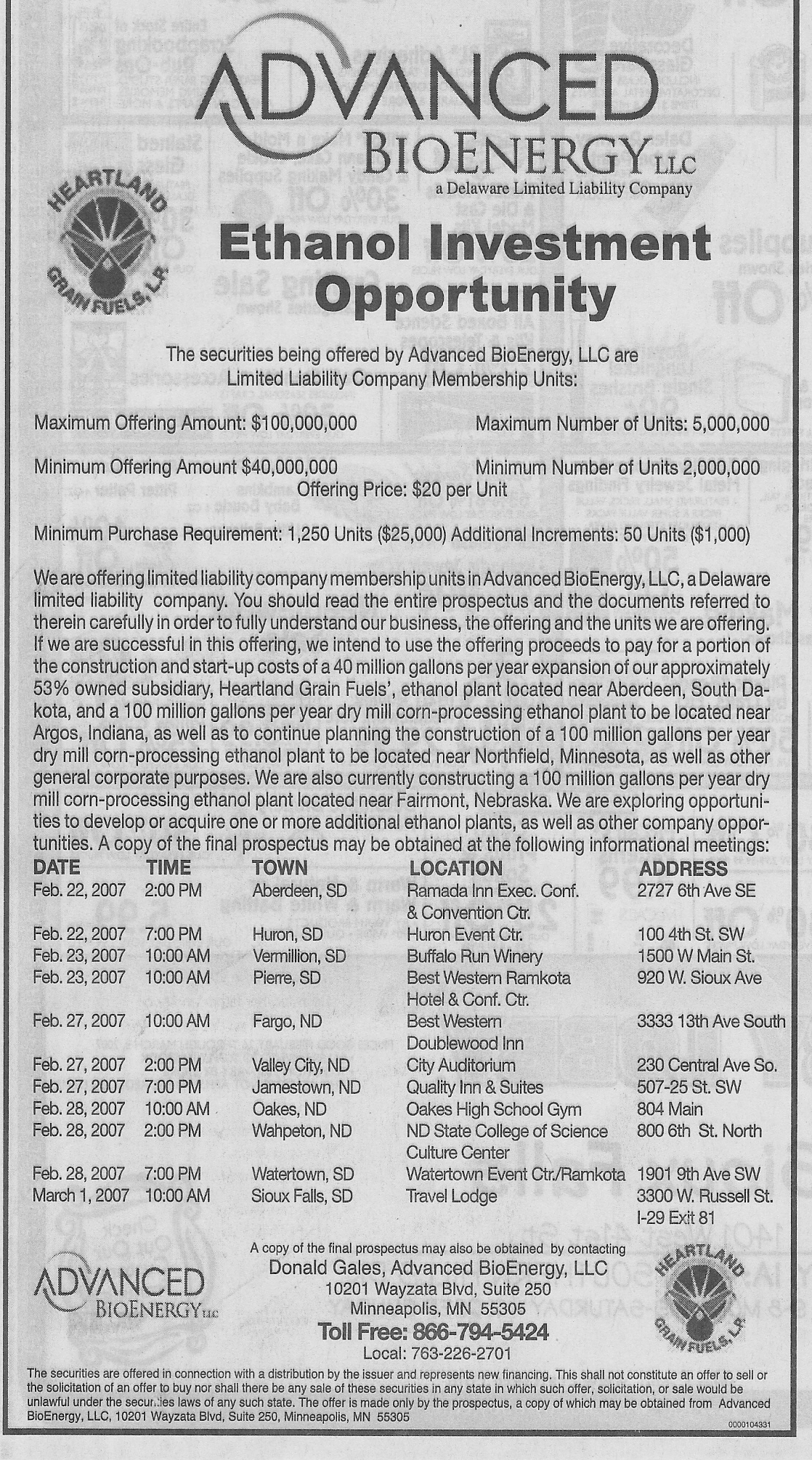
Here’s the link: ABE Investor Meetings
Seems to me there ought to be a contingency out on the road with them finding out what the scoop is — sounds like a job for the Northfield News!
Electric – 70s deja voodoo all over again
February 17th, 2007
As I work on this energy mess we’re in, I’m struck by the force of an industry push to construct despite no need, to build billions of dollars of generation and transmission that we don’t need to facilitate their unregulated wholesale market transactions, and of course that transmission will also facilitate all those new coal plants:

As if that wasn’t enough, there are all these folks promoting coal gasification when they haven’t a clue what it’s about, saying it has superior environmental performance, and pretending as if carbon capture and storage is feasible! What are they thinking?
And then I remember this meeting at Commerce, October 2000, I believe, back in the days when the enviros were ready and willing to acquiesce to “restructuring” or deregulation, which was a position utterly without gonads. This was in the … sigh… Ventura days, and although the “Department of Public Service” had been disappeared and Commerce took over, it was a time when people could easily meet with staff, a time when Commissioner Bernstein held the monthly breakfasts, when service lists were honored because the public mattered, where energy planning was a happenin’ thang and where the state’s preferences for distributed and renewable generation meant something. Anyway, recently I was jolted back by Charles Komanoff’s review and characterization of the overbuilding of the 70s, and remembered that back in October 2000, I’d copied parts of Kahn’s “The Economics of Regulation” to show the parallels, where we were going, and then Komanoff reminded me that we’re there, doing the same damn stupid human tricks all over again.


Kahn noted that utility regulation that levies current ratepayers provides, in the form of” increased cash flow to finance capacity additions,” incentive to build more generation than what’s needed. He also raised an interesting thought — that the way it’s foisted on current ratepayers, there’s inherent generational inequity. Hmmmm… Anyway, as the 70s “progressed” and so many nuclear plants were built, costs escalated astronomically, some were never completed, and those that were often left those utilities with grossly excessive and unneeded capacity. Ratepayers got hit hard. From there, go to my previously blogged description by Komanoff, in Power Plant Cost Escalation, of construction of nuclear plants that required extensive design and engineering for each plant, incorporating lessons learned and addressing problems that became apparent during design and construction, which lead to the high costs, both in construction and through abandonment of projects that weren’t economically and/or operationally feasible to build.
Coal gasification (IGCC) is our 70s nuclear. Too many yahoos are advocating construction of coal gasification plants without knowledge of the state of IGCC technology, the serious technological problems (such as gasifier problems so severe that they don’t solve it, they instead design in a “spare gasifier.” Oh, great…), and the massive cost increases — in the case of Mesaba, increasing from $500-600/kW when first proposed to legislature in January, 2002, to $3,593/kW, or $2,155,680,783 in May, 2006, and bound to go up further.
The rate structure would allow immediate inclusion in the rates, both for these IGCC plants and for the billions of dollars in unneeded transmission infrastructure of CapX2020 (Check the “Transmission cost adjustment” that lets them get it more quickly).
OK, once more with feeling. In Minnesota, our biggest utility doesn’t “need” new baseload power until 2015, and at that time, it’s only 375MW, which they’re fulfilling with wind and hydro. The Dept. of Commerce, in the Big Stone II plant in SD’s transmission docket here in MN, says that the many utilities that banded together to build BSII did not prove up need. There was no need for Mesaba so it was legislatively exempted from Certificate of Need. And Renewable Electricity Standard now before the MN legislature is a mandate, again, because there is no need (if we needed it, we wouldn’t require mandates). Yahoos claim “we’re going to freeze in the dark” NEED, growth of 2-2.49% annually but the Long Term Reliability Reports of the industry’s North American ElectriclReliability Council say otherwise — look at the lower rates of increase for demand and energy, high reserve margins, and high levels of new construction. The Wind Integration Study demonstrates that we can integrate 5,000-6,000MW into the Minnesota grid with only nominal transmission additions — we “need” 375MW and can integrate in thousands of MW! It’s really that simple!
And as we know, CapX2020 (aka Xcel, et al) is driving the construction and of course they don’t look at their own map on p. 7, nor, it seems, is anyone else:
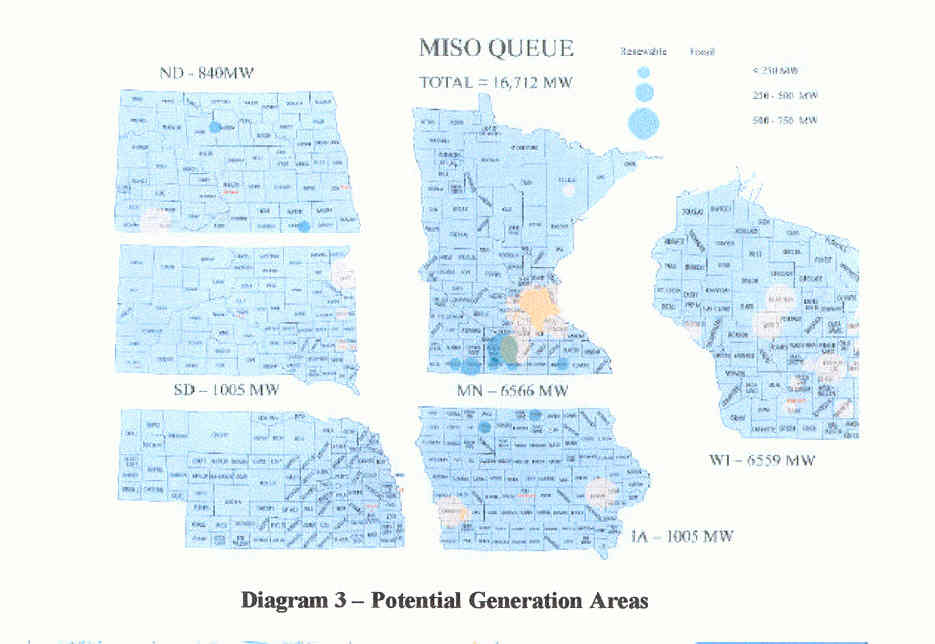
Why are legislators and policy wonks who have access to all this information buying this crap? Why would anyone think we need coal, much less that we can’t do without it? Why would anyone think we need over a billion dollars of transmission? It’s against evidence and we’ve been there, done that and we don’t need to do it again. Is it that we’re experiencing the limitations of our educational system and its inability to produce critical thinkers? Are we experiencing the impacts of mercury? Are we experiencing the impacts of the power of $$$$$$$?  Why do you thihnk they call them “power companies?”
Electricity 2020 in Grand Rapids
February 4th, 2007

Mike Bull’s on the road again … the 14th in Grand Rapids, the 15th in Edina (info below). He’s put together an odd show for Grand Rapids, hosted by IDEC. Peter McDermott, IDEC President, is an Excelsior cheerleader who doesn’t seem to be following the PPA proceeding and doesn’t have an understanding of what’s in the record. The IDEC Energy Forum in 2004 featured Tom Micheletti as Keynote Speaker!!! Usually it’s the leigslators from the area, but here, he’s got a crew where each has a tie to Excelsior’s Mesaba Project, and odder, the Chair of the Public Utilities Commission that is to make a decision on the Excelsior PPA in a couple of months! Bill Grant states we must “accelerate development of IGCC with carbon capture and storage; pair IGCC with wind to overcome barriers to transmission”demonstrating he also isn’t following the cost info of Mesaba or the DOE’s position that sequestration ain’t happening (CLICK HERE for Bill Grant presentation, p. 17). Then there’s Mike Jones, part of PCOR/EERC, which is the recipient of the $21 million Excelsior got from the DOE to “research” sequestration and it looks like pretty expensive reinvention of the wheel that the folks at Lawrence Livermore are working on, and PCOR is doing a CAP & TRADE video — with DOE funds — that’s not capture and sequestration of CO2! Very strange…
Invitation to Community Forum
ELECTRICITY 2020
Hosted by Itasca Economic Development Corporation
Wednesday, February 14th
9:45 a.m. – 1:00 p.m.
Sawmill Inn – Grand Rapids
lectricity is a basic need of local, regional and national interest. IEDC is hosting this electricity 2020 forum to provide the opportunity for everyone to become better educated and have open dialogue on the topic.
Forum speakers will be:
Mike Bull, Assistant Commissioner, Renewable Energy and Advanced Technologies, Minnesota Department of Commerce. He will share the Department of Commerce’s perspective on wind as a generation resource and the Governor’s Next Generation Energy Initiative. (25% by 2025). (stolen from Ray’s blog) Prior to his current position, Mike was Senior Policy Advisor for environment and natural resource issues for Governor Tim Pawlenty. He has also worked on energy, telecommunications and environmental protection issues in key policy positions for the Minnesota Public Utilities Commission, Minnesota Attorney General Mike Hatch, the Minnesota Department of Commerce and both bodies of the Minnesota State Legislature. He holds graduate degrees in Law and Public Policy, both from the University of Minnesota.
Bill Grant, Associate Executive Director, The Izaak Walton League- Midwest Office. Bill Grant will cover conservation and climate-friendly power supply.
Mike Jones – Senior Research Advisor, Energy & Environmental Research Center, University of North Dakota. Mike Jones is scheduled to speak about the availability of coal as a future resource and the current and emerging technologies regarding emission controls and coal utilization.
LeRoy Koppendrayer, Chairman of Minnesota Public Utilities Commission. The program will conclude with a key-note address by LeRoy Koppendrayer on the future of power supply for Minnesotans. Koppendrayer has this CV posted on the PUC site: Republican, Vermillion State Junior College; Course work at Anoka Vocational Technical Institute; Dunwoody Institute, Minneapolis; 1990 elected to Minnesota State Legislature and served through 1998, served as Assistant House Minority Leader and House Republican Whip; 1986-91 self-employed international agriculture consultant, lived in Indonesia for three years, also worked in South America, Africa, Jamaica, Phillippines and former U.S.S.R. Countries; 1974-86 dairy farmer; 1969 – 1974 manager, Fingerhut Corp. in Princeton, Alexandria, Sauk Center and Mora, MN; 1960-69 heavy equipment operator, truck driver, Reserve Mining Company; currently serves on the following committees for the National Association Regulatory Utility Commissioners (NARUC); Liaison, NARUC International Relations Committee; NARUC Regulatory Advisory Committee to the Institute of Public Utilities; NARUC Committee on Electricity and Subcommittee on Strategic Issues. Chair, Nuclear Waste Strategy Coalition; serves on the Board of the Organization of Midwest States which oversees the Midwest electricity grid; appointed Commissioner January 6, 1998; appointed Chairman January 6, 2003; Reappointed January 26, 2004, term expires January 4, 2010.
There will be an opportunity for questions and answers following the presentations.
The forum is open to the public and will include lunch at a cost of $10 per person.
Reservations are required.
Please call IEDC at 326-9411 to RSVP your attendance.
=======================
And the next day, February 15th in Edina:
Legislating Energy Issues
Mike Bull
Assistant Commissioner, Renewable Energy and Advanced Technologies, Minnesota Department of Commerce
and
Rep. Maria Ruud (Dist. 42A)
Vice Chair, House Energy Finance and Policy Committee
Thurs, Feb 15 7:00 – 8:30 pm
Edina Comm Ctr Door 2, Room 350
Edina Community Center, 5701 Normandale Rd, Edina
Energy issues course through the legislature renewable electricity standards, lobal warming, emissions trading… What re these issues and what is their status
locally and statewide? Get the answers and earn how to take action on energy legislation. Community Ed Adult Enrichment pdf
Sponsored by the League of Women Voters of Edina.
No charge, but please preregister: CLICK HERE TO REGISTER
PPSA Annual Hearing Update
January 15th, 2007
Bob Cupit sent around a notice with an agenda, and remember, it’s a potluck! I’ll leave the grrrrrrrrls at home.
Heads up Bob, bring an organization chart that addresses DoC and PUC, and, as below, PUC and DOC coordination of authorities and process efficiency efforts!
Here’s the official notice:
NOTICE IS HEREBY GIVEN that the staff of the Minnesota Public Utilities Commission will convene the annual public hearing on the Power Plant Siting and Transmission Line Routing Program from 2:00 to 4:00 p.m. on Tuesday, January 23, 2007, in the Small Hearing Room at the Commissionâ??s offices on the third floor of the Metro Square Building, 121 7th Place East, Suite 350, St. Paul, Minnesota, 55101.
The annual hearing is intended to advise the public of matters relating to the siting of large electric power generating plants and routing of high voltage transmission lines and to afford interested persons an opportunity to be heard regarding any aspects of the Commissionâ??s activities, duties, or policies pursuant to the Power Plant Siting Act, Minnesota Statutes section 216E.001-.18 (renumbered from 116C.51-.69), or its Power Plant and Transmission Line Siting Rules, Minnesota Rules chapter 4400.
The Commission has prepared an Agenda for the meeting, available on its webpage at
http://www.puc.state.mn.us/index.htm
At the hearing the public will be afforded an opportunity to be heard through the presentation of oral or written statements. Written statements may also be submitted for inclusion in the annual hearing record by delivery to the Commissionâ??s offices at the address above by the close of business on February 2, 2007. The staff recognizes that the time and location makes it difficult for all interested persons to attend, and emphasizes that written comments are encouraged and will be given equal consideration.
The Commission staff will prepare a written report regarding the matters discussed at the annual hearing within thirty days after the close of the hearing. This report will be provided to the Commission and will appear on its webpage.
Direct all inquiries and written comments regarding the annual hearing to: Bob Cupit, Phone 651-201-2255, email: bob.cupit@state.mn.us.
3rd Floor Small Hearing Room
121 7th Place East
St. Paul, Minnesota 55101
AGENDA
I. Introductions
II. Overview of Programs
A. Public Utilities Commission â?? Facility Permitting Unit
B. Department of Commerce â?? Energy Facility Permitting Unit
C. PUC and DOC coordination of authorities and process efficiency efforts
III. Projects Reviewed
A. Projects completed in 2006
B. Pending and anticipated projects
Electric Facilities Subject to Power Plant Siting Act
1. Generating Plants
2. Transmission Lines
Other Jurisdictional Energy Facilities
1. Wind Projects
2. Pipelines
IV. Public Questions and Comments
V. Adjourn
Bob Cupit
Senior Facility Planner
Reliability and Facilities Permitting
Minnesota Public Utilities Commission
Phone: 651-201-2255
121 7th Place East, Suite 350
St. Paul, MN 55101-2147
How many Minnesotans does it take…
January 14th, 2007

How many Minnesotans does it take to change a light bulb to flourescent in order to compensate for Excelsior’s 5.4 million tons of annual carbon dioxide emissions?
