Mid-Atlantic’s MAPP line cut short
May 20th, 2009
PJM, Delmarva Power, PEPCO, PHI, whatever, admit that demand is down and that the Mid-Atlantic Power Pathway, the transmission line through Maryland and Delaware to New Jersey, should be delayed

The Mid-Atlantic Power Pathway, or MAPP, is part of PJM’s “Project Mountaineer,” a web of lines expressly designed to move coal generation from the Amos plant in West Virginia and gather other coal and nuclear generation and send it in a northeasterly direction:
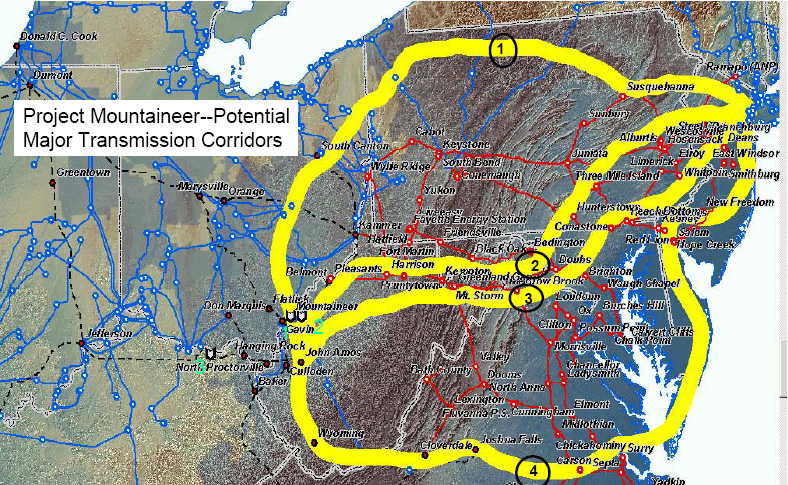
See the MAPP line there in the NE section of Project Mountaineer line 4?
PJM has recommended delay of the inservice date for a portion of the MAPP line by a year, the portion from Indian River to Salem nuclear plant. What remains, however, is a problem, because electrically, it makes no sense to build a 500kV radial line to nowhere. If part of the line should be delayed, the ENTIRE line should be delayed.
Here’s the corporate Press Release and two “articles” which should be compared!
Press Release from Delmarva site
MAPP: Controversial High Voltage Electric Transmission Line Delayed for One Year
PJM Reinforces MAPP Need: Adds Year to Schedule (states “contributed by Delmarva Power”)
This demonstration of lack of need is something that should be raised in the Delmarva Power IRP docket, that demand is down so significantly that PJM thinks infrastructure construction should be delayed. And yes, PJM demand is way, way down.
So, since demand is so far down, this is a good time to let the PSC know, in the Delmarva Power IRP docket, that we know that demand is down, so far down that they can’t cover anymore and they have to postpone some of their infrastructure construction. The Hearing Officer is taking public comments on the Delmarva Power IRP until some time in July, I think the 25th.
Send IRP Public Comments to the Hearing Eximaner Ruth Price:
What’s an IRP Comment? The Integrated Resource Planning process is supposed to be the way a utility plans ahead to cover their demand, and it’s essentially the intersection of energy policy and those #(%&*)#*( utilities. This is the arena where it’s determined whether they should meet their demand through conservation (the cheapest and environmentally the smallest footprint), efficiency steps like load shifting and SmartGrid, offshore wind paired with natural gas for backup, and whether external costs of various generation options are taken into account. SOOOOO, does that give you an idea of what’s up?
See Delmarva Power’s IRP docket at the PSC, scroll down beyond that rulemaking on the top:
And note this sly trick — they couldn’t get their IRP right from last cycle and were told by PSC staff to take it home and try again, and the last revision of that last IRP is the one they submitted:
And they said in their accompanying letter that this one should be for THIS cycle! AAAAAAARGH!
So, it’s time to review this joke of an IRP, take a look at PJM load forecasting, look at PJM and PEPCO SEC filings like their 2008 10-K and 2009 1st Quarter 10-Q:
Dig up some good conservation reports and sent them in as examples of what can be done. Let them know that with PJM demand down, we expect some changes, that this is a good opportunity to take a sustainable fork in the road, when demand is down we can make conscious choices.
Once more with feeling, check out the Delmarva Power IRP and send comments to ruth.price@state.de.us.
So where did Mikey Bull go?
May 18th, 2009

I’ve heard he’s at Xcel, which given Pawlenty and WOW would not be that much of a change, but can it really be?
Yes, it is true, Mike Bull now works at Xcel Energy, confirmed by two independent sources and then confirmed by Mikey himself! All I can say is, “Oh… my…” and shake my head in amazement.
I preferred speculating about what he might be doing:
Maybe he’s trying to get Pawlenty’s energy program on track?
Maybe he’s on maternity leave?
Maybe he’s at MISO with cohort Ed Garvey?
Maybe he’s high-tailed it to Costa Rica where they’ve got sensible energy policy?
Maybe he’s in the klink for corruption?
Maybe he’s at Commerce again trying to fix that hopeless Dogforsaken mess?
Maybe he’s out east to knock some “sense” into those transmission negative-nellies?
Maybe he’s in a cabin in the mountains writing the scandalous tell-all?
Maybe he’s at Briggs & Morgan selling/redeeming his soul?
Maybe he’s home house-training their new puppy?
Working for WOW made no sense at all, but now what?
Xcel???? Into the bowels of the devil itself, hard to get worse than WOW but … oh… my… this is worse…
… pass the barf bag…

PJM demand is DOWN
May 10th, 2009
Yes, what’s new, but here it is again, so let’s take a look at their 2008 Annual Report and their 2008 Financial Report:
Eastern Governors stand up against Transmission!!!
May 6th, 2009

Yeaaaaaaaaaaaa! One for the home team!!!!
First it was NYISO and ISO-New England:
Then it was New York’s Deputy Secretary of Energy testifying before Senate Energy Committee:
And now the Governors from the Northeast and Mid-Atlantic states have stood up against the insane Midwest transmission plans — transmission plans like CapX 2020, JCSP/MTEP, Green Power Express, and the unnamed group announced on April 3rd, starting in North Dakota, banding southern Minnesota, and shooting out into Wisconsin.
Here’s their letter:
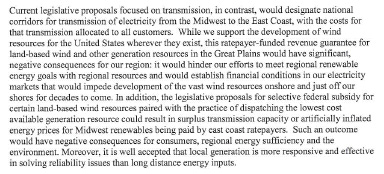
It’s blurry, so click the letter and read the whole thing. An eye opener for the Midwest, those who don’t recognize that there’s a big world out there and it’s not all about Midwest wind. Folks, you have a marketing problem, your target market says NO! What about NO can’t you understand?
David Morris on PUC process and Capx 2020 decision
April 24th, 2009
Once more, it’s David Morris, Institute for Local Self Reliance, telling it like it is. The PUC process is long over do a complete revamping. It is based on laws and rules that grew out of the 1970s-1980s transmission fights, and gave people a useful and meaningful way to participate in these proceedings. But that’s gone, gone with the 2001 changes, gone with the 2005 Transmission Omnibus Bill from Hell, and we’re left with just about nothing. In other states, there’s Intervenor Compensation which allows Intervenors the ability to pay for expert witnesses, there are free transcripts as a matter of course, and there’s encouragement and support of Intervenors, not a drive to push them out of the process that we see here, that we saw in this CapX proceeding, when the ALJ tried to boot out U-CAN; that we saw in the Excelsior Energy docket (scroll down to “Fourth Prehearing Order”).

David Morris: If it’s citizens vs. utilities, utilities win
The PUC has an approval process that stacks the deck against the public.
By DAVID MORRIS
Last update: April 23, 2009 – 6:50 PM
A few days ago, the Minnesota Public Utilities Commission (PUC) approved a massive high-voltage transmission project known as CapX that will cost Minnesotans an amount equal to the projected biennial state budget deficit and four times the total bill to taxpayers for the Twins and Gophers stadiums.
With respect to the stadiums, Minnesotans were able to actively participate in the decisions, both directly and indirectly through elected representatives. Both those in favor and those opposed to using tax dollars to pay for the stadiums engaged in a spirited public debate. The Legislature is currently just as vigorously debating ways it can eliminate the budget deficit.
The PUC process, on the other hand, is much more hostile to citizen participation and influence. Indeed, the deck is stacked against the average citizen. Utilities have a virtually unlimited budget to argue their positions — a budget they raise from their ratepayers. Citizens, on the other hand, must raise their own money, and lots of it, to participate effectively.
The rules under which the PUC operates are established by the Legislature. Utility lobbyists are powerful there. But they’re not all-powerful. Thus, over the years, Minnesotans have been able to enact rules to help level the playing field for citizens. For example, the law requires the PUC to reject an application to build a large power plant or a high-voltage transmission line unless the utility proves it is needed to improve reliability or meet increased demand or achieve renewable-energy goals. As part of the application, the utility is expected to thoroughly and completely explore alternatives to its proposal, including no-build options. The burden of proof on whether a project is needed rests with the utilities.
The PUC, regrettably, has interpreted this rule so as to turn it on its head. At the PUC, the burden of proof rests with those opposed to a new power plant or high-voltage transmission line. It is up to the people whose homes and farms may be seized by utilities if a project is approved to make the case for alternatives. Doing so requires an extremely high level of technical expertise. A serious technical and economic examination of alternatives can cost $100,000 to $200,000 or more.
Even if citizens are able to raise that kind of money, they face other hurdles. To analyze alternatives, they must access data that only utilities possess. In many cases, the utilities call that data proprietary and argue that to make the information public is to give a possible advantage to a competitor. One would think that this would be a hard argument to make. After all, Minnesota utilities have a monopoly on the sale of electricity. Apparently, however, it is not a hard argument to make at the PUC.
A formal proceeding, such as a judicial proceeding, involves the cross-examination of witnesses. In many proceedings, utilities again tax their customers by using ratepayer money to acquire a transcript. One would think that since the transcript is in electronic form, the PUC would post it and make it freely available to the public. Astonishingly, the PUC rules state that court reporters own the transcript! Citizens and other intervenors must pay for their own copies of transcripts, which, for controversial projects, could mean $5,000 to $10,000 per copy.
In the recent CapX transmission case, the PUC went one step further in denying citizens. The need for the transmission lines was based in large part on a projection of significantly increasing demand. That projection was largely made in forecasts completed in 2004. It has already proven to be vastly overstated. Moreover, the current economic collapse is translating into shrinking, not growing, electricity demand. Hundreds of citizens asked the PUC to take this new information into account and keep the proceeding open. The PUC decided the current economic free fall doesn’t make a difference.
Utilities are gearing up to ask the PUC to spend billions more for even higher-voltage transmission lines. These will be built to send electricity from the Dakotas to Chicago and New York while running right through Minnesota. If these lines are approved, Minnesotans will probably pay most of the costs, while receiving little if any benefit.
Imagine if legislators proposed taxing us to build a sports stadium in Chicago. The proposal would be dead on arrival. Citizens have influence and even power in the Legislature. The process and rules at the PUC must be redesigned to allow them similar access and influence over energy decisions.
David Morris is vice president of the Institute for Local Self-Reliance, based in Minneapolis and Washington, D.C.