Goodhue Wind Truth appeals PUC Order
September 22nd, 2011

It’s a complicated thing. The PUC made its oh-so-contorted decision on AWA’s Goodhue Wind Project:
And then we filed our Motions for Reconsideration… here’s one:
Today AWA filed their respose:
For all of them, go to www.puc.state.mn.us and click on the blue “Search eDockets” button and search for docket “08-1233” and “09-1186.”
So far on the Appellate site and the filings that we’ve exchanged (the Notice of Appeal was in my inbox before I got back to Red Wing, with a reference to Belle Creek, though not Goodhue County’s but their filings were in the inbox!):
Belle Creek Township’s Appeal – Initial Filings – Petition for Writ and Statement of Case
GWT – Appeal Notice & Initial Filings – Petition for Writ and Statement of Case
No Appellate Docket yet – Goodhue County
Goodhue County Appeal – Initial Pleading – Petition for Writ and Statement of Case
No Appellate Docket yet – Coalition for Sensible Siting
CSS Appeal – Initial Pleading – Petition for Write and Statement of Case
This is shaping up to be a “robust” appeal… I’m so tickled to see the county’s recognition and appreciation of Goodhue Wind Truth’s efforts (really, read the pleadings). And personally, it’s a thrill to see how far we’ve come since the struggle of the nuclear “in Goodhue County” days.
Jason Lewis and I agree? Not quite…
September 18th, 2011

A little birdie told me there was an op-ed in the STrib that I had to read. Sure enough…
The birdie cocked his shining eye and said:
Ok, how cool is it that I now have my answer to the question “what could Carol and Jason Lewis possibly agree on?”
It’s close but not quite. Not by a long shot… and close doesn’t count. Lewis is not doing anyone any favors with this piece. He’s agitating by deviating away from the problems with this project, and by unreasonably tying it to selected others, both projects and people, he’s misfiring. He may get people worked up, but they’ll miss the boat too.
Look at the way he frames sand mine opposition and AWA Goodhue Wind Project opposition, and his claim that “environmental activists” are stopping the fracking sand mine, but ignoring the on the ground environmental activists who are tracking, (photo)shooting eagles, pulling in USFWS to document the eagles. And he’s framing mine opposition and AWA Goodhue wind opposition as separate universes when there are many opposed to both and for a variety of reasons. He also frames it as a partisan issue when it is not — there’s strong bi-partisan support for wind. There is strong bi-partisan opposition to wind. Has he forgotten that the Green Chameleon was a champion of wind, coal gasification, and transmission? Has he forgotten that Republican House Speaker Steve Sviggum bought in hook, line and sinker and promoted wind generally and C-BED specifically, that the 2005 Energy Omnibus Bill from Hell couldn’t have passed without him, and look at the way it turned out… somehow the plans for the first C-BED wind project out the chute had a turbine and substation on Sviggum’s land??? What, Lewis didn’t forget… he didn’t know? Oh, right… uh-huh… oh, my…
And he ends on this note, which is blatant misrepresentation:
… silica sand mining (primarily used to make glass) has been a fact of life in the upper Mississippi Valley for as long as anyone can remember. In fact, there are sand- and gravel-mining operations in every county in Minnesota, according to the state Department of Natural Resources.
Really!!! And there’s no mention of the Wabasha County silica sand mine moratorium, begun a couple months ago. Statements like that don’t do anything for his credibility, and don’t help us get any closer to a turn-around of the PUC decision.
I do trust my “little birdie” doesn’t really think Jason Lewis is expressing my take on this!!!
Here’s the whole thing, get out the waders:
Right here in Minnesota, a windfall of bad policy
Wind-energy projects are damaging to nature, to taxpayers and to residents, but onward they buzz.
Oh, and in case you’re wondering, the Energy Information Administration reports that, by comparison, subsidies for coal and natural gas come in at just 44 and 25 cents per megawatt hour, respectively.
It gets worse.
State Rep. Tim Kelly, R-Red Wing, is calling on the PUC to decertify the project as a Community Based Energy Development eligible for the Minnesota’s CBED tariff (read rate hike) in the Power Purchasing Agreement between Xcel Energy and AWA Goodhue — if for no other reason that the word “community” in this case statutorily means based in Minnesota, not Texas.
The Minnesota PUC, like successive Republican and Democratic administrations, seems hellbent on ending local control over wind developments that swallow up thousands of acres, relying instead on the state’s renewable energy standards.
Enacted under the euphemistic title of “next-generation energy” legislation in 2007, the ill-advised mandate means that Minnesota utilities are now busy passing along the costs to ratepayers.
Because generating power from wind is about as reliable as, well, the weather, utilities will still need to pay for steadier sources as backup. As a result, a Beacon Hill Institute study says the average Minnesota household will have paid an extra $1,814 for electricity by the time the standards are fully implemented.
Regardless of the economics, it’s becoming quite obvious that these mammoth wind developments are every bit as damaging to Mother Nature as anything the fossil-fuel industry could dream up.
For the price of intermittent power, nearby homeowners put up with 400-foot towers with flashing lights; high-voltage transmission lines; flickering shadows from 95-foot rotors, along with the potential for dangerous ice shards flying off the blades during winter, and near-constant high- and low-frequency background noise disturbing to the human ear.
Estimates vary as to how many birds are slaughtered each year due to wind power, but it’s certainly in the tens of thousands.
The Washington Post reports that “one of the nation’s largest wind farms, the Altamont Pass Wind Resource Area near Livermore, Calif., has killed an average of nearly 2,000 raptors annually, including more than 500 eagles, over four years, according to federal agencies and bird watchers.” Hardly good news for the bald eagle along the Mississippi flyway for migratory birds.
Where’s the Endangered Species Act when you need it?
Meanwhile, hope for a more-sensible energy future remains hostage to a few activists who get their talking points from movies like “Gasland” (environmentalists used to love natural gas until they realized you had to drill for it). Hydraulic fracturing, known pejoratively as “fracking,” has the potential to dramatically alter America’s economic landscape by lowering the costs of domestic energy production.
The Rand Corp. (a nonprofit research organization) says there are 800 billion barrels of recoverable shale oil — three times the reserves of Saudi Arabia — in the United States alone. Remarkably, “if the full potential of domestic oil and gas production could be achieved while also increasing imports from Canadian oil, all of America’s liquid fuels could come from secure North American sources within 15 years,” notes the American Petroleum Institute in a study released last week.
One key component of fracture drilling is silica sand, ubiquitous in the sandstone bluffs throughout southeastern Minnesota. That’s why another Texas company, Windsor Permian, wants to start constructing sand mines and transportation facilities in and around Red Wing for its operations in the lucrative Permian basin. And it plans to do it with no “renewable energy credits” or state CBED tariffs.
It seems that something which is viable needs no subsidy — while all the subsidies in the world won’t make viable that which isn’t.
Alas, the Goodhue County Board adopted a one-year de facto moratorium on the Windsor project earlier this month, despite the fact that silica sand mining (primarily used to make glass) has been a fact of life in the upper Mississippi Valley for as long as anyone can remember. In fact, there are sand- and gravel-mining operations in every county in Minnesota, according to the state Department of Natural Resources.
No matter, because for now our energy future is just blowin’ in the wind.
* * *
Jason Lewis is a nationally syndicated talk-show host based in Minneapolis-St. Paul and is the author of “Power Divided is Power Checked: The Argument for States’ Rights” from Bascom Hill Publishing. He can be heard from 5 to 8 p.m. weekdays on NewsTalk Radio (1130 AM) or online at jasonlewisshow.com.
Why is Keystone XL pipeline special?
August 30th, 2011

595 arrested so far… There’s been a lot online about opposition to the Keystone XL pipeline for Tar Sands oil.
TAR SANDS ACTION
I’m looking at all of this and I’m wondering where the resistance was to the MinnCan pipeline, just one of our own tar sands crude oil pipeline through Minnesota. Why is the Keystone XL pipeline project special? Why are people waking up about tar sands pipelines? Is it because Keystone XL is a “Presidential Permit” project at the Dept. of State?
MPIRG helped some of the landowners affected by MinnCan organize after they got very late notice they were potentially affected, but they lost bigtime, were denied intervention status by the ALJ because they were “late,” and then after it was permitted, booted out of the Appellate Court because they were not formal intervenors. As they were in condemnation court for the pipeline, they got notice that they were targeted for CapX 2020 transmission. At that point they became dyed-in-the-wool activists and joined with NoCapX 2020 as intervenors, in the Certificate of Need case and subsequent routing dockets for CapX transmission across Minnesota, right now in the Hampton-LaCrosse CapX 2020 routing docket .
For more info, here’s the MinnCan routing docket at PUC:
http://energyfacilities.puc.state.mn.us/Docket.html?Id=18339
Here is a link to a post with the Appellate decision:
Appellate court affirms PUC in pipeline appeal
Here are county maps, from Clearwater Co. down to the refinery in Dakota County:
http://energyfacilities.puc.state.mn.us/resource.html?Id=19000
And the Certificate of Need, go hear and search for docket “06-02” (year-docket no.)
Here’re some other tar sands pipelines in Minnesota, completed:
The “Alberta Clipper” pipeline project:
http://energyfacilities.puc.state.mn.us/Docket.html?Id=19203
And another Enbridge “Southern Lights” oil pipeline project
http://energyfacilities.puc.state.mn.us/Docket.html?Id=19133
LIARS – 9,504 MW is NOT record peak demand for Xcel
July 19th, 2011

Read the STrib today? Xcel has 9,500 record peak.
Xcel, how dare you… the 9,500MW peak you report is exaggerated… naughty, naughty. You didn’t deduct for the interruptible service customers’ megawatts, and you’re including electricity you’ve generated and sold elsewhere, that the number represents the totals Xcel put on the grid, and not accounting for the demand that they’ve shed, not wholesale sales in other markets. THIS IS NOT PEAK DEMAND!!! YOU’RE CHEATING, XCEL… sigh… what’s new…
Thanks for clearing that up, little birdie!

But even considering that sleight of hand, it’s no record, it’s not even up to the 2006 peak… and that was FIVE years ago. Your CapX 2020 transmission is predicated on 2.43% (is that right, 2.4 something…) increase annually, but folks, we’re not even close to that.
Here’s the peak demand over the last 10 years:


And here’s what the STrib said today, what they said that Xcel said, blah blah blah, 9,500 my ass:
Bent Tree Wind Farm Sound Levels
July 14th, 2011
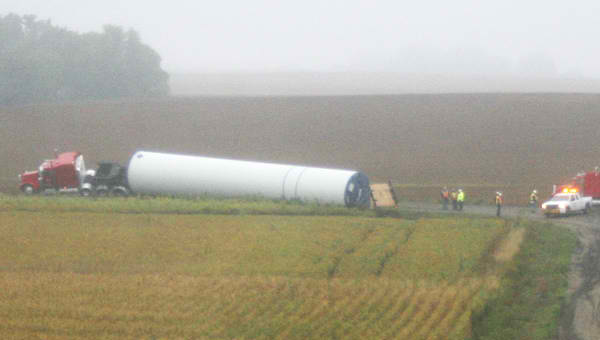
From Albert Lea Tribune, Fair Use, capturing one of those classic “oh shit…” moments in trucking… (see article below).
In another “oh shit” moment, the Bent Tree Wind Farm noise testing report is out, was released about a month ago, and I’m finally getting around to publishing it.
Bent Tree – Survey of Operational Sound Levels
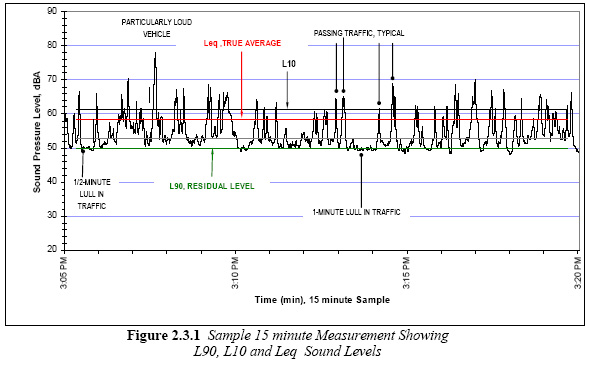
Take a look at p. 19 and 20 for L10 and L50 levels, and look how frequently the levels are higher state noise limits! See Minn. Rule 7030.0040:

Here’s a summary chart from the Bent Tree noise report, p. 13:
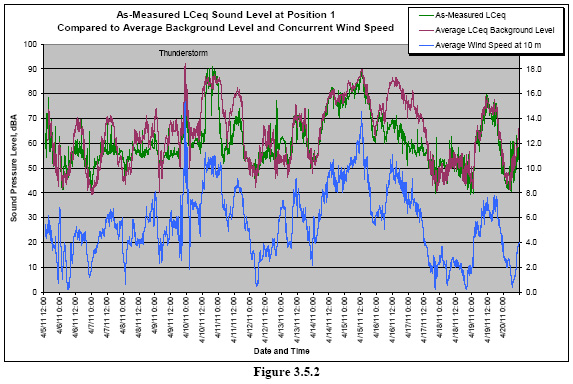
And what they’re trying to do is to remove background sound so that the numbers won’t be above what is allowed by the state’s rules. Graphically, here’s what that comparison, with and without background noise, looks like, p. 43:
The article that was the source of the photo at the top is from the Albert Lea Tribune, and it’s old news, from Sept. 2010, but for those inquiring minds that want to know:
Wind turbine tower falls off truck
Published 9:43am Thursday, September 16, 2010
MANCHESTER — A section of a Vestas wind turbine tower slipped off the semi that was hauling it early Thursday morning.
The truck was carrying the large tower section on gravel 695th Avenue north of Freeborn County Road 29 near West Freeborn Lutheran Church. It fell off near a turn in the road.
The gravel roads in southern Minnesota were saturated after heavy rains Wednesday night. Albert Lea received more than an inch on Wednesday.
Fortunately for the construction workers, the ditch along 695th Avenue was shallow compared to most. It is a minimal traffic road.
Trucks have been delivering these large pieces to each site in the Bent Tree Wind Farm since July.
The Freeborn County Sheriff’s Office responded to the incident. The call went out around 7 a.m. Sheriff Mark Harig said as far as he knew there were no injuries or damages reported.
“It’s just blocking the road,” Harig said.
He said as of 8 a.m. a deputy was still near the site performing traffic control.
“They’ll have to get a crane to pick it up and move it where it needs to go,” Harig said.
Calls to Bent Tree Wind Farm officials were not immediately returned before this story went to press Thursday morning.