Goodhue Wind Project – Force de Manure
November 19th, 2012

The Public Utilities Commission has been trying to get information out of “New Era Wind Farm, LLC” about the Goodhue Wind Project. Search Legalectric for “Goodhue” and you’ll find a LOT about it.
Here are the latest PUC Information Requests:
And today, Peter Mastic … hmmmmmm… in the summer, would we call him “Tan Mastic” and is that the key to how he it all holds together?

Anyway, Peter Mastic filed responses last week, probably from his new Goodhue, Minnesota office…

… and the PUC eFiled them today:
New Era Response to PUC Information Requests – Nov 19 2012
Some of the responses are VERRRRRRRRRRY INTERESTING…
Here’s the final response and the most interesting one, raising Force d’ Manure (click for larger view, or download the info request responses and scroll down to the end):

December, 2011, that’s when Trishe Wind bought National Wind, and Trishe didn’t take on the Goodhue Wind project, wanted nothing to do with it. So when exactly did that happen? Likely in December, 2011, when Trishe Wind bought National Wind, and if so, well, that was nearly a year ago. We’d just found out about Trishe in what, September? And we find out about this Force de Manure notice now and the notice was given to Xcel Energy last December? Ummmmm… I’d think this is something the Commission should have received notice on… and the public too, of course.
I’m going to print these out and read them as I make some bread — the oven’s fixed now and I’m not about to start buying bread anytime soon!
And for those looking to remove Mastic, here’s just the folks to do it:
They note that “When flooring is removed often there is one or many layers of “sticky stuff” aka…mastic, that needs to be removed. Complete floor mastic removal is always best.” Mastic removal? OK, let’s get to it!

Notice Plan – “Not-so-Great” Northern Transmission Line
November 19th, 2012

Today Comments were due on Minnesota Power’s Great Northern Transmission Line. I’m sorry, but I just can’t bring myself to call a transmission line “Great” and that’s just how it is… Anyway, Minnesota Power is getting ready to file a Certificate of Need application, this is the lead up, what they have to do to provide notice to people when they actually file. So here’s their draft plan:
Minnesota Power’s Notice Plan for Great Northern Transmission Line
Comments on that plan were due today. Here’s what I filed:
Here’s what Commerce filed earlier today:
Haven’t gotten word on any others.
To keep an eye on what’s going on in this docket, go HERE and search for docket 12-1163.
A little sidebar here — while looking for a logo, some things popped out — did you know that Minnesota Power sponsors, with the Lignite Energy Council, a “Teachers Seminar” on coal? It’s the only teacher workshop listed, though there are multiple listings under “School Programs” and “Educational Materials.”
OH MY! Check their “Electricity 101” pdf:
p. 7:
1929—Stock market crash revealed that many holding companies were over-leveraged
–As a result, federal and state governments strengthened utility regulation.
There are some interesting charts and graphs in Electricity 101 that are interesting and that I’d like to see updated. Hear that, MP!?!?!

PJM Demand is DOWN!
November 15th, 2012
But we knew that…
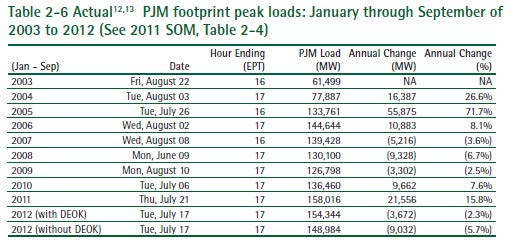
Here’s the part I’m most interested, demand is DOWN, from the intro, summarizing p. 23 of the report linked above:
The PJM system peak load for the first nine months of 2012 was 154,344
MW, which was 3,672 MW, or 2.3 percent, lower than the PJM peak
load for the first nine months of 2011. The DEOK Transmission Zone
accounted for 5,360 MW in the peak hour of the first nine months of
2012. The peak load in 2012 excluding the DEOK Transmission Zone was
148,984 MW, a decrease of 9,032 MW, or 5.7 percent, from the peak load
for the first nine months 2011. (See page 23)
2.3%, 5.7%, DUH! Demand is DOWN! Here’s the specifics:
 I love it when that happens…
Prairie Island Uprate – who needs it???
October 26th, 2012

Xcel is now admitting they don’t need the Prairie Island uprate:
It’s something even they can’t ignore:
This new information stems from our most recent refueling outage at PI, where the extended outage allows us to modify the schedule for future refueling outages. This change further and materially reduces the anticipated benefits of the PI uprates, which had already been substantially reduced from those predicted in the Certificate of Need case authorizing the uprates. …We note that, in light of the total system costs, $10 million PVRR is not a meaningful difference. In essence, before considering risk factors, the Strategist model does not draw a clear distinction between the two scenarios, thus no longer identifies a clear benefit associated with implementation of the uprates.
They go on and state it more directly:
Our updated plan agreed with the Department of Commerce’s recommendation of a 400 to 600 MW need, which would accommodate a decision to not proceed with the uprates.
…
As a result, we conclude that a decision not to proceed with the uprates would in no way pose risk to customers of an insufficient supply to meet their needs.
…
At this point, we believe it is reasonable to conclude that further investment in the project will not benefit our customers.
…
Based on these considerations, we conclude that the risks of the project outweigh the expected benefits, and customers would be better off if this project did not proceed.
I’m not sure that’s clear enough for the PUC, it’s on the agenda and Staff isn’t clear in their recommendation. Alan and I fired this off Tuesday:
To access the uprate docket, GO HERE and plug in dockets 08-509 and 08-510. Note they’re “08” dockets, which was after the electric crash, but before they admitted demand was down and before we had such a good record of demand going down, staying down, down, down.
Hyperion Refinery one step closer to GONE!
October 2nd, 2012

The Hyperion project, an 800 pound gorilla, an oil refinery PLUS a coal gasification (IGCC) plant (it morphed quite a bit over the years), proposed for agricultural land west of Sioux Falls, South Dakota, has been looming for a long time, but there’s evidence that the stakes through it’s slimy heart are having an impact.

In the Argus Leader:
Hyperion declines to renew options with Union County landowners
The stake in Hyperion’s slimy heart is that there’s no money:
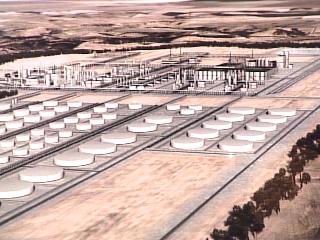
There’s no money to build Hyperion, no investors, another vaperware project sounding a lot like the AWA Goodhue wind project here in Goodhue Count, or Excelsior Energy’s Mesaba Project, coal gasification on the Iron Range. It’s the lack of money that’s the real news:
Industry analysts question Hyperion
“Nobody would finance it,” he told Platts. “It would take forever to build.”
Rough road
Building pipeline