Romney’s Energy Plan – much ado about nothing
August 23rd, 2012
.

FULL DISCLOSURE: I’m a bumper-sticker carrying member of Dogs Against Romney.

A link to Romney’s Energy Plan, “The Romney Plan for a Stronger Middle Class: ENERGY INDEPENDENCE,” showed up in the inbox today, so I printed it out, got out the highlighter… but I was SO disappointed, there’s hardly anything in it, about half of it is quotes and links from news articles. For the most part, this is about oil. OIL, not ENERGY. Oil is only one piece of our energy use and needs. That’s not a plan. It looks like something written by a campaign intern not yet graduated. The structure is a heading, a few bullet points, and a narrative paragraph, followed by the news articles. But the good news for me this morning is it left much less to read, highlight and critique!
T. Boone Pickens apparently doesn’t like it:
Pickens got an early look at the outline for the 21-page Romney plan, which will be introduced during a speech in Hobbs, N.M. Thursday.
“I was disappointed that he didn’t mention natural gas,” Pickens said, referring to the Romney plan. “The United States has more natural gas than any other country in the world…I cannot believe an energy plan that I saw, and I know I saw the outline, but there was no mention of natural gas.”
But TBP, it DOES mention natural gas, often, do a search (but there’s not much of substance about it, or anything else).
Let’s take a look. The first sentence is where I start having problems with it:
A crucial component of Mitt Romney’s Plan for a Stronger Middle Class is to dramatically increase domestic energy production and partner closely with Canada and Mexico to achieve North American energy independence by 2020.
So he’s talking “North America” and more importantly, INCREASE energy production. I would guess that “partner closely with Canada and Mexico” means to take their oil. There’s also a focus on “lower energy prices” which is not going to do anything but create more energy dependence through increased use and reliance on a cheap, illusory “plentiful” supply.
The focus on this “plan” is oil, and increasing domestic production. There is not a word about decreasing non-domestic imports.
Back to the “plan” area by area, all 9 sections, 31 bullet points and 16 paragraphs (not much of substance):
- An Achievable Goal: Energy Independence by 2020. (there’s ONE paragraph) It’s not US Energy Independence, it’s using Canadian and Mexican oil. And it’s about open access — I don’t see anything about the impacts of the ND oil rush, the gas rush in PA, NY and subsequent waste injections in Ohio and elsewhere, destruction of the aquifers and exploding wells and flammeable tap water nothing.
- The Result: The Emergence of an Energy Superpower. (here we get TWO paragraphs) This section makes claims of over 3 million jobs, $500 billion addition to GDP, reduced trade deficit, $1 trillion in revenue for federal state, and local governments, lower energy prices for “job creators and middle-class families,” and national security because we’re not beholden to unstable but oil-rich regions. What I want to see are the assumptions, how much of what has to be extracted to achieve this, show me the numbers. I also want to see numbers on use of federal lands, OUR lands, not oil company lands.
- The Result: Resurgence in American Manufacturing. (here we’re back to ONE paragraph). Stresses that manufacturers will benefit by lower energy and feedstock prices. ??? Most manufacturers use electricity, not oil, to power their operations. What are these assumptions based on? One article cited is about a steel plant opening up in Youngstown, Ohio, with 350 jobs making seamless pipes for fracking, the same fracking that has been pumping in fracking waste near Youngstown and causing earthquakes in the area. Is this a reasonable tradeoff? Steel plant and 350 jobs for waste and earthquakes? Has anyone checked the aquifer lately?
- The Romney Agenda: Federal Lands. (WOO-HOO, TWO paragraphs here). Yes, let’s talk about federal lands. State jurisdiction over federal lands within a state? State regulatory process “deemed to satisfy all requirements of federal law” ???? It pushes “STRONGER” and “IOGCC” and if you google “STRONGER” nada, have to get to “State Review of Natural Gas Environmental Regulation” to have it come up. Look at the formation of “STRONGER.” And IOGCC — I come up with the Interstate Oil and Gas Compact Commission in Oklahoma, and a big focus of theirs is CO2 Capture and Storage and we know what a scam that is. The narrative brags that “The state of North Dakota can permit a project in 10 days, Colorado does it in twenty-seven.” The articles cited notes that “In Ohio, it takes 14 days.” In talking about ramping up use of federal lands, there is no recognition in his “We Built It” mindset that this is about exploitation of FEDERAL lands, OUR land, blatant corporate welfare. Corporate welfare? Well, what else would you call it where Peabody buys for $0.25/ton and sells for $80-100/ton export? No, Peabody, you’re not building it, you’re stealing it from us.
- The Romney Agenda: Offshore Areas. (here we get TWO paragraphs again). There is no mention of the BP spill and its impact on feasibility and reasonableness of offshore drilling. Oh, and COST, because the cost of spills needs to be in that cost/benefit analysis. And again, whose land is this, who owns the oceans? Not the oil companies. Romney is all for “opening greater access and streamlining permitting…” and we know what that means.
- The Romney Agenda: North America. (here we get another TWO paragraphs) This is about Canada and Mexico, the XL pipeline, objecting to Canada exporting it, without mention of intent of exporting much of that oil from U.S. if it got down to the Gulf in the pipeline. Romney says it outright, at the top, “Approve the Keystone XL pipeline.” It also bullet-points “Institute fast track regulatory approval processes for cross-border pipelines and other infrastructure.” Pipelines and transmission, probably under the Dept. of State as with XL pipeline. The “plan” claims that Canada and Mexico are wanting partnership and collaboration, and that if we do that, “…America can guarantee itself a reliable and affordable supply of energy while also opening up new opportunities for American businesses and workers in the region.” Region — opening up new opportunities for American busniesses and workers in Mexico and Canada. Oh… right..
- The Romney Agenda: Resource Evaluations. (here we get another TWO paragraphs) This section is about assessment and inventory. Offshore resource exploration it seems would be encouraged and maybe performed by the feds and extraction of Canada and Mexico’s resource information as well. Note the references to “seismic” on this page. Messing with the earth creates seismic impacts, as evidenced in Pennsylvania, Oklahoma and Ohio related to fracking and waste injection. (Oh, and I’ve not seen waste mentioned anywhere here, BIG issue.)
- The Romney Agenda: Regulatory Reform. (here we get yet another TWO paragraphs). This is more of the strengthen environmental protection through gutting regulation, the angle I find SO offensive. Gutting regulation guts jobs, and regulation creates jobs both for industry and regulators! And the projects typically get permitted and get built. What are they complaining about? The MPCA doesn’t even look at expired permits, only new ones, because they don’t have the staff or budget, and because they haven’t been directed to by their boss, the Governor. But more importantly, without environmental review and regulation, we’d have more really stupid projects than we’d otherwise have. In Minnesota, MPCA is responsible for federal review delegated to the state, yet how often do they deny a permit? The PUC is responsible for need determinations and routing/siting permits, and the only projects they’ve denied have been vaporware projects that don’t have a PPA or a project to speak of. Without Minnesota environmental review and regulation, we’d have vaporware Excelsior Energy’s Mesaba Project on the Range, we’d have Kenyon and Goodhue wind projects here in Goodhue County, and we’d have the utterly unnecessary Big Stone II coal plant up and running. From what I can see, the PUC has never met a transmission line it didn’t like. Romney has accused Obama of bankrupting the coal industry, but Obama has been a friend of coal, promoter of IGCC, he’s from a coal state and is in the pockets of coal lobbyists. EH? The “plan” goes on: “But statutes and regulations that were designed to protect public health and the environment have instead been seized on by environmentalists as tools to stop development altogether.” OK, tell me what projects were stopped by “environmentalists” and tell me what projects were stopped because by regulatory agencies because they’d violate regulatory provisions? I’ve been looking at this in association with Dayton’s “review of environmental review” and note that the MPCA only rarely denies a permit, but permits expire and the plants spewing pollution are allowed to continue operating without a renewal application or any review! There is no pattern of delay in issuing permits. Romney, show me the data! He wants disclosure of “federal funds spent reimbursing groups for lawsuits against the government.” DUH, where anyone sues the government for flagrant violations of federal law, and where fees and costs are paid as part of the win, that is public information, just look at the settlements! How else would federal law be enforced? They’ve gutted the agency budgets and they’re not doing review, so it’s up to the citizens. Romney says that “laws should be carefully crafted to support rather than impede development.” It is not an agency’s job to SUPPORT development, it is their job to impartially review permits, conduct analysis. What Romney is promoting is the MN Dept. of Commerce style of regulation, where according to PUC Commissioners, it looks like Commerce is representing the project applicant. “Repetitive reviews and strategic lawsuits should not be allowed to endlessly delay progress or force government into imposing rules behind closed doors that it would not approve in public.” Examples please, because I haven’t a clue what you’re talking about! An article cited states that “individuals have accounted for just 7% of Plaintiff cases filed under the EAJA while Environmental Groups have accounted for 30%. First, what’s the other 63%? Second, is it the Romney position that Environmental Groups are suing too often? That individuals should sue the government more? How would we do that? Please let me know, I’d be happy to comply!
- The Romney Agenda: Innovation. (and we get another two paragraphs). “The federal government has a role to play in facilitating innovation in the energy industry.” Please explain. Isn’t it the Romney position that government should not insert itself into business? “Instead of distorting the playing field, the government should be ensuring that it remains level.” Level? When has it been level? “… success should be defined as eliminating any abrriers that might prevent the best technologies from succeeding on their own.” This is straight out of the Wind on the Wires playbook, always looking to eliminate barriers, particularly to transmission (she says, admittedly a barrier to transmission herself!). Are they looking at cutting 1703(d) coal perks anytime soon? See the “End Polluter Welfare Act of 2012” for specific examples of coal perks (GO Bernie!). And last but not least, last but everlasting, Romney is promoting nuclear power, to “revitalize nuclear power by equipping the NRC to approve new designs and to license approve reactor designs on approved sites within two years.” Even Xcel admits it has no desire to build a nuclear power plant. And new plants are not needed, there is a glut of electricity that is leading utilities to close down their smaller dirty coal plants and recently, even some larger ones. So why would he promote nuclear after Fukushima Dai-ichi? Our Monticello plant is the same design. Earth to Mars…
Citizens League and “Electrical Energy?”
July 17th, 2012
Citizens League has an “Electrical Energy” project sponsored by none other than Great River Energy, Xcel Energy, District Energy and University of Minnesota Energy Management:
So what is Citizens League doing “to develop and advance policy recommendations?” What are the sponsors after? Looking at their report, it seems the focus is on advancement of utility desires for utility benefit and profit, and given the assumptions in this report, I don’t want to see ANY 0olicy recommendations come out of it.
Here’s the report:
They’ve hosted several meetings across the state so far and there are more to come:
Upcoming Meetings (click date/location link for their page for that meeting):
July 24 — Rochester
5:30-7:00 p.m.
University Center Rochester
Main campus building, room CF206/208 in Coffman
851 30th Ave SE, Rochester (building map)July 25 — Maple Grove
6:00-7:30 p.m.
Great River Energy
12300 Elm Creek Blvd N, Maple Grove 55369July 31 — St. Paul
5:30-7:30 p.m.
Rondo Community Outreach Library, Multi-Purpose Room
461 N Dale Street, St. Paul
So what’s the problem? In large part, it’s how they’re framing the problem!
- It starts off with a sense of urgency — “We must start now, before crises arise.” “Now is the time to act.” “We must confront these issues now, before they reach a crisis point.” “This is the time to ask:…” But it’s years too late, In 2002 the wheels were set in motion to put us where we are today with the enviros deal to support CapX 2020 and other transmission, and then their support of the 2005 Transmission bill:
$8.1 Million Wind on Wires grant from McKnight/Energy Foundation
2005 Ch 97 – Xcel transmission perks and C-BED
After all this, it’s waaaaaaay too late! With CapX 2020, we’re now committed to 50+ years of central station business-as-usual power. It’s too late to create a “vision.”
- Report operates on false and outdated presumptions of need – of demand for electricity, of infrastructure needs and reliability. Claims “we cannot assume we’ll use electricity in the same way in 30 years as we do today,” but with CapX we’ve just locked in to another4 50 years of central station power. Xcel itself admits dramatically reduced demand, both peak and energy demand, significantly to alter forecasts to 0.5% and 0.7% respectively:
Xcel’s Resource Plan Update – Dec 2011
Look at the reserve margins (p. 46, et seq.) in the NERC 2011 Long Term Reliability Assessment!
- They talk a lot about retail rates, and that “the price of electricity has been rising over past decades; however, this increase has not kept up with inflation.” This is a REGULATED industry! Rates have kept up with utility costs, and I guess it’s a safe bet that retail rates have NOT dropped in relation to the crash in wholesale costs. Wholesale rates are so low, and have been for so long, that they probably owe us one massive refund! So what is this section supposed to mean? (see p. 8-10).
- Green House Gas emissions are way down, they state that it is due to a “reduced reliance on coal.” How about impact of decreased demand for electricity, decreased burning of coal, focused on lower need, not “reduced reliance.” There’s a difference! Xcel’s Sherco is down, has been for what, a year now? Xcel’s Black Dog is down, Minnesota coal plants are not running and it has nothing to do with a choice in fuel, but more to do with unplanned explosions at the generators at a time when that capacity is not needed! At least we presume the explosions are unplanned.
- Claims of inefficiency belie the reliance on transmission and CapX 2020 and other commitments to continued use of transmission that is inherently inefficient, and to plan to use it even more inefficiently in transferring bulk power over long distances. “It would be inefficient to invest heavily in infrastructure with a life cycle of 100 years, for example, if a key resource supporting that system is expected to become rare or expensive in 20years.” Well DUH, but that’s exactly what we’ve done, what we’re doing, with CapX. Anyone making noises about efficiency has no business promoting transmission! And yet look at the plans promoting transmission across the country!
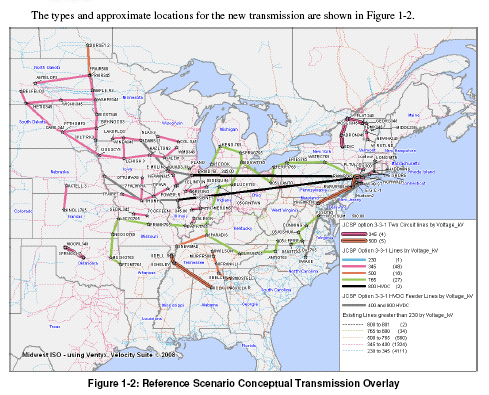
No way do they want our transmission out to the Mid-Atlantic:
East Coast Governors STAND UP AGAIN!
- Throughout, this report does not distinguish between transmission and distribution issues, but it should! Particularly in discussing outages, and even in the discussion of “back-up generators for business” where reliability does NOT presume back-up generators as redundancy!
- Pay attention to the order of “Key Characteristics of the Electrical System” — RELIABILITY is not first! It’s about money!
- Appears to advocate for perpetual motion in stating “A system that cannot continue indefinitely without bankrupting the participating people or institutions cannot be sustained.” Very odd concept of economic viability. Energy systems will always require more input that what is received as output.
As I look at this report, and its trajectory, it seems like a prelude to a dis! Perhaps increased rates for lower MWhr sales, or perhaps even claiming unused and unneeded coal plants as stranded costs!
JP Morgan Chase and MISO – abusive practices!
July 7th, 2012
.

“MISO” trademark owned by… JPMorgan Chase!
But seriously folks! JPMorgan got caught with its hand in the cookie jar again, CAISO and MISO have filed claims of abusive practices at FERC. Here’s the short version of what they allegedly did (it’s allegedly for now, but just you wait!) — from the second article below:
In the Midwest, the alleged manipulation involved day-ahead margin assurance payments, under which generators are compensated for situations when their real-time dispatch falls below the level set by the day-ahead dispatch schedule. As in California, traders found a flaw where they could force the market to make “inappropriate or excess” payments by placing lowball bids in the day-ahead market – as low as negative $500 per megawatt-hour – and much higher bids in the real-time market, Miso said.
Here’s the Amended CAISO Petition against JPMorgan Chase:
Still looking for the MISO Petition and FERC’s legendary Constellation Order.
In the news:
JPMorgan Chase Manipulation Scandal Raises Specter of Enron
AWA Goodhue appeal came down
June 26th, 2012
… and what a downer it is:
Question – given this is the first ever ruling about Minn. Stat.216F.081, why is this unpublished?
And, as I commented on the STrib site, what struck me was the court’s misplaced reliance on the Renewable Energy Standard as energy policy in MN. Xcel holds the 2 PPAs for this project. Whether they build this 78MW project does not make or break Xcel Energy’s compliance with the RES, Xcel is already ahead of the game, in compliance for years into the future. Compliance with the state’s RES is not at issue here! That’s a red herring.
Here’s the Coalition for Sensible Siting’s take:
Here are some articles:
StPPP – Minnesota court of appeals throws out county obstacles to Goodhue wind project
RochPB – Appellate court rules in favor of AWA Goodhue wind project
MPR – Court ruling green lights Goodhue County wind turbines
KSTP – Wind Turbine Project in Goodhue County Will Move Forward
Federal appellate slap down of NRC!
June 8th, 2012

The Prairie Island Nuclear Generating Plant here in Red Wing, Minnesota.
Today the Appellate Court tossed out the NRC’s “Waste Confidence Decision,” which essentially was the NRC’s statement that they were confident that the nuclear waste problem will be solved (as if!) so let’s just carry on and not worry about it. The Appellate Court said, in essence, WE DON’T THINK SO:
Here’s the latest version of the Waste Confidence Decision that they’re rejecting:
All I can say is, IT’S ABOUT TIME!!! And no way will the utilities go for this, so off to the Supreme Court we go!