ALJ: Underground Hiawatha Project
October 9th, 2010

Underground Xcel’s Hiawatha Project transmission. That’s BIG, it’s good news, except for one thing — “Who pays?” is still a question:
ALJ Heydinger’s Recommendation for Xcel’s Hiawatha Transmission Project
Problem is, cost allocation isn’t dealt with specifically, only explained, so no recommendation regarding that.
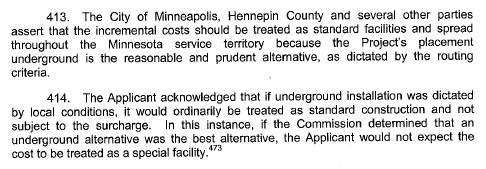
If the PUC went ahead, would it be spread across the Metro area, the full Xcel rate base, or???
For the SE Metro, and for the Chisago Transmission Project, if they cities would have agreed to shoulder the cost, undergrounding was no problem. But that’s not feasible for a city to pay. So now what? Will the PUC actually order undergrounding, with a broad rate base recovery?
MAPP delayed again… of course!
October 7th, 2010
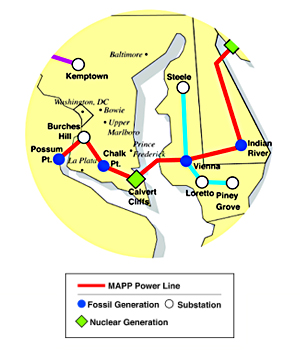
MAPP then… and MAPP now:
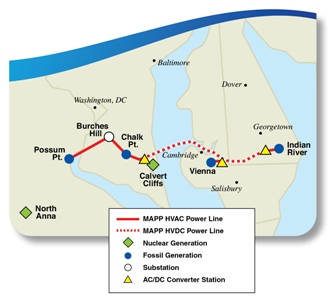
Good news on the Mid-Atlantic Power Pathway front — another continuance granted!
This Order gives the parties until November 30, 2010 to report in on whether a Status Conference is necessary.
Mid-Atlantic Power Pathway is a 500kV transmission line proposed for Maryland and Delaware (the New Jersey part has gone the way of the brontosaurus. Apparently there’s a delay in the Application (well of course, delay’s appropriate and expected when something isn’t needed!). A little birdie told me that Pepco Holdings (PHI) will probably file their updated Application for the Maryland CPCN in November, if PJM gets their act together. The part in Maryland is a revised southern Maryland segment, the undergrounded Bay crossing and the eastern shore to the Delaware state line.
A significant part of this line will be undergrounded.
UMTDI Transmission coming soon?!?!?!
September 30th, 2010

But wait… it’s already here!
Just in from Bob Cupit, from the Upper Midwest Transmission Development Initiative:
Here’s the initial idea:
The RGOS first-mover subset located within the UMTDI states’ footprint is:
• Big Stone, SD to Brookings, SD 345kV – estimated cost of $150 million.
• Brookings, SD to Twin Cities, MN 345kV – estimated cost of $700 million.
• Lakefield Junction, MN to Mitchell County, IA operated at 345kV but constructed at 765kV specifications to allow full upgrading and operation at 765kV in the future – estimated cost of $600 million.
• North La Crosse, WI to North Madison, WI and Dubuque, IA to Spring Green, WI to Cardinal, WI 345kV – estimated cost of $811 million.
• Sheldon, IA to Webster, IA to Hazleton, IA 345kV – estimated cost of $458 million.
In addition to the proposed transmission projects above, the Midwest ISO’s Midwest Transmission Expansion Plan (MTEP) for 2011 identifies the following transmission project as an initial candidate for regional cost sharing because of its regional benefits.
• Ellendale, ND to Big Stone, SD 345 kV – estimated cost of $275 million.
OK, folks, do any of these lines look familiar? Why is the CapX 2020 Brookings SD to Twin Cities MN 345kV line on this list? Why is the CapX/ATC North LaCrosse, WI to North Madison, WI on this list? Hmmmmmmmmmm…yet they say this:
Although UMTDI actively engaged in the identification of possible renewable resource areas and potential transmission corridors, this should not be taken as expression of support for particular routes, particular projects, particular voltages, or appropriate levels of spending in any state proceeding. Those decisions remain for a future day, when specific projects might be proposed. However, the Executive Committee sees great value in affirming its support for coordinated state efforts on these multi-state projects, and its general support for these corridors, which appear to have value in all identified reasonable futures.
Um… hello, they’re listing specific proposed projects.
Of course it’s all connected, how stupid do they think we are? Well, pretty damn stupid, look what they’re recommending, cost-sharing to shift the cost across MISO:
A key, unresolved issue for construction of projects of this magnitude is cost sharing. The criteria in the Midwest ISO’s recent tariff filing at FERC, as well as other activities ongoing at the Midwest ISO, indicate that these first-mover projects would likely all qualify for cost allocation treatment. This designation would mean that all energy users in the Midwest ISO’s footprint would share the costs of these “no regrets” lines. FERC has not approved this rate treatment, however, and it is likely that FERC will receive a number of comments and objections to the Midwest ISO’s tariff proposal. While the UMTDI Executive Committee has not taken a position on the Midwest ISO’s cost allocation filing, it is safe to say that the absence of cost sharing would make construction of EHV transmission lines in these corridors very difficult.
And PJM too:
The total cost for these first-mover lines is approximately $5.8 billion with $1.4 billion being funded by customers in PJM, the Midwest ISO’s neighboring independent system operator to the east.
And because they know this isn’t needed or wanted, they’re frantically trying to find a way to circumvent state authority — how about a multi-state regulatory body to site transmission… or direction to the states from FERC to act:
States Together
Interstate Compacts At the highest levels, all five states have the power to create a compact, with the consent of Congress, to establish a common agreement on how to develop the UMTDI Project. Minnesota and Wisconsin provide specific powers to their respective governors to enter compacts involving transmission lines. Congress has specifically contemplated the compact mechanism by authorizing three or more states to form a compact, subject to Congressional approval to “facilitate siting of future electric energy transmission facilities.” Sec. 216(i) of the Federal Power Act (FPA), 16 U.S.C. § 824p. Another FPA provision, little used § 209, authorizes the FERC to delegate any subject matter in its jurisdiction to a group of states, offering another potential avenue of federal approval for joint state action on transmission siting and cost allocation.
…”little used § 209″… how perverted can we get? Perhaps there’s a reason why a state PUC would be reluctant to permit projects like this?!?!?!?
PSEG S-R applications rejected and withdrawn!
August 6th, 2010

HA! I love it when this happens. Just before National Park Service public hearings (schedule below), PSEG screws up and an application gets tossed back in their face!
I’m representing Stop the Lines against PSEG”s Susquehanna-Roseland transmission project in New Jersey.
PSEG thought they’d be “smart,” and given the length and intensity of process for the federal environmental review of its proposal to cross the federally designated Wild & Scenic Delaware Water Gap with massive transmission…

… they tried to divide the line in half for its News Jersey Dept. of Environmental Protection wetlands application and other DEP applications too.
First the DEP rejected that maneuver, short and sweet, and rejected their wetlands application:
Here’s the meat of it, first the funny part:
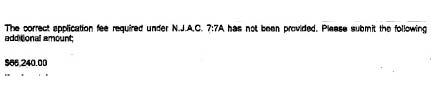
… and then, the substantive issue…
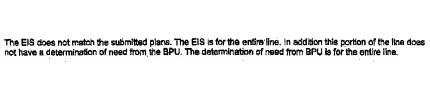
So then, PSEG withdraws their other DEP applications:
I love it when that happens… and what great timing. Bring on the National Park Service hearings!
Here’s an Alert from the New Jersey Sierra Club:
Urge the National Park Service to Select the “No Action” Alternative!
The National Park Service will be hosting 3 public meetings to present the Preliminary Alternatives for the Susquehanna-Roseland transmission line as part of its NEPA (National Environmental Policy Act) review for this project. The meetings will consist of an “open house” portion where information will be available and NPS staff can answer questions and a formal “public hearing” portion. The meetings will be held:
Tuesday, August 17
Fernwood Hotel and Resort
US 209 North
Bushkill, PA
Open House: 2:30 p.m. – 4:30 p.m.
Public Hearing: 6:00 p.m. – 9:00 p.m.
Wednesday, August 18, 2010
Stroudsmoor Country Inn – Terraview
North 4th St
Stroudsburg, PA
Open House: 2:30 p.m. – 4:30 p.m.
Public Hearing: 6:00 p.m. – 9:00 p.m.
Thursday, August 19, 2010
Farmstead Golf and Country Club
88 Lawrence Road
Lafayette, NJ
Open House: 2:30 p.m. – 4:30 p.m.
Public Hearing: 6:00 p.m. – 9:00 p.m.
The proposed alternative routes can be viewed here. Click on the “Preliminary Alternatives Newsletter” for details and mapping of the 6 proposed routes.
Please come to these meetings and voice your support for the “No Build Alternative”! If you are unable to attend the hearings, comments can be submitted online here. NPS will accept comments on these alternatives August 8- September 7.
++++++++++++++++++++++++++
And word is getting out:
Opponents of powerline upgrade are happy that project is delayed
BY COLLEEN O’DEA • STAFF WRITER • August 5, 2010
Last week, PSE&G’s second quarter earnings statement disclosed that the utility would not complete work on the eastern half of the line, from Hopatcong through portions of Morris County to Roseland, until 2014 and on the western section to the Delaware Water Gap until 2015.
Read the rest of this entry »
Xcel’s “forward sale agreement”
August 5th, 2010

Xcel is trading a bunch of paper for a bunch of money, 21,850,000 pieces of paper to be precise. How much money is that? Seems to be $469,775,000, or $408,500,000, gross, or $396,245,000 net to Xcel, depending on what numbers you look at, or what they sell at!
What will they do with it? According to the prospectus, and an article written about it:
“Xcel Energy intends to use any net proceeds that it receives upon settlement of the forward sale agreement described above, or from the sale of any shares to the underwriters to cover over-allotments, to repay outstanding commercial paper and make capital contributions to its operating subsidiaries.”
Here’s an article from Marketwatch:
Doesn’t this have the feel that they’re desperate for cash flow? We know they can’t get their construction capital to build the Brookings transmission line, and they’re hot to trot both about PUC ordained rate recovery, which they did not get and their Motion for Reconsideration (PUC Docket 09-1048) went nowhere.
Here’s Seeking Alpha’s Xcel 2Q Earnings Call Transcript!
Seeking Alpha Xcel 2Q Earnings Call Question & Answer
And a choice answer snippet from the Q&A: