Transmission parallel with Hwy. 19 – Notice Plan released
June 13th, 2006

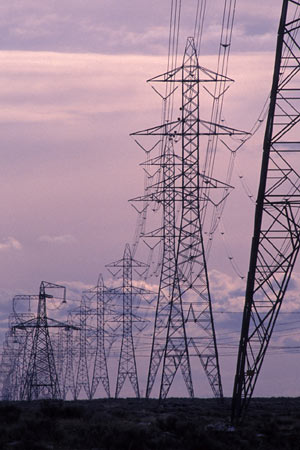
GRE has served the Notice Plan for the big 345kV line to sweep across the middle of southern Minnesota, from Brookings SD to Hampton Corners (not connecting at PI anymore, but unless the PI-Roch-LaX line originates at Hampton Corners, it will go through PI and there will be upgrades to what’s there). It pretty much parallels Hwy. 19. and the corridor includes Belle Plaine, New Prague, Belle Plaine Twp., Helena Twp., Cedar Lake Twp. and New Market Twp., all in Scott County; in Rice County, it’s Wheatland and Webster and City of Northfield; in Dakota County its Greenvale, Waterford, Eureak, Castle Rock, southern Empire and Hampton Townships and City of Farmington, City of Hampton and City of New Trier. Lots of landowners are affected by this line — not to mention the impact on state energy policy — locking us into a 50+ year commitment to central station power and massive bulk power exports.
IS THIS WERE WE WANT TO GO?
IS THIS WHERE WE WANT TO BE?
IS THIS OUR ENERGY FUTURE?
Here’s the full map: View image
Here’s the western half: View image
Here’s the eastern half: View image
Here’s the Notice Plan: Download file
Comments are due by 4:30 p.m. on June 29, 2006.
Send Comments to:
PUC
121 – 7th Place East, Suite 350
St. Paul, MN 55101
For more info:
PUC – Certificate of Need
Brent Ekness- email
(651) 201-2236Routing & Environmental Review (formerly EQB)
Deb Pile – email (651) 297-2375

$1.3 Billion in Transmission coming soon near you!
June 10th, 2006

Yes, they’ve made it very, very official, and I hope everyone who is experiencing a tightening and lurching stomach at the prospect of this $1.3 BILLION transmission project (Phase I of how many phases?) calls or emails Bill Grant of the Izaak Walton League (651) 649-1446, and George Crocker, North American Water Office, (651) 770-3861, to thank them for ushering through the 2005 Transmission Omnibus Bill from Hell. Special thanks are due Rep. Aaron Peterson too, email him or call him at (320) 226-1737. This is the direct result of that bill, this is a direct result of their “deal, a package deal, a good deal.” Here’s that deal, SF1368/Ch97. This bill made these projects possible.
It makes me sick…
Here’s the STrib’s report:
Electricity network upgrade underway
Xcel Energy and other utilities kicked off a $1.3 billion project to add transmission capacity in Minnesota and neighboring states.
Joy Powell, Star Tribune
Regional utilities on Friday filed regulatory papers kicking off a $1.3 billion transmission project aimed at feeding the region’s growing appetite for electricity.
Between 2009 and 2020, Xcel Energy Inc. and other utilities will upgrade a transmission “backbone” in Minnesota and neighboring states.
It’s the biggest such effort undertaken by Xcel and other Midwest utilities in nearly 25 years, said Terry Grove of Great River Energy, a project leader.
“These transmission capacity upgrades are needed to deliver new electricity generation to support economic, job and population growth in the future,” Grove said, adding that they’re also needed to deliver more wind energy.
Customer demand for electricity is projected to grow by 6,300 megawatts from 2009 to 2020, or about 2.5 percent a year. (One megawatt can serve about 1,000 households.)
“It’s existing customers using more energy,” Grove said. “It’s new customers, and that’s generally a measure of the economic growth and vitality of the state. And in some cases, you’ve got industries that are expanding dramatically, like the ethanol industry and, potentially, biodiesel refineries.”
With more capacity in the transmission system, utilities will be better able to buy competitively priced wholesale energy supplies and move it through the system.
And that could help lower customers’ bills overall, officials said.
“We are definitely operating with the lines at their full capacity many times,” Grove said.
The approximate lengths and locations of the proposed lines:
â?¢ A 200-mile, 345-kilovolt line between Brookings, S.D., and the southeastern Twin Cities. Also, a related 30-mile line.
â?¢ A 200-mile, 345-kilovolt line between Fargo, N.D., and the St. Cloud-Monticello area.
â?¢ A 150-mile, 345-kilovolt line from the southeastern Twin Cities area to Rochester and La Crosse, Wis.
â?¢ A 70-mile, 230-kilovolt line in the Bemidji area of north-central Minnesota.
Once the Minnesota Public Utility Commission approves the plans, Xcel will mail letters to potentially affected property owners along each of the planned paths of the transmission lines, letting them know how they can learn more, said Laura McCarten of Xcel.
That route-permitting process will determine the paths of the power lines, the location of substations and which owners will be affected. The utilities could seek condemnation of land needed for public use, if agreements can’t be reached.
“We know that we will cross many parcels, but it’s very hard to quantify at this point,” Grove said.
“We’re very early in the process. The filings we just made [Friday] are to seek the Public Utilities Commission’s approval [of] how we will notify local government units, landowners and the general public.”
Xcel Energy, Great River Energy and Otter Tail Power Co. will cover much of the $1.3 billion cost, which will be passed on to consumers in small amounts, beginning in 2009 or 2010.
By 2012, or once the projects go into service, the investment could result in an increase of less than $1.50 per month to a typical residential customer’s bill by 2012, Xcel spokeswoman Mary Sandok said.
This $1.3 billion project is the first of three phases. The second will build more transmission lines and substations to serve the load primarily in eastern Minnesota.
The third will create more facilities to integrate new generation into the grid, Grove said.
Proof of need for Distributed Generation
May 24th, 2006

6,300 MW becomes 8,000MW?? 1,700MW more? Why? It’s because of losses!
There was an MTEP 06 meeting on April 12 that I missed because of the mold house trial. DAMN! Shoulda been there, I guess! Look at this old power point showing WoW‘s buy in on this “Midwest Transmission Expansion Plan.” Update on Transmission Planning for Windpower in the Upper Midwest
Anyway, here’s the problem: The electric industry’s been whining and crying about our “need” for 6,300MW in the REGION, that’s from the CapX2020 Techinical Report. Regular readers should know this report by heart by now, but that 6,300 figure is cited on p. 1, and then there’s that great map on p. 7 that shows 16,712MW of generation proposed for the same area:

And now they say no, it’s more — we need to build 8,000MW of generation to cover the 6,300MW we say we need. Why? It’s called losses. In the SW MN 345kV proceeding, they presumed 30% losses. Download file The 8,000MW figure to generate 6,300MW presumes 1,700MW of losses, a tad under the 1,890 if the 30% assumption were used.
Isn’t this the best damn argument you’ve ever heard for Distributed Generation? How much transmission would we have to build to transmit all this power, and how much transmission do we have to pay for, all for the joy of losing 30% in losses? So please explain to me why this makes any sense!!!!
Do you realize that 1,700MW represents the generation of all three of our nuclear plants? Monticello at 600MW and Prairie Island at 1,060?
Isn’t this the best damn argument not to rely on coal plants way out west? If we sited wind with all the gas plants, how much of that coal wouldn’t be necessary? If we sited near load, we wouldn’t have to build three new coal plants.
Who benefits from this goofy scenario?
Taking the farm for transmission — it’s NOT for wind
May 19th, 2006

I’ve been finding snippets of the struggle out in SW Minnesota (PUC eDocket 01-1958) in my inbox that is painful to hear about from afar:
Do you know a Dave Callahan from Xcel ? Callahan is supposed to meet with a couple of us on the transmission line, neighbor diggng in heels as are several others, double circut pay is an issue, access is another…. on the easement compensation sheet, there is a 1099 item, the full paymet is listed here & reported to the feds., then further down the 50% reduction language was covered up by a sticker/arrow pointing to “sign below.” Another case of trickery.
It’s the same arrogant utility attitude that they encountered on the Minnesota side of the Arrowhead project, though the Arrowhead landowners inexplicably decided to pursue an ineffective action at the PUC rather than fight their case in court — they never argued their condemnation case, and even the judge was puzzled, so the opinion says.
Condemnation Part I Download file
Condemnation Part II Download file
And the “Buy the Farm” provision of the Power Plant Siting Act, 116C.63, Subd. 4 — when they lowered the threshold for High Voltagea Transmission Line to 100kV and above, the following year they went and raised the “Buy the Farm” threshold to 200kV and above — the majority of those affected by transmission lines now, because they’re building high capacity low-voltage lines, can’t opt out from living under the line.
And the particularly painful part of it is that party line, “It’s transmission for wind.” It’s NOT transmission for wind — here’s my “Transmission for Dummies #2” – scroll down to “It’s NOT for wind!” Here’s the powerflow that proves it, 213MVA out of the 2085 capacity coming down from Buffalo Ridge at the Nobles substation, the ONLY entry point from Buff Ridge on the line: View image
Here’s the story from the STrib:
Power play: Farmers fight Xcel
Southwestern Minnesota farmers challenge Xcel’s use of eminent domain and the compensation for use of their land.
Joy Powell, Star Tribune
The phone call came one morning during spring planting, when a man from a land-acquisition firm told Loren and Ethelyn Cuperus that part of their small farm near Lakefield, Minn., was condemned for construction of a new Xcel Energy power line.
For months, the couple had insisted that Xcel wasn’t offering an adequate payment to use the land — a 150-foot-wide strip through the middle of their farm in Jackson County. Xcel is moving ahead with the easement, the caller said, as part of a $162 million project to build transmission lines for the growing wind-energy industry.
“We’re not against wind energy,” said Loren Cuperus, 69. “We only want to be treated fairly. They want to bulldoze their way through.”
Depending on the site, Xcel has been offering 50 or 85 percent of the value of the land; farmers can continue to grow crops around the lines. But the Cuperuses and other farmers say that 50 percent is not a fair price for use of their land, for crops that will be reduced, and for damage to nutrient-rich brown loam during construction.
It’s a story that spotlights the controversy over eminent domain, with which governments or utilities can buy property from unwilling sellers for an important public use.
Xcel, which has revenue of $10 billion a year, says its project is essential to operate the above-ground transmission line and provide more electricity, primarily from wind. The new lines will more than double transmission capacity from southwestern Minnesota and boost its burgeoning wind industry, said Paul Adelmann, an Xcel spokesman.
In 2003, the Minnesota Public Utilities Commission (PUC) approved Xcel’s highest-voltage power line, which will stretch 94 miles from Brandon, S.D., near Sioux Falls, to Lakefield. It also involves three smaller lines and other improvements to strengthen the entire electricity network, from the blustery Buffalo Ridge area in southwestern Minnesota to the Twin Cities and throughout the region, Adelmann said.
So far, Xcel has reached agreements with owners of 102 of the 395 parcels involved. Another 68 parcels are being negotiated. Owners of 225 parcels have yet to receive offers.
An issue for owners of 80 parcels, including the Cuperuses, is whether they’ll receive less because they already have older power lines that would be replaced or upgraded.
To deal with farmers, Xcel hired an Iowa firm, Graham Land Acquisition Associates. It specializes in helping public works, utilities and economic development projects acquire land through condemnation.
Loren and Ethelyn Cuperus and other farmers say they’ve been “threatened” with condemnation during encounters with the firm’s representatives.
Dave Callahan, who leads the siting and land rights department for Xcel Energy, said he has heard the complaints and is trying to work out solutions.
“When we ask the landowners for specifics, what we find out is that the agent just told them the truth and they didn’t like what they heard,” Callahan said. “This is an essential service project that was approved by the PUC.”
Figuring fair compensation
On a Sunday last January, the Cuperuses, their widowed neighbor, Beverly Voehl, and a farmer who rents land on the 400-acre Cuperus farm met with a Graham representative, Brian Jennings.
The farmers said Jennings told them that if they wrote down what he was saying, he would not tell them any more.
Attempts to reach Jennings for comment this week were rebuffed by a Graham Land Acquisition official, Carroll McCracken. “We are under contract [with Xcel] to not talk with you for this project … so you have to contact Xcel Energy,” McCracken said.
Voehl ended up signing papers for an Xcel easement, although she felt bullied and disrespected, she said. The Cuperuses refused to sign because they would have been paid at a lower rate for some of their land.
That’s because in 1966, Loren’s father received a one-time payment for easements. Interstate Power and Light Co. paid his father $445 for a strip of land 75 feet wide and a half-mile long, Cuperus said. The right-of-way encompassed five “H-frame” poles, for which his father received $65 per pole, plus $120 for a wire overhang.
Now, new single poles are to replace the older double poles on the farm as part of Xcel’s 345-kilovolt line from South Dakota to a Lakefield substation in Jackson County.
Where no power poles exist, Xcel has paid farmers $3,060 per acre, which represents 85 percent of the current value of the land. The farmers still can farm on it.
Where poles already exist and will be replaced or updated, farmers have been offered 50 percent of the value, or $1,530 an acre, for the perpetual easement. Farmers still are negotiating with Xcel on that amount.
Cuperus and other farmers also say they should be receiving more for crop damage and dirt compaction and be assured timely repair of drainage tile that gets broken during construction.
“I probably have never negotiated with a landowner who didn’t think they should get more,” Callahan said. “That’s why we rely on established appraisal practices.”
Callahan said Xcel added a “signing bonus” of $1,000 for those who agreed to an easement.
‘Green’ energy is in demand
This spring, Xcel became the nation’s biggest buyer of wind energy, according to the American Wind Energy Association.
Utilities in the region expect to need 6,000 megawatts of new electricity generation to meet needs in the next 15 years, with the Twin Cities the biggest draw on that power, according to the state Commerce Department.
The department is calling on Xcel Energy to boost investments in wind energy and use less natural gas. Xcel faces a tight construction schedule as it replaces old H-style powerlines with single poles for the higher-voltage lines, Callahan said.
The utility is launching “quick-take” processes to acquire land through condemnation, according to documents sent to Loren and Ethelyn Cuperus. A court date is set for May 31, but negotiations continue.
The couple’s friend, Dave Ackermann of Lakefield, is another farmland owner fighting for higher compensation for the Xcel easements. Down the road, he said, it’s not just rural people who could be affected.
“How would people in the city like to have a 345-kilovolt line going their yard,” Ackermann asked, “and their kids playing under it?”
Joy Powell â?¢ 612-673-7750
Did you catch this LIE:
Xcel, which has revenue of $10 billion a year, says its project is essential to operate the above-ground transmission line and provide more electricity, primarily from wind. The new lines will more than double transmission capacity from southwestern Minnesota and boost its burgeoning wind industry, said Paul Adelmann, an Xcel spokesman.
Ya know, I’m a math idiot, but I know that 213 out of 2085 is NOT “PRIMARILY!”
And did you catch this half truth:
The new lines will more than double transmission capacity from southwestern Minnesota..
.
Change the “from” to “through” and you’ve got it — a line running from Sioux Falls (Split Rock sub) to Lakefield Junction isn’t going “from” SW MN, it’s going THROUGH it.
The farmers out there know who pays and who benefits, and it’s too bad that deals were made that allow Xcel to say “it’s for wind” when it’s not, when only 213MVA of the 2085MVA capacity is coming off of Buffalo Ridge. Xcel’s engineer, Rick Gonzalez, went over the powerflows in testimony in the SW MN case, it’s there in the record for anyone who cares to look…
CUB says Arrowhead transmission design is flawed
May 18th, 2006

Citizens Utility Board has filed with WI’s Public Service Commission, saying the design of the Arrowhead-Weston Transmission Line is flawed. Yeah… your point???
From today’s St.PPP:
Group alleges flaws in powerline
But transmission company says complaint is old, has no meritAssociated Press
MADISON â?? A utility watchdog group asked state regulators Tuesday to investigate what it says are serious flaws in the design of a high-voltage transmission line under construction between Wausau and Duluth, Minn.
In a worst-case scenario, a failure with the line could lead to a cascade of outages and possible damage to power plants, said Charlie Higley, executive director of the Citizens Utility Board.
But Mark Williamson, vice president of Pewaukee-based American Transmission Co., said the group’s concerns are unfounded and based on a “flawed” analysis that already has been investigated.
American Transmission will own and operate the $420 million line, being built by Wisconsin Public Service Corp., when it is brought into service in 2008.
In a letter delivered to each company, the citizens’ group said engineering mistakes mean the 345-kilovolt Arrowhead-Weston power line is undersized in capacity.
“The Arrowhead line will likely not work when it’s most needed,” Higley said. “And that’s when it’s helping support other transmission lines in the region while power is flowing heavily. That’s when the line is most vulnerable.”
Linda Barth, a spokeswoman for the state Public Service Commission, said the regulatory agency is looking at the issues raised in the group’s letter.
“But that said, this line has been approved twice and we’re confident in the exhaustive process we used in approving the Arrowhead-Weston line,” she said. “It was a sound and thorough decision.”
The Citizens Utility Board raised its concerns following an in-depth analysis by Larry Thiele, an independent consulting electrical engineer. The board hired Thiele in 2003 to provide expert testimony regarding the line’s design.
Thiele’s analysis concluded the line would fail if an outage occurred on the King-Eau Claire-Arpin transmission line, the only high-capacity line connecting Wisconsin directly to Minnesota. The failure would cause transmission lines to carry too much power and could damage power plants and lead to blackouts, Thiele concluded.
Williamson said those concerns had already been investigated and dismissed.
“This is the third time that the same complaint has been raised and there’s just no merit to it,” he said.
He said the purpose of the Arrowhead line was to strengthen the system by providing redundancy and protection for the power grid â?? solving the very problems Thiele says would threaten it.
Here’s the CUB Request for Investigation: Download file
Essentially, they’re saying that the Arrowhead line is unstable because the capacity is too low. But it seems to me they’re not taking into account the old news of the EQB’s design requirement of a capacity limitation of 800MVA through the phase shifting transformer. Here’s the MPCA Commissioner’s Memorandum to the EQB that resulted in the limitation: Download file
Mesaba Interconnection
Through all of this though, no one’s paying any attention to the impact of Mesaba on Arrowhead. Originally they were planning on connecting to Blackberry and from there going to the Forbes sub and out over Arrowhead — thankfully that is not now in the plans (it seems). Now it’s going from Blackberry to the Riverton sub. The MISO interconnection study, G519, has just been released:
MISO System Interconnection Study G519
The Conclusion of the study states that:
Under high off peak transfer conditions G519 aggravates voltage problems at 230kV, 161kV and 115kV buses around Arrowhead and Stone Lake. (Ch. 7, p. 7-1)
Going to the horse’s mouth, it says:
Transient voltage violations are attributed to the G51 project. HOwever, Table 5-2 shows that in the G519 study model the Forbes-Chisago 500kV line (F601C) is overloaded and Arrowhead-Weston is loaded above its expected operating limit of 650MW. Sensitivity analysis, presented in Section 6, was performed to verify the potential constraints with flows on F601C and Arrowhead-Weston within limits. (Ch. 5, p. 5-7)
The MISO study found that the connection of Mesaba adds to stability problems, and the modeling assumes the line is operating at above the stated capacity, above the limits, but below the phase shifting transformer limits.
More on what it means for Mesaba, but the bottom line is that Excelsior will have to have “someone” (because heaving forbid they would be responsible for their own infrastructure) make the following associated transmission system upgrades:
1) Add new 230kV line from Boswell to Riverton
2) New 230kV bus position for Boswell-Riverton line at Boswell
3) New 230kV bus position for Boswell-riverton line at Riverton
4) New 230kV subsation at Hill City
5) Replace 4 115kV circuit breakers at Nashwauk
Corresponding costs:
1) $45 million
2) $1.9 million
3) $1.7 million
4) $3.5 million
5) $720,000
TOTAL NECESSARY MESABA UPGRADES: $52.82 million
And remember, this does not include the direct interconnection costs from the plant to the Blackberry sub… and I think those costs are grossly underestimated.
Lots more on this topic later!