It’s been a year since McIntyre was shot in BC
July 26th, 2016
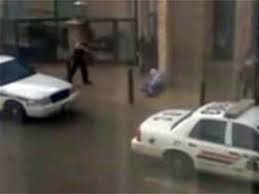
It’s been a year now since this shooting, and still no Investigation Report:
Here is an anniversary article, and note that the “investigation” has not been completed — come on, it’s been a YEAR!
‘I will never know what got into him’: One year later, family remembers masked man shot by RCMP
Here’s an article that they “shot wrong man” though I find it bizarre that tipping over tables and tearing maps is a justification for shooting someone:
Police shot wrong man at Site C dam open house, Peace River farmer says
Another:
And another about James McIntyre, the man who was shot, note from above article, police knew with certainty on Day 2 that McIntyre was not the one who “disrupted” the open house:
Here are previous posts on Legalectric:
James McIntyre ID’d as man shot by RCMP – July 23, 2015
And my Letter to the Editor was published shortly after the shooting:
And in the Alaska Highway News… – August 3, 2015
Center of the American Experiment is off track
July 18th, 2016
Under a meme “Raise your voice… before they raise your rates” on a friend’s fb page, the Center of the American Experiment goes off the rails. They’re fixated on renewable energy as the driver of the Xcel Energy rate case and rate increase, but don’t want to bother with the facts. Well, it is the Center of the American Experiment, after all…
There’s no posting of the public hearing schedule, and no links to send comments, so what’s the point? Guess they just want to rant. I posted info on the schedule, and info about the transmission driver, and surprise, they deleted my comments!
Time to trot out this old favorite:
In Grist today: Transmission Lies
And here’s CAE‘s take:
Renewable Mandate Drives New Increase in Utility Bills
“AARP knows that when utility bills go up, it hurts Minnesota families, especially those on fixed incomes or struggling to make ends meet. That’s why we’re fighting make sure you only pay what’s fair and reasonable for reliable utility service.” (the quotes aren’t formatting correctly, hence “)
“We’re making improvements to our distribution and transmission systems for continued reliability, the ability to safely integrate new energy on our system and to continue to provide carbon-free nuclear energy. Those improvements require investments, so we’re also working with regulators to bring more predictability to your energy bills.” (the quotes aren’t formatting correctly, hence “)
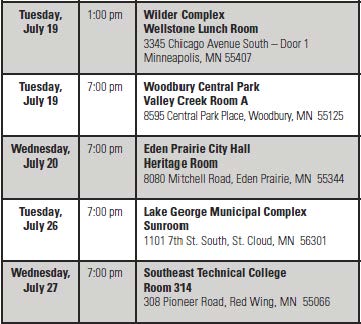
Above is the public hearing schedule for the Rate Case, which apparently CAE does not want published. IF YOU GO TO THE HEARING AND OFFER ORAL COMMENTS, ASK TO BE PUT UNDER OATH (swear or affirm) TO GIVE YOUR TESTIMONY EXTRA OOOOOOMPH!
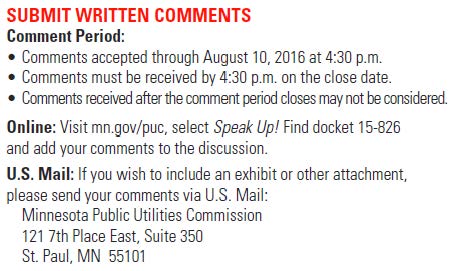
And to send in written comments, here’s from the PUC blessed Xcel Notice:
Xcel Rate Case Hearings on Tuesday & Wednesday
July 17th, 2016
There are a few more hearings for Xcel Energy’s rate case coming up:
Who cares about this rate case? Center for American Experiment does, but it’s a pretty myopic view, claiming that “Renewable Mandate Drives New Increase in Utility Bills.” Wish they’d read the testimony. Anyway, you all should care because this is a transmission driven rate case (see 2A2_MYRP_Chuck Burdick Testimony p. 28-30; 2C2_Xmsn_Benson) Greasing the skids was a consensus agreement reached by Xcel Energy on many issues, including Xcel’s proposal for a “Multi-Year Rate” plan prior to legislation being introduced to give Xcel what it wanted:
Exhibit 1B – e21_Initiative_Phase_I_Report_2014 – Xcel Filing PUC Docket 14-1055
Note this snippet, where they’re whining that their grid is only 55% utilized:
(N) Identify and develop opportunities to reduce customer costs by improving overall grid efficiency. In Minnesota, the total electric system utilization is approximately 55 percent (average demand divided by peak demand), thus providing an opportunity to reduce system costs by better utilizing existing system assets (e.g., generation, wires, etc.). (e21_Initiative_Phase_I_Report, p. 11).
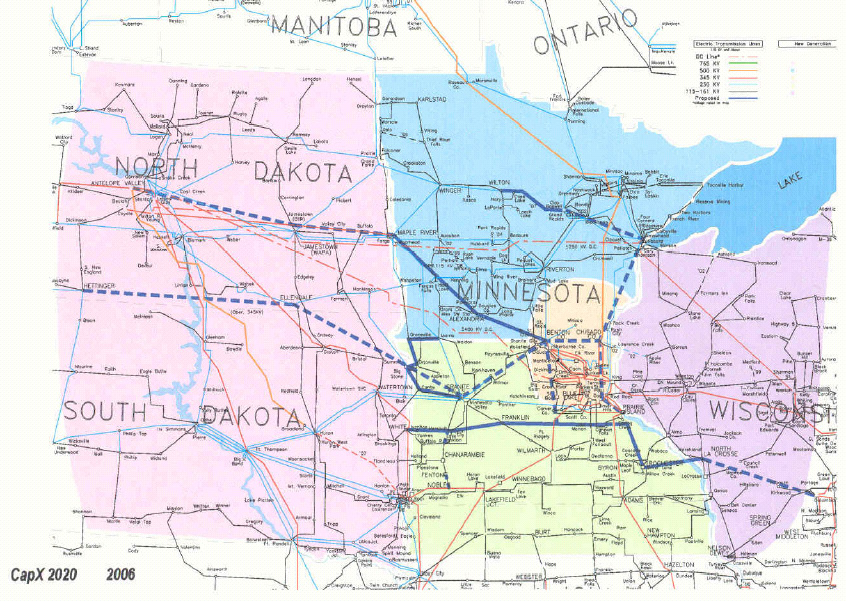
Well, DOH, we know that CapX 2020 wasn’t needed, we know the purpose was evident in the map starting at the Dakota coal fields, and putting it on our land wasn’t enough (for those who think it’s “for wind” no, it’s not, what a crock, you should have heard the testimony, seen the exhibits, the record demonstrates it isn’t, www.nocapx2020.info), now they want a whole new scheme for us to pay for their infrastructure to sell coal eastward?
 For some reason, this docket disappeared… wonder who all on this consensus e21_Initiative_Phase_I_Report made that happen!?!
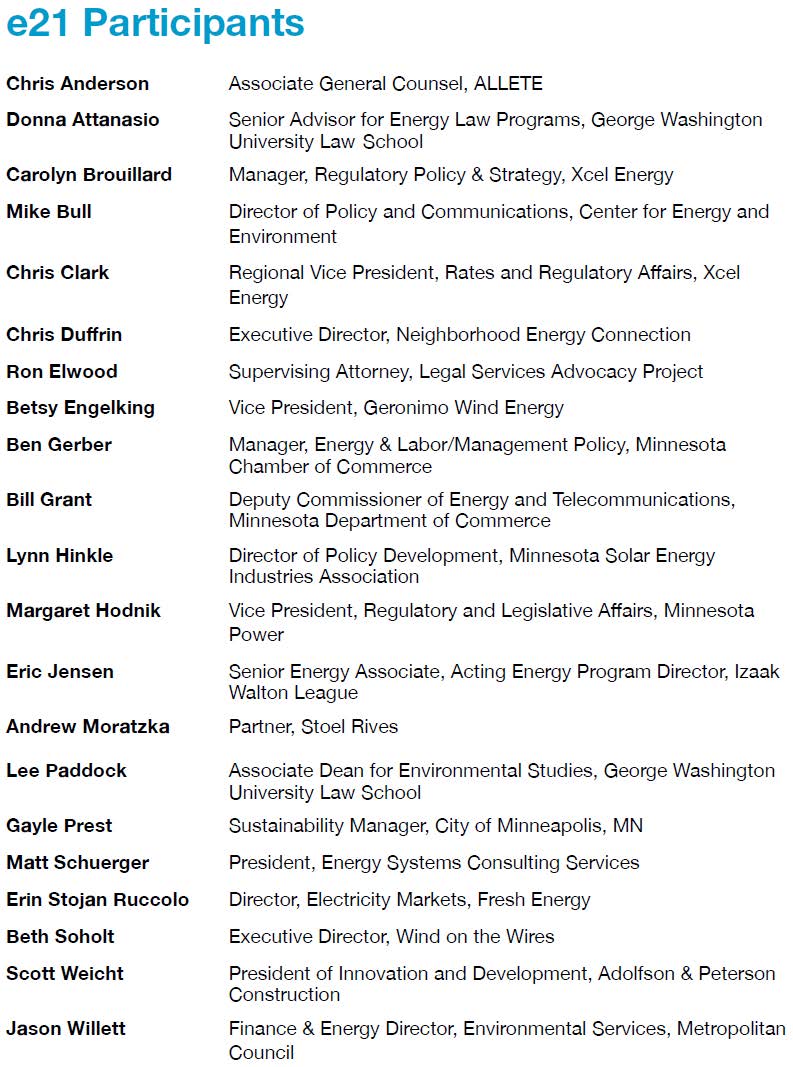 Or maybe the e21 Project Team?
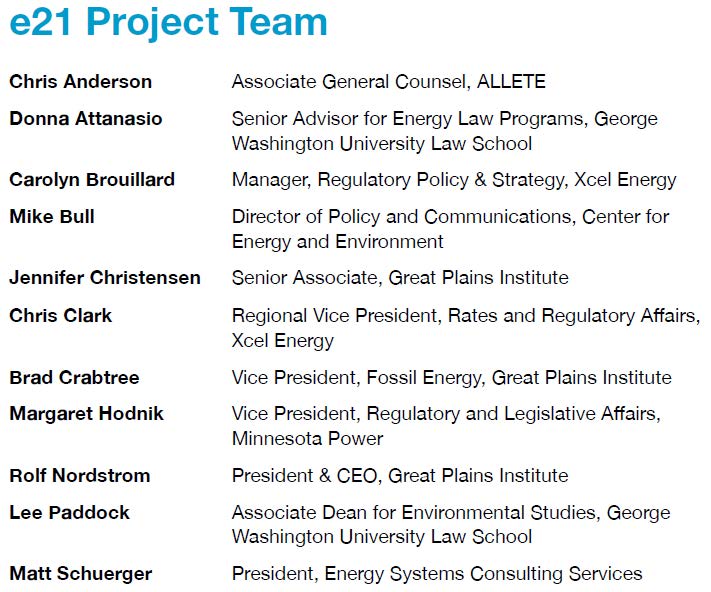 Does anyone else care that Matt Schuerger, most recent Dayton appointee to the Public Utilities Commission, was instrumental in working the e21 scam? Shouldn’t he have to recuse himself from any consideration of Xcel Energy’s e21 Initiative rate case?
And look at Bill Grant’s role in e21. He’s now Deputy Commissioner at Commerce in charge of energy issues, and was for 20+ years head of Midwest Izaak Walton League (working over then employee Beth Solholt and IWLA employee, now PUC Commissioner, Nancy Lange). Given Nancy Lange’s role in e21, she should also recuse herself.
And then there’s Mikey Bull’s role, as he recounts, and look who all is involved:
The e21 Initiative started as little more than a glimmer in my eye a couple of years ago, when I was a Manager of Policy and Strategy for Xcel Energy. I’d just come back from a meeting at the Edison Electric Institute about the impact of various dynamics – low load growth, increasing infrastructure investments, deeper penetrations of distributed resources – on the current utility business model. In general, rates were going to rise under the current model far faster as a result of those forces, and utility revenues become more uncertain.
Those dynamics were later chronicled in the Disruptive Challenges report issued by the Edison Electric Institute in January 2013. I realized that it was important for Xcel to try and get out ahead of the curve.
So I reached out from Xcel to Rolf Nordstrom at the Great Plains Institute and Nancy Lange then at CEE (now a Minnesota PUC commissioner), to start putting the e21 project together. Rolf and I worked to put a strong core project team together – CEE, Great Plains, Xcel Energy, Minnesota Power, George Washington University Law School and consultant Matt Schuerger. We then compiled a terrific group of stakeholders who together represent much of what constitutes the public interest – low income customer advocates, small and large business representatives, utilities, environmental organization, cities and other public entities, and regulators. Beginning last February, this group of 25-30 stakeholders met monthly for day-long sessions that were wonderfully facilitated by Rolf and Jennifer Christenson, his colleague at GPI, toiling together deep in the weeds of utility regulation.
It was an honor to work with all of them, as we coalesced around the set of consensus recommendations detailed in the report.
Here’s the full recap:

The legislation, SF1735, well, check the links below, and you can see how that went down. I was there, seeing is believing. First it was introduced, but despite the full room of SILENT “usual suspects” who had acquiesced to e21, and only a couple of us objecting to the bill, Sen. John Marty pulled it from consideration, initially on the Senate Energy and Environment Committee same days as legislative extension of the Getty and Black Oak wind contracts (the project couldn’t do it before the PUC so they go to the legislature), stuck in a placeholder “e21 Lite” and then put it in later as part of the Energy Ominous Bill, SF 1431:
- the problems with SF 1735… March 18th, 2015
- Bill to extend Getty/Black Oak wind contracts? (e21 discussed at this Committee meeting) March 24th, 2015
- SF 1735 – SHAME on each Senator who voted for it (in the Energy Ominous Bill) May 5th, 2015
These issues were raised, e21 marches onward, and here we are, in a rate case.
Philando Castile — dead. What’re we going to do about it?
July 7th, 2016

Philando Castile. Another police shooting death, another police murder. How do we turn this around? Why do police officers have their hands on their guns, and not tasers? Was nothing learned from Jamar Clark’s shooting? It goes beyond a matter of prosecuting the shooters, it goes beyond training, it goes to the fear, profiling, and systemic racism that triggers these shootings by police. Again, how do we turn that around?
What to do, what can be done… and it seems to me here’s a start: It’s time for systemic change to address the race/class/religious profiling and fear, for police protocol putting tasers as the first option (not guns), training all police officers on the use of deescalation techniques, raising the legal threshold for justifiable use of force, and a serious look at police psych testing and reevaluation of criteria for hiring. After the fact, we need an independent investigation, truth, and restorative justice process. Attend vigils and demonstrations, particularly us white folks. We can push in all venues, and action sure helps the existential angst!
A vigil for Castile being planned for 5:30 p.m. today at J.J. Hill Montessori Magnet School, where he worked and was well-respected. He was a cafeteria supervisor there and had worked St. Paul Public Schools since 2002.
Diamond (used Lavish fb account) Reynolds, Castile’s girlfriend, recorded this right after the shooting last night and posted it to facebook — facebook disappeared it for a while, but it’s back, and even the STrib has posted it, that probably won’t disappear.
The whole world is watching… It’s gone national, the police murder of Philando Castile, pulled over for a tail light out, and shot while sitting in his car while following directive of police to produce his license and reaching for his wallet.
From the New York Times:
Philando Castile Shooting in Minnesota Leads Governor to Seek U.S. …
And NPR:
‘I’m Outraged’: Mother Of Philando Castile, Slain By Police, Speaks Out …
Who was Philando Castile? From the St. Paul School District:
“Saint Paul Public Schools and its staff grieve the tragic death of a former student and current employee, Philando Castile.
He graduated from Central High School in 2001 and had worked for Saint Paul Public Schools (SPPS) since he was 19 years old, beginning in 2002, in the Nutrition Services Department.
Mr. Castile was promoted to a supervisory position two years ago and was currently working in one of our schools during the summer term.
Colleagues describe him as a team player who maintained great relationships with staff and students alike. He had a cheerful disposition and his colleagues enjoyed working with him. He was quick to greet former coworkers with a smile and hug.
One coworker said, “Kids loved him. He was smart, over-qualified. He was quiet, respectful, and kind. I knew him as warm and funny; he called me his ‘wing man.’ He wore a shirt and tie to his supervisor interview and said his goal was to one day ‘sit on the other side of this table.’”
Those who worked with him daily said he will be greatly missed.”
And thanks to the STrib for posting a transcript of Diamond Reynolds’ video:
Officer: Ma’am, keep your hands where they are.
Reynolds: He just got his arm shot off. We got pulled over on Larpenteur.
Officer: I told him not to reach for it. I told him to get his head up.
Reynolds: Please don’t tell me my boyfriend just went like that.
Officer: Keep your hands where they are please.
Officer: Get the female passenger out.
Reynolds: Where’s my daughter? You got my daughter?”
Officer: Let me see your purse. You have any weapons or anything?
Reynolds: Could you please get my phone for me?
Other officer: I’ll talk to my supervisor.
Reynolds: It’s right there it’s on the floor. It’s right there.
Other officer: Could you just stand here sweetie?
Child: I want to get my mommy’s purse.
Other officer: I’ll take care of that OK? Just stand right here for me.
Reynolds: Stay right here. Before you take the handcuffs off of me can you [inaudible]
Other officer: Can you search her before [inaudible]? I can’t it’s got to be processed OK?
Reynolds: Come here (to child).
Other officer: Is that your phone?
Reynolds: I can’t believe they just did this I’m [expletive] [screams].
Child: It’s OK, I’m right here with you.
Reynolds:[Cries]
Reynolds: Y’all please pray for us Jesus please y’all. I ask everybody on Facebook everybody that’s watching everybody that’s tuned in please pray for us. Sister I know I just dropped you off but I need you to pick me up I need [inaudible] to call my phone.

Dairyland’s Q-1D South Environmental Assessment
June 19th, 2016
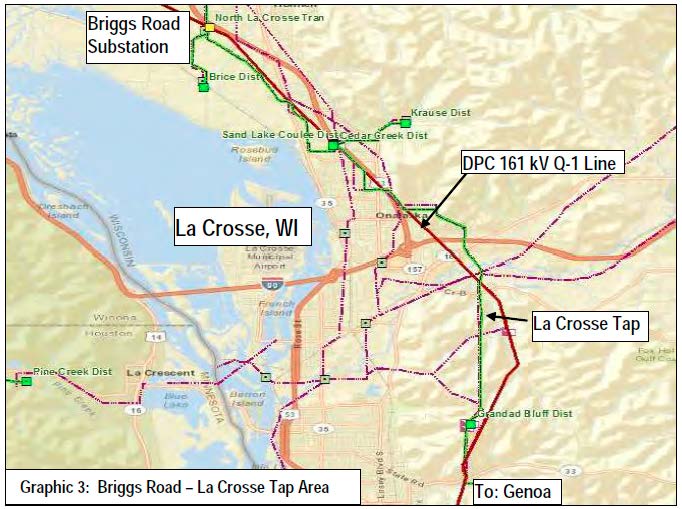
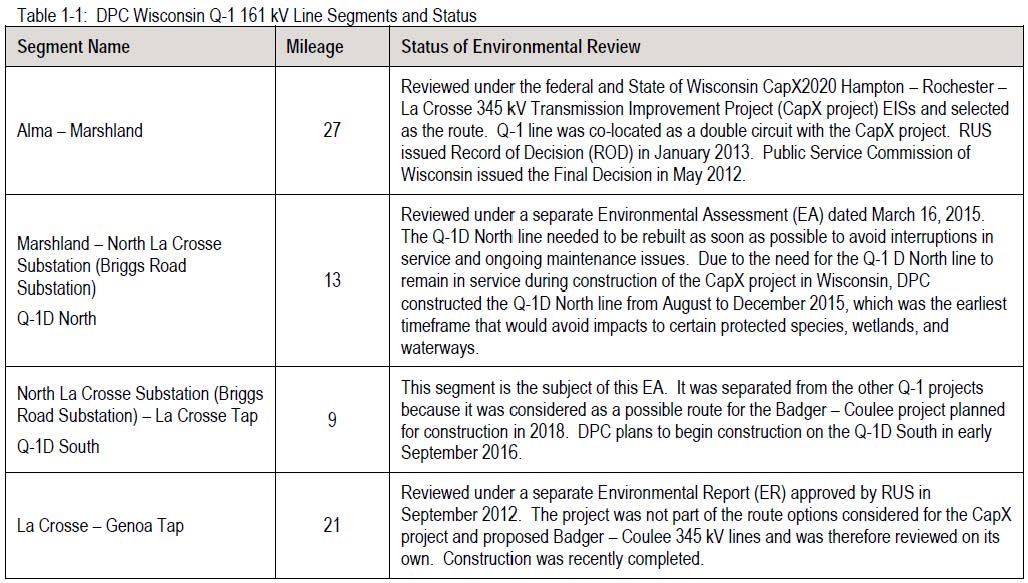
Dairyland Power Cooperative’s transmission through Onalaska and La Crosse is something to see…
Dairyland Power Cooperative and USDA’s Rural Utilities Service has released the “Q-1D South” Environmental Assessment, open for Comment until July 1, 2016:
And from Dairyland’s site:
Briggs Road to La Crosse Tap (Q-1D South) – Environmental Assessment
Comments are due July 1, 2016 — send to:
USDA’s Dennis Rankin: dennis.rankin@wdc.usda.gov
(I’d also cc DPC’s Chuck Thompson: cat@dairynet.com)
By U.S. Mail:
Dennis Rankin
Environmental Protection Specialist
USDA Rural Utilities Service
1400 Independence Avenue S.W.
Mailstop 1571, Room 2242
Washington, DC 20250-1571
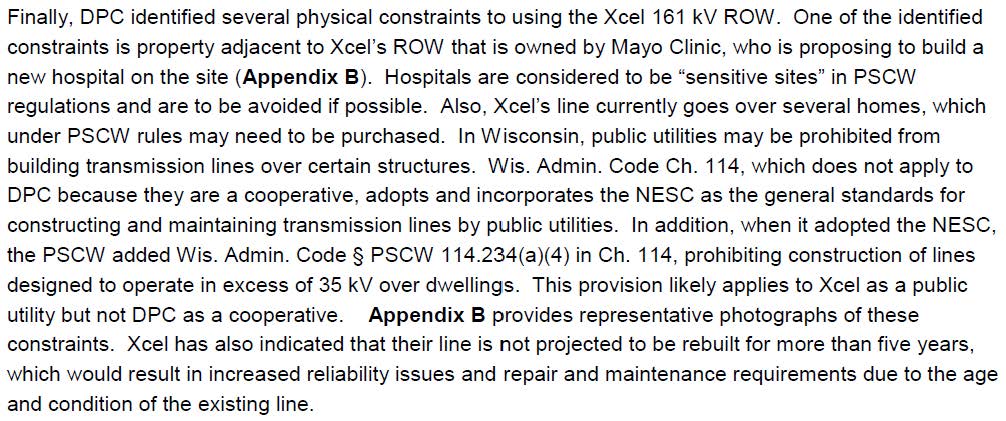
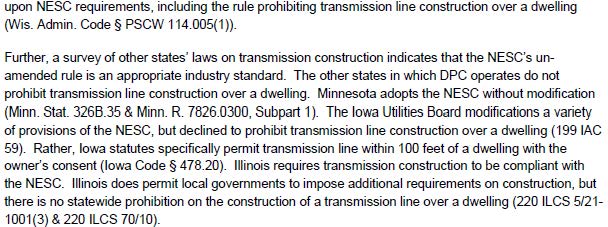
What’s to comment on? I see two issues that should be sufficient to stop this project in its tracks — the debt load of Dairyland Power Cooperative and the physical setting of the project which too near and right over people’s homes.
Debt load — Dairyland Power Cooperative’s debt is excessive and should prohibit taking on more debt:
Dairyland Power Cooperative’s Annual Meeting was last week. One purpose of an organization’s Annual Meeting is to discuss its financial status and approve plans going forward.
Dairyland depends on federal USDA/RUS loans to pay for its transmission expansion, such as the Q-1 transmission upgrades, including Marshland-Briggs Road and now the stretch from Briggs Road to North La Crosse south of I-90. Another USDA/RUS loan paid for Dairyland’s share of the CapX La Crosse line now blighting the bluffs. Dairyland will also be part owner of the MISO Hickory Creek to Cardinal line from Iowa to Madison. That’s a lot of transmission and loans.
Dairyland recognized this financial risk and lopsided debt/equity position, and in 2012 sought help from FERC_(DPC_Request4DeclaratoryOrder), requesting a hypothetical capital structure of 35 percent equity and 65 percent debt when its actual capital structure was 16.5 percent equity and 83.5 percent debt, and FERC did grant this relief in an Order for DPC for CapX 2020 (see FERC Docket, go HERE and plug in docket EL13-19-000). That Order, and the 83.5/16.5% debt/equity ratio was prior to the present Q-1 D South project and the MISO MVP Hickory Creek to Cardinal transmission line. Dairyland requested a “hypothetical” (bogus) debt/equity ratio to preserve its credit rating and enable low cost loans. The true debt level makes DPC a higher risk.
Are Dairyland members aware of the 83.5%/16.5 % debt/equity ratio and reliance on loans for major transmission projects? What’s the debt level where new projects are included? This new transmission enables increased power marketing and sales, a private purpose. Is this highly leveraged position for new transmission in the best interests of Cooperative members?
Physical setting of the project — it’s just too close!
The map way above is what the transmission system in the area looks like theoretically, according to the Wisconsin Public Service Commission, but here’s what Dairyland’s Q-1 South line looks like on the ground:

Really… Here’s what it looks like from a satellite with the lines drawn in, on the far south:
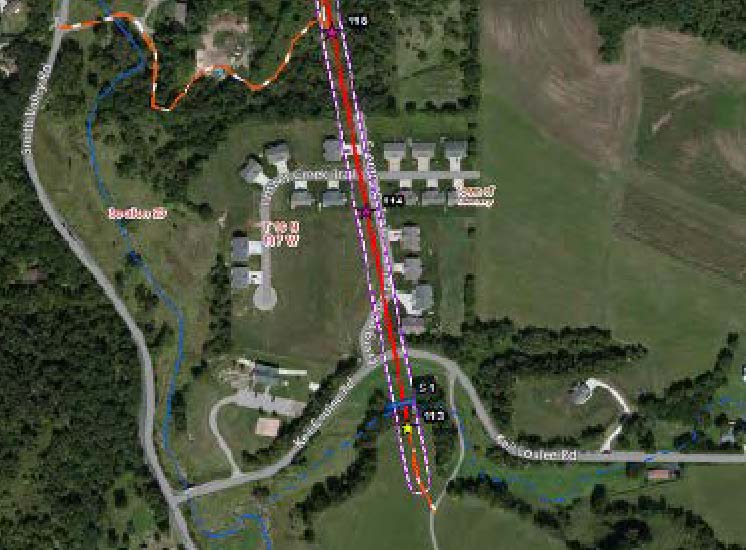
Here’s what it looks like further north — look at all those homes:

And here’s what the Wisconsin PSC Code says about clearances in PSCW 114.234:
(2) Transmission lines over dwelling units. [Follows NESC 234C1b, p. 119] (Addition) Add the following paragraph c:c. Transmission lines over dwelling units.No utility may construct conductors of supply lines designed to operate at voltages in excess of 35 kV over any portion of a dwelling unit. This provision also applies to line conductors in their wind-displaced position as defined in Rule 234A2.Note: It is the intent under s. SPS 316.225(6) that the public not construct any portion of a dwelling unit under such lines.Note: The term “dwelling unit” has the meaning given in ch. SPS 316, which adopts by reference the definitions in NEC-2008.Note: See s. SPS 316.225(6) Clearance Over Buildings and Other Structures, which refers to ch. PSC 114 regarding clearance of conductors over 600 volts and the prohibition of dwellings under or near overhead lines.
USDA’s Dennis Rankin: dennis.rankin@wdc.usda.gov
(I’d also cc DPC’s Chuck Thompson: cat@dairynet.com)
By U.S. Mail:
Dennis Rankin
Environmental Protection Specialist
USDA Rural Utilities Service
1400 Independence Avenue S.W.
Mailstop 1571, Room 2242
Washington, DC 20250-1571