Transmission CCN? NO!!! A win for Neighbors United!
March 28th, 2017

Hot off the press from the Federal Appellate Court — Missouri Western District
From the Order:
ATXI is an Illinois corporation authorized to do business in Missouri and engaged in the construction, ownership, and operation of interstate transmission lines that transmit electricity for the public use. It does not generate, distribute, or sell electricity to the general public or serve any retail service territory.
And the law is clear:
“If any of the items required under this rule are unavailable at the time the application is filed, they shall be furnished prior to the granting of the authority sought.” 4 CSR 240-3.105(2) (emphasis added).
And interpretation of the law:
The general language of section 393.170.3 authorizes the PSC to impose “reasonable and necessary” conditions on a CCN. However, the specific language of section 393.170.2 states that evidence of the county commission consents “shall” be on file before the PSC grants a CCN. “Where one provision of a statute contains general language and another provision in the same statute contains more specific language, the general language should give way to the specific.” Id.
And bottom line?
The PSC’s Report and Order is vacated as it was entered in excess of the PSC’s statutory authority.
Love it when this happens!
CO2 pipelines? It’s a red herring!
March 22nd, 2017

The Great Plains Institute has long been a problem, and it remains a problem, evidenced in today’s missive trying to bootstrap onto tRump’s “infrastructure” agenda, by releasing a “White Paper” “calling on President Trump and Congress to make CO2 pipelines a priority component of a broader national infrastructure agenda and recommending that the federal government support the development of CO2 pipeline networks.” Oh, great… brilliant idea, just brilliant.
Great Plains Institute a problem? Yes. They were paid handsomely to promote coal gasification, projects including but not limited to Excelsior Energy’s Mesaba Project, the boondoggle of boondoggles. For example:
Great Plains Institute – is Joyce getting their $$ worth?
January 18th, 2007
Carbon capture and storage/sequestration was seen by many circa 2005 as a “way forward for coal.” So the Walton’s Bill Grant said. No. It wasn’t.
CO2 sequestration is so… like… not happening!
It wasn’t a “way forward for coal” then, and it isn’t now.
The market has spoken on coal, and it’s clear that coal is on the way out as coal companies go bankrupt, as coal generated electricity languishes on the energy market, and as the inefficient and costly older coal plants have closed, with newer larger plants waiting in queue to be shuttered.
And CO2 capture and storage/sequestration is a farce. Why? Well, we learned a lot about CO2 capture in our fight against Excelsior Energy’s Mesaba Project. That’s where the Public Utilities Commission determined that it was just to expensive and risky to approve a Power Purchase Agreement — go HERE and search for PUC Docket 05-1933. Here’s a rough visual of CO2 capture and storage/use:
 From Global CCS Institute HERE
So what’s the problem?
- First, capture is costly and difficult, particularly capturing any significant portion of CO2 generated.
- The higher percentage captured, the higher the cost of that capture, and high percentage capture has not been achieved.
- The cost of capture is not only the cost to physically do it, the hardware, technology, and engineering, but there is a high cost in efficiency of the CO2 producer, a parasitic cost, meaning that if you’re capturing that CO2, you’re paying a high price in efficiency of an already inefficient process (burning is always inefficient).
- And another parasitic cost, these pipelines require pumping stations to pressurize andpump it into the pipeline, a pumping station every 75 miles or so to keep that pressure up, and a pumping station at the destination, and those pumping stations require 4-10 MW of power, depending.
- Environmentally, the impacts of digging up land for hundreds of miles is immense.
- These are private projects and for a private project, a private purpose, eminent domain isn’t available for the taking of people’s land.
Yet this CO2 capture and storage/sequestration farce continues, evidenced in the most recent Great Plains Institute missive I found in the inbox, here the missive’s link to CO2 capture and storage for oil extraction, “Enhanced Oil Recovery”.
Here’s their “White Paper” with what they’ll be lobbying for:
Short version: The federal government should make this CO2 pipeline and infrastructure build out happen across the country, a la the Interstate highway system.
In light of tRump’s Executive Order 13766, Expediting Environmental Reviews and Approvals for High Priority Infrastructure Projects, that’s a scary notion.
Check out this site from Global CCS Institute, and note, they talk of benefits, but look for talk of costs. Hmm…
A “way forward for coal?” CO2 capture? Over my dead polar bear.
#notmyPresident – Keystone XL pipeline is baaaaaaaaack
March 10th, 2017

Here it is, TransCanada’s Keystone XL Pipeline is baaaaaaaaaaack. From the Federal Register Notice:
On February 5, 2014, the Department invited members of the public to comment on any factor they deem relevant to the national interest determination that will be made for the Keystone XL project application (79 FR 6984) and it is not inviting further public comment at this time.
Really…
A cut and paste from the State Department site:
On January 26, 2017 TransCanada submitted a Presidential permit application to the Department of State. The application and other project documents can be found here.
Documents relating to TransCanada’s 2012 application can be found here.
Two days… they resubmitted the application two days later… and no comment period. WHAT?!?!
Here’s the Federal Register Notice for TransCanada Keystone Pipeline (it did take about two weeks for that to come out, and it’s just after the Enbridge Line 67 Expansion Federal Register Notice!).
Xcel Energy’s Peak Demand – nowhere’s near 2007
February 27th, 2017
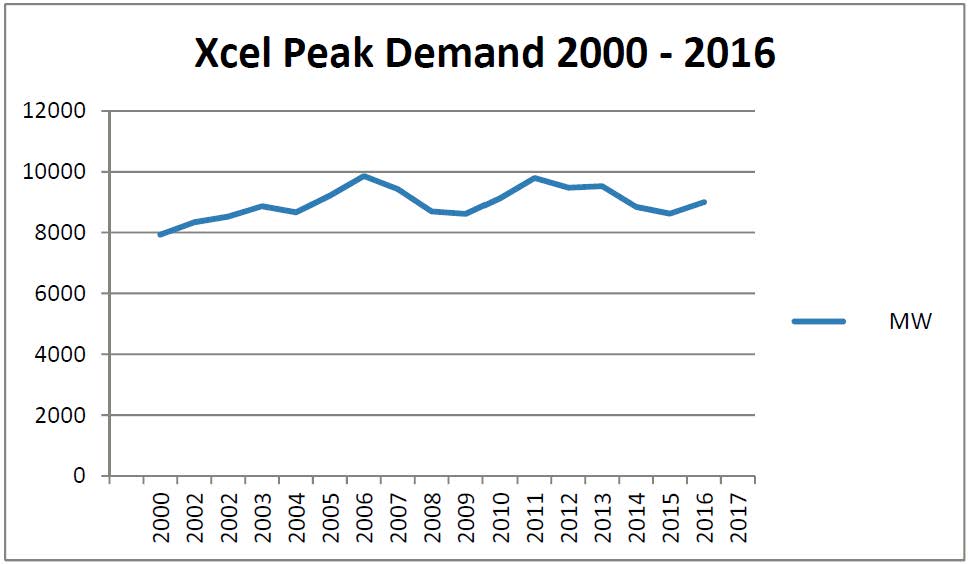
Xcel Energy has released its 2016 SEC 10-K, and here is the number I care most about, the peak demand, incorporated into the chart above:

“Peak Demand” is the number they use to attempt to justify “need” for all sorts of abhorrent and expensive infrastructure, particularly infrastructure of the transmission variety. Here are the specifics in megawatts (MW):
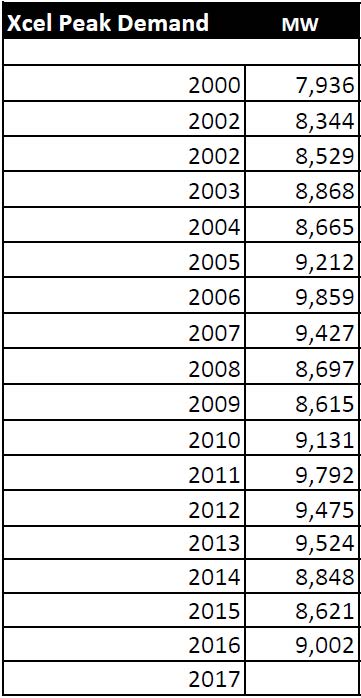
As Xcel Energy’s Ben Fowkes says, this is the “new normal.” From the Seeking Alpha transcript of the XEL Earnings Call, January 31, 2013.
Hence, they’re looking for other ways to make money, which they found in transmission, specifically CapX 2020 transmission, which was justified with this chart from MN Dept. of Commerce’s Steve Rakow, in his bar napkin depiction of the ups and down of peak demand:
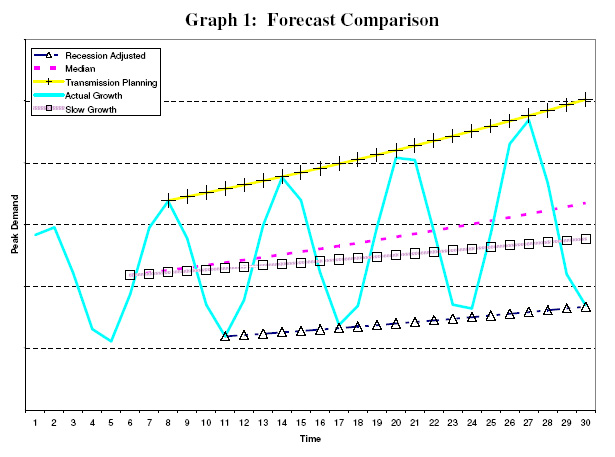
Compare this drunken-dream drawing with the actual peak demand above — doesn’t look at all similar, does it. Nevertheless, we’ve been stuck with over $2 billion in transmission infrastructure build-out which we’re just starting to pay for, and just starting to see show up in rate cases. People are just now starting to get a feel for the economic impact, as if the environmental and quality-of-life impact isn’t bad enough…


Meanwhile, after going through years and years over CapX 2020, followed by the MISO MVP 17 project portfolio, now under construction, MISO wants to spring another bunch of projects on us. Their “Transmission Overlay.” Yeah, right…
Here’s the list, in a spreadsheet:
This is the MN, WI, SD, ND and some IA wish list weeded out from that spreadsheet (click for a larger version):
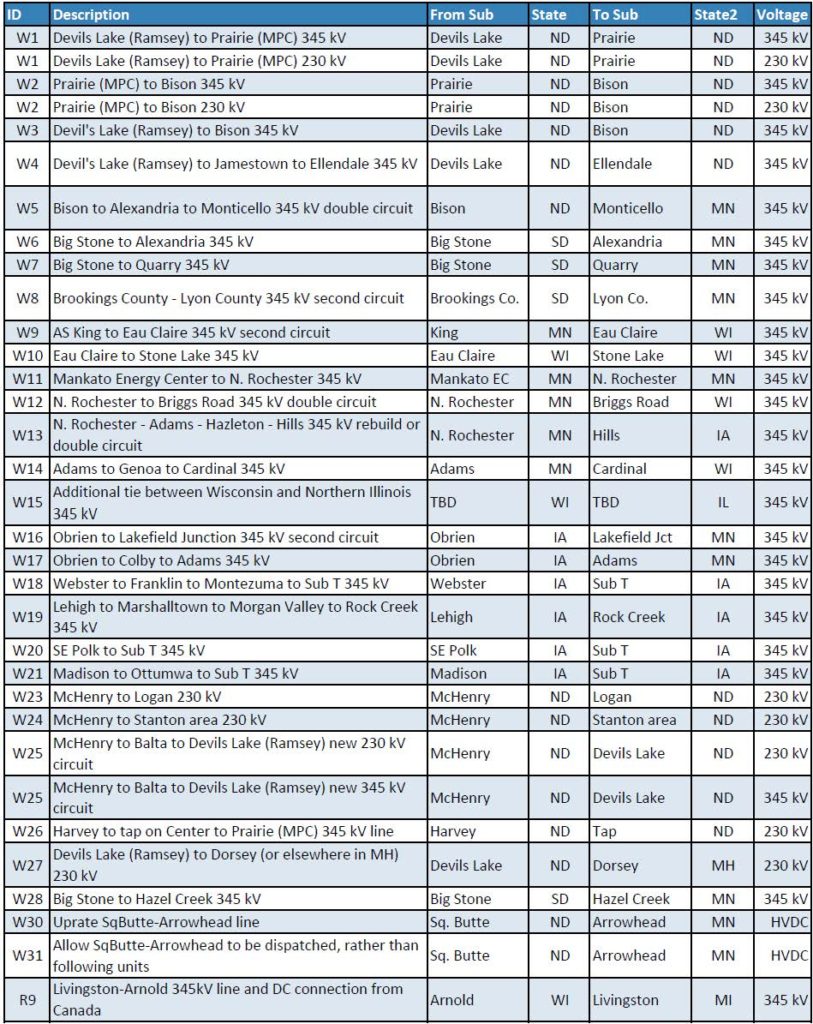
They want to add all of this, nevermind that Xcel is whining in its e21_Initiative that only 55% of the grid is not utilized:
(N) Identify and develop opportunities to reduce customer costs by improving overall grid efficiency. In Minnesota, the total electric system utilization is approximately 55 percent (average demand divided by peak demand), thus providing an opportunity to reduce system costs by better utilizing existing system assets (e.g., generation, wires, etc.). (e21_Initiative_Phase_I_Report, p. 11).
And they want to build more? MORE?!?!
And they want to ram it through even though it’s not needed, just like CapX 2020 transmission? As if Obama’s RRTT wasn’t enough, pushing CapX 2020 Hampton-La Crosse transmission line:
Obama “fast tracks” CapX Hampton-LaCrosse?!?!?!
… check out tRump’s Executive Order 13766:
Expediting Environmental Reviews and Approvals for High Priority Infrastructure Projects
GRRRRRRRRRRRR! As if there’s not enough work to do these days… but you know, the work never ends for us “paid protesters.” And a woman’s work is never done either.
Oroville dam has been under scrutiny forever!
February 18th, 2017

That’s the mess that stopped Amtrak’s Coastal Starlight train, and we had to take a bus around it, from Redding down to Sacramento (that leg is up and running again, but now Costal Starlight between San Luis Obispo and LA is down). Climate change and extreme weather is the theme of the month, particularly during this “vacation” which is turning into a “Climate Change Tour.”
Yesterday’s storm fortunately was focused on southern California, so the Oroville dam area didn’t get hit as hard as was thought earlier:
Deadly storm slams Southern California – CNN.com
But this Oroville dam safety issue is nothing new:
Releasing water at Oroville Dam a lingering problem
How Did the Oroville Dam Crisis Get So Dire? – The Atlantic
Oroville Dam Disaster Is a Wake-Up Call for Infrastructure Investment
Sacramento Bee –Check out this interactive 3D model of Oroville Dam
For years there has been ongoing safety analysis and scrutiny, yet here we are now. ??? In crisis… many people evacuated, over 180,000 in many cities and surrounding areas:

Look up FERC Docket P-2100 for more info, much is about Thermalito, but much is about Oroville. It’s about 50/50. The “good stuff” is CEII, which means that regular folks can’t look.
I’d heard there was a 2005 safety report in the relicensing docket, but can’t find a public copy. Here’s an example of what I found most interesting in the Oroville docket… BUT WAIT… it’s CEII, so we have no way of knowing what’s at issue:
| Category/ Accession |
Doc Date/ Filed Date |
Docket Number |
Description | Class/ Type |
|
|||||||||||||||||||||||||||||||||||||
| Submittal 20141216-5278 Document Components |
12/16/2014 12/16/2014 |
P-2100-000 | Department of Water Resources under P-2100 submits Ninth Part 12D Independent Consultant’s Safety Inspection Report and Supporting Technical Information Document for Oroville Dam. Availability: CEII |
Report/Form / Part 12 Consultant Safety Inspection Reports |
|
INFO | ||||||||||||||||||||||||||||||||||||
| Submittal 20141210-5070 Document Components |
12/10/2014 12/10/2014 |
P-2100-000 | Department of Water Resources submits CEII Potential Failure Mode Analysis Report for Oroville Dam under P-2100. Availability: Public |
Report/Form / Other Dam Safety Report |
|
INFO | ||||||||||||||||||||||||||||||||||||
| Submittal 20141210-5071 Document Components |
12/10/2014 12/10/2014 |
P-2100-000 | Department of Water Resources submits CEII Potential Failure Mode Analysis Report for Oroville Dam under P-2100. Availability: CEII |
Report/Form / Other Dam Safety Report |
|
INFO | ||||||||||||||||||||||||||||||||||||
| Submittal 20141205-5099 |
12/05/2014 12/05/2014 |
P-2100-000 | Update to Service List for Pierce Atwood LLP Under P-2100. Availability: Public |
Pleading/Motion / Procedural Motion |
|
INFO | ||||||||||||||||||||||||||||||||||||