Solar Tour – October 1 – Plan Ahead!
September 18th, 2005
It’s the annual Solar Tour! This year it’s Saturday, October 1, from 10:00 a.m. until 5:00 p.m., and there are 31 installations to check out, including the Carleton wind turbine… turbine? …well, it’s out in the sun, right? And the Green Institute’s Solar Roof!

The Solar Tour is sponsored by the Minnesota Renewable Energy Society (MRES), Aveda Corporation, which utilizes renewables and conservation in its production facilities; Xcel Energy, and Great River Energy. Here’s the MAP for the Solar Tour.
If you just can’t wait another week, there’s a Community Solar Project Planning Workshop at the Dodge Nature Center, all day next Saturday, September 24th, starting at 8:30 a.m.
Solar’s a happenin’ thang, from massive installations out in the desert

and on the roof of the community washeteria up in Arctic Village, Alaska, near ANWR

and if it works there, it works anywhere, well, nearly anywhere, like in Austin, Minnesota, where the paper is crowing about that community’s steps:
Friday, August 05, 2005
Opinion
Citizens can lead the way toward change
Here’s the story about that project in Austin:
Wednesday, August 03, 2005
Tapping the sun’s power
By Lee Bonorden/Austin Daily Herald
Good Earth Natural Foods is basking in the sun.
Owner Caron Jagodzinski is a believer in renewable energy, judging by her solar panels. They rest on the south side of the building, where everyone can see them and be reminded of the sun’s importance as a renewable energy source.
Hunter Electric, Inc. is doing the work, and Austin Utilities is partnering.
“I think it’s good for everyone,” said Kelly Lady, energy services consultant. “We sell power. She wants to produce her own. In this case, Good Earth Natural Foods will use all of the energy it produces. It will be minimal, but it’s a step in the right direction to find alternative energy sources and reduce our dependence upon fossil fuels.”
Work began Monday at Good Earth Natural Foods, located at 120 Third Ave. NW, Austin. Mark Hunter had the right man for the job: Tom Yates, who lives in a solar home outside of Austin.
Hunter Electric Inc.’s owner, Hunter, was excited about being involved in “energy history.”
“This is the first solar panel going up on Austin Utilities lines,” he said. “Each panel puts out about 110 watts. There are eight panels. There will be 40 volts per panel with no load on it. It will put out 320 volts of DC power.”
That’s a minimal amount of electricity, but Hunter said it’s enough to illuminate eight 100-watt light bulbs an hour.
Hunter said the solar project should be completed this week.
Yates, the “Mr. Solar Energy” of Austin, said the Good Earth Natural Foods system’s 880 watts is a little less than 1 kilowatt. “This is going to run lights and cash register. That kind of equipment,” Yates said.
Because of the heavy demands for electricity by the freezer/refrigeration equipment in Good Earth Natural Foods, the panels will generate less than 10 percent of the total energy needs of the business.
“I think she’s doing it more for the next generation,” Yates said.
“This system would cover a third of my use for my house,” Jagodzinski said.
The business owner is serious about trying to reduce her own dependence upon the public utility’s electricity. “I have already put compact fluorescents in and reduced my electrical use by three or four percent,” she said.
At home she uses a washing machine that will pay for itself in five years with just the water she saves.
“This is a dream come true for me,” Jagodzinski said of choosing the solar system for her business.
Choosing the south side of her building was the “perfect location” for the solar panels, according to Yates.
Solar technologies use the sun’s energy and light to provide heat, light, hot water, electricity and even cooling, for homes, businesses and industry.
“They make a huge variety of solar energy devices,” Hunter said. “Shingles that go on roofs, as well as panels.”
“Drive around and look at all the highway construction signs,” Hunter said. “They have panels to power batteries to illuminate the signs.”
Austin Utilities has a policy to guide the implementation of projects such as the Good Earth Natural Foods solar panels.
According to the utility spokesperson, Lady, people in Austin who want to produce their own electricity must contact Austin Utilities first for a preplan and follow-up inspections.
In Jagodzinski’s case, the solar energy she will produce will be tied directly to the Austin Utilities power line through an inverter converting the energy from DC to AC.
According to Yates, adapting to renewable energy sources is being done more aggressively by businesses.
According to the Austin Utilities’ spokesperson, it will cost between 18 and 25 cents per kilowatt hour to produce electricity with the eight solar panels, while the utility’s cost is 8 cents per kilowatt hour.
Austin Utilities plans to launch a campaign to encourage solar energy usage in October.
People such as Yates and now Jagodzinski are prepared to endure that while making a statement.
“Look at the heat,” Jagodzinski said Monday afternoon, during the sidewalk interview on another hot, humid day. “Right now, as we’re standing here, that’s going to work up there.”
By mid-afternoon Tuesday, the panels had generated their first units of electricity. A meter installed in the front window of the business will record the energy generated.
For information about renewable energy projects with Austin Utilities, call Lady at 433-8886.
============================================
This year’s Solar Tour will feature Austin’s Good Earth Natural Foods new solar system, and also the home system of Tom Yates, the guy who built the one at Good Earth — and ask him how to make your own diesel fuel while you’re there. Look for numbers 30 and 31 on the Solar Tour!
The Solar Tour has sites in Minneapolis, such as Christine Ziebold’s #18, and in St. Paul, of course, and also Sun’s Warmth Rich Huelskamp’s house near Red Wing, the Brom residence in Winona, and even homes in Mora and Mendota Heights and Fridley! Here’s the MAP for the Solar Tour. That’s Saturday, October 1, from 10 a.m. to 5 p.m.
The Midwest Renewable Energy Association (MREA) also has a solar tour that pretty much covers the state of Wisconsin. Details here. There are tours, but you have to sign up for them, so check it out ASAP! MREA offers Certification classes — their page is under construction, so call 715-592-6595 for information or email.
How come Bob & Suzannah’s house isn’t on the tour? Ray, you’re slipping!

Hey Gov – time to get Bob Cupit and Mike Bull out in front!
September 9th, 2005
This weekend I was mired in energy policy — I needed to stay home for quality time with the girls, a good excuse to bite the bullet and reorganize my home office, which is the polite term for boxes and piles of energy biomass strewn all over the house. It’s important stuff, consisting of electrical studies, newspaper articles from all over, project applications, thousands of pages of transcripts, bootleg EPRI reports, the Arrowhead file alone is over 12 boxes and my shelves are collapsing. So it’s off to buy 2x4s and shelf “systems” and do what it takes to anchor it into the walls and give the house an easterly list. Ta-daaa! Done!

The worst part of this job was the days of prep work in refiling and reboxing, reliving the files, and the best part is recognition of some brilliant nuggets, particularly in nuclear, and rediscovering all the gems of information that should be public information. Without John Bailey as keeper of the ME3 website, we’ve lost the most important information clearinghouse ever — in this day of computers and internet, there’s no excuse for not having a public resource for all of this. So how do we make sure all of this is in the public domain — that’s what I’m mulling about these days.
FOCUS ON ENERGY POLICY NOW!
Today’s STrib editorials were energy focused, and here’s one I agree with wholeheartedly. We need to put energy issues and those working on energy up front where they belong, particularly given those in important positions, like Bob Cupit, the Energy Planning Director, and Mike Bull, Energy Pooh-Bah.
Editorial: Energy & govs/What they say, do matters
September 9, 2005
Let’s play “Name That Governor.” Who responded to fast-rising gasoline and heating-fuel prices by creating a state agency to promote conservation and non-fossil fuel energy sources?
Answer: Gov. Wendell Anderson. The year was 1974.
Who made headlines urging that Minnesota become as energy-independent as possible? Who proposed that Minnesota become North America’s top energy research center? Who asked the Legislature for a $30 million program to promote conservation and renewable energy sources, including solar, biomass and peat? (Hint: Peat is found on the Iron Range.)
Answer: Gov. Rudy Perpich, in 1983. By then, Minnesota was on its way toward establishing itself as an energy policy leader among the states. Actions by state lawmakers were crucial to putting ethanol-blended gasoline in Minnesotans’ vehicle tanks, and turning the Buffalo Ridge in southwestern Minnesota into the Saudi Arabia of wind-generated electricity. The Natural Resources Research Institute at the University of Minnesota-Duluth was spawned by Perpich’s call for more energy research.
It cannot be said that Minnesota has dropped the ball on energy in the intervening years. But this state is no longer running away with it, either.
Seventeen states have tougher requirements for electric utilities to convert to renewable fuel sources for power generation. Others offer tax incentives that Minnesota does not for the purchase of energy-efficient products. One of the state’s key conservation programs would be more effective if it concentrated on business rather than residential consumers, a legislative auditor’s report said. Minnesota’s interest in ethanol as a motor fuel has appeared to be mostly about propping up the price of corn.
Still, to his credit, Gov. Tim Pawlenty mimics Perpich on energy in an important way: He talks about it. In recent months he’s popped up at pro-ethanol rallies and wind-turbine dedications. As gas prices shot up last week in the wake of Hurricane Katrina, he touted ethanol use in motor vehicles, and said at the State Fair that it’s time to “encourage people to think about their traveling and purchasing habits, in a way that emphasizes smarter ways to get around, like transit and perhaps more fuel-efficient vehicles.”
What governors say matters. So does how they organize their administration. In that regard, Pawlenty might consider mimicking Anderson’s move. The state energy office is now tucked almost invisibly in the Commerce Department. Given the importance of sustainable, affordable energy supplies to this state’s prosperity, a more visible and vigorous state office promoting conservation and renewable resources is warranted.
Xcel’s highly exercised influence exposed
August 30th, 2005
Xcel really gets around — it we knew how far those tentacles reached…

Candidate questions Kelly link to Xcel exec
Jackie Crosby, Star Tribune
August 30, 2005St. Paul mayoral candidate Elizabeth Dickinson questioned Monday whether Mayor Randy Kelly could legally allow a top Xcel Energy executive to raise money for his campaign while at the same time the city is negotiating a new franchise agreement with the energy company. Kelly’s office and campaign strongly denied any wrongdoing.
Dickinson, the Green Party candidate, stopped short of accusing the mayor of breaking any laws, but said: “I think that a lot of people looking at this would say it may not pass the smell test.”
Dickinson, who has a combative history with Xcel Energy over its coal-producing High Bridge plant in St. Paul, held a news conference in front of City Hall to question whether Kelly violated the city’s “ex parte contacts” ordinance after Steve Schmidt, Xcel’s manager of local government relations, was among the hosts of a fundraiser for Kelly on Aug. 17. “Ex parte” is a legal term that refers to one-sided communication in a contested matter.
The franchise fee agreement with Xcel grants the company rights to provide natural gas and electricity using city streets and other rights of way. It is renegotiated every 10 years and will expire in mid-2006. The city is in the early stages of the process, with formal negotiations expected to begin in October.
St. Paul City Attorney Manuel Cervantes said “ex parte” laws apply to conversations, not social functions, fundraisers or relationships.
“As long as you’re not in communication about the issues that are on the franchise negotiation table, the prohibition is not in place,” he said.
Nancy Haas, Kelly’s chief of staff, said Dickinson’s claims were unfounded.
“The mayor understands the law and the sensitivities involved in contract negotiations,” Haas said. “He has never had a conversation with Steve Schmidt regarding a material issue in this case.”
A spokeswoman at Xcel Energy also said no “ex parte” conversations have occurred regarding the franchise renegotiation. Mary Sandok said in a statement that Xcel encourages employees to be politically active, “recognizing that such involvement is strictly voluntary and shall take place on the employee’s own time.”
Schmidt has been the liaison between the city and Xcel Energy during this pre-negotiation stage, said Matt Smith, St. Paul’s finance director and chair of the negotiating committee.
Schmidt is a civic booster who was crowned King Boreas of the St. Paul Winter Carnival in January. He was one of about 35 people putting on the fundraiser, Kelly’s campaign said.
“Steve Schmidt is an active citizen of St. Paul and has the same freedoms as every other American to be active in the political process,” said Vince Musik, a spokesman for Kelly’s campaign.
Dickinson has made renegotiating the franchise agreement a campaign issue. This year, fees from Xcel Energy will bring about $17 million to the city, the third-largest revenue source behind property taxes and the state’s local government aid.
Dickinson has proposed increasing the franchise fees paid by residents to raise $1 million to $2 million, which she would use to pay for public safety.
Dickinson said she is not planning to make a formal complaint against Kelly or his campaign at this time.
Jackie Crosby is at jcrosby@startribune.com
——————————————————–
Thanks to St. Paul Mayoral Candidate Elizabeth Dickinson for shining the light on this connection.

Here’s her website. I know her from her work on the Clean Water Action Alliance Board, and appreciate her courage in testifying against the Mesaba project, when environmental groups supposedly concerned about coal and central station power were utterly absent, and she was one of us few who testified.
————————————————-
This example of the influence of Xcel is all too familiar. I remember when Todd Rapp, former House Speaker Phil Carruthers’ top guy, went over to the dark side… there was a rash of this back then, haven’t looked at that file in years, let’s see, there was Mary Krinkie, Jill Sletten, Tony Kliwas (?), who else… I’ll dig up the file and fill in the blanks soon.
TODD RAPP, FORMER aide to House Speaker Phil Carruthers (DFL-Brooklyn Park), this week starts work at Northern States Power managing state-government relations. Recently, Rapp stirred controversy at the Legislature when it was rumored that he would be taking the NSP position shortly after attending a legislative junket to California to study energy deregulation. At the time, Rapp said he was planning to take a month off before deciding where he would land. He stayed home after Sen. John Marty (DFL-Roseville) and Rep. Alice Hausman (DFL-St. Paul) pointed out the conflict posed by Rapp’s taking both the trip and the NSP job.
“It must have been a wonderfully lucky guess,” Marty quips of his prediction, adding that it’d be disappointing if Rapp took the job at NSP last month but didn’t announce it because it would look bad. “If the goal was to take a month’s break, then say I’m going to take a long break and then go work for NSP,” Marty says. “If this was an attempt to minimize criticism for the revolving door, they have consequently shown that it is a concern.”
Todd Rapp went to NSP not long after his boss, then Speaker Phil Carruthers, did a deal that left me wondering — Carruthers wanted NSP to have the option of putting nuclear waste in Florence Township, and he wanted it bad. At the time I represented Florence Township, and we were trying for a repeal of the “Alternate Site Mandate.” Carruthers did a deal with Steve Sviggum that showed up in Rep. Phyllis Kahn’s Gov Ops committee, and in this deal he would give up the DFL’s minimum wage increase to KEEP Florence Township stuck with nuclear waste under the “Alternate Site Mandate” (Can you think of a positive rationale for this?). Kahn and Rep. Tommy Rukavina were brilliant, they separated the two sections out, and first outed Carruthers on the minimum wage, and he gave it up and that amendment passed, and then had the committee vote on repealing the alternate site mandate, and that passed too, and Carrthers was furious! The repeal went forward (but ultimately failed). It was one of the most informative moments in politics I’ve ever experienced!
Ed Garvey is oblivious???
August 1st, 2005
Back to Wisconsin’s Ed Garvey:

This is the Ed Garvey who ran in 1998 for Governor of Wisconsin, who over the years took around $500,000 in Wisconsin’s Intervenor Compensation to represent SOUL on the Arrowhead Transmission Line (and put a first year attorney on the case), and recently in his blog seemed upset that WI’s Democratic Gov. Doyle signed the legislation that gave utilities power to take county land for the Arrowhead Transmission Line… Huh? Can it be that Garvey, the 1998 Democratic gubernatorial candidate, doesn’t know what the Democratic gubernatorial candidates before and after him have done? Does he not know of Chuch Chvala’s impending trial? Does he not know of Doyle’s acceptance of campaign money from utility PACs and employees?
Funny how it works — I got this article from a “little birdie” in Wisconsin moments ago…
From the Milwaukee Journal Sentinal (click on headline for full story):
Utilities gave Doyle cash as projects OK’d
Political action committees for and employees of Wisconsin Energy Corp., Wisconsin Public Service Corp. and American Transmission Co. gave Doyle $50,660 just before or after their projects received key approvals, according to figures collected by the Wisconsin Democracy Campaign, a non-partisan group pushing for campaign finance reform.
And it’s an ongoing thing:
Between 2002 and June 30, 2004, people affiliated with the state’s gas and electric utilities gave Doyle $133,323, a 17-fold increase over the $7,911 such individuals gave Doyle from 1995 to 2001 when he was attorney general, the report found.
Here’s an itemization of Doyle’s “Energy” contributors.
Why is Garvey having so much trouble accepting that Chvala and Doyle are utility toadies? Is it because the straight line between the 1994 and 2002 races runs right through Garvey’s 1998 race?
Deja vu! Electricity: Winners and Losers
August 1st, 2005
You may remember reading about this on the Bly Blog, and here it is again, Electricity: Winners and Losers, but this time the gathering was in Lindstrom, Minnesota.

Jamie Anderson, our hostess with the mostess, runs Many Voices Bookseller and Coffeeshop, and it’s “info central” in the area, hosting events like this, the Wild River Audubon Society, and trying to fill those needs in a small rural/exurban community, well, you have to be out here to understand…
We were there to see Green Green Water and talk about energy. Now’s the time to check it out, right HERE! It’s the story of the impacts of our energy choices, and an urgent call to take responsibility for electrical generation — we can do it differently.
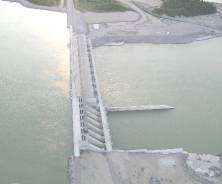
This “Electricity: Winners and Losers” was put together by Just Energy and was sponsored by Women’s Environmental Institute, Many Voices Bookseller and Coffeehouse, and Minnesotans for an Energy-Efficient Economy, and Ken Bradley of Just Energy at ME3 presented their film clip of Green Green River.
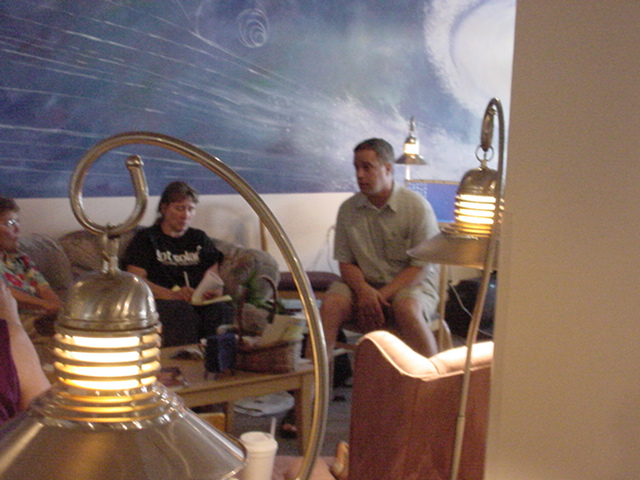
Also present were Women’s Environmental Institute staff members Rep. Karen Clark and Jacqueline Zita, and a room full of area folks, real people who are affected by the changes this legislative session.
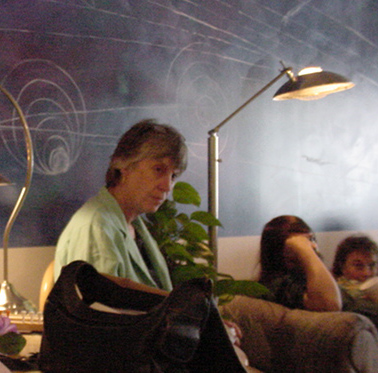
Yes, I went there on a mission — first, to make sure everyone in that room knew there was no electricity crisis. For that, just look at the CapX2020 report (the 6,000MW claimed need in the chart on p. 5, and the 16,712MW in line for generation interconnection shown on p. 7, do the math, we’re fine). The more complicated part was about the Chisago line, which is going to go right through downtown Lindstrom. Years back, the locals had tanked the NSP Chisago Transmission Line by showing that it wasn’t needed to serve Minnesota load, that was back in the days where it was “Minnesota” need that mattered. Now, as of the last legislative session’s Transmission Omnibus Bill from Hell, it’s REGIONAL need, and it’s going to be pert near impossible to disprove that need, it’s just too broad. Shellene Johnson, President of Concerned River Valley Citizens, did a great briefing of the status of the project and some of the problems she anticipates, and she knows that the changes this session will hurt her community, those living under the line.
All of you at home, get out your pens and Thank You Notes — We have Bill Grant of the Izaak Walton League, Midwest Office, and George Crocker of North American Water Office to thank for their work as the primary ones who trotted this “good deal” around and sold it to legislators. That’s what made this change happen.
Everyone in that room in Many Voices in Lindstrom needed to know that Xcel regularly promises to submit its application, and has already obtained approval from the PUC of its Notice Plan. This legislative change will have an impact on them all personally. So, get ready, roll up your sleeves — we’ll have a lot of work to do.
Here are the specific legislative additions that make “regional” need the criteria — from the Transmission Omnibus Bill from Hell SF1368:
6.35 or, in the case of a high-voltage transmission line, the
6.36 relationship of the proposed line to regional energy needs, as
7.1 presented in the transmission plan submitted under section
7.2 216B.2425;
and
7.19 (9) with respect to a high-voltage transmission line, the
7.20 benefits of enhanced regional reliability, access, or
7.21 deliverability to the extent these factors improve the
7.22 robustness of the transmission system or lower costs for
7.23 electric consumers in Minnesota;
and
12.28 Subdivision 1. [TARIFF ESTABLISHMENT.] A tariff shall be
12.29 established to optimize local, regional, and state benefits from
12.30 wind energy development, and to facilitate widespread
12.31 development of community-based wind energy projects throughout
12.32 Minnesota.
Regional need. Great. Thanks George… Thanks Bill…