The Face of Mesaba & the Cox & Bull Story!
October 21st, 2005
Last night was the Energy Discussion that Mike Bull put together, one of many he’s doing around the state. Here’s his name in lights this week: Energy plan tilts to windmills. Mike’s the Assistant Commissioner for Renewable Energy and Advanced Technologies, and I’d guess he’s probably hitting those areas that need the help that only the Gov’s top energy boy can lend! Coming up soon, Morris, Preston, and somewhere on the Range in December! Without a doubt, it’s campaign season in Minnesota…

As Ray notes in his blog, many of those present were lobbyists — how many can you name in this photo???

After Mike’s presentation, it was opened to questions, and there was a lot of talk about biodiesel, and Jesse Streitz did have great comments about reducing energy and the need to make energy options available to all, making it an individual action that people can really take — I sure couldn’t afford solar or a new hybrid car, much less a home like Ray built for Jesse!
The Face of Mesaba
The drum roll came as Linda Castagneri spoke. She and her husband Ron Gustafson are the “Face of Mesaba.” Linda is a native of the range who grew up with the Michelettis. Ron and Linda are very real people who are faced with this insane concept of trains and trucks roaring through their yard, transmission lines overhead, underground pipe lines for natural gas and water, constant industrial sounds and bright lights… who could have imagined that one day this project would come to their beautiful haven nestled between two lakes in the old growth pine bog?

Linda and Ron are two of the landowners affected by the Mesaba coal gasification plant. Here is the site plan Download file
Linda asked Rep. Cox why he supported the bill exempting Excelsior from a Certificate of Need, and giving them, a private company, the power of Eminent Domain. Ray admitted to supporting the Bill, but stated that it has turned out to be a “bait and switch” as legislators were led to believe the project was to be built in Hoyt Lakes. He did not say that he’d do anything to change it!
Mike Bull stated several times that the Excelsior Energy Plant was not a done deal, and said the state is “kicking the tires” and not quite sure to buy into the project or not. He said it has become very expensive and that no one knows at this point what it will actually cost. Ron, who had the DOE Notice of Intent, reminded him that the Federal Register lists the cost at 1.9 billion, plus the state bond costs, and he let us know that Excelsior Energy had come to the County wanting even more money, more than $50 million for infrastructure. Mike also stated that although the statute exempts Excelsior from a Certificate of Need, it does not prevent the state from requiring Excelsior to prove the need for the plant, and they will have to do this at the PUC when the Power Purchase Agreement goes before the Commission. This statement was contrary to what Bill Storm, the EQB project manager, has previously told Ron and Linda. It’s also contrary to my take on the law and agency process. And claims that “it’s not a done deal” do not alter the fact that everyone concerned about Mesaba will have to participate in every aspect of the permitting process — I’ve already been on this project since December, 2001. It keeps moving forward, and it is moving forward, it has not stopped.
Mike Bull said that neither he nor the state considers coal gasification as a renewable energy source, although there were legislative attempts to classify it as renewable. He thinks the coal gasification process MAY be a cleaner alternative to present coal burning plants and an alternative to nuclear plants, and the state needs to look at all alternatives. Ron pointed out that the Federal Register identifies Coal Gasification as a “Demonstration Project of high economic risk”.
Linda and Ron also provided Cox and Bull with handouts of the law from the 2003 Special Session, Chapter 11, HF 9, photos of their property and their neighbors, and the Federal Register Notice of Intent from the Department of Energy. Mesaba is going forward. It’s time those who promote it recognize the real damage it will do, and recognize the impacts it has on the very real people who live in its footprint and beyond.
This is the face of Mesaba… Linda’s statement was riviting.
It’s time to hold the supporters of Mesaba accountable. You could build tens of thousands of off-grid energy efficient homes before it would offset the negative impact of this one Mesaba plant.

Cover of Rolling Stone????
October 13th, 2005
Naaaaaaaaaaaaaaaaaaaah…
But I did make Time Magazine! Thanks to Griff for letting me know!

Sun setting on turbine installation a tadbit north and east of Owatonna.
One alternative-energy source finally makes economic sense, but try telling that to the neighbors
By UNMESH KHER, MARC HEQUET/ OCEANA COUNTYSuffering from migraines and sick of suburban life, real estate agent Dawn Deel fled the outskirts of Detroit three years ago to build a new life in Golden Township, Oceana County, on Lake Michigan’s eastern shore. Deel’s new house, in an area known for the beauty of its sand-duned beaches and orchard-clad hills, overlooks a fallow field where cherry trees once grew. She hopes this bucolic vista will lure buyers to the adjacent plots she owns. Best of all, her migraines are gone. “Since I’ve been up here,” she says, “my whole physiology has changed.” Deel, however, now has a different sort of headache. Alternative-energy companies Michigan Wind Energy and Mackinaw Power plan to build dozens of wind turbines–290-ft.-tall white steel pinwheels–across the county. Some may stand just a quarter-mile from Deel’s new house, and she believes that their looming presence will erode the value of her property. She and her neighbors will ask the township this week for a six-month moratorium to reconsider its role in Michigan’s largest wind-energy project.
But Deel’s neighbor Ron Longcore, 66, a burly, gruff orchardist and Oceana County lifer, wants to lease a sliver of his land to house some of Michigan Wind Energy’s turbines. The money, he says, would help cover taxes and insurance on his orchards, averting the need to parcel off parts of the property to residential developers. “I’d rather see one or two towers sitting out there than a bunch of houses,” says Longcore. “I want to preserve my way of life.”
Opposition to wind power used to come mostly from wildlife enthusiasts, who are concerned about the birds and bats windmills kill. But the battle these days focuses on something much more primal: money. Ranchers and farmers like Longcore across the U.S.–and, for that matter, much of Europe–can earn extra income by leasing out their land for turbines. But as pollution-free wind farms proliferate from California to northern Germany, a trend driven by tax breaks and international concern about global warming, homeowners are worried about the effects on real estate values. “Resistance to wind turbines is inversely proportional to the distance between the individual turbine and the nearest McMansion,” says Carol Overland, a Northfield, Minn., attorney who works on wind issues.
The winds of fortune have lately favored people like Longcore because the economics finally make sense. Although wind accounts for only 0.5% of all the power generated in the U.S., a federal tax subsidy of 1.8¢ a kilowatt-hour (kW-h) has made it the nation’s fastest-growing source of electrical power. The country had the capacity to generate 6,700 megawatts (MW) of wind-generated electricity last year, up from 2,500 MW in 2000. That’s enough to electrify 1.6 million households annually, the equivalent of burning 9 million tons of coal. At 3¢ to 7¢ per kW-h, it is competitively priced as well, costing about the same as power generated from natural gas. Meanwhile, California, New York and 18 other states have passed laws promoting renewable energy that are sure to boost investment in wind.
Many European countries are way ahead of the U.S. on the wind front. Germany alone produces more than a third of the world’s 47 MW of wind energy. This June, when a wind farm in Ceredigion, Wales, came online, Britain became one of eight nations producing more than 1 billion watts–or a gigawatt–of wind-generated electricity. “We’re in an exponential growth phase,” says Alison Hill of the British Wind Energy Association. “It has taken us 14 years to get our first gig. It’ll take 14 months to get our second.”
But if wind is gaining force around the world, the opposition is making gains as well. The first offshore wind-power project in the U.S., in Massachusetts’ Nantucket Sound, has met with stiff resistance from well-heeled beachfront residents, including Senator Ted Kennedy. In New York, Tom Golisano, the billionaire founder of Paychex Inc., is leading the fight against a plan to build hundreds of turbines in the west of the state, near the Great Lakes. And an odd alliance of environmentalists, oil and gas interests and ranchers has emerged to legally thwart a wind farm planned for the Flint Hills of Kansas, one of the last pristine tallgrass prairies in the U.S. About 100 local antiwind groups have emerged in Germany, and in France, which has just 440 wind farms but hopes to operate 7,000 by 2010, such groups have banded together to form a national network named Wind of Anger.
Scenery isn’t the only concern. Noise and light pollution often enliven the debate. Kelly Alexander, who lives about 500 yds. from two turbines in northern Michigan, watched his property value drop from $102,000 in 1999 to $96,000 in 2002. The tax assessor’s form attributed the markdown to “noise from two wind generating systems.” Alexander says when the rotors catch the sun at particular angles, a flickering light permeates his house. Indeed, it isn’t easy to sell a house that sits near a turbine. Julie and Bart Thiry of Kewaunee County, Wis., who live in a ranch house 800 ft. away from the nearest of five turbines, believe that the windmills are somehow responsible for the persistent headaches of their 8- and 9-year-old daughters. Bart, a school bus driver and janitor, says when he tried to sell the house, he couldn’t get an offer.
Randall Swisher, executive director of the American Wind Energy Association, says complaints about noise from turbines are grossly exaggerated. “If you ever visit a wind farm,” he says, “you will notice that the wind often makes more noise than the turbine.” Still, Invenergy, the firm that will develop Mackinaw Power’s part of the western Michigan initiative, often pays homeowners who live near its turbines $800 to $1,000 a year in compensation, says Invenergy’s senior development manager, Joel Link. As for the putative threat to scenery posed by towering turbines, wind-power supporters point out that tourists often flock to wind farms. But such arguments aren’t likely to defuse the growing conflict in Oceana County. “People also come to look at train wrecks,” retorts Ted Cuchna, president of a local construction company. “I don’t want a train wreck in my back yard.” In Oceana County, the war over wind has just begun.
Looking at our energy world through solar
October 5th, 2005
Right now we’re feeling an annular solar eclipse of the sun, other things too, it’s an intense time for everyone, time to wake up, face reality, do it different, get with the program and get a grip on life! In the words of Eric Francis:
For sure, eclipses can SUCK. They can be wrenching, they can derail us, they can induce amnesia, they can portend locusts and pestilences. And this can be fabulous, too: they are, very consistently, those times in which we put the past behind us, as Sting said: sooner or later, just like the world’s first day, sooner or later, we learn to throw the past away.*
Rarely is this simple, or one-dimensional: Ah, how nice, the past is over. Time to move on. It can be…! Truly.
But not always. Sometimes all the agonizing on the way to getting to the point of letting go can leave us with some post traumatic stress. But not always; not even usually; we are living in the times of It Is Time, and that’s what an eclipse says. Andiamo, allons-y, on with the show, or, in the immortal words of my brother, broadcast authoritatively from the roof-mounted loudspeaker of his van (generally reserved for traffic jams), “Move your fuckin’ parade!”

The eve of an eclipse was a fitting time for the Solar Tour, we need to do energy differently and it feels to me like a binary time — we cannot continue on this fossil fuel/central station power path. I’d sent this Guest Column in to appear as a prelude to the Solar Tour, oh well, here it is in today’s Northfield News — can’t have me sharing Guest Column space with Ray Cox after all!

Looking at our energy future through solar
Saturday was the Solar Tour, where homes and businesses were open to see what’s possible, from commercial buildings filled with solar panels to passive solar additions and home-sized installations for homes like yours.
Solar isn’t anything that complicated or odd or arcane; renewable energy is a solid investment, complete with rebates, to take control of energy generation.
It’s everywhere you look, and each day people are conserving and generating their own electricity.
But on the other hand, from the transmission owners recently released plans to build a web of big transmission lines in Minnesota to those who continue to buy SUVs, I’m shaking my head a lot lately … whatever are they thinking?
This is not the energy future I envision, it’s not what I’m working for, and it’s not the world I want to live in. Yes, I’m utterly disgusted with this direction and looking at tico houses in Costa Rica but my work here isn’t done yet. How ?bout each of you? Are you accepting this energy nightmare or are you doing something about it. Energy is binary!
What’s got me reeling is the speed with which the utilities are taking advantage of the transmission policy gains made last legislative session, specifically the announcement of “Phase I” of the transmission owners’ plan to cross the state many times over with big lines that enable bulk power transfers. The primary legislative changes that make this possible are the switch from requiring a Minnesota-based need demonstration to a demonstration of regional need; enactment of an “automatic adjustment” for transmission claimed to be for renewable energy; and legislative approval of transmission only entities that will trigger the shift of control over transmission from state to the feds.
These policy steps were part of a 2003 agreement that utilities made with environmental groups that should know better; they have now become law after being ushered through the legislature by these same groups. We’re starting to see the utility horses launching themselves out of the gate.
Who cares about electric transmission? It’s not something people think about; it’s just there, everywhere we go, and becomes part of our assumptions. It’s a subtle thing. Someone I know urges surreptitiously painting transmission lines on the masters’ landscapes, and decades ago in China, government directed transmission lines be added to artists works to promote electrification of the country! A former state energy policy wonk now working for a utility put it simply: “If you let us build transmission, we’ll build coal plants, and if you don’t, we’ll have to do distributed generation.”
Electricity is indeed binary; if we build billions of dollars of transmission infrastructure with its 35-year financing and 50-year life span, we are committed to 50 years of coal plants and central station power, big power plants with big long transmission lines. Do we want big, long transmission lines? Do we want more coal plants? Do we want re-licensed nuclear plants? They have the go-ahead for transmission; it’s being built; and the big generating plants will come.
What’s wrong with that? Ask the women of the Northfield area who are advised by their prenatal care providers not to eat fish. Ask the residents of Becker who are neighbors of coal plants who every morning sweep coal plant emission dust off their cars. Ask the residents of Prairie Island Indian Community who learn of an “incident” at the nuclear plant by the rush of employee cars out of the plant. Ask the Minnesota landowners with $1 easements for the new Arrowhead transmission line about the recent Douglas County settlement for “under $1 million” for easements for that same line. Ask the municipal utilities and co-ops who fight to get their share of transmission to serve their customers when transmission owners want to increase bulk power transfers for export.
By each of us doing our part, we can shape a hopeful energy future, whether by solar and geothermal installations in our home for electricity and heat, or by enabling local-distributed generation or advocating sensible energy policy. Our energy future must be one of distributed generation with small plants built near the load, one of non-toxic generation, transmission and distribution that builds our local economy. That’s an energy future we can live with.
— Carol Overland is a utility regulatory attorney and a Northfield business owner.
Solar Tour 2005
October 4th, 2005
How do we do energy different? Solar is so passive… yawn… it doesn’t really jump up and do anything, but thanks to the Minnesota Renewable Energy Society, and sponsors Xcel Energy, Aveda and Great River Energy, we can spend a beautiful fall day on the Solar Tour 2005 learning exactly how others are doing it! And that’s anything but passive! Those who opened their homes to the masses were inspiring.
Here’s the Brorn home, in Winona:

They built it themselves, and in addition to solar hot water, they have been continuously updating, everything from reinsulating parts of the roof that weren’t quite right, to louvers over southern windows to shelter the interior from direct sunlight, to a … well, look at the photo, the wood shade over the front porch… don’t know what to call it. They also had a Honda Accord hybrid on display, but the mileage was only about 30mpg on the highway, not any better than my vintage Diamante. That was the only disappointment of the day.
Next up was the Huelskamp/Hutchinson off-grid home. Rich is a renewable energy contractor, designer, etc., as Sun’s Warmth, and their dome home is amazing, very comfortable, beautifully built, and it’s easy to imagine living like that! Here’s the shop with solar, the wind turbine in the background, and the electric solar is behind the shop.

I had an errand to run in the cities, so the Garvin/Jacobson home was the next stop, near the old ‘hood, in Seward neighborhood. Their home was a great example of what regular people can do, and again, it was done beautifully, so much so that their back yard was an oasis from the city. Peonies were available for the taking, and at that point I noticed that there is a direct correlation between park-like yards covered in wild varieties of plants, anything but BORING GREEN GRASS, and solar homes! I feel a marketing strategy coming on…

Their home had the most amazing spiral staircase to the very top level with a tree trunk in the middle of the spiral. This one, because it was an old house like mine, was my favorite because they creatively altered it to fit their lives.
And last but not least is Christine Ziebold’s home:

She and John were married last week in Wirth Park (been there, done that, and in Wirth Park too!), and she’s part of a health conference at the U (drat, can’t find the link, name, or anything). They’ve covered every inch of the southern side of the roof with solar, both for heat and electricity, and rave about Ralph Jacobson’s Innovative Power Systems! She says that the only way to go is with someone who can design it, install it, and most importantly, who will be around for service if necessary.
That’s Solar Tour 2005 in a nutshell. There were too many houses to cover, but it was a good excuse to get out and burn up some gas… hmmm… is there something wrong with this picture?
Transmission Projects roaring through Minnesota
September 25th, 2005
From the STrib’s Shortcuts:
Give ’em a break
“This bill is based on the premise that we believe in private free-market capitalism to develop the resources of this land in a cost-efficient fashion.”
Rep. Joe Barton, R-Texas, describing Congress’ new energy bill, which gives $14.5 billion in new subsidies and tax breaks to the oil, gas and nuclear industries.

In Minnesota we have our own version of “giving them a break.” Minnesota invested heavily in NEW coal in last session’s Omnibus Transmission Bill from Hell. As a utility rep said, “You let us build transmission and we’ll build coal, if you don’t, we’ll build distributed generation.” The horse is out of the barn, and here we go with transmission to support coal! Three groups of projects coming soon to a field and town and backyard near you.
Great River Energy, on behalf of the CapX Utilities sent a missive announcing a slight change in plans, following on the heels of their statewide transmission meetings, a “by the way” notice that the utilities are going forward with BIG transmission plans in Minnesota that were NOT discussed at the meetings. Here’s the notice: Download file I’ll just describe them briefly, so you get the large picture.
Here’s the one by me — from Prairie Island to Rochester to LaCrosse, a big new 345kV line, it’s the red dotted line in Minnesota, and blue dotted line in Wisconsin, which I’ve learned they did talk about specifically at the part of the meeting I missed because I’m the eternally late Overland:

This line is claimed to have grown from a Rochester Public Utilities study to cover provision of electricity to Rochester, but it really goes back to the 1998 WRAO report, it’s WRAO Option 2. I have the DRAFT study from Rochester Public Utilities, email me if you want a copy, it’s too big to upload. I’ve found a few things I need to talk to them about, a lot more on that later, but essentially, costs are grossly understated, need is grossly overstated, and the report from a Rochester perspective is a clear demonstration of the need for distributed generation. Oh, well… I’ve been following this study at the MAPP meetings for a while now, and there, and at the Rochester Minnsota Transmission Owners meeting about the Biennial Report, Southeastern Zone they did announce it’s a probable line, that’s after denying it at the MAPP meetings I’d attended. Great, here we go. That’s also what was said about Dairyland’s big coal plant in Adams, so I guess we ought to expect that too, even though it’s not listed on their “Power Supply Updates” page.
… sigh… here’s another one, or two, or three, the red dotted lines, part of the “It’s for Wind!” lie (check Transmission for Dummies #1, 2 – It’s not for Wind!, and 3) and on this map, there’s Big Stone at the western end of the lie, er… line. The divide it into three categories, called “Big Stone II Transmission,” “Buffalo Ridge Outlet” and “Buffalo Ridge — Metro 345kV. Here’s the map:
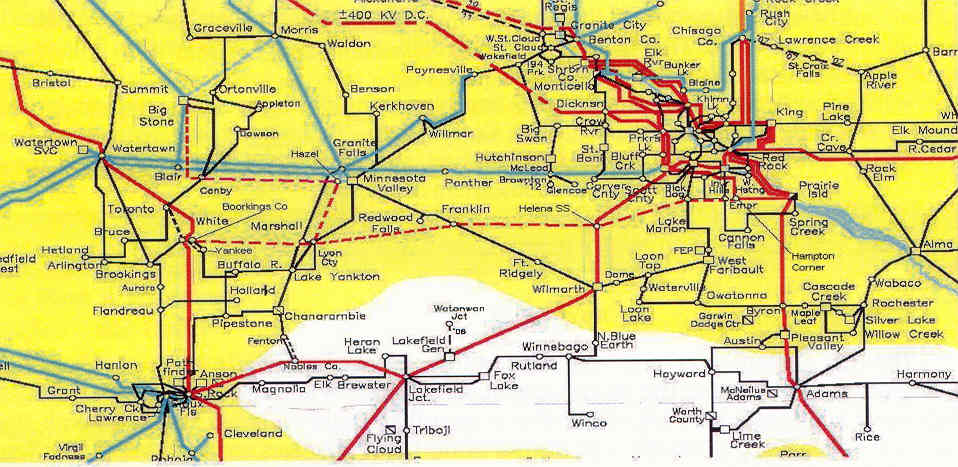
This is what they say about Big Stone’s 600MW coal upgrade, no suprise for anyone who’s paying attention, but for those who believe the party line, it may be a shock:
The first element to be presented for certificate of need approvals will be transmission facilities associated with the Big Stone generation project. While the Big Stone II partners include some non-CapX members, those of us responsible for transmission associated with Big Stone II have been working closely with the rest of the CapX members and with MISO. As was outlined in the Big Stone notice plan, MISO interconnection studies show that a second unit at Big Stone requires a minimum of two 230kV interconnection lines. The Big Stone partners now intend to propose constructing the line connecting Big Stone and Granite Falls to 345kV standards to better meet and be integrated with CapX, state, and regional objectives. As a result, the Big Stone transmission project, in addition to providing interconnection facilities for a second unit at Big Stone, is now being planned as the first phase of a 345kV line between southwestern Minnesota and the Twin Cities metro area. The Big Stone transmission partners expect to file a certificate of need for these facilities in September.
And last but not least… the “Northwest” project, a misnomer because this first one looks like it ties into Mesaba, which is planned for just a titch north of Bovey, east of Grand Rapids, and the lines there tie into the Arrowhead substation:

And the big honkin’ 345kV line from Fargo to the Metro that will aptly handle that anticipated Coal Creek upgrade:
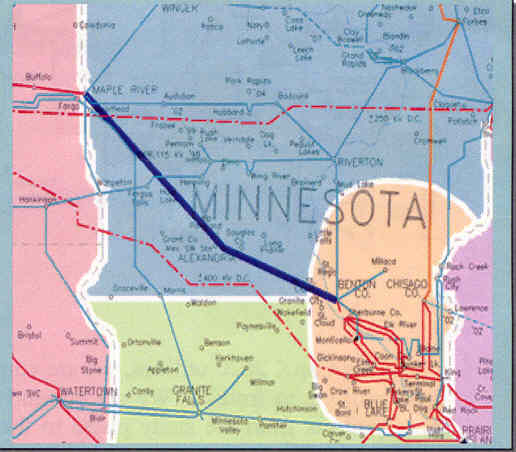
As we say in transmission, “It’s all connected!”
And as they say in transmission, “You let us build transmission and we’ll build coal, if you don’t, we’ll build distributed generation.”
Take out your WRAO reports, pps. 8, 12, Appendix C-1 p. 1-10, and note that they want to build WRAO Option 2. Hmmm… wasn’t Arrowhead the be all and end all of transmission? But then the’ve permitted parts of WRAO Option 9 and Chisago is WRAO Option 5 and …
Let’s look at what WRAO recommended (p. 12):
Plan 1 (Salem – Fitchburg) – they may do 2 and from LaCrosse to Salem, so…
Plan 2 (Prairie Island-Roch-LaCrosse – to Columbia or W.Middleton) – application pending
Plan 3 (Arrowhead) permitted
Plan 5 (Chisago Weston 345kV) pending at 115/161kV with Arrowhead level capacity
Plan 9 (Lakefield-Columbia) parts to Lakefield are permitted, other parts pending
Plan 10 (King-Weston 345kV) rate increase docket in WI says King-Arpin to be upgraded
WRAO developed many options, recommended that just one, the Arrowhead line, was necessary because it was the be all and end all of transmission, yet here we are with each option considered going forward, some as planned, some morphed, but all of them now planned or permitted.
Yup, it’s all connected. Here we go, massive transmission infrastructure for Minnesota, coming soon to a community near you — or even your own back yard.