Xcel’s Hiawatha Project sent to Committee
January 10th, 2009

Well this is interesting… to put it mildly… Xcel’s Hiawatha Project, transmission through Phillips, is in the news.
A move to “delay its application… until it provides a more thorough analysis of the need an alternatives” and that if line is “needed,” to bury it under 28th Street is deemed “trying to get the council to adopt a position without public hearings or notice?”
Hmmmmmmmmmmm…
Now Xcel claims the need for the Hiawatha Project is based on the “South Minneapolis Load Service Study,” but cannot or will not produce a copy of that study. They say it is not completed yet… Oh, and so you’re wanting this line for what????
And then I find that there’s also a “South Minneapolis Electric Reliability Project” where they want to run a 345kV line from Hwy. 280 to the new Hiawatha Project substation.
As discussed, but not quite yet formally proposed, Xcel’s Hiawatha Project would have a substation somewhere near 28th & Hiawatha, and the line would go east through Prestigious East Phillips to near the old Honeywell site near 35W.
Don’t forget, there are three meetings coming up, one held by the community, and two others by Xcel:
Community Forum on Xcel’s Hiawatha Project
Sponsored by the Phillips Community Energy Cooperative, the Greenway Coalition, and others
Monday, January 12, 2009
At Plaza Verde
1516 East Lake Street
6:30 p.m. to 8:30 p.m.
… and an Open House, another opportunity to dig into this project and find out what’s really going on:
Xcel Energy’s Public Open House on the Hiawatha Project
Thursday, January 15, 2009
At Plaza Verde, 1516 East Lake Street
Noon to 2:00 p.m.
and 5:00 p.m. to 7:00 p.m.
Search this site for “Hiawatha Project” for background information.


Minneapolis council diverts power-line issue
“We have a responsibility outside an empty room,” Council Member Lisa Goodman said.
DNREC settles with NRG for ~ $1.00 per violation!
January 8th, 2009

Horse’s Ass Award to DNREC’s John Hughes and (not-soon-enough) outgoing Gov. Minner (can’t have Delmarva Power’s Todd Goodman thinking he’s the only one!):

Let’s think a bit here… why this settlement? What would make it worth their while?

NRG has been belching pollution forever, violating federal rules, violating the Clean Air Act. For years this has been an issue, Green Delaware at the head of the charge. There’s been building attention and recently, Citizens for Clean Power filed Notice of Intent to Sue (below). And now, at the last minute of the Minner administration, DNREC does a deal with NRG that is so slimy, rolling over in a way that is less than a slap on the wrist to NRG and which could be just barely enough to prevent a suit by Citizens for Clean Power. And what if this had been filed at the END of November to put Markell on notice that he was expected to act, taking away that power to do an end run from Minner’s administration?
Here’s the 60 day notice filed on behalf of Citizens for Clean Power:
Here are some Green Delaware Alerts about NRG’s Indian River Power Plant:
And from the Archives:
Green Delaware Alert 238 – Minner administration proposes reduced reporting of SO2 releases
Green Delaware Alert 302 – Where does Delaware’s mercury come from?
Green Delaware Alert 499 – What problems are fundamental? Will our legislators tackle them?
Green Delaware Alert 506 – A decision time for power plant pollution in Delaware
For more from Green Delaware on NRG, go to www.greendel.org and search for NRG
From the News Journal yesterday and today:
This came over the wire today from Pat Gearity, Citizens for Clean Power, who have been leaning hard on NRG, that’s their mission:
Dear supporters of clean air:
Two months ago, CCP filed a 60-day Notice of Intent to Sue NRG’s Indian River Power Plant for over 5,000 violations of federal law from 2004-2008, including exceedances of nitrous oxide emissions and the opacity standard (a measure of particulate density discharged from the stacks). By law, DNREC and Governor Minner were also notified. Yesterday, DNREC announced its own lawsuit against NRG for the very violations CCP has alleged and that the agency has done nothing about since 2004. Why did DNREC take this action exactly 60 days before CCP could file its lawsuit? BY ENTERING INTO A TOKEN SETTLEMENT WITH NRG, DNREC AND JOHN HUGHES ALSO ATTEMPT TO BAR THE FILING OF CCP’S LAWSUIT.
On what basis did NRG Indian River solicit DNREC’s legal action to stop CCP’s impending citizen suit? Under the Clean Air Act, “diligent prosecution” in a court by a state agency precludes a private citizen suit if the agency files before the citizen suit can be filed.
On his way out the door, John Hughes took care of NRG again. Under a citizen lawsuit, IRPP could have been fined as much as $32,500 per violation and could have been ordered to pay additional funds to mitigate the environmental damage. Instead, the Secretary and the Agency stepped in to try to stop us for $1.00 per violation and a few token changes, with no environmental mitigation penalties.
NRG’s profits from IRPP make it a mega-million $ “cash cow” for the company. DNREC’s attempted interference with citizen’s rights is disgraceful. Change is desperately needed at DNREC. Please write Governor-elect Jack Markell at: Jack Markell <campaign@markell.org> or call him at 302 672-6700. Ask him to appoint a Secretary who will put public health, safety and corporate accountability above industry profit.
Please forward this email to interested persons. CCP’s 60-day Notice Letter to NRG is attached FYI.
Pat Gearity, Citizens for Clean Power
CITIZENS DECRY DNREC ATTEMPT TO PREVENT PRIVATE LAWSUIT AGAINST INDIAN RIVER POWER PLANT
LEWES, DELAWARE, January 7, 2009 – Citizens for Clean Power charged today that the Delaware Department of Natural Resources and Environmental Control (DNREC) is attempting to bar the filing of a private citizen lawsuit against the NRG-owned Indian River Generating Station (IRGS) for over 5,000 violations of the federal Clean Air Act since 2004, by filing its own lawsuit and pursuing only nominal penalties from the company.
On November 6, 2008, the Mid-Atlantic Environmental Law Center, representing Citizens for Clean Power (CCP), provided notice of intent to sue NRG affiliate Indian River Power, LLC, the operator of the power plant (IRGS) in Millsboro, Delaware. On January 5, 2009, one week before CCP could file its case by law, DNREC filed its own lawsuit against Indian River Power. DNREC’s suit mirrors the charges made by CCP. CCP’s notice letter charged that IRGS has violated provisions of the Clean Air Act, its Title V Operating Permit, and the emission limitations in various federal and state rules
and permits. The letter identified violations of state and federal opacity standards and nitrogen oxide standards from all four operating units at the plant. In its notice, CCP alleged that IRGS committed more than 4400 opacity violations and 771 violations of nitrogen oxide standards dating to 2004, and indicated the suit would seek financial penalties and injunctive relief to ensure future compliance.“We have complained to DNREC about the pollution from this plant for years, but until our lawsuit approached, DNREC consistently declined to enforce the law,” William Zak, co-founder of Citizens for Clean Power, said. “Despite Indian River Power Plant being the biggest polluter in the state, DNREC has now essentially acted on the plant’s behalf to halt the meaningful deterrence and compliance-inducing injunctive relief we would seek through our suit,” Zak continued.
Each time that Indian River violated its permit and the underlying regulations a separate violation of the Clean Air Act occurred. Under a private citizen lawsuit, each violation can result in maximum civil penalties of up to $32,500. Proceeding under state law, DNREC’s suit indicates it is authorized to seek financial penalties against the plant between $1,000 and $10,000 per violation. But the reality is
far, far lower. The filed Consent Order from DNREC, agreed to by Indian River Power, features a $5,000 penalty, along with other minor requirements.“The pattern of opacity non-compliance at Indian River is so extensive that only significant penalties designed to deter future violations and an upgrade in particulate matter pollution controls will resolve the situation,” said Michael Fiorentino of Mid-Atlantic Environmental Law Center, Counsel to CCP. “At less than a dollar per incident, violating the Clean Air Act has never been this cheap.”
Zak was outraged by word of DNREC’s settlement. “It’s a major slap in the face to the public and particularly to the citizens of eastern Sussex County, who have been breathing toxic pollution from the Indian River plant for more than fifty years, with little or no advocacy by the one state agency charged with protecting them,” Zak said.
——————-
——————-
As Pat Gearity reports, they’re not done with this yet… stay tuned for the rest of the story!
TVA coal ash slide – UPDATES
December 27th, 2008
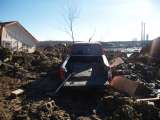
The only good news in this is that the media is picking this up, it’s not going to be “disappeared.”
From the “field” or from the slime, muck & yuck, here are updates. Special thanks to United Mountain Defense, John Walthen, Nicholas Mann, Tom Swinford, Chris Irwin, Donna Lisenby, Dot Griffith, and all those doing tremendous work getting the word and pictures out (whose names haven’t shown up in the emails I’ve received). This is a clear example of the importance of the internet.
Here’s from The Tennessean:
Would you believe 5.4 million cubic yards? Can you even imagine that?
A video from the scene by people taking water samples on the Emory River:
There is a great collection of photos on Photobucket:
A general view of the devastation, being downplayed by TVA and the coal industry:
Here you can watch the cops clearing out the area (at the end), can’t have this showing up on YouTube, don’t cha know:
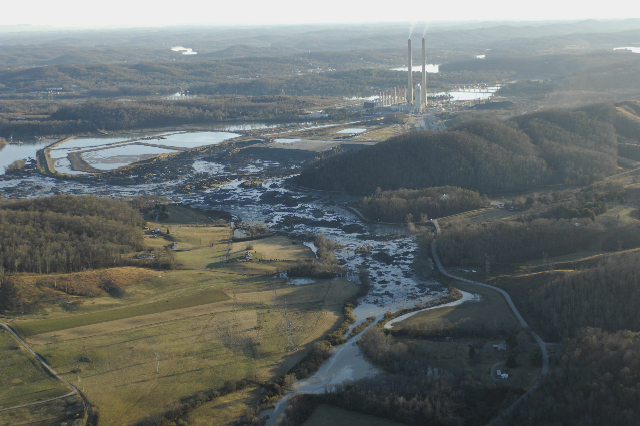
And this photo by Dot Griffith puts it all together:
Award for Todd Goodman, Delmarva Power
December 23rd, 2008
We sent this post out as a Green Delaware Alert to test the new consolidated email list, and WHEW, this has done a lot for Green Delaware fundraising! Keep it comin’, folks! To donate to Green Delaware, you can use PayPal (CLICK HERE FOR PAYPAL) or send to Green Delaware, P.O. Box 69, Port Penn, Delaware 19731. Thanks to all those who got fired up and nominated others for a Horse’s Ass Award. Feel free to leave suggestions in the Comment section (you have to click on the headline to get into the individual post, and the comment section is at the bottom, it’s moderated, but I approve everything but spam). CLICK HERE FOR PAYPAL FOR GREEN DELAWARE. And click here for the Green Delaware Newsletter – December 2008.
Back to Todd Goodman, Attorney for Delmarva Power, and his Horse’s Ass Award…
Today’s Horse’s Ass award goes to BADMAN Todd Goodman, counsel for Delmarva Power. He put on a superb performance December 3, and deserves this award, no doubt!
It took a long time to get the transcript. I asked how long it would take, and was told 7 days. Two weeks later, I started inquiring, and both Alan and I had a couple phone calls and emails with the “Nickerson twins,” Karen and Donna, staff at the PSC, a bit of fisticuffs, and finally, here it is.
So here’s what happened. I went to a hearing on the Delmarva Power Integrated Resource Plan, a PUBLIC hearing that is, and he tried to keep me from testifying. It was grossly offensive, saying that I was representing Green Delaware, which I was not, I have plenty of my own to say, thank you… and Muller can assuredly speak for himself, when he’s not wearing a gag.
Goodman was a certified horse’s ass. He accused me of practicing law without a license (by testifying as Carol A. Overland in an IRP docket based on what I know from MN IRPs?), that I should not be allowed to testify because I don’t live in Delaware (excuse me, I live in Minnesota and Delaware, so there, pppppppffffffffbbt!), he tried everything he could think of, smirking all the way. What is he afraid of? It was so extreme that it made me wonder if his company knows what he’s doing. Does Delmarva Power approve of and promote conduct like this? Unreal…

Throughout, the Public Advocate sat there, not even at the table, sat behind in the peanut gallery, silent. The good news is that PSC Commissioner Jeff Clark was there, witness to it all. That makes it worthwhile, Delmarva exposed, behaving that way before a regulator. As a bull-headed Minnesota energy regulator/energy wonk/worthy opponent said, upon hearing this story:
Re: Delmarva Power — haven’t those folks learned that it really doesn’t help them to try to screw with you like that? A) You always have useful things to say and for folks to consider, resulting in better decisions; and B) it just pisses you off and makes you want to make things 10 times worse for them.
Yup, that it does, and yes-siree, it will indeed be 10 times worse for them.
Here’s the transcript, Todd Goodman in technicolor:
If you want to have another good laugh, check out the Delmarva Power IRP.
This 2006 IRP is on the third iteration because they couldn’t come up with one that the PUC would accept, it was deficient, and deficient again, and so now this third one was submitted in November. On December 15, rather than file their 2008 IRP they send a letter saying they want to use this 2006 amended IRP filing as the one that’s due in December 2008. How lame can we get? I hope the PSC gives them the gong on that idea.

TVA coal ash spews over Tennessee
December 23rd, 2008

Yesterday the TVA’s Kingston coal plant’s coal ash sludge pit blew a sidewall and spewed all over near Harriman, Tennessee, into the Tennessee River. over 400 acres were covered in sludge. There was at least 2.6 million cubic yards or 500 million gallons of coal ash and an entire watershed is affected. That’s really toxic stuff, coal ash. Lots of heavy metals are left, lots of hazardous chemicals, there’s mercury, lead, arsenic, and is this coal slag also radioactive like much in the Dakotas? How will they deal with this?
IF YOU WERE HIT BY THIS COAL ASH FLOOD- CALL TVA: 865-717-4006
Lots of links now, I’m updating now and then.
It’s now in The Tennessean:
Here’s an article with photos and video:
From WYMT:
Here’s Volunteer TV with some more aerial video (and the odd comment that “The damage is done, all that’s left now is the clean up!” Oh… OK…
From WTVC – Chattanooga:
From WMCTV – Memphis:
They don’t know what caused it and yet say there is no danger from the other sludge pits in the area… say what?
TVA ash pond breach: Resident says area has ‘changed forever’
The sludge has encroached 10 feet farther into his yard than the usual winter pool level, and the scenic landscape is replaced by 15-foot-high piles of ash.
“It’s changed forever, I don’t see how this can be brought back,” Copeland said.
Here’s Dave Cooper’s post on Ruminations from the Distant Hills:
From YouTube, the video from Knoxnews of this disaster (this is a must see):
This could be one of the worst environmental disasters ever. One more example of the dangers and inherent problems with burning coal. Does the TVA have a “get out of jail free” card, like nuclear does in Price-Anderson Act? How can the clean up this mess, and how will the coal plant be held accountable? How will the coal industry prevent this from happening again?
It’s not like this is something new. Thanks to It’s Getting Hot in Here for a look at history, least we forget…
It happened in Martin County, Kentucky, in 2000:
It happened in Logan County, West Virginia, where 125 people died, 1,200+ were injured and over 4,000 were homeless:
I’m looking for updates on this… and I found them — try “TVA” and “flood” and not “TVA” and “coal ash.” Seems it’s not well acknowledged that it’s coal ash!
And here we go national:

SF Chronicle: Dike bursts in Tenn. damaging a dozen homes (AP)
By Josh Flory (Contact)
Tuesday, December 23, 2008The ash that burst out of a TVA retention pond on Monday is the sort of waste that has gotten scrutiny from federal regulators and lawmakers in recent months.
The mixture in question was made of water and fly ash, a fine particle that’s one of the by-products of burning coal to generate electricity. The ash is collected by scrubbers that aim to clean up emissions from power-plant smokestacks, and it includes trace elements of materials like arsenic and lead.
In June, a subcommittee in the U.S. House of Representatives held an oversight hearing to examine how the government should address the health and environmental risks of coal combustion waste, including fly ash.
Mary Fox, an assistant professor in the Department of Health Policy and Management in the Johns Hopkins Bloomberg School of Public Health, testified at this summer’s hearing and said in written testimony that “Risks to human health are increased if people are exposed to coal combustion waste.”
In an interview on Monday, Fox said she was reassured about reports that the Kingston spill was a release of wet ash because that means it wouldn’t have gotten into the air as dust.
Fox said generally the concern about fly ash is in regard to long-term exposures – from leaching into the groundwater, for example – and said that when it comes to a spill, the main exposure issues initially will be for people who are cleaning up the mess.
“If it did impact someone’s home,” she said, “you’d want them to stay away from it and not try to be scooping it up with your own broom and dustpan, that kind of thing. It’s not something that you’d want to try and clean up yourself.”
In addition to state and local authorities, the Environmental Protection Agency also dispatched a coordinator and a contractor to the site. EPA is currently reviewing its regulation of coal combustion waste, including fly ash, and one of the documents involved in that process is a 2007 report which found 24 proven cases of damage to ground or surface water from the disposal of coal combustion wastes.
Lisa Evans, an attorney with Earthjustice, a California-based nonprofit law firm, said that in recent years, ash impoundments also have failed in Pennsylvania and Georgia. “Unfortunately this isn’t an isolated instance,” she said “The surface impoundments are not safe places to keep coal ash in general.”
On the other hand, fly ash can be recycled into something useful. David Goss, executive director of the American Coal Ash Association, said ash that meets certain quality standards can be used as a substitute for Portland cement in concrete, and also has uses including soil and waste stabilization. Goss indicated that heavy metals are usually found only in low concentrations, and that they are diluted when stored in liquid.
While he wasn’t familiar with the exact details of the Kingston spill, Goss said that typically the “levels of these concentrations are low enough not to deem them a public hazard.”