Report on Monday Chisago meeting
October 22nd, 2009

Blake Wheatley promotes his vaporware project (from Chisago County Press, fair use)
Here’s the latest from the Chisago County Press:
Hundreds attend LS Power information meeting sponsored by county and Lent Township
If citizens feel the system still failed to consider issues, the decision of the PUC can be appealed to the state Court of Appeals.
Read the rest of this entry »
Minnesota Resource Assessment Survey
October 21st, 2009
From the Minnesota Office of Energy Security:
… the Minnesota Resource Assessment … sigh…
Get out your waders… from the solicited Comments at the end, from “stakeholders,” (did I miss some notice and comment period here??? Did any of YOU get notice???) the problems raised are nearly universally complaints.

OK, now open it up and look … and in it on page 6 is that MOE’S napkin calulation that they finagled into the CapX 2020 record after we got extracted some damning testimony about decreased demand, this is such utter bullshit, look at this and see for yourself:
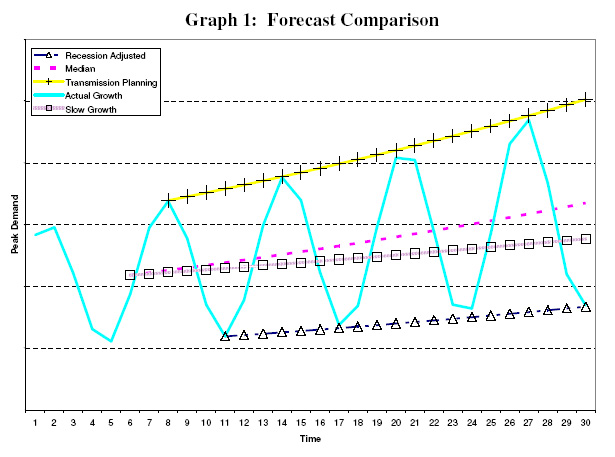
And you may ask, what that in the X axis? Good question, there’s no identification. And the Y? Same.
WTF?
This is the report we’ve been waiting so long for?
This is the report that, at the Legislative Energy Commission I testified at, Chair Solon-Prettner was asking for, demanding, because it was way late?
This report was presented in all seriousness to the Legislative Energy Commission? I would hope that I could hear them laughing all the way down here in Red Wing…
Here’s “Capital Costs” from page 19:

And further back, the Preliminary Capital Costs:

Oh, please… Commerce was part of the Mesaba Project, and Elion Amit did the economic analysis. From that 2005 data, this is way way off, THERE IS NO EXCUSE FOR THIS WHATSOEVER.
IGCC in 2005 dollars was $3,595/kW and now it’s more.
IGCC w/ sequestration is, first, NOT POSSIBLE, and second, price would double just for capture, and the storage can’t be done.
Coal is more expensive that that and you know it.
Wake me up when you can deliver some meaningful numbers.
Look at “Generation by fuel source under selected scenarios” starting on p. 87. In only one scenario does coal go down at all, and that’s for a “National RES” scenario, and it only goes down a teeny teeny bit. Give me a break…
DOH!
If you have questions or comments on this Minnesota Resource Assessment contact:
Marya White, Reliability Administrator
Minnesota Department of Commerce
85 7th Place East. Suite 500
St. Paul, MN 55101
651-297-1773
marya.white [at] state.mn.us
If you want to tell Steve Rakow what you think of his “Forecast Comparison” and analysis:
Steve Rakow
Minnesota Department of Commerce
85 7th Place East. Suite 500
St. Paul, MN 55101
steve.rakow [at] state.mn.us
Once more with feeling…
DOH!
So another utility toady thinks I’ve got my head implanted…
October 4th, 2009
.
Apparently Jonathan Travers, “Engineer of Knowledge” is another utility toady or self-declared energy wonk, and thinks I’ve got my head implanted regarding my comments about the MAPP line and about PSE&G’s dissing Midwest transmission. EH? I’d say my Google Analyics stats say otherwise. And then there’s the little energy birdie who admitted the other day that Legalectric is one of his first stops in the morning!

Who is Jonathan Travers? Haven’t a clue, his reputation does not exceed him! Google’s got very little to say. Hmmmmmmm… There is a “Travers” on the Dorchester County Council, Ricky Travers. This “Jonathan Travers,” he’s got a blog, Jonathan Travers Chronicles, with only a handful of postings that are focused on blasting opposition to the Mid-Atlantic Power Pathway (MAPP) transmission line, i.e., Dorchester County’s Dorchester Citizens for Safe Energy and Eastern Shore Land Conservancy, who are having some success in fighting the MAPP line, and though Travers’ blog’s banner states “Debate Through Logical Argumentation Only. Not For Flamers!” the level of discourse he’s posting is not even up to “Horse’s Ass Awards” and such:
Here are his comments about my MAPP post, “MAPP Transmission Line Under the Microscope” a couple weeks ago:
Submitted on 2009/10/04 at 9:18amTo the attention of Legalectric Blog.
You make the statement, “this transmission line is not needed.” Per logical argumentation, you make (sic) no backup facts to support this opening statement. As any English writing course teaches, this is just poor writing skills (sic). As it has been (sic) well documented by “The Public Service Commission” report (sic) released last December (sic) warned that the state could experience rolling blackouts as early as 2011 to helped (sic… really!) people understand the reason for MAPP’s conception. So with just your opening statement, you have negated your argument and quite poorly I might add (how “sic” can it be?).
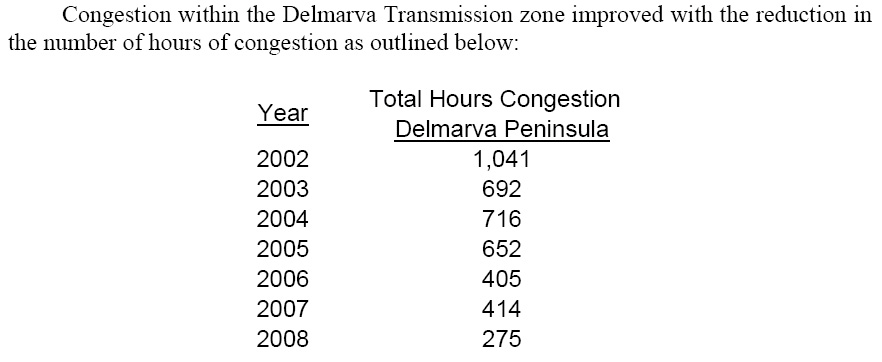
Overland comments: “backup facts” about transmission line not needed can be found by searching this site for “decreased demand” and “PJM annual report” and PJM Load Capability. Ummmm, Hello, I’m a writing major, and your comment about “poor writing skills” isn’t about writing, it’s about evidence that you want. Don’t worry, it’s there, just look! “Rolling blackouts” is hysteria, blown away by DEC’s annual Energy Plan, showing sharply decreased congestion on the Delmarva peninsula:
You then go on to post the article from the Star Democrat written by Dustin Holt who may have a journalistic degree but by his statements he has no knowledge of electrical engineering. I have spoken with Mr. Holt in the past and within a short amount of conversation, it was quite apparent that he did not even have the basic understanding of what he was writing about. Mr. Holt starts off by referencing statements from Libby Nagel who has self proclaimed herself (sic) president of the Dorchester Citizens for Safe Energy. It is my evaluation that with her lack of electrical engineering knowledge, Ms. Nagel would be better off proclaiming herself President of the Dorchester’s chapter of the Mickey Mouse Club (SIC!). So once again you have quoted a source that does not have adequate credential (sic) to even be speaking on the subject negating your argument again.Overland comments: I posted the article as a good example of on-the-ground activism, where people work to increase awareness of their issue, and Dorchester Citizens for Safe Energy did a great job! They got press coverage, their elected officials showed up, and pro-MAPP people are flailing wildly — that’s a measure of success! Libby IS, not was, the President, and IS self-DESCRIBED President, she was elected President by the organization, it’s “described’ not “proclaimed.” Your “evaluation” is really immaterial. Ms. Nagel has all the “credential” necessary to speak as an affected community member and President of the primary opposition organization. The article I posted says she’s the “Chairman,” and not “President.” Really!
Let me try to explain it this way. If you run just one transmission route like Ms. Nagel is stating would be (sic) like having one extension cord with a hundred electrical appliances, tools, etc. plugged into it. It will not be long before you have overloaded the circuit causing a short circuit or even causing a fire. It is the diversification that the multiple routes provide so that the electrical load required by the Delmarva Peninsula (sic) is what makes the electrical grid secure and stable.
Overland comments: This is such convoluted and tortured writing that it’s hard to tell where to put the “sic” parentheticals in. WHEW! Anyway, back to “substance.” WTF? I see only one reference to Ms. Nagel in the article, “Dorchester Citizens for Safe Energy Chairman Libby Nagel said the power line would require about a 200-foot right-of-way.” Nowhere in this article is Nagel advocating for “just one transmission route,” and I don’t think Nagle advocates for ANY transmission route, she’s stating that a new transmission line is not needed!
I would suggest that your readers can get the correct and accurate arguments with regards to MAPP at my site http://www.jonathantraverschronicles.blogspot.com/
Overland comment: I would suggest that my readers check out the site and comment away!!! Have at it. My readers will be able to easily dissect that site.
Good day,
Jonathan Travers

Oh, he’s not THAT Jon Travers???
OK, now on to his next comment, on the “PSEG’s Izzo disses Midwest Transmission” post :
Submitted on 2009/10/04 at 2:54pmTo the attention of Legalectric Blog.
In your earlier posting you made the statement, “PJM, the private utility transmission promotion entity, has admitted that the Indian River to Salem part of the line is not justified, and have taken it off their wish list.”
Counter Point:
To start off with PJM simply stands for Pennsylvania, New Jersey, and Maryland and the state of Delaware has now (sic?) been included since its conception. PJM is an oversight committee (EH?) made up of knowledgeable people in the industry but they do not tell power utilities to build anything (EH?). It is the utilities (sic) to come up with their own plan to address the problem of the soon (sic) lack of electrical power for their regions. Again your statement you are passing on are (sic) incorrect(sic) negating you (sic) argument.Overland comment: PJM is more than a committee, it’s a formal business organization. PJM IS the utilities, and per PSE&G testimony in the Susquehanna-Roseland case, PJM is telling them to build the line. Now obviously PJM has no authority, but if they press the matter with FERC, FERC could direct the utilities to build it. It’s much more than an “oversight” committee, it’s an organization that is comprised of utilities, and they not only address electric reliability issues, but they control and manipulate the electric market. “Lack of electrical power?” Somebody hasn’t been reading the SEC filings, reserve margins, and annual reports, EARTH TO MARS, there’s a substantial decrease in electrical use and need, we aren’t going to have a power shortage. Project Mountaineer is not a plan of the individual utilities’ making. JCSP is not a plan of individual utilities, CapX is not a plan of individual utilities…
“A little knowledge is a very dangerous thing,” and the writer of this blog has demonstrated their sever (sic) lack of knowledge in this subject by the statements presented.”
Overland comment: Oh, uh-huh…
Now with this posting they are stating their case as if there is only one transmission line that needs to be considered. For those educated in electrical engineering, it is plain that the writer of this blog does not even have the basic understanding of Ohms Law. What MAPP is offering are multiple access points for electrical transmission routes.
Overland comment: Ummmmm, “they?” And who is advocating for transmission? This is the same thing that “Travers” says about Nagel, who said nothing of the sort. This mantra does not fly. Multiple access points? For what generation? Let’s get clear about that…
For anyone else whom (sic) should (sic) like to inform themselves more proficiently on this subject, I suggest you go to http://www.jonathantraverschronicles.blogspot.com/ where this has all been address (sic) before.
Thank you,
Jonathan Travers************************************
Overland comment: Whoever wrote this is clearly not a native speaker/writer nor in any position to critique writing. Content, well, anyone can criticize content, but I’d guess that “Travers” is a retired engineer or a newly imported engineer who has not had experience with the capitalist system and the shift of focus of PJM, MISO, etc., to economic dispatch, a market system, where economic considerations are primary, and where the game in transmission is how to build out as much as possible while shifting cost-allocation elsewhere, for someone else to pay, anyone. Then PJM gets shot down by the 7th Circuit and all their transmission cost apportionment plans are in limbo.
PUC’s Public Health Impacts of Wind
September 16th, 2009
Here’s what just was filed on behalf of Minnesota Coalition for Sensible Siting:
Exhibit E – Harding – Wind Turbines, Flicker and Photosensitive Epilepsy
And this was filed by CFERS:
To look at all the filings, go to www.puc.state.mn.us and to eDockets and search for docket 09-845.
CUB and WEIG appeal Bent Tree WI PSC decision
September 1st, 2009

I’m representing Safe Wind in Freeborn County, and we’re working to increase the setbacks on the Bent Tree project to something that the neighbors can live with, participating in the PUC Certificate of Need and Siting dockets.
Last Thursday, Citizens Utility Board and Wisconsin Industrial Energy Group filed an appeal of the PSC’s Bent Tree decision.
CUB & WIEG Petition for Review and PSC-WI Bent Tree Decision
I’ve posted their pleadings on the Bent Tree dockets in Minnesota. To review the Bent Tree dockets in Minnesota, go to www.puc.state.mn.us and then click “Search Dockets” and search for dockets 08-573 and/or 07-1425.
Here’s an article about the challenge from the WSJ (Wisconsin State Journal, that is):
More blowback: Suit challenges Alliant wind farm
By Thomas Content of the Journal Sentinel
Aug. 28, 2009State regulators set a bad precedent for other energy projects when they gave the go-ahead to Alliant Energy Corp. to build a $497 million wind farm in Minnesota, two energy customer groups say.
The groups filed suit in Dane County Circuit Court on Friday to protest the vote by the state Public Service Commission to approve the project under a less rigorous review procedure than is typically required of major energy projects.
The Public Service Commission had used the less stringent review process because the project is an out-of-state project. The commission’s approval is needed for out-of-state project because the agency reviews whether a power plant is cost-effective for utility customers.
“Electric rates have been rapidly rising so we simply can’t afford less stringent regulatory review of new energy projects,” said Todd Stuart, executive director of Wisconsin Industrial Energy Group, in a statement. “The cost and need of energy infrastructure can’t be ignored, especially right now with the massive job losses in Wisconsin.”
Rob Crain, a spokesman for Alliant, said the legal challenge could likely mean delays for the project, which is slated to be operational by 2011, Crain said. The wind farm is needed for the utility to comply with the state’s renewable energy mandate that requires 10% of the state’s electricity to come from wind power and other renewable energy sources by 2015, he said.
“We are surprised and certainly disappointed that WIEG and CUB have chosen to make this filing. We view it as more process over substance,” Crain said.
The commission decided in November to move forward with reviewing the project under a less-stringent standard, a decision that was supported by Commissioners Eric Callisto and Mark Meyer but opposed by commissioner Lauren Azar.
“As far as we were concerned the issue was settled at that point in time,” Crain said.
Charlie Higley, executive director of the Citizens’ Utility Board, said the customer groups couldn’t legally file a legal challenge on the issue until after the commission’s final vote on the project in July. In this summer, the groups had warned Alliant’s Madison subsidiary, Wisconsin Power & Light Co., that it was proceeding at its own risk by moving forward with the project under the less-strict review.
The groups are concerned about the precedent the commission’s decision could set for other types of energy projects that utilities could seek to build outside the state’s borders, such as a costly nuclear power plant or coal-fired power plant.
“The bottom line is risk for customers,” Higley said. “And the risk is that poorly designed or expensive projects could be approved and forced on to ratepayers who would then pay higher rates than they should be.”