BOOM! at Xcel’s Black Dog plant

September 22nd, 2010

An “ignition event” in the coal hopper, more commonly called an explosion and fire… Three firefighters on the scene were injured when it blew after they arrived.

This’ll be old news, but I’ve been incommunicado for a while, lost in the mountains of the Northwest, where there is no cell, no internet… what a concept!
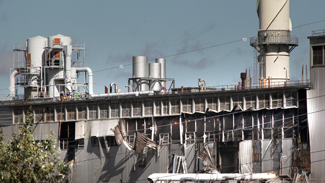
blackdog3

Photo by Bill Klotz, Finance & Commerce (Fair Use!)

An interesting quote:

“I would say it’s pretty significant,” said Behnken, gesturing toward the Black Dog plant from a nearby park. Though reporters were not allowed closer access to the plant, it was apparent from a distance that the explosion’s force far exceeded initial references to it as a small explosion in a coal bin.

Here’s some video from KARE 11 with shots of the exterior damage:

In the St. Paul Pioneer Press:

3 firefighters hurt in blast at Xcel Energy coal plant in Burnsville

Workers noticed smoldering coal bin

By Emily Cutts and Deepta Holalkere
Pioneer Press
Updated: 09/21/2010 11:47:43 PM CDT

Three Burnsville firefighters were injured Tuesday morning at a power plant fire and explosion that shook local residents out of bed.

The fire started in a smoldering coal bin at Xcel Energy’s Black Dog power plant in Burnsville, the company said. As fire crews tried to extinguish the flames, a blast in the bin rocked the plant.

Two of the firefighters were treated at the scene for minor burns and returned to fighting the fire. A third was taken to Regions Hospital in St. Paul with a leg injury, said Burnsville police Sgt. Jef Behnken.

“I heard a boom and then a bigger boom,” said Nancy Caneff, who lives nearby. Caneff was in bed when the blasts — the second strong enough to shake her bed — happened.

Firefighters put out two relatively small fires at the plant by 2 p.m. Tuesday but remained on site through the afternoon to handle hot spots, Xcel spokesman Tom Hoen said.
Read the rest of this entry »

littlebirdie-cardinal

A couple of days ago, a little birdie sent me an uplifting article, and what I like most about it is the use of the term “boondoggle,” which is the definition of Minnesota’s “own” Mesaba Project:

For Carbon Capture, DOE Moves Oxycombustion Ahead of IGCC

If IEEE’s Spectrum is using that term, the rest of the world can’t be far behind!

We’ve been having quite a few go-rounds about Mesaba lately, since Iron Range Resources unilaterally decided to significantly and substantively alter the “contract” for the $9.5 million in funding.   I’d started a post on that and can’t find it for the life of me, so here we go… Now remember, this is not including the state’s Renewable Development Fund money or the DOE’s money thrown at this project, this is “only” the state IRR’s money, $9.5 million, and the interest on that “loan” is 20%:

MCGP Exhibit 5023 – IRR & Excelsior Convertible Debenture Agreement

You’ll find that interest rate on p. 12, 20% simple interest per annum on the outstanding principal.  Since they’ve paid nothing on it except the $40k that they were found to have spent improperly (with many other issues not addressed because the IRR had “destroyed” documentation… yeah, right…), 20% simple interest per annum on a “loan” from 2004 means that there’s another $8,000,000 due now.  And this does NOT take into account the initial $1.5 million from IRR, it’s just the agreement above.

And as noted above,  a couple of weeks ago, it seems the IRR unilaterally decided to significantly and substantively alter the “contract” … based on exactly what???

Here’s how Commissioner Sandy Layman characterized the predicament:

The principal balance owed by Excelsior Energy, Inc. to Iron Range Resources under the
existing loan documents is $9,454,962.

No mention is made of the more than $10 million in interest.   Nada…

Here are two of Aaron Brown’s posts:

Excelsior Energy to seek huge break from Iron Range Resources

… and …

This Iron Range blogger is done apologizing for Iron Range cronyism

Here’s Charlotte Neigh’s editorial, published in the Grand Rapids Herald-Review and on the Citizens Against the Mesaba Project site:

IRR WRITES OFF $ MILLIONS OWED BY EXCELSIOR ENERGY

By failing to declare Excelsior Energy in default, which would put an end to the Mesaba Energy Project, the Iron Range Resources Board is enabling Excelsior to draw down the remaining $2.3 million of Department of Energy funding, which can continue to provide handsome salaries for Tom Micheletti and his wife and co-president, Julie Jorgensen.

In April 2007 Excelsior Energy defaulted on its $952,376 interest payment on loans from IRR and it hasn’t paid any interest yet. Since then interest has been accruing on $9.5 million at the rate of 20% per year and the annual payments should be about $2 million. In addition, Excelsior was supposed to pay $800,000 per year on the principal, starting in December 2009, which it also failed to do. After repeated extensions of the due date, payment was supposed to be made by December 2010.

However, at a non-public meeting on August 10th, an IRR committee discussed Tom Micheletti’s proposed changes to the terms of the loans and the IRR Board rubber-stamped these amendments at its meeting on August 19th. From the limited information available, it can be determined that: the annual principal payment will start in December 2010 and will be reduced from $800,000 to $100,000; the interest will be calculated at the reduced rate of 5% instead of 20% and annual payments are not required; and if Excelsior pays off the entire principal by 12/31/17, the interest rate will be recalculated at 3% per year. This amounts to a loss of revenue to IRR well in excess of $10 million, in addition to the $9.5 million that probably never will be repaid.

The high initial interest rate reflected the risk level of the Mesaba Energy Project, which has been borne out by Excelsior’s failure to attract investors or customers. This is despite having spent nearly 40 million public dollars, including approximately $20 million from the federal Department of Energy and $10 million from Minnesota’s Renewable Development Fund, in addition to IRR’s $9.5 million. Tom Micheletti did not offer the IRR Board any revised plan for making this project succeed. When the remaining $2.3 million is gone, Excelsior can declare bankruptcy without assets to repay its creditors, and its co-presidents can walk away.

Micheletti touts the accomplishment of a final environmental impact statement but that process has not been finished because it still lacks a Record of Decision by the DOE. Micheletti touts the accomplishment of having the site approved by the Public Utilities Commission but fails to mention that the project cannot proceed without required regulatory permits. The air permitting has been delayed since 2006 and is problematic because this project is competing with mining operations that can’t be located elsewhere for scarce space for more pollutants in the airshed.

Sensible people must wonder why the IRR Board would do this, or why it would have funded this project in the first place, or why it would have waived the requirement for matching funds, or why it would have extended the due date for payments while it continued throwing good money after bad. A likely factor is the generosity of Excelsior insiders at campaign fundraisers for some of these legislators the week before the committee meeting and over recent years.

FEIS NOT ACTUALLY “FINAL”: AIR AND WATER PERMITS LACKING

The final step for the environmental impact statement (issued in November 2009) is a “record of decision” (ROD) prepared within the DOE, vouchsafing that all has been done thoroughly and properly and the project should be allowed to proceed with DOE support. However, the ROD has been delayed and the monthly reports indicate “schedule uncertain”. We don’t know all of the reasons for this but they may include concerns previously raised by the EPA, the Army Corps of Engineers and the federal land managers. One of the known reasons is Excelsior’s failure to acquire the necessary air and water permits from the Minnesota Pollution Control Agency (MPCA). Apparently Excelsior continues to qualify for cost-sharing contributions from the $22 million DOE fund ($2.3 million remaining) while it pursues these permits.

Excelsior is not actively pursuing water permits at the MPCA; if there have been any changes since the June 2006 applications, revised applications will be required. In late spring Excelsior contacted the MPCA regarding the air permits and work is currently underway to determine what updates to the 2006 applications will be required. It appears that no draft permit will be issued in the foreseeable future and if one ever is, it can be appealed to the EPA, a process that could take 18 months.


Xcel, STOP IT!

August 26th, 2010

tnt_squirrel

It’s one of those mornings, had a long bath in the bestest tub in the world, then got the doggies fed and out and pooped, and ready to commence work, fired up the machine, got maybe two emails opened and suddenly… SILENCE and DARKNESS (it’s dark on the side of a bluff).  No computer, no light, no ceiling fan… There goes Xcel again, they know I’ve got work to do, and they sent out their terrorist army.

squirrel-terrorist

NOT… it was a squirrel.  Alan hear the fuse on the distribution pole across the street go, and saw something drop, I said, “it’s a squirrel.”  Damned if it wasn’t a squirrel he saw fall, a brave soul who gave is life to Xcel to bring everything to a halt this a.m.  Power is back.  And neener, neener, neener, neener, Xcel, I got to office in Prestigious West Red Wing withwireless, Greek Strata and unlimited coffee.

dollarsbigpile.jpg

Xcel is trading a bunch of paper for a bunch of money, 21,850,000 pieces of paper to be precise.  How much money is that?  Seems to be $469,775,000,  or $408,500,000, gross, or $396,245,000 net to Xcel, depending on what numbers you look at, or what they sell at!

Xcel’s 424B2 filed with SEC August 4, 2010

What will they do with it?  According to the prospectus, and an article written about it:

“Xcel Energy intends to use any net proceeds that it receives upon settlement of the forward sale agreement described above, or from the sale of any shares to the underwriters to cover over-allotments, to repay outstanding commercial paper and make capital contributions to its operating subsidiaries.”

Here’s an article from Marketwatch:

Xcel Energy Announces Pricing of Common Stock

Doesn’t this have the feel that they’re desperate for cash flow?  We know they can’t get their construction capital to build the Brookings transmission line, and they’re hot to trot both about PUC ordained rate recovery, which they did not get and their Motion for Reconsideration (PUC Docket 09-1048) went nowhere.

Here’s Seeking Alpha’s Xcel 2Q Earnings Call Transcript!

Seeking Alpha Xcel 2Q Earnings Call Question & Answer

And a choice answer snippet from the Q&A:

Ben Fowke

Transaction transmission will be a very big part of our capital profile as you get to the middle and latter part of the decade it’s a result of all the years of efforts we’ve already put into project like CapEx 2020. It takes a very long time to get these things done.

mark-roberts

Well, a busy couple of days.  Mark Roberts, M.D., Exponent, toady for whatever project developer has the dough to pay him, made appearances in Goodhue, Minnesota for a hearing on the Goodhue Wind project, and in Wausau, Wisconsin, for an open house for a proposed biomass plant.  How much of a toady is he?

Dig this, he was “Corporate Medical Director of BP.”  Yes, our friend British Petroleum!

LINK TO PROFILE – MARK ROBERTS, M.D.

Wednesday, he was here in Goodhue, a puppet for the developers.

Here’s a link to the rest of the story: Goodhue Wind Truth

Thursday, he’s in Wausau, WI, a puppet for the developers.

Here’s a link to the rest of the story: Saving Our Air Resource, opponents of that Wausau biomass plant.

From Faux News 55:

Here’s from the Wasau Daily Herald:

Rothschild residents preview Biomass plant plans

By Kathleen Foody • Wausau Daily Herald • July 23, 2010

OTHSCHILD — The mood at the open house hosted by We Energies on Thursday about a proposed biomass plant in Rothschild was calm, though discussion about the project has become heated.

About 110 residents attended the sessions, one each in the afternoon and evening, at the Holiday Inn in Rothschild. Staff from We Energies and Domtar stood near displays and video monitors, explaining the plant plan and its effects on the community.

The proposal to burn woody biomass as fuel to create electricity for sale by the Milwaukee energy company and steam to power the Domtar paper mill is pending before the Wisconsin Public Service Commission. Since the plant was proposed in September 2009, We Energies has tried to get ahead of critics with direct mailings, community meetings and door-to-door consultations.

Many residents who attended the Thursday meetings said they were undecided or in favor of the $250 million project and felt satisfied with answers to their questions about air quality, jobs and traffic around the plant.

“I want to make sure it’s safe. My grandkids attend (Rothschild Elementary School) across the street (from the mill),” Andy Champine of Weston said. “I walked in neutral to get the facts.”

Barry McNulty, a spokesman for We Energies at the event, said the company was pleased with turnout and the questions posed.

“No one particular issue stood out,” he said. “Residents asked very similar questions (as at the February open house), and we tried to give them a better understanding of what we do and how we do it.”

Rob Hughes, a member of Save Our Air Resources, a citizen group that has opposed the plant, said he applauded the open house events. But he’s not satisfied with We Energies’ responses to his requests for specific information on air quality if the plant is constructed.

“They had a doctor there saying this is good, but thousands of doctors have signed on to a letter (in Massachusetts) saying these plants are bad for people’s health,” Hughes said.

Hughes was referring to the Massachusetts Medical Society, and its December decision to oppose three biomass plants, citing respiratory problems that air pollution can cause or worsen. The organization also asked state governments to discourage the construction of biomass facilities.