Woodbury has the right idea — utility tax
November 26th, 2006
Now here’s a way that local governments can deal with the utilities pulling the rug out from under them by cutting, recalculating, suing, and whatever else they can think of to eliminate the utility personal property tax that provides siginifcant revenue. Red Wing is in the midst of doing a deal with Xcel about utility personal property tax, as is Goodhue County — why isn’t the entire state instituting this instead of caving? I’ve got to dig up some papers in this pile, but that means getting the Exhibits done for Mesaba… finishing my testimony & Exhibit chart, so in short, it’ll be later rather than sooner, but this article has to get out there for consideration:
City wants $750,000 in added yearly revenue
BY STEVE SCOTT
Pioneer PressMaplewood is negotiating with Xcel Energy on the details of an increased electric tax that would produce $750,000 in additional annual revenue for the city, municipal officials say.
As it does in several metro-area cities, Xcel collects what the city calls a monthly franchise tax from all electric users, at the city’s request, and passes the money along to the city.
Xcel has collected such a tax for Maplewood since 2005, but the city is seeking more than a fivefold increase for 2007.
“We’ve always looked at this as a way to reduce property taxes,” City Manager Greg Copeland said.
“We have 133 properties in Maplewood that are tax-exempt (such as schools, churches and railroads). What we are hoping to do is collect some additional revenue from these entities from the franchise tax.”
Because the electric tax is spread out over every utility user in the city, not just property owners, Maplewood officials plan for that increase to reduce next year’s anticipated property tax increase from 11.4 percent to 6.4 percent.
The increased electric tax, however, would be applied across the board to residential customers, small businesses and large commercial and industrial accounts.
For example, the city’s residential customers, who now pay a franchise tax of 50 cents a month, would pay a proposed $2.70 a month.
City officials say the increased electric tax would equate to property tax savings ranging from $1.80 a year on a $150,000 home to $43.80 a year on a $400,000 home.
Many of the nearly 20 residents who spoke out on the issue at last week’s City Council meeting were skeptical.
“This is like putting two quarters in my left pocket â?¦ by taking two quarters out of my right pocket,” John Gores said.
Some residents questioned why residential and commercial customers would be assessed the same percentage increase. Small-business accounts paying a monthly electric tax of $1 to $6 would pay a proposed $5.40 to $32.40. Large commercial accounts would pay $243, up from $45.
Other residents asked why the electric tax wouldn’t be prorated among property owners according to energy usage.
“Flat taxes like this are extremely regressive,” William Robbins said. “If these taxes might be collected, I would hope it would be with fairness and equity.”
Colette Jurek, government relations manager for Xcel, said the company’s policy since 2000 has been to assess a flat tax.
“Our company believes a customer’s energy consumption is not proportionate to the amount of city services they use in a month,” she said.
City officials agreed with some of the residents’ objections but said Xcel would have to agree to any changes. Mayor Diana Longrie moved to table the issue to allow the city to negotiate with Xcel for “a more proportionate tax rate.”
Because of that delay, it’s likely an increase would not take effect until March.
The city indicated it would apply the revenue from an electric tax increase toward utility charges at city buildings, including the Community Center; street lighting; utility right-of-way maintenance; energy conservation projects; and weatherization of low-income homes.
Steve Scott may be reached at 651-228-5526 or sscott@pioneerpress.com.
Just in – David’s retirement plan
November 25th, 2006

Little Bro off to do some Retirement Planning — find the jackass in this photo! Also, rumor has it there may be an investigative piece on David’s theory in a local paper soon, that thorough journalistic expertise is being applied with due diligence.
(Just in – here it is to prove I don’t always hit delete or junk! David’s one for indiscriminate forwarding and doesn’t appreciate the hilarious results of a dyslixic boob painstakingly plunking on the keyboard, descriptions of unearthing the lift stations at the resort, or probing journeys into sinusoidal cavities, and the photos…)
Retirement Planning
If you had purchased $1000.00 of Nortel stock one year ago, it would now be worth $49.00.
With Enron, you would have had $16.50 left of the original $1000.00. With WorldCom, you would have had less than $5.00 left.
If you had purchased $1000 of Delta Air Lines stock you would have $49.00 left
But, if you had purchased $1,000.00 worth of beer one year ago, drank all the beer, then turned in the cans for the aluminum recycling REFUND,you would have had $214.00.
Based on the above, the best current investment advice is to drink heavily and recycle.
It’s called the 401-Keg Plan
=============
And speaking of retirement planning, he’s probably the guy sitting on the Minnesota $47 million lottery ticket!
They caaalll Mesaaaba liiiars…
November 25th, 2006

“If we were a bunch of liars, we’d have never got this project to where it is today.”
Tom Micheletti, Grand Rapids Herald Review, Nov. 20, 2006
OK, y’all, this is a test! Find the lies, misrepresentations, and balderdash in the Mesaba Messenger:
mesaba-messenger-november-2006-1.pdf
Please leave your findings in the comments below.
Need a hint?
- Consider the legal meaning of denial of a motion to dismiss!
- Explain how 10/25 rulings are big step forward!
- Explain impact of “Plan for Carbon Capture” on CO2 emissions!
- How many jobs for Range residents?
- Exactly how were the inputs for the UMD study verified?
- How many jobs? 1,000 in 2002, 107 in application, 143 in newsletter?
- When crucial pieces are so unreliable that a spare is needed, is it success?
- Is it good engineering to rely on gasifiers that are proven unreliable?
- Should “gas” be the secondary fuel noted on the DOE Agreement?
- Exactly what region has a 6,000MW need? (this should be easy for my regular readers).
- Exactly how many MW in the MISO queue for that same region when the CapX2020 report was written?
- Now many MW in the MISO queue for that same region NOW?
Excelsior states the following are myths (taken from the 3,781 word “Guest Column” in a Range paper), and ignore and misrepresent the facts:
Myth: The Mesaba Project will force wind energy off from the grid.
Fact: Read the MISO G519 study. “Misunderstand?” Right….
Myth: The Mesaba Project is an experimental project.
Fact: Read the DOE Notice of Intent, it’s a demonstration project, deemed too risky for private investment.
Myth: Energy from the Mesaba Project will be much more expensive than conventional technologies.
Fact: Excelsior’s presentation to the Metro Counties Energy Task Force says it’s $6,38. If we lose 25% with CO2 capture and another $7-14 billion for transport and sequestration, it’ll be what??? (as if $6.8 isn’t bad enough!)
Myth: The environmental advantages of Meaba’s IGCC technology over conventional coal plants may not be significant.
Fact: Read the testimony in this case! And note that Natural Resources Defense Council ($437,500), Clean Air Task Force ($787,500) and various chapters of the Sierra Club are funded by the Joyce Foundation to promote IGCC. Hey, you left out Clean Wisconsin and their $750,000, reported as $500,000 but we know better!
So, put on your thinking caps and find the errors in the Mesaba Messenger!
mesaba-messenger-november-2006-1.pdf
Extra credit if you can figure out what crucial newsletter staple is missing!!!
ERROR – Excelsior Legislative Presentations
November 23rd, 2006

OOPS! The presentations that Excelsior made to the legislature in 2002 and that I’d posted a couple days ago were off, two Senate ones were posted rather than the House Regulated and Senate Energy versions. SO, they’re corrected below and here they are again, they’ve been the “Top 2” this week, so I guess I’d better get it right, eh? For your edification and enjoyment!
mcgp-ex-excelsiorlegislativepresentationsenate2002.pdf
mcgp-ex-excelsiorlegislativepresentationhouse2002.pdf
Pay particular attention to the promise of a brownfield site and utilization of existing infrastructure, the 1,000MW of wind, and the wind turbine factory!!! Amazing how it’s morphed, but who would know, because who was there? Other than Excelsior… and moi… and none of the other current Intervenors weighed in in 2002 or 2003!
First you say you won’t, and then you will…
November 23rd, 2006

…then you say you don’t, and then you do,
you’re undecided now, so what are you going to doooooo…
Yeah, it’s backwards, but that’s how absurd this Mesaba coal gasification case is!!! Obviously they’ve got a plan… SNORT…

We’ve been straightforward. If we were a bunch of liars we’d have never got this project to where it is today.
— Tom Micheletti, Grand Rapids Herald Review, Nov. 20, 2006.
Uh-huh…
Here’s the map that all the experts paid to study potential CO2 sequestration locations say the potential CO2 sequestration sites are — and look closely at Minnesota for the nearest potential CO2 sequestration location to Excelsior’s preferred site for Mesaba — at least 600 miles, eh? Pretty costly, eh? Cost prohibitive, obviously, eh?
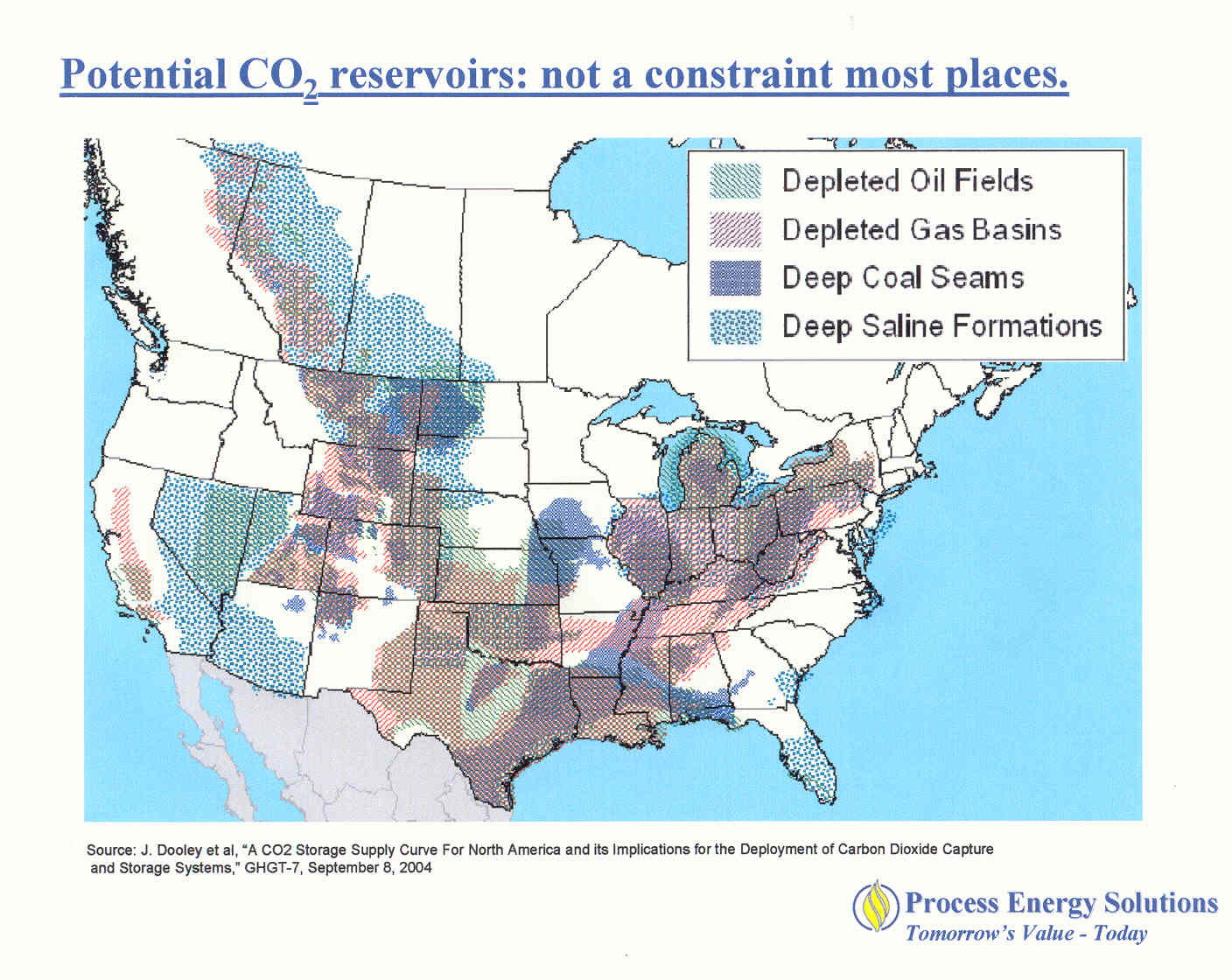
So now what? Quick start bailing and where’s the bondo, we’re takin’ on water…
OK, put on your life preserver and seat belt and get out your barf bag… at the 11:59th hour, Excelsior submits a “Supplemental Response to MCGP’s First Interrogatories and Document Requests No. 21(#2), written by a not-long licensed ATTORNEY providing hearsay “evidence” about sequestration:
On November 13, 2006, Excelsior discussed potential caron sinks in the Upper Midwest with Julio Friedmann, the Associate Program Leader of the Carbon Management Program at Lawrence Livermore National Laboratory and Harvey Thorleifson, Director of the Minnesota Geological Survey. Based on those discussions, Excelsior concludes that prospects do exist in Minnesota for geologic formations that may be appropriate for sequestration. At present, the geological understanding of these formations is limited and further study is necessary to determine their suitability for carbon sequestration…
…Because of the lack of oil and gas exploration in the area, the Midcontinent Rift in Minnesota has not been characterized to the degree of other identified and confirmed sinks. Excelsior is exploring ways to facilitate this research. However, until this occurs, the potential to sequester carbon in Minnesota can neither be confirmed nor denied.
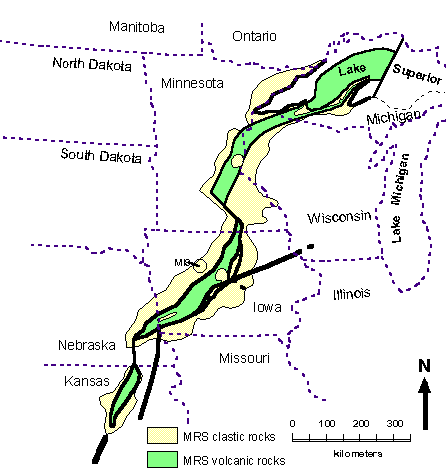
Uh-huh, right… here’s their “map” produced Tuesday (note the quality):

There’s been some snorting and chortling about what that MidContinent Drift Formation resembles… and this gambit is about as effective!
Here’s the full Excelsior missive.
Excelsior Supplemental Response re: CO2 Sequestration
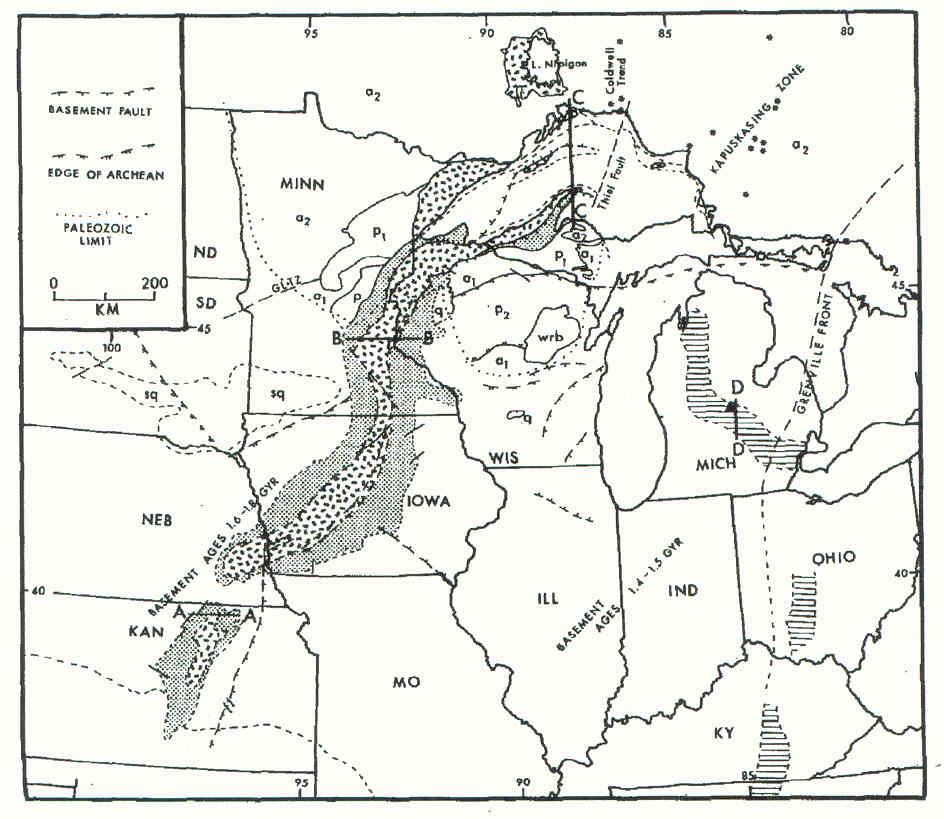
Let’s see, they’ve had how many highly paid big name witnesses submit testimony about sequestration??? Daniel Schrag, Douglas Cortez, Dick Stone, Ed Steadman and even Bob Evans is in the mix and suddenly this Precambrian basement, embedded in older Archean gneiss-migmatite terrane, Archean granite-greenstone terrane, Proterozoic cratonic cover, Early Proterozoic igneous comlex, Sioux Quartzite, Early Proterozoic quartzites and 1500-Myr-old Wolf River Batholith that composes the Midcontinent Rift System is a potential site for CO2 sequestration?
Oh, give me a fuckin’ break…
Just for yucks, let’s look at a real map, one that’s more legible than the Exelsior one:
Now for shits and giggles, let’s check out this map:
And this one of the MidContinent Rift around Lake Superior:
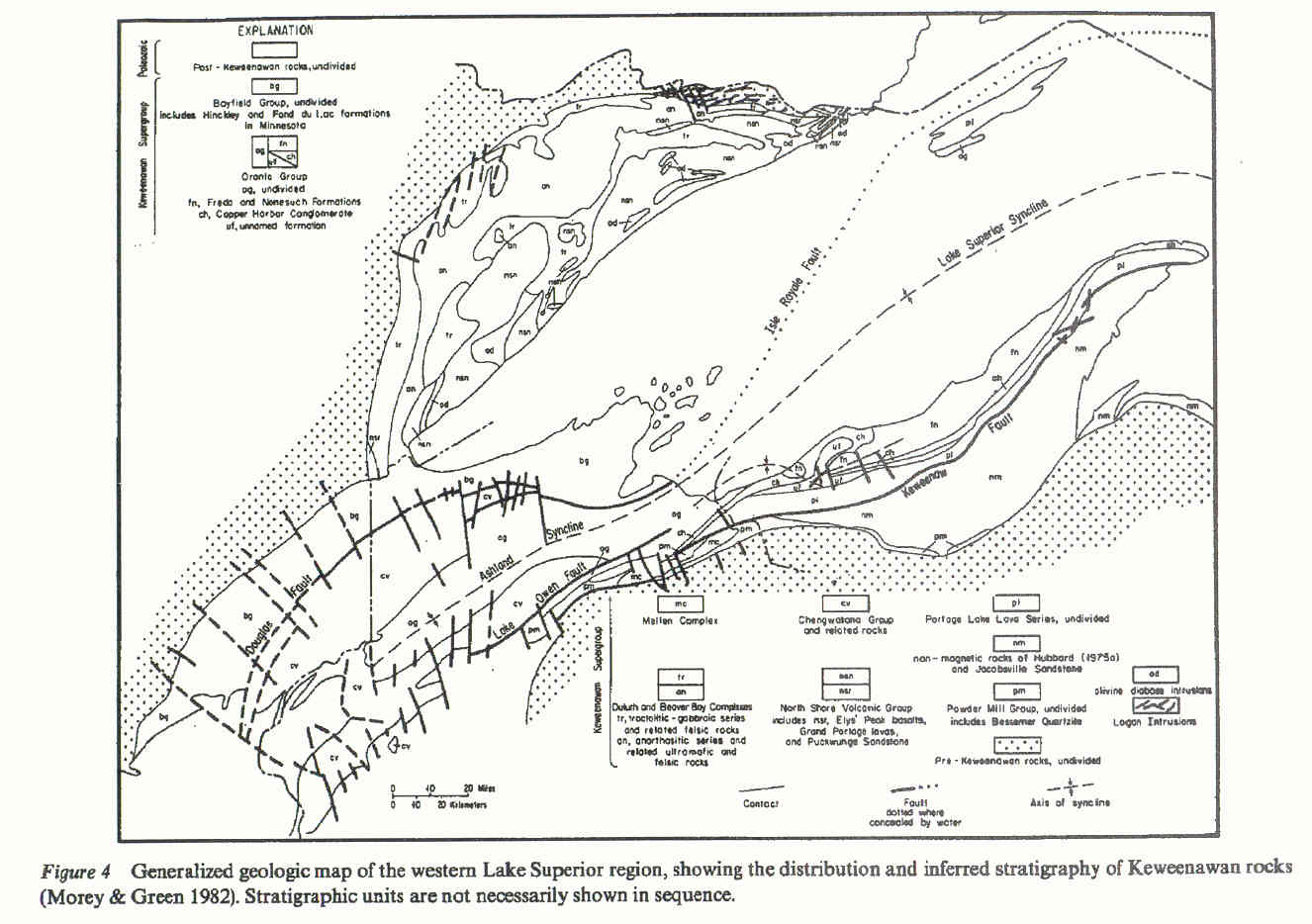
Yup, this possibility just suddenly appears… I wonder what Paul Witherspoon would think of this theory?