Eastern Governors stand up against Transmission!!!
May 6th, 2009

Yeaaaaaaaaaaaa! One for the home team!!!!
First it was NYISO and ISO-New England:
Then it was New York’s Deputy Secretary of Energy testifying before Senate Energy Committee:
And now the Governors from the Northeast and Mid-Atlantic states have stood up against the insane Midwest transmission plans — transmission plans like CapX 2020, JCSP/MTEP, Green Power Express, and the unnamed group announced on April 3rd, starting in North Dakota, banding southern Minnesota, and shooting out into Wisconsin.
Here’s their letter:
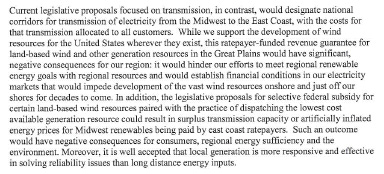
It’s blurry, so click the letter and read the whole thing. An eye opener for the Midwest, those who don’t recognize that there’s a big world out there and it’s not all about Midwest wind. Folks, you have a marketing problem, your target market says NO! What about NO can’t you understand?
The GALL of GRE’s Kaul!
April 30th, 2009

Will Kaul, VP of GRE, let loose in response to David Morris’ opinion piece a few days ago. What a doozy! How dare he! Talk about out of touch with reality! Maybe he’d better ask a few of the thousands who showed up and commented on this insane series of transmission projects across Minnesota known as CapX 2020.
You can call him and tell him what you think. Will Kaul @ GRE (763) 241-2380!

Will Kaul: Citizens have plenty of input on utilities
The facts on three new power lines came out in dozens of public events.By WILL KAUL
Last update: April 30, 2009 – 11:05 AM
The above quote, “to be a formal intervener, an individual or group simply had to sign up,” is false, and the utmost in arrogance. Kaul … read more sure wasn’t at the CapX proceeding that I was at, and it looks like he hasn’t read the transcript. If he had, he’d know that a couple weeks into the hearing, the judge issued an Order to Show Cause to two intervenors, the Prairie Island Indian Community and United Citizens Action Network to explain why they shouldn’t be booted out! Prairie Island Indian Community said they’d withdraw and maybe intervene in the siting docket. U-CAN, landowners in the route corridor, succinctly told the judge they had every right to be Intervenors, there were no requirements for level of participation, and btw, they were in the middle of condemnation proceedings for the MinnCan pipeline (another of her dockets and recommendations!) and didn’t have resources to do much in CapX. The judge then graciously allowed them to remain in the proceeding. nocapx2020.info/?p=324 Electric use is down, down, hence NoCapX 2020’s Motion to Reopen (November and last month), and soon, Motion for Reconsideration and then appeal. The forecasts are old, 2004-2005, and Xcel admits in its SEC filings that 2007 and 2008 saw declining beaks, SIGNIFICANTLY declining peaks, over 11% in just two years rather than their 2.49% increase, 1.5% increase, or whatever other number was dreamed up for the occasion. Those two years alone push any claimed need for this project way out there in time. And even if there was the “need” that they claim, the physical conductor is way over-spec’d, many many times what’s necessary for even the most generous forecast, and then they have the nerve to upsize it, doubling it, with zero justification! “The PUC upheld the recommendation of the judge…” Of course, they’re supporting MISO’s economic dispatch, rather than ratepayer interests, rather than the public interest. It’s time for a shake-up, not the usual shake-down. Yes, the many pages of transcripts, testimony, exhibits reflect the facts, but the ALJ recommendation and PUC decision do not reflect those facts or the purpose and reality of CapX 2020. From the utility squeals, it’s clear David Morris hit a nerve by being right on target.
An April 24 opinion piece by David Morris (“If it’s citizens vs. utilities, utilities win”) criticized the process state regulators use to review and approve new transmission lines and questioned whether Minnesotans had an opportunity to participate in the recent proceedings concerning three 345-kilovolt lines proposed by CapX2020, a group of 11 utilities.
The piece also made a rather bizarre comparison between sports stadiums and electric transmission lines. Electricity is an essential service that every Minnesotan depends on 24 hours a day, seven days a week.
The state regulatory process encourages public participation. It requires an independent review to ensure that utilities’ plans undergo a thorough and comprehensive vetting.
In the CapX2020 case:
•The Minnesota Department of Commerce held 10 public meetings, and an administrative law judge held 19 public hearings. Any interested citizen could attend and speak.
•To be a formal intervener, an individual or group simply had to sign up.
•The utilities hosted more than 100 public meetings and made more than 150 public presentations about the projects.
Following that extensive review, the Minnesota Public Utilities Commission voted unanimously that the three lines are needed. The decision upheld the recommendation of an administrative law judge, who reviewed thousands of pages of testimony and public comments and conducted seven weeks of evidentiary hearings and three weeks of public hearings.
Among the points the utilities made:
•Since the last major transmission system upgrade in Minnesota 30 years ago, much has changed. Electricity consumption has doubled, as has the number of electricity customers. Communities such as St. Cloud, Alexandria, Rochester and the Twin Cities have experienced significant growth and are facing serious electricity reliability issues.
•Despite today’s economic slowdown, electricity use is projected to continue growing, particularly peak electricity use.
•The transmission system must be designed to withstand the loss of one line by instantaneously transferring power to other lines.
•Minnesota has the most aggressive renewable energy standard in the country, requiring that 25 percent of electricity be from renewable sources by 2025. The Buffalo Ridge in southwestern Minnesota is one of the country’s greatest wind resources. Transmission lines are required to move that energy to customers.
The CapX2020 transmission lines aim to ensure that Minnesota communities continue to enjoy reliable electricity service and that the state’s renewable-energy mandate is met. The regulatory process aims to ensure that citizens have a say in determining whether the lines are needed and where they should be routed.
Will Kaul is vice president of transmission for Great River Energy and is chairman of the CapX2020 organization.
Susquehanna-Roseland Xmsn Interventions OK’d
April 29th, 2009
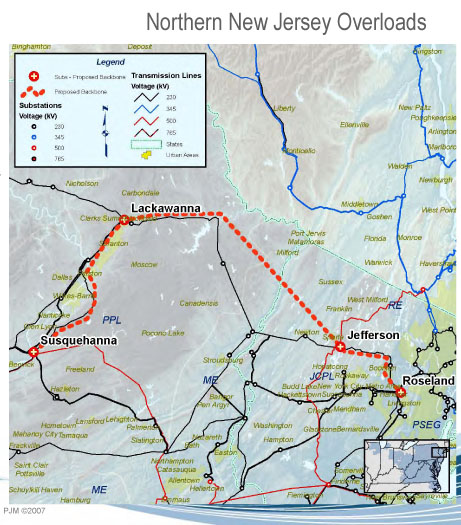
Day before yesterday, New Jersey’s Board of Public Utilities met to make determinations on the Motions for Intervention of a large number of parties. Stop the Lines, of course being one! They’d objected to our Intervention:
… but had no objection to my Pro Hac Vice… go figure. And the feeling I had from the BPU is that they were honestly encouraging interventions. SO, what happened?
State: 17 groups may intervene in PSE&G’s power line proposal
By Colleen O’Dea • Daily Record • April 27, 2009All 17 groups that sought to be part of the hearing process on Public Service Electric and Gas Company’s proposed transmission line project may do so, the state Board of Public Utilities decided today.
Meeting in Newark, the board also directed PSE&G to meet with the intervening parties – several municipalities, environmental organizations and citizens groups – to negotiate an agreement on the establishment of an escrow account from which the groups could pay for expert witnesses.
“Super,” is how Dave Slaperud of the 300-member Stop the Lines, one of six groups the utility had sought to bar from intervening in its application to add 500 kilovolt lines along a 46-mile transmission corridor from Pennsylvania through Morris County to Roseland, described the BPU’s decision.
“We would have been really surprised if we had been denied intervener status,” said Slaperud. “There are so many of us living along the line who are affected and not all the municipalities are getting involved in the process.”
Among the government bodies that are involved are East Hanover, Montville, Parsippany and Byram townships and the Montville Board of Education. Interveners are allowed to request discovery documents, cross examine witnesses and present their own expert testimony.
And more:
Groups cleared to speak at powerline hearings
Xcel’s applied for Hiawatha Project
April 28th, 2009
HEY MOES, I’D SIGNED UP FOR THE LIST AND AS OF TODAY, 4/28, HAVE NOT RECEIVED NOTICE OF THIS PROJECT APPLICATION THAT YOU’VE POSTED ON APRIL 24! WHAT GIVES?
Here’s the state’s routing webpage – HERE’S THE LINK FOR APPLICATION AND TO SIGN UP FOR FURTHER INFORMATION:
Now take a look at this map for the FULL plan, well, at least a larger picture, than what they’re disclosing for the Hiawatha Project. Here’s the map, and note carefully, from B-C is what they’re calling the Hiawatha Project. tHIS SECTION IS FOR XCEL’s PAM RASMUSSEN, WHO HATES IT WHEN I PUBLISH THIS MAP, SO I’VE GOT TO BE VERY SPECIFIC WHERE THIS INFORMATION IS COMING FROM AND WHAT CONSTITUTES THE “HIAWATHA PROJECT” and as far as Xcel is disclosing, the applied for Hiawatha Project is “B-C” of this map. Look below to see where the rest comes from!

Here’s the NM-SPG meeting minutes reporting on the A-B link, the 345kV line from a new substation on Hwy 280 (A) to the new Hiawatha Project substation (B).
Then there’s “Hiawatha Project” from B-C.
For C, D and E, see the “Minnesota Transmission Owners” 2007 Biennial Transmission Plan, where they list these extension alternatives:
Alternatives. Initial investigation and scoping discussions have led to the development of three potential alternatives:
(1) Construct a new 115 kV line from a new Hiawatha Substation along Highway 55 to a new Oakland Substation near Lake Street and I-35W. The line would then continue south to a new Highway 62 Substation near Highway 62 and Nicollet Avenue. The line would continue to its final termination at a new Penn Lake Substation near I-494 and Sheridan Avenue.
(2) Similar to Option 1, but the final 115 kV line would stretch from Highway 62 Substation to the existing Wilson Substation near I-494 and Wentworth Avenue.
(3) Construct two smaller 115 kV loops with new 115 kV lines running from Hiawatha to Oakland to Elliot Park and a second loop from Penn Lake to Highway 62 to Wilson.
Section 7 of Biennial Transmission Plan, go to Section 7.5 and all the way down to 3rd and 4th to last pages:
Another point to note: the Hiawatha Project is WAY over spec’d. This is a double circuited ACSS 795kCmil conductor — see what that means and compare it with the claimed 100MW need in the FUTURE!
And now, for today’s STrib article:
Will burying power lines in Midtown bury city, users with $12.6 million bill?
David Morris on PUC process and Capx 2020 decision
April 24th, 2009
Once more, it’s David Morris, Institute for Local Self Reliance, telling it like it is. The PUC process is long over do a complete revamping. It is based on laws and rules that grew out of the 1970s-1980s transmission fights, and gave people a useful and meaningful way to participate in these proceedings. But that’s gone, gone with the 2001 changes, gone with the 2005 Transmission Omnibus Bill from Hell, and we’re left with just about nothing. In other states, there’s Intervenor Compensation which allows Intervenors the ability to pay for expert witnesses, there are free transcripts as a matter of course, and there’s encouragement and support of Intervenors, not a drive to push them out of the process that we see here, that we saw in this CapX proceeding, when the ALJ tried to boot out U-CAN; that we saw in the Excelsior Energy docket (scroll down to “Fourth Prehearing Order”).

David Morris: If it’s citizens vs. utilities, utilities win
The PUC has an approval process that stacks the deck against the public.
By DAVID MORRIS
Last update: April 23, 2009 – 6:50 PM
A few days ago, the Minnesota Public Utilities Commission (PUC) approved a massive high-voltage transmission project known as CapX that will cost Minnesotans an amount equal to the projected biennial state budget deficit and four times the total bill to taxpayers for the Twins and Gophers stadiums.
With respect to the stadiums, Minnesotans were able to actively participate in the decisions, both directly and indirectly through elected representatives. Both those in favor and those opposed to using tax dollars to pay for the stadiums engaged in a spirited public debate. The Legislature is currently just as vigorously debating ways it can eliminate the budget deficit.
The PUC process, on the other hand, is much more hostile to citizen participation and influence. Indeed, the deck is stacked against the average citizen. Utilities have a virtually unlimited budget to argue their positions — a budget they raise from their ratepayers. Citizens, on the other hand, must raise their own money, and lots of it, to participate effectively.
The rules under which the PUC operates are established by the Legislature. Utility lobbyists are powerful there. But they’re not all-powerful. Thus, over the years, Minnesotans have been able to enact rules to help level the playing field for citizens. For example, the law requires the PUC to reject an application to build a large power plant or a high-voltage transmission line unless the utility proves it is needed to improve reliability or meet increased demand or achieve renewable-energy goals. As part of the application, the utility is expected to thoroughly and completely explore alternatives to its proposal, including no-build options. The burden of proof on whether a project is needed rests with the utilities.
The PUC, regrettably, has interpreted this rule so as to turn it on its head. At the PUC, the burden of proof rests with those opposed to a new power plant or high-voltage transmission line. It is up to the people whose homes and farms may be seized by utilities if a project is approved to make the case for alternatives. Doing so requires an extremely high level of technical expertise. A serious technical and economic examination of alternatives can cost $100,000 to $200,000 or more.
Even if citizens are able to raise that kind of money, they face other hurdles. To analyze alternatives, they must access data that only utilities possess. In many cases, the utilities call that data proprietary and argue that to make the information public is to give a possible advantage to a competitor. One would think that this would be a hard argument to make. After all, Minnesota utilities have a monopoly on the sale of electricity. Apparently, however, it is not a hard argument to make at the PUC.
A formal proceeding, such as a judicial proceeding, involves the cross-examination of witnesses. In many proceedings, utilities again tax their customers by using ratepayer money to acquire a transcript. One would think that since the transcript is in electronic form, the PUC would post it and make it freely available to the public. Astonishingly, the PUC rules state that court reporters own the transcript! Citizens and other intervenors must pay for their own copies of transcripts, which, for controversial projects, could mean $5,000 to $10,000 per copy.
In the recent CapX transmission case, the PUC went one step further in denying citizens. The need for the transmission lines was based in large part on a projection of significantly increasing demand. That projection was largely made in forecasts completed in 2004. It has already proven to be vastly overstated. Moreover, the current economic collapse is translating into shrinking, not growing, electricity demand. Hundreds of citizens asked the PUC to take this new information into account and keep the proceeding open. The PUC decided the current economic free fall doesn’t make a difference.
Utilities are gearing up to ask the PUC to spend billions more for even higher-voltage transmission lines. These will be built to send electricity from the Dakotas to Chicago and New York while running right through Minnesota. If these lines are approved, Minnesotans will probably pay most of the costs, while receiving little if any benefit.
Imagine if legislators proposed taxing us to build a sports stadium in Chicago. The proposal would be dead on arrival. Citizens have influence and even power in the Legislature. The process and rules at the PUC must be redesigned to allow them similar access and influence over energy decisions.
David Morris is vice president of the Institute for Local Self-Reliance, based in Minneapolis and Washington, D.C.