Putting money where dream is
June 1st, 2007

From Greg Nolan, he’s the one on the right, hiding the bowl of his homegrown blueberries, at the Windy River Energy Fair a couple years ago:
Will to do good work
I had a dream the other day. When I opened my electric bill, I found a letter that offered an investment opportunity to me. It seems that our legislators had changed the way citizens and utilities were taxed on investments they made together. The utilities saw an opportunity to use their customers investment capital, a share at a time, to purchase and operate utility grade wind machines in our region. What the utilities offered, with the legislators blessing, was a chance to democratize the production of electricity. Both the legislators and the utilities knew putting the people and their “will to do good work” was the best way to solve problems in America. Making rate payers a part of the production of clean power would make all of us winners. Everyone involved knew that new power plants that burned coal would create a lot of problems and that the wind in our region was a clean, renewable resource that could produce vast amounts of home brewed power. The electrical co-ops had a leg up on other electric companies as they were organized perfectly to get their customers involved. The consumer would not just own a monetary investment but a production quota, so as power went up in price so would their investments. The consumer would have the right to take there production quota off their bill every month after the power company was paid for the good service they provided moving the power to the customers. Power lines from these wind machines put up in windy areas, connecting the people in need, would be built with the same federal loan program that got power to rural Minnesota in the 30’s and 40’s. Non-profits in our region followed this program up with investments of their own in economic development to build utility grade wind machines in our area, creating jobs. The goal was to produce the best wind machines in the world and export these wind machines instead of weapons to the world. Research dollars were invested in electrifying transportation and more economic development went into making cars locally with good batteries that could store the wind energy. We all lived in a cleaner more peaceful place. Our kids took stock in our investments in the future and let out a sigh of relief.
Greg Nolan lives and naps at Snowy Pines, a 40 acre well managed forest in rural central Minnesota. He has lived in a solar power home for over 25 years, and has planted over 3 million trees with his family forestry business.
Today is Delaware PSC meeting
May 8th, 2007
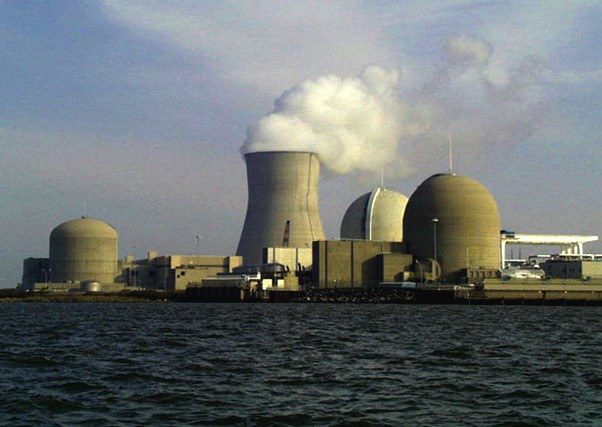
It’s about as perfectly beeeeauuuuuteeeful a spring day as can be found anywhere. From my desk looking out an easterly window towards the river, this Salem plume would be visible if a block’s worth of houses weren’t in the way — and unfortunately, not being able to see it does reduce its presence, much like the way my Prairie Island nuclear plant is nestled behind a bluff, but directly upwind and upriver… Here in this nuclear zone, they don’t get calendars, they don’t get pottasium iodide, though they do have the nuke sirens.
There have been some very interesting reports coming out of the PSC lately, things that look like thoughtful energy planning — and I hope it’s not a ruse. There was that staff recommendation of a wind/gas combo on the RFP side of things, and the recommendation focused on the broader policy issues that need to be addressed, those pesky little things like the need for a portfolio approach, the state’s dependence on transmission and need for its own generation… like wow!
Then there’s a report about transmission and generator interconnection:
And a short update/correction with additional runs on the RFP evaluation:
Overland’s take? The staff recommendation is a good option, in the public interest, and it gets wind going as dispatchable generation, removing one of the primary objections to wind, it’s variability. The IRP is the venue to make the larger policy changes, where, as staff noted in the RFP recommendation, a portfolio approach can be established. This is where the policy directives establishing DSM with TEETH (not present in DE yet), establishing the need for Delaware generation to prevent extortion by generation and transmission owners, demonstrating the need for specifically sited generation that would eliminate voltage problems in this electrical island. This RFP docket is one step and can propel the state into energy planning in the IRP — that’s what I’d like to see.
Imagine DE fulfilling its “baseload” needs with dispatchable wind — wind in combo with backup generation! Arizona is using concentrated solar and gas, Minnesota is using wind/gas and wind/hydro, Delaware can do wind/gas!
Imagine DE, through policy declarations, systematically choosing not to buy dirty coal! Indian River Units 1 and 2 are only 160 MW, not hard to replace. If Xcel can do it (well, we know, anything but IGCC!), imagine…
An MPR piece on the Bluewater Wind proposal in the RFP:
Here’s the Delaware State Treasurer standing up for the public interest (stolen from Green Delaware): State Treasurer Jack Markell’s Letter to Delmarva Power.
Plus there’s a new report – a consultant’s view of reregulation! Where is it??? Can’t find it. I’ll post it as soon as I do…
ConocoPhillips draws a crowd!
April 28th, 2007

ConocoPhillips says it’s paying attention:
“Our industry has lost touch with the public,” said Conoco’s Bob Ridge in his opening statements. “We did a poll, and we found our credibility was below the tobacco industry. We want to listen.”
From the Rochester Post Bulletin:

As I said before, when ConocoPhillips comes to down on the heels of its big technology gamble, coal gasification, going down the hopper in spectacular flames, I’m wary, and I’m downright suspicious when “our” very own Ed Garvey is up there on the bias… er… dais… errrrr… bias… And the CERTs folks are not to happy that I’m asking questions about their promotion of this event, and consenting to parts of two front rows and breakfast the next day (dinner before hand perhaps?) But ConocoPhillips has a lot at stake here, IGCC alone is a tremendous investment, even for the likes of a company that big. Anyway, I was ready, I went with my friend Tom, who’s pretty laid back, and fortified myself with two mango margaroodies from Fiesta before hand — a sure way to keep me quiet throughout. That and my “no bark” collar! Meanwhile, Chuck Michels of SEH and Mike Gregorson of Great Plains Institute were getting a vicarious thrill wondering what’s up in Delaware!?!?! Jeez, get a life… Poor Mike gets assigned to follow me over to Denver 2/12 for our IGCC Conference and then to be in Grand Rapids 2/14 (and he got to fly, not fair…) — hey, Mike, here’s a hint — are you booked yet for the PSC meeting on May 8 in Dover, maybe the deathknell of yet another IGCC project??? See ya there!
Oh, and someone thinks I need to post “my price” on the blog… let’s just keep them guessing.

I was paying attention to Ed Garvey’s Comments, which started with four important points:
1) Humans cause climate change
2) Renew, manage, replace and improve current energy infrastructure
3) Promote renewables
4) Increase conservation and efficiency
As he said that, both Tom and I noticed that conservation and efficiency were DEAD LAST. Better reverse that order! grrrrrrrrrrrrrr…

Anyway, his final four points are supposed to be a policy statement, but the horiffic things that are happening in energy right now show that there’s something wrong here. He’s saying that energy must be:
– Reliable
– Low Cost
– Community Based
– Environmentally Superior
Ummmmm… could someone please let Governor Pawlenty know of his own “policy” points so he’s not supporting unsupportable projects like the boondoggle Mesaba Project, and the massive coal enabling transmission of CapX2020? Ahem…
Turkey turds redux
April 26th, 2007
  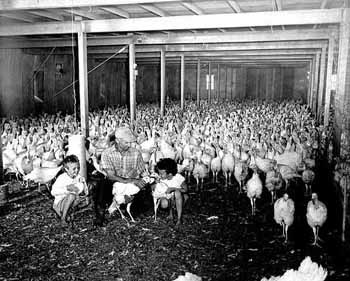
Stolen from St. Olaf, an interesting piece on “Thanksgiving and the Environment” (Interior of a turkey barn, 1947. Photo courtesy of the MN Historical Society)
In today’s STrib:
Gov. Pawlenty, who wants to be known as the “Energy Governor,” supports Fibrominn and turkey turd incineration:
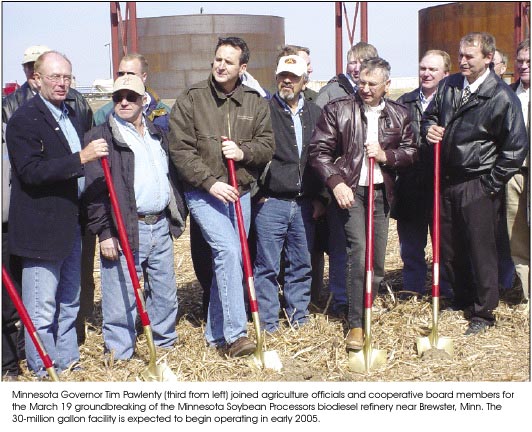
As the STrib article notes:
Even in an era when renewable energy has moved from environmental wish lists to mainstream discussions embraced by President Bush, Gov. Tim Pawlenty and labor unions, the business of burning poultry manure has ruffled some feathers.
David Morris lays out the problems. It’s not “green” by any measure:
“Being green means being informed and being sophisticated,” said David Morris of the Institute for Local Self-Reliance, an energy expert and longtime critic of the litter-burning project. “Simply because you’re taking a renewable resource and turning it into something else does not mean that it’s environmentally benign or economically worthwhile.”
and the price is not reasonable:
But even with federal tax incentives, Xcel is paying twice as much for Fibrominn’s power than for wind energy, according to Morris of the Institute for Local Self-Reliance. He said it amounts to an $11-million-a-year subsidy that ratepayers ultimately will pay.
“That’s almost a quarter of a billion in subsidies over the life of this contract,” he said. “And in terms of projected power needs for Xcel or the state, this is a really, really tiny plant. From a systems analysis it stinks. And talking about it from an economic analysis, it stinks.”
Here’s a piece from David Morris:
Here’s the EQB’s Order on Fibrominn:
Findings of Fact, Conclusions of Law and Order Granting Exemption
And on p. 16, there’s a recap of the Senate Committee Hearings on Fibrominn:
A couple of points on the STrib article and turkey turds from Alan Muller, of Green Delaware. Green Delaware was an active part of the effort to run Fibrowatt out of Delaware:

Sent to the STrib:
Nothing short of nuclear reactions can turn poop or anything else into energy. The carbon burns to CO2 and the hydrogen burns to water (H2O). This is a constant misrepresentation made by burner promoters….
Energy is not “created.” This is basic thermodynamics. Some chemical energy is released as thermal energy in the chemical reactions of combustion, and some of this (maybe 85 percent or so) can be captured in the boilers and used to operate steam turbines. The overall thermal efficiency for a plant like this is likely to be on the order of 25-30 percent. The electricity is useful, if very expensive, but against this we need to consider various negative impacts.
This type of facility is likely to be a significant source of air pollution…. “Renewable” does not mean “clean” or “green.” (Note the 350 foot smokestack needed to disperse air pollutants!) It is likely that people living near the facility will suffer health impacts, particular from fine particle pollution and acid gasses.
Removal of poop nutrients from the agricultural cycle is undesirable. Using the ash as fertilizer is not as desirable as using the poop itself as fertilizer. David Morris made this point in his testimony.
Getting screwed by electric deregulation!
April 21st, 2007
.

“Instead of competition producing lower rates, the choices are between high or higher prices.”
It doesn’t take a rocket scientist to know that deregulation of the electric market is a bad thing, we even had a report to that effect written eons ago here in Minnesota, in part by none other than NRG’s Steve Corneli!
And just for yucks, let’s not forget his great stranded ASSETS argument when NSP was demanding deregulation and payment for “stranded costs” which were nonexistent:
Anyway, the utter rip-off of “deregulation” has become impossible to ignore and today appeared in detail in the STrib:
Power bills soar as electric deregulation fails to live up to its promises
By Ryan Keith, Associated Press
BENTON, Ill. — This wasn’t supposed to happen with deregulation. Electric bills were supposed to go down. Instead, Ellie Dorchincez can almost see the dollars evaporating every time she turns on the lights or opens the freezer at her small Farm Fresh grocery store.
Her electric bill, which used to be about $800 a month, has jumped to $1,800. She’s shut down a large freezer of frozen treats and now closes the store an hour early to cut costs but fears she still may have to raise prices and lay off some workers.
“I’m just trying to figure any way that I can right now to keep my business afloat,” Dorchincez said. “My life is at stake here.”
The cause of her distress is a common problem: the failure of deregulation to deliver its promise of lower electricity prices. In many states, it’s had the opposite effect with sharply higher rates — 72 percent in Maryland, up to 50 percent in Illinois.
Not one of the 16 states — plus the District of Columbia — that have pushed forward with deregulation since the late 1990s can call it a success. In fact, consumers in those states fared worse than residents in states that stuck with a policy of regulating their power industries.
An Associated Press analysis of federal data shows consumers in the 17 deregulated areas paid an average of 30 percent more for power in 2006 than their counterparts in regulated states. That’s up from a 22 percent gap in 1990.
The idea was to move from a monopoly situation to robust competition for electric customers, with backers promising potentially lower rates in state after state.
“We are good at taking money out of people’s pockets, but seldom can somebody rise on the floor and say we are going to save people billions over a specific course of time,” Illinois state Sen. William Mahar, a lead proponent of electric deregulation, said when his chamber passed a deregulation bill in 1997.
But competition, especially for residential and small business customers, rarely emerged.
Utilities say markets are still adjusting to many years of artificially low rates that drove potential competitors away. They point to states like Illinois, where rate caps just recently were lifted and where there already is talk of reinstating them.
Consumer groups, however, say deregulation has had a chance to prove itself. In Texas, for example, competition did develop after rate caps ended — but the energy prices remained higher.
The AP analysis was based on the average electric rate that residential consumers paid each year from 1990 to 2006, according to numbers provided by the U.S. Department of Energy. Numerical and percentage changes in utility rates of both deregulated and regulated states were compared.
The analysis found more than a widening price discrepancy. Consumers in deregulated states also have suffered from bigger price swings, as rate caps in place when deregulation began in the late 1990s were lifted in the last couple of years.
Now those states’ lawmakers are scrambling to figure out how to provide short-term relief for consumers while coming up with a long-term approach to get lower and more stabilized prices. Ideas range from continued rate freezes — vehemently fought by utilities — to re-regulation of the industry.
“We said back then it was a raw deal for consumers. We now know it was a raw deal for consumers,” said Johanna Neumann of Maryland Public Interest Research Group.
But an industry official argues that such comparisons don’t adequately show the peaks and valleys in rates during that time, and among individual states. And utility executives say that over the last decade, rates in deregulated and regulated states have generally increased at similar levels, thanks largely to sharp spikes in fuel costs — not deregulation.
John Shelk, president of the Electrical Power Supply Association trade group based in Washington, D.C., says all states have seen large rate increases in the last decade, largely because of the increased price of natural gas and building power plants. The average U.S. price for natural gas used by the electric power sector tripled from $2.76 per million Btus in 1997 to $8.21 per thousand cubic feet in 2005, a peak year for natural gas prices, according to federal energy statistics. Prices dropped slightly in 2006 but are projected to rise again over the next two years.
Utility officials say natural gas prices, environmental regulations, property taxes, the cost of building nuclear plants and other expenses in states that deregulated had already driven prices higher than in other states.
But years after many states deregulated, the rate gap between those states and regulated states had widened even more, experts and consumers advocates say, because consumers in deregulated states were left paying market prices — even though in many cases no competitive market existed.
“Now they’re trying to come to grips with the reality that the market isn’t working as well as they thought it would,” Ken Rose, a senior fellow with the Institute of Public Utilities at Michigan State University, says of decision-makers in deregulated states.
Shelk says consumers in states like Illinois are seeing “sticker shock” because their rates were artificially low for years, and that forced a large increase to get back to market prices when rate caps were lifted.
“It’s kind of like pulling the Band-Aid off,” Shelk said. “I think you can fault the design that said you can roll these rates back and freeze them.”
He predicts that the rate gap between deregulated and regulated states will shrink in the next few years when regulated states in the Southeast that rely heavily on coal-fueled power see prices soar under heavier environmental restrictions.
“It’s so easy to focus only on the here and now … and draw the wrong conclusions, which is ‘Oh, gee, we’re going to be better off regulating,’ because we’re not,” Shelk said.
Shelk also contends that deregulation has been successful in states like Texas because, despite price jumps there, the competition has kept rates lower than they would have been under monopoly conditions, and still has produced a more predictable market for utilities and customers.
Exelon executive vice president Betsy Moler said rates in all states, regardless of their regulatory structure, have soared about 34 percent since 1996, mirroring fuel cost increases. That should overshadow critics’ blame of deregulation, she argues.
“It’s really not about deregulation,” Moler said. “It’s all about the cost of fuel.”
Yet the last decade saw extended rate freezes in many states, and more recent data shows a returning gap between regulated and deregulated states once those freezes end.
Illinois’ deregulation plan froze rates for 10 years. The freeze ended in January and rates immediately soared 30 percent to 50 percent for millions of people. Some have seen their bills double and even triple.
In Carterville in southern Illinois, Dorothy Petersen is looking for a second job to supplement her $1,000-a-month income after seeing her electric bill more than double, to $450. A single mother with four kids — all with health or development problems — Petersen is heating only the kids’ rooms and turning off lights.
“If it was just me, it wouldn’t matter. There’s things I could do,” Petersen said. “But I have these kids.”
Maryland faced a 72 percent rate increase last summer, until lawmakers stepped in and cut the initial jump to 15 percent to 25 percent. Now consumers must pay the remainder this summer, and advocates fear problems for the most vulnerable citizens — seniors, low-income households, working families.
Texas residents like recent retiree Bill Sebenoler of Arlington have more utility choices under deregulation, but that hasn’t kept prices down. Sebenoler said his bill reached nearly $500 in September 2006, up 82 percent from a year earlier.
“It’s irritating as hell, and that money would go somewhere else,” Sebenoler said. “Something ain’t working right.”
Consumers in Delaware, Rhode Island and Connecticut have seen rate spikes in recent years, putting their rates among the nation’s highest. That led to more than 25,000 electricity shutoffs in Rhode Island last year, a new state record, said Henry Shelton of the George Wiley Center advocacy group.
In Montana, Ed Eaton says he and other consumers have seen a 40 percent increase since rate caps were lifted in 2001. Eaton said he’s cut expenses by eating more canned tuna for meals.
“I probably could have turned this into a weight loss program and benefited,” said Eaton, a former state employee.
Deregulation was sold to state decision-makers as a boon for everyone. The thinking was that by separating electricity generators from distributors and letting the market determine prices, competition would thrive and customers would benefit from better choices and lower rates.
Experts and advocates acknowledge that some consumers have seen those benefits.
In some states, large industrial and business users have seen increased competition, giving them the ability to switch to other utilities. Residential users in states such as Texas also have a few more options.
But besides a small group of commercial users, consumers in deregulated states have seen a disappointing result.
Instead of competition producing lower rates, the choices are between high or higher prices. In some states such as Illinois, residents have no choice but to get their power from one or two mega-utilities, who are passing on soaring costs for the power they’re buying.
ComEd, for example, has about 3.3 million residential customers in and around Chicago, while Ameren covers 1.2 million customers in central and southern Illinois. Combined, they control about 98 percent of Illinois’ investor-owned market, according to the Illinois Commerce Commission.
“In terms of price, you can’t see the customers benefiting,” said Rose, the Michigan utility expert.
Utilities say they’re not to blame for consumers’ higher costs.
Since they no longer produce their own power, the utilities in Illinois, for example, say they’ve simply passed on their higher purchasing costs to consumers, resulting in the higher rates. While some of the generation companies have ownership ties to the retail utilities like ComEd and Ameren, Illinois regulators note they have strict rules to ensure affiliates do not trade information or conspire on pricing.
The utilities also note that they warned consumers last year about the pending increases and offered assistance through some financial aid and a phase-in plan.
“I think we’ve done all the things we know how to do as a utility to soften the transition into the new rates,” ComEd CEO Frank Clark said in February.
The poster child of deregulation failure is California, which saw a combination of skyrocketing rates and service problems before scrapping the experiment. Some other states such as Virginia tried deregulation but rejected it after it didn’t provide lower rates.
States that did embrace deregulation now are trying to figure out what to do next.
In Illinois, lawmakers are debating rolling back rates to 2006 levels and freezing them for up to three years. They’re also negotiating with the utilities for millions of dollars in rate rebates for consumers hit hardest by the increases.
Re-regulating the market is a popular idea. State-owned utilities are another possibility.
Utilities and their advocates are urging caution for states considering dumping deregulation. They say competition couldn’t thrive under rate caps but should now that many of those caps have been lifted and the market is determining rates.
The utilities also warn that any further rate rollbacks and caps could create financial disaster, sending them quickly into bankruptcy if they’re forced to buy power at higher costs than they can recoup from customers.
Even so, consumers like Dorchincez are looking for relief now.
In addition to the problems at her grocery store, Dorchincez got hit at home, where her bill jumped from $230 to $700. She’s looking to cut back wherever she can — turning down the store’s thermostat, shutting off other freezers and soda machines, turning off lights in the parking lot.
Consumer advocates say states should be able to see the folly that deregulation created and should act soon to prevent more consumer suffering.
“It’s never going to work. There’s never going to be robust competition created,” said David Hughes of Citizen Power, an advocacy group covering Pennsylvania and Ohio. “It just doesn’t lend itself to the volatility of the marketplace.”
©. All rights reserved.