The rest of the story… ???
September 27th, 2013
Back to transmission lines and pipelines…
Looking at the footprints, at what’s proposed, it makes sense, meaning that it fits together, the rest of the story. But does it? There’s the Not-So-Great Northern Transmission Line (Minnesota Power’s Great Northern Transmission Line), and there’s the Enbridge Sandpiper pipeline. But is it all connected? Or is there even more in store? How much do these companies want?
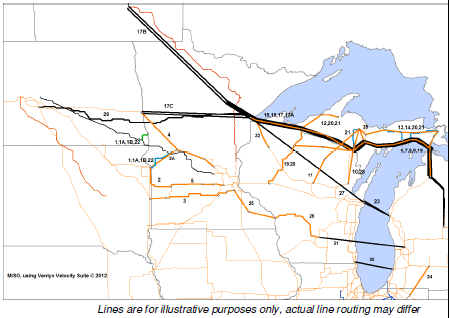
The Not-So-Great Northern Transmission Line:
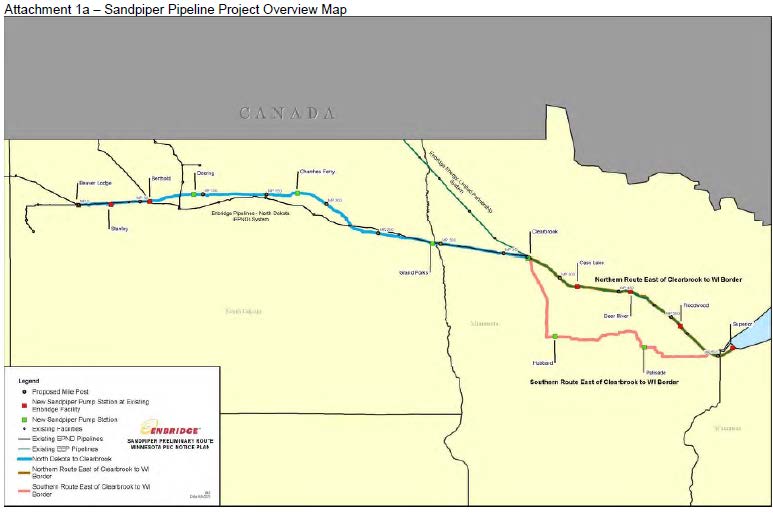
And there’s the Enbridge Sandpiper pipeline:
And then there’s this, the Allete Energy Corridor:
 There are differences… the Allete Energy Corridor is further south, headed straight east to Duluth. But look at the map that is in their Notice Plan, the “Preferred Route.” It’s also south:
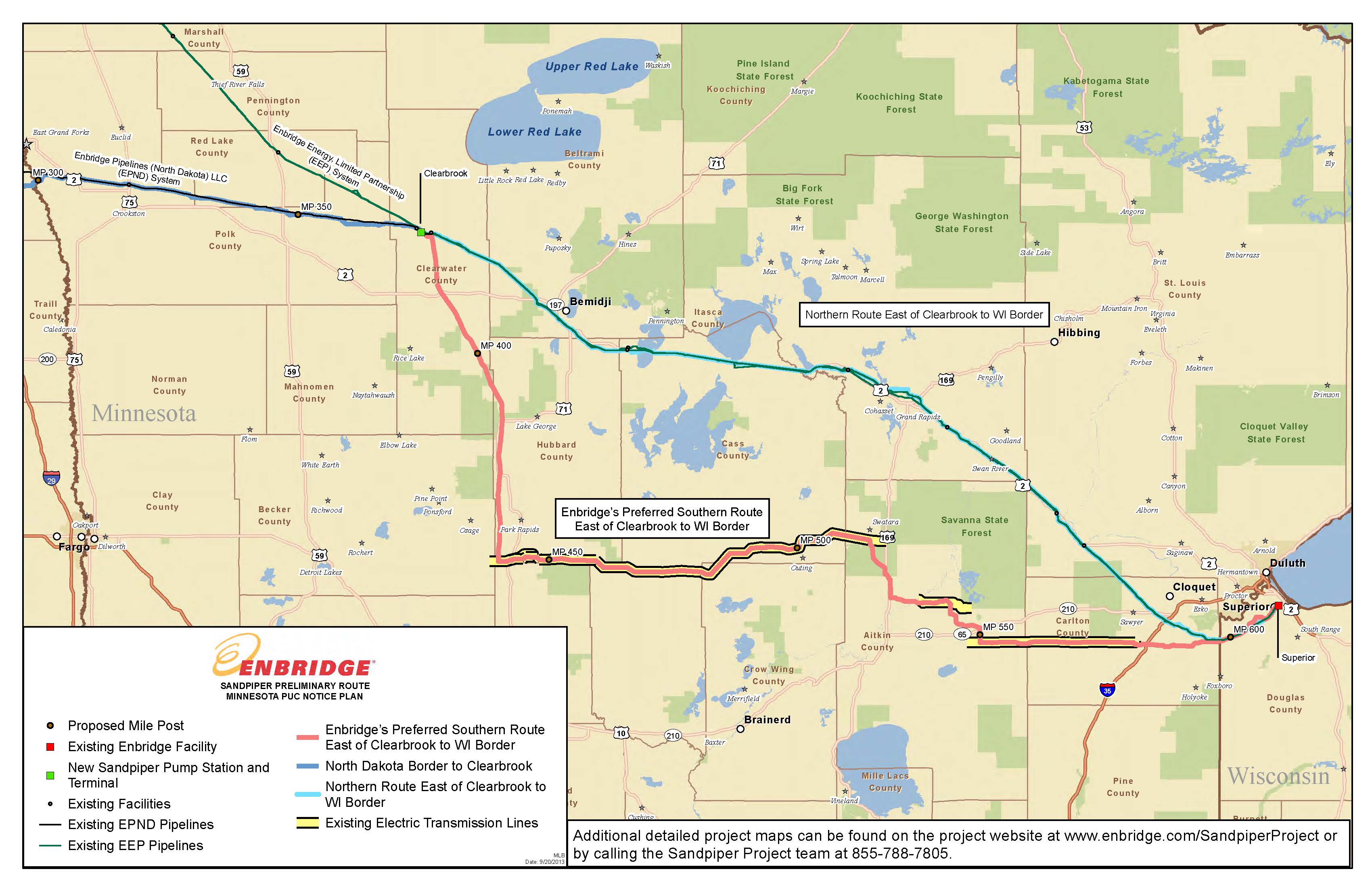
Do they need both? Is this all one and the same project(s)? As we say in transmission, it’s all connected. So do tell, what’s the connection with the two announced projects, one transmission and one pipeline, and this “energy corridor.” Enbridge must submit more detailed maps for the Notice Plan, so we should see soon their “preference.”
Meanwhile, what’s Allete up to? Seems it started over two years ago:
And yesterday:
ALLETE Energy Corridor Would Offer Efficient Movement of Multiple Products, from Flared Gas to Water
by Business Wire via The Motley Fool Sep 25th 2013 12:30PM
Updated Sep 25th 2013 12:32PM
ALLETE Energy Corridor Would Offer Efficient Movement of Multiple Products, from Flared Gas to Water to Carbon
N.D. governor supports comprehensive solution
BISMARCK, N.D.–(BUSINESS WIRE)– ALLETE (NYS: ALE) today laid out its vision for a comprehensive energy transportation corridor that could help provide solutions for the movement of natural gas, petroleum products, water and wastewater, wind energy and future sequestered carbon across a coordinated, shared right-of-way.
The energy corridor’s backbone would follow an existing 465-mile path that contains a direct current transmission line running between Center, N.D. and Duluth, Minn. This 250-kilovolt line, purchased in 2009, is used to transmit electric energy from the lignite-fired Young Generating Station in Center and the nearby Bison Wind Energy Center to Duluth, Minn., home of the nation’s busiest inland seaport. The energy corridor would expand a pathway along strategic portions of the existing right of way to minimize land use and optimize energy delivery infrastructure development within North Dakota.
A top priority of the ALLETE Energy Corridor is to develop an extension of the existing energy delivery path some 60 miles westward to the burgeoning Bakken shale oil fields of west-central North Dakota. ALLETE subsidiary ALLETE Clean Energy has been working diligently with potential partners to study the co-location of facilities and assess the capital needs for the Bakken link. It is envisioned that various lengths of the corridor would be used for different purposes.
“We see the ALLETE Energy Corridor as a comprehensive infrastructure solution in North Dakota that could serve many products and producers across the region,” said ALLETE President, Chairman and CEO Alan R. Hodnik. “We value Gov. Dalrymple’s support of our vision and appreciate him bringing it forward to other members of the state’s energy sector.”
“ALLETE has been invested in North Dakota for decades,” Hodnik added. “We are confident that our rich history of partnering with others can help forge creative solutions to today’s new challenges facing energy markets in the Upper Midwest.”
North Dakota Governor Jack Dalrymple voiced support of the ALLETE Energy Corridor today in remarks to EmPower North Dakota, a commission established to develop a comprehensive energy policy for the state. He said the energy corridor concept is a prime example of the way business can creatively tackle pressing problems like the proliferation of flare gas at oil wells dotting the Bakken field, and the traffic tie-ups caused by too many trucks and trains hauling petroleum products to market.
“The ALLETE Energy Corridor is a breakthrough opportunity to reduce flaring by locating a major natural gas pipeline from the Bakken to eastern markets,” Gov. Jack Dalrymple said. “While the corridor would support the transfer of many energy resources, it could also carry carbon dioxide from coal-fired power plants to western North Dakota for use in advanced oil recovery.”
The ALLETE Energy Corridor could accommodate several pipelines capable of transporting natural gas that would otherwise be flared, as well as wastewater and carbon sequestered from fossil fuel generation. Future wind expansions could also benefit.
“We look forward to working with project developers and government officials to implement this vision,” said Eric Norberg, president of ALLETE Clean Energy. “We have an opportunity to pursue investments that will help solve some current issues and lay the groundwork for more efficient movement of energy products, water and wastewater in the future.”
More information about the ALLETE Energy Corridor can be found www.ALLETECleanEnergy.com.
ALLETE, Inc., an energy company based in Duluth, Minn., has a well-established presence in North Dakota that includes BNI Coal, now undergoing a major expansion to extend coal delivery to its partner Minnkota Power, and the Bison Wind Energy Center, where work on a $350 million fourth phase is scheduled to begin this year. ALLETE’s energy businesses also include Minnesota Power, Superior Water, Light & Power Co. and ALLETE Clean Energy. More information about the company is available at www.allete.com.
The statements contained in this release and statements that ALLETE may make orally in connection with this release that are not historical facts, are forward-looking statements. These forward-looking statements involve risks and uncertainties and investors are directed to the risks discussed in documents filed by ALLETE with the Securities and Exchange Commission.
Photos/Multimedia Gallery Available: http://www.businesswire.com/multimedia/home/20130925005251/en/
Inspecting Bakken oil in rail cars
August 30th, 2013

BOOM!
Now things are making more sense. A Bloomberg article, via the STrib, written by a Greiling, puts it all together. When the rail cars blew up and took out the heart of Lac-Megantic, I couldn’t understand how crude oil had exploded so horrifically. It turns out that the contents of the cars being shipped out of Bakken had been under investigation for at least three months prior to that explosion, and as the article below notes, “Most grades of crude would not be that volatile.” DOH!
The investigation began in March, and the explosion was July 6, 2013. Thus far, the railroad crew has been blamed for not properly setting the brakes, but it seems there’s more to the story. There have been murmurs of whether the brakes that had been repaired previously had been repaired properly or if they were overheated and triggered the explosion. But if what was inside the car wasn’t crude, and was more volatile, it’s an entirely different animal.
Let’s see the FOIA responses to questions about what triggered the investigation!
This is an issue for us both here and there, Red Wing and Port Penn, Delaware. These Bakken cars go through Red Wing, the heart of Red Wing, as they did in Lac-Megantic — that’s the rail station right smack dab in the middle. If things went BOOM! in the night, there goes Red Wing Shoe, the St. James Hotel, the ADM oil plant, downtown Red Wing good bye!

And on to Delaware… in Delaware City, just up the road from Port Penn, it’s same thing. The refinery there was reopened, thanks to Gov. Jack Markell, the brown governor, and Bakken rail cars are sitting around and going through to the Delaware City refinery. They built a big spur near Hwy. 1 for staging the cars (so new it’s on the map but not on google earth!) and are taking in Bakken oil, even adding a new unloading facility.
PBF Energy Completes Delaware City Rail Terminal for Bakken Oil

The oil going to Delaware City is loaded at the same “New Town” Bakken oil loading facility that’s under investigation and where inspections are being conducted, the same one where the Lac-Megantic cars were loaded. They stage the cars off to the west of the refinery, it looks like a horse track, and then they run the cars through the middle of the refinery, in the middle of this map, and way to the eastern end:


It seems to me that Delaware City has more security/terrorist issues that just the three nuclear reactors across the river in Salem. And it seems that the risks of pollution and harm to the people nearby is heightened beyond the already horribly polluted air and water due to this hornets’ nest of industry. They’re already having to bring water in for people. What are they thinking to reopen this refinery?
PUC deliberation on Xcel rate case
August 8th, 2013

This is a VERY interesting discussion, if you have some knitting or furniture refinishing to do, this is good background:
The link will be live for about 90 days.
PUC requests Comments on 7829 rules
August 8th, 2013
The Minnesota Public Utilities Commission has issued its Request for Comments on its procedural rules, Minn. R. Ch. 7829:
This is the rulemaking where I wasn’t even given notice, nevermind that I’d submitted a rulemaking petition March 14, 2011:
The meeting last Thursday was interesting, particularly Commissioner O’Brien’s comments on the Rule 11 like language, where there’s at long last language regarding truthfulness in pleadings and arguments before the Commission, ’bout time. The bottom issue is important because if staff recommends something that’s not even been discussed in the proceeding, we, intervenors and the public, need the chance to discuss it, to put in our perspective, and more so, we need the ability to vet their proposal. So check out this webcast, it’ll be posted for ~ 90 days.
Here’s the meat of it:
Topics Open for Comment:
• Any issue arising from the draft of possible amendments filed in the Commission’s electronic filing system in this docket as an attachment to Staff Briefing Papers on July 25, 2013—with emphasis on the following possible revisions:
• What should the Commission consider when deciding whether to include language that discusses possible sanctions for violations of the proposed Commission rule governing representations of fact or law to the Commission (Part 7829.0250)?
• Assuming that the Commission were to decide that a sanctions provision is appropriate, the Commission seeks comment on the following proposed language:
Subp. 2. Sanctions. If, after notice and an opportunity for comment and reply, the commission determines that subpart 1 has been violated, the commission may impose a sanction on any party or participant who violated subpart 1 or is responsible for the violation. A sanction imposed under this rule must be limited to what suffices to deter repetition of the conduct or comparable conduct by others similarly situated. An order imposing a sanction must describe the sanctioned conduct and explain the basis for the sanction.
• What should the Commission consider when deciding whether to amend rule part 7829.2600 to read “If commission staff recommend action not advocated by any party, at the request of any party and to the extent practicable, all parties must be granted an opportunity to comment.”?
To file Comments: E-file using the Commission’s electronic filing system (info on registration at this link too), or email to Christopher.Moseng@state.mn.us. Persons without e-mail access may send by U.S. mail to Christopher Moseng, Staff Attorney, Minnesota Public Utilities Commission, 121 7th Place East, Suite 350, St. Paul MN 55101-2147. Please include the Commission’s docket number in all communications – U-999/R-13-24.
7849 Rulemaking — deja vu all over again
July 12th, 2013
This post is dedicated to Kristen Eide-Tollefson, a fierce advocate for public participation who likely strikes terror into the heart of every bureaucrat trying to keep the public out.
To have come full circle again, AGAIN, with the same old arguments from utilities and agencies charged with protecting the ratepayers, public interest, and environment, it’s getting old… as I am… and tired of spending so much time countering utility self-interest and agency pandering trying to preserve a modicum of equity in review of their proposals.
 Photo from Daily Planet: Save Dinkytown effort escalates in Minneapolis as Book House and the Podium get ready to say goodbye
Having been through Minnesota’s statutory changes to the Power Plant Siting Act, and the subsequent rulemaking, remember, this was after NSP’s legislatively mandated attempt to site nuclear waste in Florence Township and post Arrowhead-Weston and Chisago Transmission Project in an effort to keep that sort of mess from happening again, I’m more than a little skeptical of the agency (arm of the executive, don’t forget) and utility agendas. Add to it the inexplicable draft proposals from Office of Administrative Hearings on the 1400-1405 rules used in utility and other contested case proceedings (oh, and I guess I’d better check to see what they did to rulemaking!?!), it’s a big job to think up the dreadful scenarios that could result from their proposals and try to prevent it.
So there I am, cleaning out the office in one house, trying to separate the wheat from the diamonds, and I found this gem:
This was an email sent March 16, 2001, over 12 years ago…
Experience shows that when timelines or processes are foreshortened, or need review &/or siting processes are circumvented, the public grows reactive. Persistent attempts to evade full review by state and public bodies create increased, and increasingly organized resistance, to utility strategies. To attempt to “streamline” or proceed with projects without due public process invites only grassroots revolt & lawsuits. Such “streamlining” may give one side or another momentary advantage (maybe just enough to get those bulk power transmission projects into place), but it will not bring the two “sides” into better working relationship.
The public rarely goes into a siting or routing situation distrusting the utility. Controversy is created time and time again by the utility itself in”
1) the disregard applications show for the qualities and values of the communities; and
2) inadequate information given to the public; and
3) lack of candor/disclosure of the real purposes or goals of a project.
Deja vu all over again… The public has spoken, over and over and over and over and over and over, in the individual project dockets and for close to two decades at the Power Plant Siting Act Annual Hearing. Back to Kristen’s missive:
Among other things, the public advised:
1) more careful screening of applications up front.
2) reviving the ongoing public advisory task force; and
3) reactivating the “planning” component with public participation in standards and criteria development (Minn. Stat. 116C.55, since deleted). To be involved with planning features up front could alleviate tensions and create more mutual accountability among all parties; and
4) greater consideration of resource discrepancies between proposers and affected public/communities.
As proof of the continuity of public response, we found in reviewing the record of the power plant siting advisory committees from the early 80s that our advisories, almost 20 years later, differed very little from theirs.
Let’s make it 30 years now… Yet what we’ve seen since these words were written in 2001 is something else entirely, for example, the removal of planning from the state, to MAPP in St. Paul, to MISO in Indiana, further away from the project area, and further away from the people, geographically and in our ability to participate. Planning has become more and more remote. Citizens complaining are told to participate at MISO — right, yeah sure, as if any participation there has any impact:
Back to Kristen’s missive:
From a public perspective, these two values are primary. Private utility investments, fair profits and returns are part of the equation. But infrastructure development for distant industrial markets for competitive advantage of private corporate interests is another matter. The development of this competitive infrastructure depends above all else, according to the January issue of Electricity Journal, upon transmission. This is the line that the public has drawn.
We do not want our lands, air and waters to become a generating and transmission ‘factory’ for industrial centers. We do not want our affordable energy to be traded, sold or transferred to other states, and to be blamed for ‘reliability’ problems when it is.
To fail to provide due process for the analysis of the implications and impacts of such proposals is to fail the public purpose of law and policy. Please consider these implications in all of your deliberations.
Hear that, Public Utilities Commission?