Big Stone II on 10/11 PUC agenda
October 8th, 2007

So first there was this “Agreement” between BSII partners and the Minnesota Department of Commerce:
And then GRE and SMMPA pull out of the deal (smart move, eh?)
So now it’s on the PUC’s agenda for Thursday, October 11, and the PUC’s question is “[w]hat procedural actions should the Commission take at this time, given the apparent change in participation by two of the Applicants?” Hmmmm… “apparent” change, what more do they need to make that real? Anyway, here’s the Staff Briefing Papers on this:
Though staff states that options 1 and 4 in the Briefing Papers are not what they’d recommend, here’s what I’d recommend: BE DONE WITH IT! Yes, Option 4:
4. Dismissing the application without prejudice, requiring the Applicants to file a new
application if they wish to proceed with a revised project.
The SW Minnesota 345kV line is going up
October 3rd, 2007

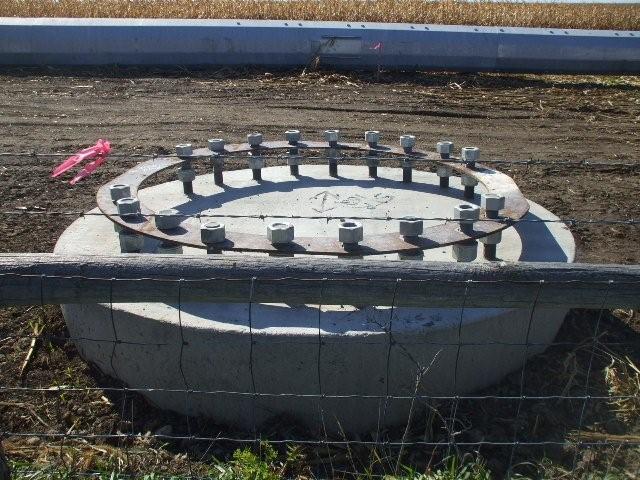
It’s been one of those times, after the computer crash getting everything together again, and doing that on the road, what a mess. But here’s an update, from after a quick trip to Denver for Nancy LaPlaca and Andy Bardwell’s wedding, we took a few days out in SD, in the Black Hills and Badlands. It’s been 40 years or so since I’ve been there, and for sure, everything shrunk! Except for the Crazy Horse Memorial. But on the way back, look what was going on:

It’s soooooooooo sad. There’s a whole lotta diggin’ goin’ on… it’s the 345kV “It’s for wind NOT” line. What? Not for wind??? Yup, here’s why:
Transmission for Dummies – #2
It’s NOT for WIND!
Watching that go up, it’s so depressing, such a clear loss. Worse, it’s the prep for CapX 2020. AAAAAAAAGH!
But where there’s CapX 2020, there’s www.nocapx2020.info!!
And an interesting factoid. I’d expected the conductors to be arranged in delta, but noooooo, take a close look here. They’re vertical, all on one side, and look at these flanges that are on the other side — ready and waiting to add another three arm and another 2085 MVA capacity!

GRE out! Big Stone II down in flames?!?!?!
September 17th, 2007

So spur of the moment, I check out the STrib, and LOOK!!!!!
BIG STONE IS GOING DOWN – GRE HAS PULLED OUT AND NO WAY CAN THIS GO FORWARD WITHOUT GRE!!!
Here’s the St.PPP article:
Dig this quote, I mean really, come on, Ward, give me a break… he actually said this:
Uggerud said it’s not uncommon for such changes in large, extensive projects, particularly during a long regulatory process.
Oh, pluh-eeeeeeeze. Oh well… whatever…
EEEEEEEEEEEE-HAAAAAAAAAAA!!!
But then my paranoid self wonders if GRE is instead buying into that IGCC plant proposed in SD?? Or one at Coal Creek, in conjunction with that coal drying DOE project? So it could be good news and bad news… we’ll see.
Also, I heard a rumor that SMMPA had BSII on their agenda last week and pulled it. IS THAT TRUE??? Anyone know??? The rats are jumping off ship, maybe SMMPA too!!!
Sen. Ellen Anderson has editorial in STrib, and as you may recall, the Global Warming bill was her bill, and that bill exempted Big Stone II from the moratorium:
Slightly different version of the article from AP in the STrib:
Associated Press
Last update: September 17, 2007 – 6:35 PM
SIOUX FALLS, S.D. — Great River Energy of Elk River, Minn., is withdrawing as an owner of the $1.6 billion Big Stone II power plant, a new coal-fired power plant in extreme northeastern South Dakota, Big Stone II officials said Monday.Big Stone II officials said Great River Energy representatives told them the decision stems from an analysis that included Great River’s changing demand and other resources.
Great River Energy’s share of the proposed 630-megawatt Big Stone II was 122 megawatts.
Participants in Big Stone II must reaffirm their commitment by certain dates. The next date is Sept. 21, and Great River Energy’s members decided to drop out, officials said.
Also, project officials say Southern Minnesota Municipal Power Agency, which has a 49 megawatt share, can’t make a long-term commitment until it resolves some litigation.
Officials say SMMPA could remain as a participant, though not as a direct owner.
The five project co-owners are Otter Tail Power Co., Central Minnesota Municipal Power Agency, Heartland Consumers Power District, Missouri River Energy Services and Montana-Dakota Utilities Co.
The North Dakota Public Service Commission held hearings on the project in June. South Dakota’s Public Utilities Commission approved the Big Stone II construction last July.
Environmentalists are trying to stop the plant, saying so much new energy isn’t needed, and that alternatives such as wind power should be explored first. They also say the plant would generate too much carbon dioxide.
On Monday, SMMPA emphasized its support for Big Stone II as a critical resource in helping meet regional needs, Big Stone II officials said in a release.
The lead developer for Big Stone II is Otter Tail Power, of Fergus Falls, Minn. Ward Uggerud, senior vice president, said Great River Energy’s exit does not change the need for new power and transmission facilities for the remaining utilities.
“The remaining utilities’ load requirements show Big Stone II to be the least-cost option for meeting our customers’ demand requirements even if we were to choose to downsize the project given these changes in participation,” he said.
Uggerud said it’s not uncommon for such changes in large, extensive projects, particularly during a long regulatory process.
———
Meyer Shark — who will fill his shoes?
September 16th, 2007
OH NOOOOOOOO! In my search of the New York Times just now for articles about Xcel, I found this, an obituary for Meyer Shark, who died in May when I was out in Delaware… I had no idea. He was one of a kind, making a second career of exposing and correcting utility abuses. I met him when I was working for Florence Township, and we explored various means to hold Xcel, then NSP, accountable, and I was delighted to know there was someone leading the charge. In the NRG docket, he pushed hard to make public the impact of NRG’s bankruptcy on Xcel and Minnesota ratepayers. Now what? Where are the public interest attorneys?!?!
To find the NRG docket:
Go to www.puc.state.mn.us
Click “eDockets” and “Search Documents”
Search for docket 02-1436
Here’s David Cay Johnston’s tribute from the New York Times:
By DAVID CAY JOHNSTON
Myer Shark, a Minnesota consumer lawyer whose last case sought to recover $300 million of taxes that electric customers paid a utility but that federal and state governments never received, died yesterday in a suburb of Minneapolis, days after filing the final papers in the case. He was 94.
His death was announced by a daughter, Janet Frisch. He died at a hospice in St. Louis Park, Minn.
The taxes Mr. Shark sought were embedded in the electric rates paid by customers of Xcel Energy’s Minnesota electric utility. The government did not get the money because a sister company went bankrupt, generating a huge tax refund for Xcel. Mr. Shark’s pursuit of the case inspired investigations and hearings in at least four other states.
“The law says utilities are entitled to just and reasonable returns,” Mr. Shark said three weeks ago. “When the utility pockets money that they got from ratepayers, money that was supposed to pay taxes, then they are earning unjust and unreasonable rates and I’m going to fight that as long as I’m alive.”
Ron Giteck, an assistant Minnesota attorney general, said that in the weeks before he died, Mr. Shark “filed everything that needed to be filed so the case can be decided” by the Minnesota Court of Appeals.
Last week the Minnesota Public Utilities Commission awarded Mr. Shark $20,000, the maximum allowed under state law, for his pursuit of the tax case on behalf of ratepayers. In an era when lawyer fees in a case can run into the tens of millions of dollars, Mr. Shark had asked for $160 an hour plus $437 in expenses, for a total of $30,000. Xcel opposed any payment.
Mr. Shark was born in Devils Lake, N.D., and graduated from the University of Minnesota Law School in 1936.
In addition to his daughter Janet, of Golden Valley, Minn., he is survived by his wife of 67 years, Marjorie, of St. Louis Park, Minn.; another daughter, Miriam Shark of Baltimore; two sons, Bud, of Lyons, Colo., and Steve, of Fargo, N.D.; five grandchildren; and four great-grandchildren.
While he was a fierce opponent in rate cases, Mr. Shark often answered his phone whimsically, saying “you have reached your friendly Shark.”
Here’s the tax appellate case:
In the Matter of Complaint of Meyer Shark, et al., Regarding Xcel Energy’s Income Taxes
Meanwhile, a search of the Star Tribune, “all years” shows nothing… Oh, here it is: Myer Shark – Star Tribune
New York A.G. serves Xcel with subpoena
September 16th, 2007

OOOOOOOH, there’s trouble at Xcel’s door. We know from Mesaba that it’s the financial aspects that kill a project, such as Mesaba which is deemed by the DOE to be “too risky for private investment” and then there’s BSII. Coal is engaged in a full court press to preserve it’s filthy ass, in a time when the expense of a coal plant can’t be justified. PUCs/PSCs across the country are faced with a wave of coal plant applications and are making determinations as to whether an investment in a coal plant or IGCC plant is a “reasonable and prudent” investment, and many are saying NO, that it’s not in the public interest. That’s protection of the ratepayers and taxpayers. Who is informing the utility shareholders of the risks of investment in coal? Perhaps Bill Gates, a big coal investor, could help on this, eh? Maybe subpoena him too?
New York Subpoenas 5 Energy Companies
By FELICITY BARRINGER and DANNY HAKIM
Attorney General Andrew M. Cuomo of New York has opened an investigation of five large energy companies, questioning whether their plans to build coal-fired power plants pose undisclosed financial risks that their investors should know about.
Mr. Cuomo, using the same state securities law wielded by his predecessor, Gov. Eliot Spitzer, to investigate corruption on Wall Street, sent subpoenas late Friday to the top executives of the five companies, seeking internal documents.
The companies, which have projects in various states, are AES Corporation, Dominion, Dynegy, Peabody Energy and Xcel Energy.
It is rare, if not unique, for a securities law to be used for an environmental purpose, in this case the fight against new coal-fired power plants. The plants’ main emission, carbon dioxide, has been linked by scientists to global warming.
In letters accompanying the subpoenas, the attorney general’s office asked whether investors received adequate information about the potential financial liabilities of carbon dioxide emissions that exacerbate climate change.
“Any one of the several new or likely regulatory initiatives for CO2 emissions from power plants — including state carbon controls, E.P.A.’s regulations under the Clean Air Act, or the enactment of federal global warming legislation — would add a significant cost to carbon-intensive coal generation,” the letters said.
They added, “Selective disclosure of favorable information or omission of unfavorable information concerning climate change is misleading.”
Mr. Cuomo’s move represents a new tactic in an expanding campaign against some of the more than 100 coal-fired power plants currently under consideration.
The nationwide anti-coal effort is being directed by a coalition of environmental groups, shareholder activists and state officials in the Northeast and on the West Coast, including in New York and California.
In an interview, Mr. Cuomo said, “The concept here is using the securities laws to investigate whether the economic risks of these plants are being disclosed — the economic risks which are dovetailing with the environmental concerns.”
Katherine Kennedy, a special deputy attorney general in the environmental protection bureau who worked for the Natural Resources Defense Council for 19 years, added that power plants produced about 30 percent of carbon emissions in the United States, so “it seemed like a logical place to begin.”
Mr. Cuomo said, “It’s a priority for us.”
Two of the five companies disputed Mr. Cuomo’s assertions. Representatives of the other companies postponed comment until they could examine the letters and subpoenas.
The power plant investigation was the second last week in which Mr. Cuomo issued subpoenas under the Martin Act, a 1921 state securities law that predates the creation of the federal Securities and Exchange Commission. The New York law grants the attorney general broad powers to compel testimony and subpoena records.
Until Mr. Spitzer used the law as a weapon against corruption on Wall Street, it was obscure. In June, The Wall Street Journal’s editorial page called for its repeal, arguing that “it is a law that allows a prosecutor to punish, or even ruin, any financial company regardless of evidence or motive.”
In the case of the five energy companies, Mr. Cuomo said, “This is a very straightforward, consistent use of the act because it’s about disclosure to investors.”
For five years, environmentally oriented shareholder groups have been filing resolutions seeking similar disclosures — including one with Peabody Energy — said Dan Bakal, the director of electric power programs for Ceres, a Boston-based coalition of investors and environmental groups focused on the environmental impacts of corporate actions.
“This ratchets up the pressure on companies to provide more information as the risks become more and more material,” Mr. Bakal said. Peabody Energy, he added, had increased its disclosure somewhat following shareholders’ requests.
Vic Svec, a spokesman for Peabody, said in an e-mail message yesterday that the company included climate change disclosures “in multiple places” in its public financial filings.
Mr. Svec also said the letter was inaccurate “in claiming that we operate power plants.” He said Peabody is a minority partner in a planned Illinois plant.
Mr. Svec called the New York action “outrageous,” adding, “The legal system was designed to protect — not harass — those such as Peabody who are providing clean energy solutions for America.”
Representatives of Dynegy, Dominion and AES said the documents were under review.
Xcel Energy is building a coal-fired plant in Colorado that was cited in the letter from the attorney general.
A company spokeswoman, Mary Sandok, said in an e-mailed statement: “The plant under construction in Colorado is being built under an agreement we reached with national, state and local environmental groups, including the Sierra Club and Environmental Defense. Our financial disclosures are adequate.”
Data from the federal Energy Information Administration shows that about half the country’s electrical generation comes from coal. For the next two or three years, new capacity will be coming largely from natural gas.
But coal, which is now the cheapest fuel — absent expensive technology, still in its experimental stage, to control carbon dioxide emissions — is projected to be the dominant fuel for new electricity from 2009 onward.
The fight against new coal-fired plants has been waged by environmental groups in tandem with their fight at the state, regional and national levels to cap emissions of greenhouse gases in all sectors of the economy.
A group of 10 Northeastern states, including New York, is adopting a program that would cap emissions and allow trading of pollution allotments among projects in those states.
California already has developed rules, which are being copied by New York, Vermont and 10 other states, to reduce heat-trapping gases from passenger vehicles. Those rules were endorsed in a ruling by a federal district judge in Vermont last week — in a case in which Mr. Cuomo’s staff participated.
But this is Mr. Cuomo’s most significant foray into the arena of climate change since taking over in January from Mr. Spitzer, who was one of the most high-profile occupants of the attorney general’s office.
Before he started, Mr. Cuomo acknowledged Mr. Spitzer’s formidable shadow; a Cuomo campaign ad last year said his predecessor had left “big shoes to fill” and featured people holding up the foot-measuring scales used by shoe salesmen. This year, Mr. Cuomo, who is a former federal housing secretary and son of a former governor, has himself made waves nationwide.
He shined a harsh light on close ties between some universities and student lenders, and he is now expanding Mr. Spitzer’s aggressive use of the Martin Act in new areas.
Mr. Cuomo’s office said last week that the attorney general had also invoked the Martin Act and issued subpoenas in his investigation of the oversight of the state’s $154 billion pension fund during the four-year tenure of Alan G. Hevesi as state comptroller.