EQB Standards & Criteria in Mankato
October 25th, 2013

“Minnesota’s Finest Sands.” So says Jordan Sands, the big silica sand mining operation in the Mankato area. And in Mankato we were today, for the EQB meeting about Standards and Criteria:

And Jordan Sands, Unimin, etc., were putting out a lot of dough and a lot of time in their multiple representatives at the EQB meeting in Mankato at the Blue Earth County Library. Coming it, it looked well attended. But after a look around, it was apparent that at least half were industry toadies, like my buddy Dennis Egan:
 On the other hand, several direct neighbors of the recently permitted Jordan Sands project, and a township official were there and spoke eloquently of their concerns. Scott County’s environmental crew (3) was there and told of their silica sand mine permitting experience.
I was handing out flyers to help people put in Comments on point about the statutory Standards and Criteria, specific ones that might be meaningful and might be taken into account — it’s hard to get people focused. But my ink jet ran out so I only had a handful. Here it is:
Ag Commissioner Fredrickson and MPCA Commissioner Stine were on hand, as well as DNR Commissioner Landwehr, and others too:


It was a public meeting, in an open house and also presentation/Q&A format where the EQB was soliciting input for the silica sands Standards and Criteria, as directed by last session’s 116C.99:
The standards and criteria must include:
(1) recommendations for setbacks or buffers for mining operation and processing, including:
(i) any residence or residential zoning district boundary;
(ii) any property line or right-of-way line of any existing or proposed street or highway;
(iii) ordinary high water levels of public waters;
(iv) bluffs;
(v) designated trout streams, Class 2A water as designated in the rules of the Pollution Control Agency, or any perennially flowing tributary of a designated trout stream or Class 2A water;
(vi) calcareous fens;
(vii) wellhead protection areas as defined in section 103I.005;
(viii) critical natural habitat acquired by the commissioner of natural resources under section 84.944; and
(ix) a natural resource easement paid wholly or in part by public funds;(2) standards for hours of operation;
(3) groundwater and surface water quality and quantity monitoring and mitigation plan requirements, including:
(i) applicable groundwater and surface water appropriation permit requirements;
(ii) well sealing requirements;
(iii) annual submission of monitoring well data; and
(iv) storm water runoff rate limits not to exceed two-, ten-, and 100-year storm events;(4) air monitoring and data submission requirements;
(5) dust control requirements;
(6) noise testing and mitigation plan requirements;
(7) blast monitoring plan requirements;
(8) lighting requirements;
(9) inspection requirements;
(10) containment requirements for silica sand in temporary storage to protect air and water quality;
(11) containment requirements for chemicals used in processing;
(12) financial assurance requirements;
(13) road and bridge impacts and requirements; and
(14) reclamation plan requirements as required under the rules adopted by the commissioner of natural resources.
Here’s a chart to give people a format and idea how to submit comments — for this exercise, we need to file specific ideas for particular standard/criteria (in the middle column), and it’s very helpful to list whatever supporting documentation or authority you have for this criteria (right hand column), such as a local ordinance, or health studies:
Below is a prior comment I’d sent in for Winona County CASM with some thoughts tossed together — well, at least the EQB used the format I proposed!
Now, back to process — here’s the schedule established at the most recent EQB meeting (last week), Will Seuffert said he was working on that earlier this month…

(ja, the light in there was awful) …and voila, the schedule, here it is:

EQB’s sand site: http://silicasand.mn.gov/
I’m concerned about the focus on SE Minnesota, evidenced by the statutory language, and listening to the words used by the toady from Unimin, that “SE IS UNIQUE” and so it is special, and implying that an open door along the Minnesota River is just fine… NOT! Earth to Mars, frac sand mining is NOT unique to SE Minnesota. Here’s the map:
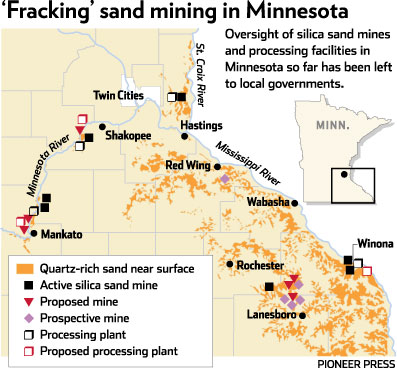
and from the DNR:

Think about where the major spill has been — INTO THE FEDERALLY PROTECTED WILD & SCENIC ST. CROIX RIVER!! Not even close to SE Minnesota. Where did they start up a processing/transport facility with no permits? Harris, MN (is Loren Jennings involved in this???).
And that much is clear from the many who did show up on a Friday afternoon in Mankato, by the permits issued already, Jordan Sands in Mankato, and as addressed by the Scott County environmental guy and other staff people who had just completed an intense permitting process there. Scott (Frenchette?), Scott County, raised a few state statutes, such as Minn. Stat. 103H.01 focused on ground water degradation, 116D.04, Subd. 6 (you all recognize MEPA by now, EH?), 103I and Minn. R. 7060 regarding protection of ground water. He asked about these statutes, all related to state permits, and rhetorically wondered what a local government is to do, is there protection offered in these statutes?
Time to get to work!
Send comments on Standards and Criteria to:
silicasand.eqb@state.mn.us, and copy:
Will.Seuffert@state.mn.us
jeff.smyser@state.mn.us
bob.patton@state.mn.us
kate.frantz@state.mn.us
Deadline is November 12, but the sooner the better, give them some time to incorporate in your thoughts!
A policy win in Goodhue Co. District Court!
October 20th, 2013

I’m on the Board of the Humane Society of Goodhue County, have been for a while now, and GOOD NEWS!! Thursday, in Goodhue County, we were able for the first time to see an animal hoarder sentenced and required to undergo a psychological evaluation for harding. Representing the animals, through our Victim Impact Statement, we made this the top priority, with restitution of our costs (a very conservative estimate), secondary.
Over the years, we’ve had more than a few hoarding cases here in Goodhue County, and the Humane Society of Goodhue County is on call to address these problems, working with law enforcement and social services to inspect the home, assess the situation, and if necessary, confiscate animals.
Hoarding is a serious problem, and hoarding animals is even worse because animals are involved, living in squalor in a situation where the person responsible for them has no insight into the problem, no awareness that it is a problem, and typically the people involved feel that they are caring for the animals and no one else could do as good a job.
Small rescues often turn into animal hoarding situations, because there are so many animals needing help, needing homes, that people take animals in but don’t have sufficient resources to care for them, be it space at a rescue with a facility, through boarding, or available fosters. I know about this from personal experience — the rescue that took in our Kady and found her a foster out on Long Island until we got her, 6th Angel Shepherd Rescue, was recently shut down for animal neglect and abuse. Terry Silva was charged with 43 counts of animal cruelty and Samantha Kenney 28 counts. Terry Silva convicted of 43 counts of animal cruelty.

The woman running it had 29 dogs in her law office! Another article: Some ask “what justice?” in Delco animal abuser verdict.
Collection of articles about Terry Silva and 6th Angel Shepherd Rescue.
So back home to Goodhue County. This Thursday, perhaps a little justice for abused animals. We had a win in Goodhue County District Court, a win because the court ordered a psychological evaluation for hoarding and compliance with the recommendation.
This is HUGE because hoarding is not something that just stops, hoarders start up all over again, recidivism is essentially 100%. Hoarding is now listed as a psychological disorder in DSM-V, and treatment is available, there are several practitioners in the area who work on hoarding issues. In this case, there were 26 animals, 7 dogs and 19 cats, who were neglected, inadequate food and water, lacking veterinary care, physical problems including rotting, loose and missing teeth, egregiously long toenails, filthy and matted coats, ear mites, and one with tumors. The animals were not spayed and neutered, and often in front of the house there was a large sign posted to sell puppies. The condition of the house was horrific, dog and cat shit everywhere, even on the kitchen counter, piled on furniture, and while they were confiscating the animals, a cat pissed on a bed! The smell was overpowering to the people on the scene.


The defendant settled for two counts related to the animals, and five other counts were dismissed, and as sentencing, one year of probation, the psych eval and follow up, restitution of $3,367.40 to the Humane Society (converted to a civil judgment as the defendant has no money) with specific direction to work through the probation officer to pay when possible, no new animals, and no contact with the new adoptive owners of the animals. Our goal was that the defendant be required to be evaluated for hoarding, and it’s ordered!!!
This is something that I want to see in every jurisdiction, because intervention is the only way a hoarder is going to, hopefully address hoarding. There’s no guarantee of progress or effectiveness, of course, but it’s a start.
Keeping on keeping on…
October 12th, 2013
Sometimes it gets really tired out. There have been two LONG projects that slowly wound down lately, five long years. It’s hard to keep up that kind of slow-motion fight. Ya know how that is? Well, the article below was received a while back from a cohort in a big long mess of a case that ended sort of well (except that someone always gets stuck with the infrastructure in their yard). Knowing of the battle, being out there on the front lines, she sent this:
Worth the read… a reality check that we are indeed in a long strange trip!
And speaking of this activist cohort, look who’s joining her family, is she cute or what — look at that smile, it’s enough to sustain any conservationist. I’m SO looking forward to meeting this little grrrrrrrl:

After 5 (#&%(#)* years — Goodhue Wind is DEAD!
October 10th, 2013
What a day at the Minnesota Public Utilities Commission:
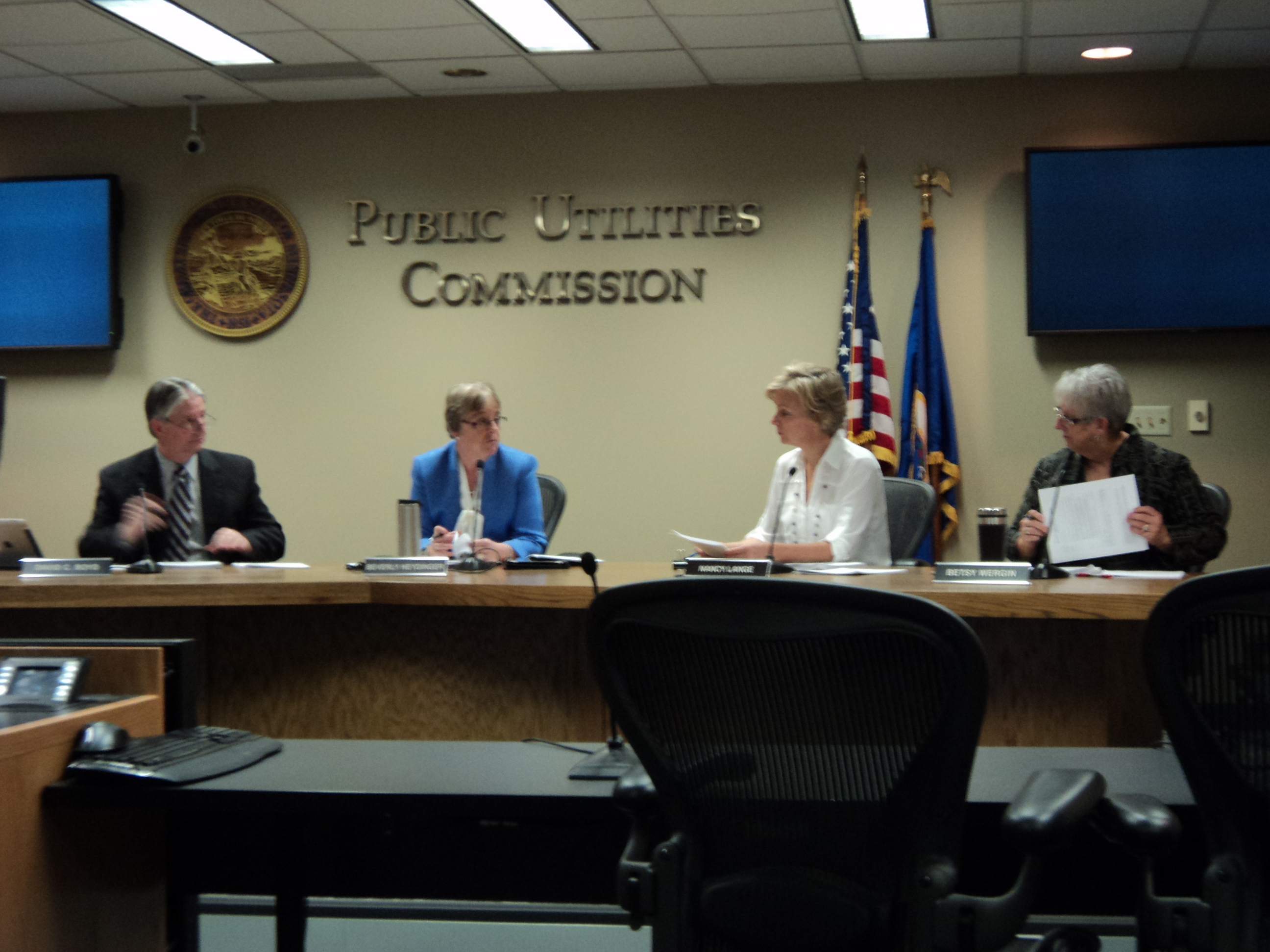
This project, applied for back in 2008 as “Goodhue Wind” and then in January 2010 becoming AWA Goodhue, and then ??? more recently becoming “New Era Wnd,” has been a headache for the state since the original application. For those in and near the footprint, it’s been much more than a headache. Now, after over 5 years of weighing in, participating, dodging helicopters and gathering frightened cattle, digging through deeds and filings at the County Recorder’s office, scouring the countryside for eagle nests that developers don’t want found, compiling piles and piles of information and testimony about impacts of low frequency sound, wading through misrepresentations, misstatements and mischaracterizations and discovering the truth, taking every possible avenue to be heard and finding a few more for good measure, after five long years we can finally say, “YES!!!” this project is over, it is done, DEAD!
The Goodhue Wind Certificate of Need and Siting Permit have been REVOKED. The Power Purchase Agreements with Xcel Energy have been terminated.
Five long years, what a headache…
Five years — what took so long?
Looking at the big picture, this is an example of systemic problems within the state, at the Public Utilities Commission, at the Dept. of Commerce, and at the legislature.
I also ask, what is it with these projects in Goodhue County? I’ve been involved in three of them, three projects not built, ranging from NSP’s nuclear waste “in Goodhue County” in Florence Township; to the Kenyon Wind project proposed by John Daniels, husband of Windustry’s Lisa Daniels and which, as the first C-BED project in the state, proposed to put a substation and turbine on former House Speaker Steve Sviggum’s land; and this “Goodhue Wind” project (note that we’re not counting the quickly dropped CapX 2020 initial talk of coming down the west side of the Mississippi over “Site P” in Florence Township, and the much longer CapX 2020 proposal and ultimately permitted transmission line on the west end of the county, that is a whole ‘nother story, to be found at www.nocapx2020.info!). NONE of these three projects were built, and ALL took five years to get from proposal to rejection. WHY SO LONG?
I see this as a litany of systemic problems.
SYSTEMIC PROBLEM #1 – INADEQUATE ENVIRONMENTAL REVIEW
It’s pretty much a no-brainer, but once more with feeling… environmental review for wind projects is inadequate because the siting law exempts wind projects from environmental review!!! This is not compliant with the Minnesota Environmental Policy Act. And under the Certificate of Need rules, all that’s necessary is an “Environmental Report,” and not an Environmental Impact Statement. This “Environmental Report” though, to be clear, is NOT statutory, it is the work of the agency in rulemaking, perfectly legal for the agency to write its own rules, BUT it’s time they were challenged on the result, the failure of any agency to require an environmental impact statement on a project with such significant impacts. We’re in rulemaking now on Certificate of Need, and it’s time to correct that change made about a decade ago.
Another aspect to this is that Bill Grant, formerly Izaak Walton League, is now in charge of utility infrastructure siting at the Dept. of Commerce. Bill Grant is one who helped usher through the legislation exempting wind projects from environmental review!!! He’s got to go and we’ve got to undo the damage he’s brought to the state of Minnesota.
The state law requires:
This review of impacts, including economic, employment, and sociological effects must be addressed. We need to look at the adverse impacts, not ignore them, and we must not inflict the impacts on a community while castigating those who struggle to make the impacts known. And FYI, an “Environmental Report” is not an “Environmental Impact Statement.”
SYSTEMIC PROBLEM #2 – REGULATORS THAT WON’T REGULATE
This project dragged on and on and on and on and on and on, because no one wanted to make a decision on this project. Evidence piled up, the developer wouldn’t produce requested information… How much of a demonstration of inability to put together a project is necessary before action is taken? How much is necessary before it’s apparent that the project shouldn’t have a permit in the first place? How much misrepresentation before the state stands up and says NO! The Public Utilities Commission must be willing to look at the economics and the structure of a proposed project — THEY’RE the regulator. Take a close look at projects, and sooner rather than later!
SYSTEMIC PROBLEM #3 – APPLICANTS ARE RUNNING ROUGHSHOD OVER PEOPLE
Projects run roughshod over people in the area. In this case, standing up to the Goodhue Wind Project took five years of commitment, as significant cost to those who participated. It was the people who initially raised the issues that ultimately killed the Goodhue Wind Project, including C-BED status, eagles, siting, multiple misrepresentations on the part of the Applicants. But this isn’t their job, it’s the job of the regulators, meaning it is the job of the Dept. of Commerce and the Public Utilities Commission to investigate, to verify information, to assure that the applicant produces the information necessary and that its representations are TRUE!
When I work with clients on a project like this, I urge them to develop a big picture approach, and to work within the framework provided. It’s arcane, it’s a royal pain, but this is what we’ve got. Unfortunately, this is not an example where “the system worked,” and instead, it is yet another example that it did not work. The Goodhue Wind Project fell apart of its own deficiencies. YEAAAAAAAAA! But don’t be fooled. The regulatory system in Minnesota is NOT working. Don’t be fooled for one minute!
The good news of this is that Peter Mastic can close his “office” and go back to Nevada: