DEED info about opening up!
May 14th, 2020

Hot off the press… errrrrrrr… inbox, from DEED, answering questions about what it means to “reopen,” and practices and procedures to reopen safely.
First, the long version:
DEED – Guidance on Reopening Businesses
And the email that just came in:
++++++++++++++++++++++++++++++++++++

Safely reopening and returning to work: What businesses and workers need to know
As Minnesota businesses begin the process of reopening and safely returning people to work, we know there are a lot of questions. We’ve answered many of the most common questions at mn.gov/deed/safework, and I encourage businesses and workers alike to review customized guidance there.
We also know that businesses and workers may be wondering about the process for bringing workers back into the workplace, and that many workers may have concerns about returning to the workplace given the threat of COVID-19. On May 13, Governor Walz issued Executive Order 20-54 which provides more clarity on worker protections in light of the COVID-19 pandemic.
We hope that this post will address some additional questions about how unemployment insurance works in this context.
Here’s what you need to know:
Most importantly, businesses must be safe and healthy for their workers and customers.
- Businesses must follow all CDC and MDH guidance and OSHA standards about creating a safe and healthy environment for workers and customers.
- A business may not take adverse action (including terminating, laying off or other retaliatory action) against a worker for raising safety and health concerns, refusing to work under conditions they reasonably believe are unsafe or unhealthy related to COVID-19, participating in union activities concerning work place safety and health issues, filing a safety and health complaint, or participating in an OSHA investigation.
In order to reopen, any non-Critical Sector business or retail establishment must have a COVID-19 Preparedness Plan in place to protect the health and safety of their workers.
- Plans are extremely important to provide direction on how workers are going to remain safe. To help in the process, Minnesota Department of Health (MDH), DEED, and the Minnesota Department of Labor and Industry (DLI) have developed a template plan and guidance that businesses can use as a starting point. Businesses aren’t required to use this template, but a business’ plan does need to follow CDC and MDH guidelines and OSHA standards.
- Wherever possible, workers should continue to work from home.
- Businesses are encouraged to consult with workers on the development of their plans – it will make the plans better, proactively address many worker concerns and ensure workers are invested in the new norms businesses are setting.
- We aren’t requiring businesses to submit their plans to the state for approval, but businesses should be prepared to provide a copy of your plan if requested.
- Copies of the plan must be shared with workers in advance of reopening and posted at the workplace.
Once a COVID-19 Preparedness plan is in place and workers are called back to work, anticipate that some may be nervous or worried about returning to the workplace. Be flexible and provide necessary accommodations for workers.
- This is an uncertain and challenging time, and many workers may have concerns about being back at work. Workers should also not have to sacrifice their health and safety for economic security. Businesses are encouraged to be as flexible as possible with workers, be responsive to requests for accommodations and ensure that you have provided appropriate protective gear in accordance with CDC and MDH guidance and OSHA standards – such as gloves if handling goods or money with customers, and non-medical face coverings.
Some employees may not be able to return to work.
- Executive Order 20-05 provides a list of COVID-19 exemptions for workers, including those with underlying health issues or caretaking responsibilities.
- Workers who qualify for these exemptions do not need to return to work and will continue to qualify for Unemployment Insurance benefits.
If a worker feels that their employer is not operating with a COVID-19 Preparedness Plan and/or not following health and safety protocols, there is action they can take.
- Any worker who believes that their workplace is not following their COVID-19 Preparedness Plan or is not following CDC or Minnesota Department of Health guidelines is encouraged to attempt to resolve their concerns directly with their employer.
- If the worker is not successful in that attempt, is not comfortable raising their concerns with their employer, or has additional concerns about the safety of their workplace, the worker should contact Minnesota OSHA at 651-284-5050 or Compliance@state.mn.us.
- If a worker raises concerns with an employer about not operating with a COVID-19 Preparedness Plan and/or not following health and safety protocols and the employer does not address the concern in a reasonable amount of time, the worker can quit and not lose unemployment insurance eligibility benefits as long as it was reasonable to do so.
- If a worker is fired for raising concerns about workplace safety–either with Minnesota OSHA or directly with their employer–they will not lose unemployment benefits eligibility.
State Unemployment Insurance law prevents the state from continuing to pay benefits to those who are no longer eligible.
- Workers who are offered the opportunity to return to work and don’t qualify for an exemption under Executive Order 20-05 or state unemployment insurance law are no longer eligible to receive benefits.
- We ask every applicant on a weekly basis whether they have refused an offer of suitable employment. Providing inaccurate information may result in an applicant being held overpaid for unemployment benefits.
- When workers return to work or want to stop requesting unemployment benefits, no additional notification is needed. They simply should stop requesting weekly benefits in their unemployment insurance account. Some additional information about unemployment and returning to work can be found here.
- Under Minnesota law, businesses can “raise an issue” regarding a former employee’s eligibility for unemployment insurance
- Raising an issue is the way to tell us that you have a question regarding an employee’s eligibility for unemployment. You can find more information about how to raise an issue here.
- Businesses must follow all CDC and MDH guidance and OSHA standards about creating a safe and healthy environment for workers and customers. For non-Critical Sector businesses, this includes having a COVID-19 Preparedness Plan.
- A business may not take adverse action (including terminating, laying off or other retaliatory action) against a worker for raising safety and health concerns, refusing to work under conditions they reasonably believe are unsafe or unhealthy related to COVID-19, participating in union activities concerning work place safety and health issues, filing a safety and health complaint, or participating in an OSHA investigation.
If a worker or employer notifies the department that an offer to return to work was refused, we will review the applicant’s eligibility for unemployment. What happens next?
- DEED will mail questionnaires out to both the applicant and employer about why the applicant did not return to work – including questions about the applicant’s medical situation. A doctor’s note may be requested during any follow-up process for additional information.
- Once the department has enough information to make a decision, a written determination about the applicant’s continued eligibility for unemployment will be provided.
- At this point, either the applicant or employer can file an appeal within 20 calendar days. Minnesota Unemployment Insurance Law provides an opportunity for a fair and impartial hearing to any party who disagrees with a determination issued by the Minnesota Unemployment Insurance Program.
- A telephone hearing and an appeals process follow from there, which will be outlined in detail to any worker or employer in this situation.
We know that both businesses and workers want to make the process of returning to work safe, effective, and fair. Thoughtful planning, clear communication, and a collaborative and generous spirit are going to get us through this difficult time.
We hope these guidelines make it clear how this process will work, and we encourage everyone to get more information in the FAQ section of UIMN.org.
– Commissioner Steve Grove
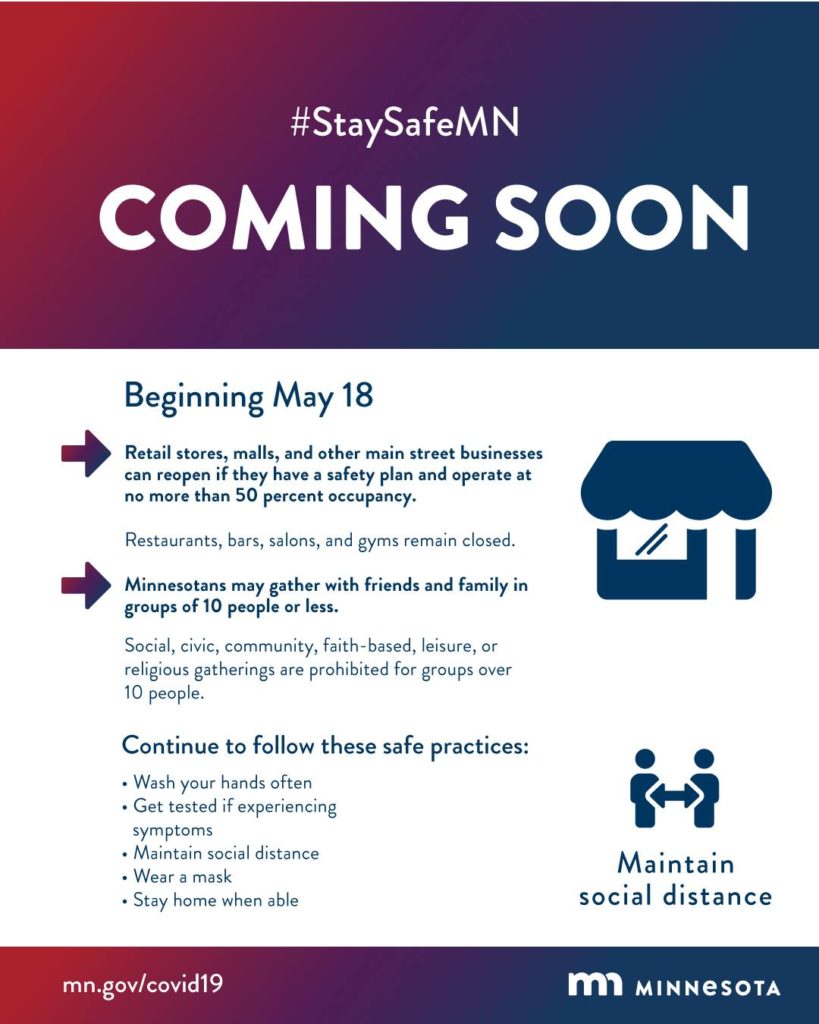
Gov. Noem, back off Rosebud
May 14th, 2020
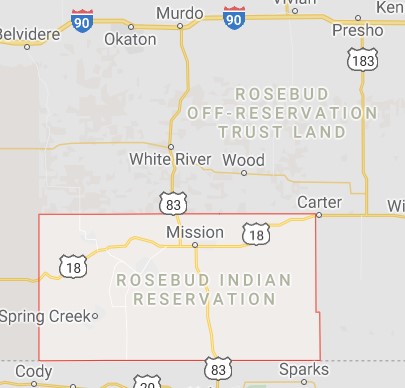
There’s case law that looks to me to say that it’s a really bad idea to push Rosebud about monitoring highways through the reservation:

Even TIME magazine is taking notice:
South Dakota Governor Demands Tribe Leaders Remove Checkpoints Set Up to Prevent the Spread of COVID-19
Oglala Sioux had the right idea earlier, closing their doors to Gov. Noem, though she’s now allowed on the reservation:
Oglala Sioux Tribe lifts ban of Gov. Kristi Noem from Pine Ridge reservation
Who’s hollering “OPEN UP!”
May 12th, 2020

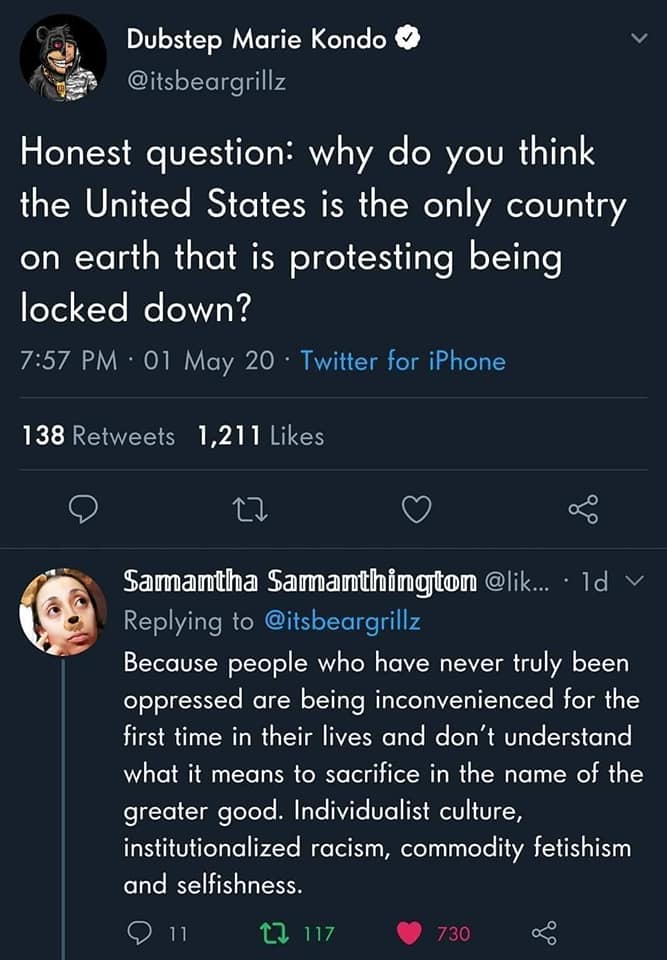
What struck me most in the videos of the “protests” at the Governor’s mansion two and three Saturdays ago (wasn’t one this Saturday that I noticed) was that people were in a carnival mood, that they seemed new at demonstrations. I was also shocked at their disregard for distancing and so few masks, like they were inviting COVID. And I’ve been thinking a lot about just who would behave this way, why people would act so against their self-interest and against the community interest. Then today, I saw this piece on facebook, yeah, I know, the internet, but like Anger Games, a study of common factors in tRump supporters, this little ditty today made so much intuitive sense explaining those who are pushing so hard for “Open Up!”
Oh, Karen…

Here it is:
This morning, I awoke to find that I was out of coffee; so I took myself down to the coffee shop to buy myself a pound of beans.
Our local Peet’s has set up its cash registers in the doorway, so you stand on the sidewalk to place your order and wait, rather than going inside.
I found myself standing in a line with a bunch of other middle-aged white people in masks.
The guy in front of me got to the front of the line and said, “Hi, I’d like my usual, please.”
Dude’s standing there in a mask, asking for “his usual.”The cashier was like, “Uhhhh…”
And the dude eventually had to actually come out and actually say what he wanted.
And I had a sudden revelation: That guy was standing there, at a chain coffee shop ordering a generic fucking drink, in order to feel like he was participating in civic life. Like, his whole reason for being there was to feel like he belonged to a community where somebody would remember his name and treat him nice.
This is the reason people are so pissed off about not being able to go fucking shopping: It’s because for them, the retail experience is the whole and all of their civic participation. They’ve fully bought into the idea that their role in society is to go to work and earn money, and that with that money they get this transactional sort of membership in the body politic, or the body societas, or whatever.
This is why Karen wants to speak to your manager, and why she’s so entitled about it: She’s exercising all the power she’s got, in order to demonstrate to herself that she’s got an important role in society.
Karen doesn’t go to meetings. She doesn’t do art. She doesn’t participate in collective endeavors of any kind. Even though she espouses religious beliefs, she doesn’t go to church — and if she does, it’s a megachurch where she’s not actually required to do anything except sit in the pews and pony up to the collection palate.
All her participation in the culture is transactional: She gets paid, she buys things, and she votes.
No wonder they’re so upset. They actually bought the idea of a transactional society, and now it’s being denied them.
++++++++++++++++++++++++++++
I’m not so sure that Karen votes, but if she does, we know for who…
MN PUC’s COVID docket(s)
May 10th, 2020
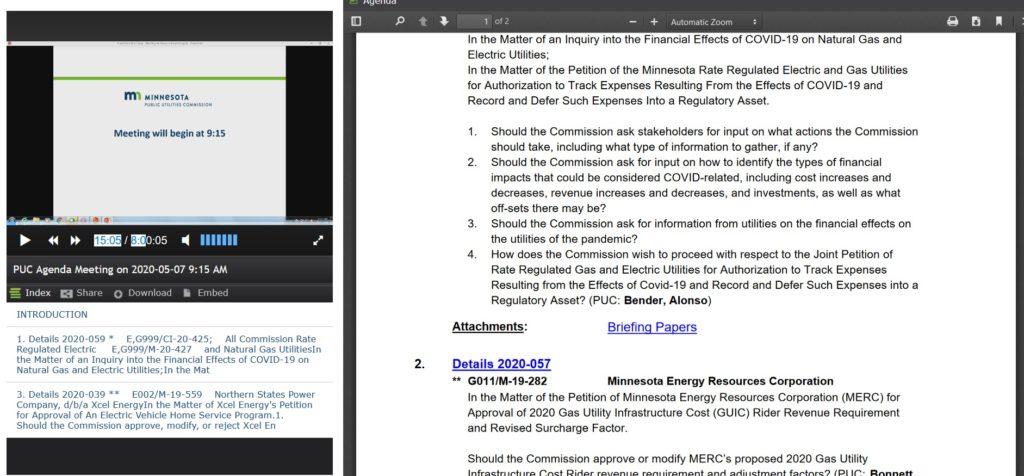
Minnesota’s Public Utilities Commission has opened dockets about impacts of COVID and utility recovery of costs. To look at dockets, go to PUC eDocket Search HERE and search for dockets 20-427, and for early filings in 20-425.
LISTEN TO PUC MEETING HERE – IT’S INTERESTING!
The big utilities have requested Deferred Accounting, here’s their petition, and Staff Briefing Papers with the decision options:
From Commissioner Sullivan’s memo:
My thought: Broadband across rural Minnesota anyone?!?!?! THIS is needed and would do so much to provide jobs, jobs, jobs, AND bring rural Minnesota into the 21st Century. Rural Minnesota’s lack of broadband is huge factor in difficulty of remote education during this COVID mess, and the perfect project for COVID recovery!
In addition to impacts on utility revenue, COVID has an impact on utility projects, in queue, under construction, etc.. Is anyone tracking those impacts? In this PUC discussion, someone mention that in addition to lost revenue, there would be COVID related savings, i.e., fuel savings, construction cost savings, etc.
What do those project impacts look like? For example, back in February, I’d received Notice of Force Majeure regarding two solar projects, and then in March, I’d sent Data Practices Act Requests to Commerce and PUC about that, those posts here:
Solar Force Majeure in WI – Coronavirus – February 26th, 2020
Coronavirus impact on markets is HUGE – February 27th, 2020 (includes Data Practices Act Request to PUC)
Cancellation of Force Majeure – March 11th, 2020
Impact of COVID on energy projects – March 30th, 2020
Reopen? Plans! Procedures! Criteria!
May 8th, 2020

Minnesota, as of this morning’s report, has had a cumulative 10,088 cases of COVID, with 534 deaths. Reopen? We’re not there yet!
There are a lot of loud demands to “REOPEN” the U.S., for reversal of the Governors’ Executive Orders declaring a “state of emergency” and closing most businesses. These loud demands are from a small minority, and have no basis in science or epidemiology, with no reference to any of the opening up procedures or plans that are out there. Even the White House criteria for reopen hasn’t been met — we have not reached peak here in Minnesota, numbers of confirmed new COVID cases are skyrocketing (again, Minnesota passed 10,000 cumulative cases today), and numbers of daily new cases are not decreasing.
These numbers are is evidence to support a more rigorous STAY HOME, protective measures, constant handwashing is easy enough, and firm enforcement of preventative measures, particularly no groups of folks from other households, and distancing and masking in public.
Here’s the screen shot of White House criteria, past peak and 14 days of decreasing new cases:
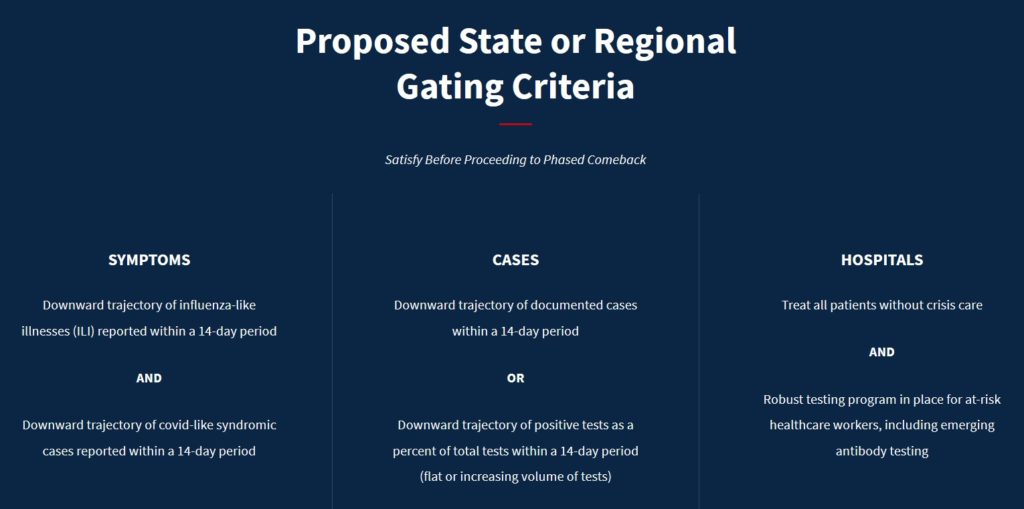
White House: Opening Up America Again
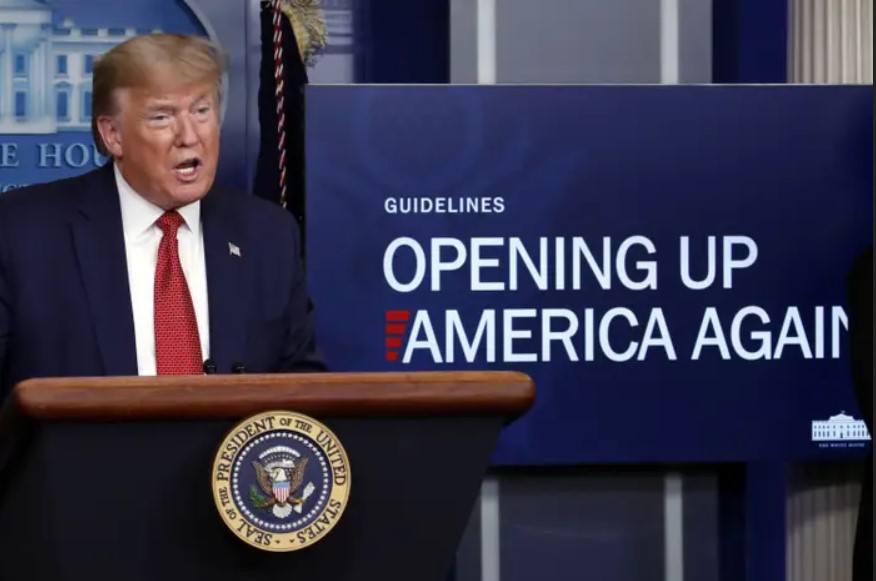
There also was a “plan” developed by the CDC that the White House is burying, and it’s not really a “plan,” it’s “Interim Guidelines” for a few types of businesses:
Minnesota’s DEED – Reopening a Business
Minnesota DEED – Can my business be open? Review the guidance
Minnesota COVID-19 Preparedness Plan template – Word document | PDF
- Checklist guidelines for creating a COVID-19 Preparedness Plan – Word document | PDF
Wisconsin’s COVID-19 Badger Bounce Back
And here is Target’s plan for use by Target and as guidance for other businesses:
Minnesota Department of Health Guidance
University of Minnesota “Sunrise Plan”
And another, Illinois Gov. Pritzker’s “Restore Illinois” plan
And for those complaining about STAY HOME and the declared State of Emergency, “it’s taking away my rights,” here’s the Michigan decision which explains in clear terms the federal case law precedent and U.S. constitution about a Governor’s powers to protect public safety v. “rights” and “liberty.”
And Wisconsin’s “Reopen Guidelines”
Projected Delaware Phase 1 – June 1