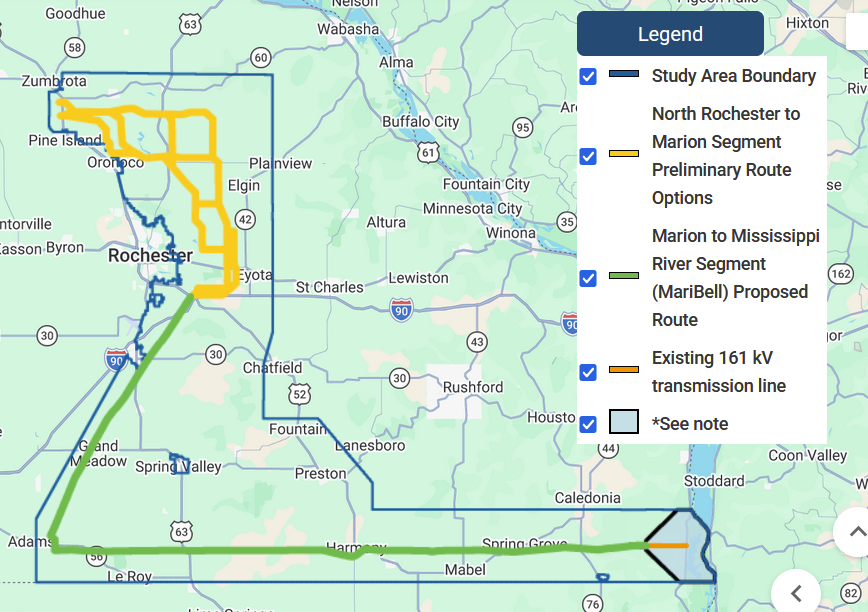
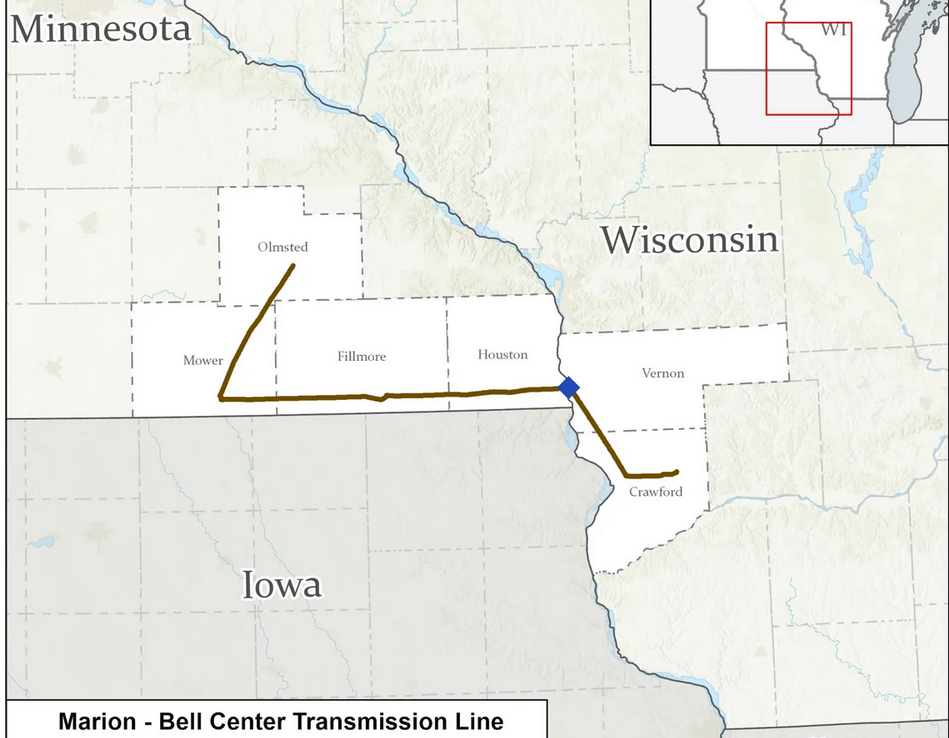
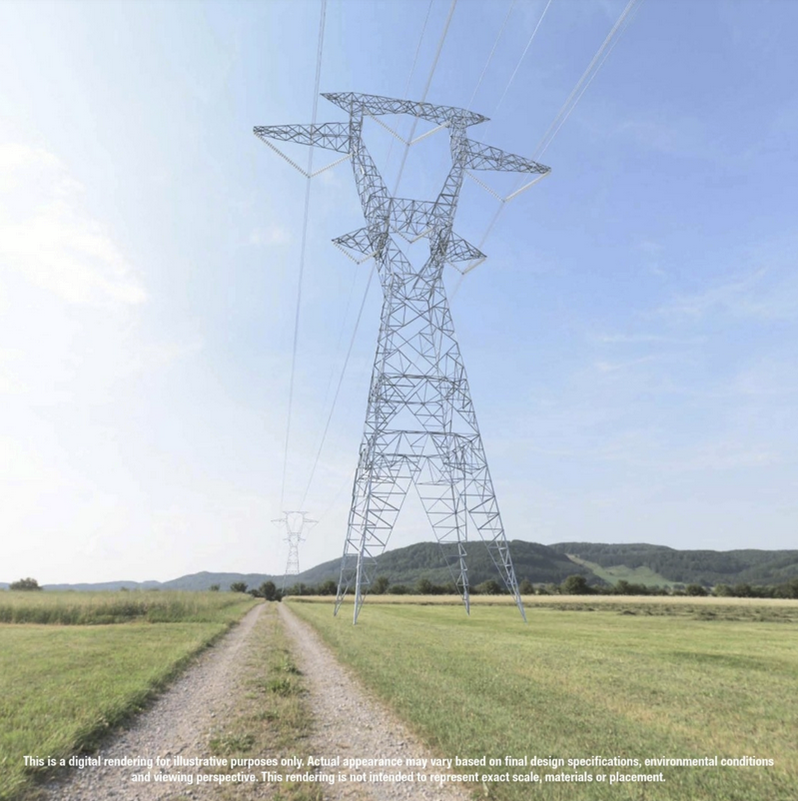
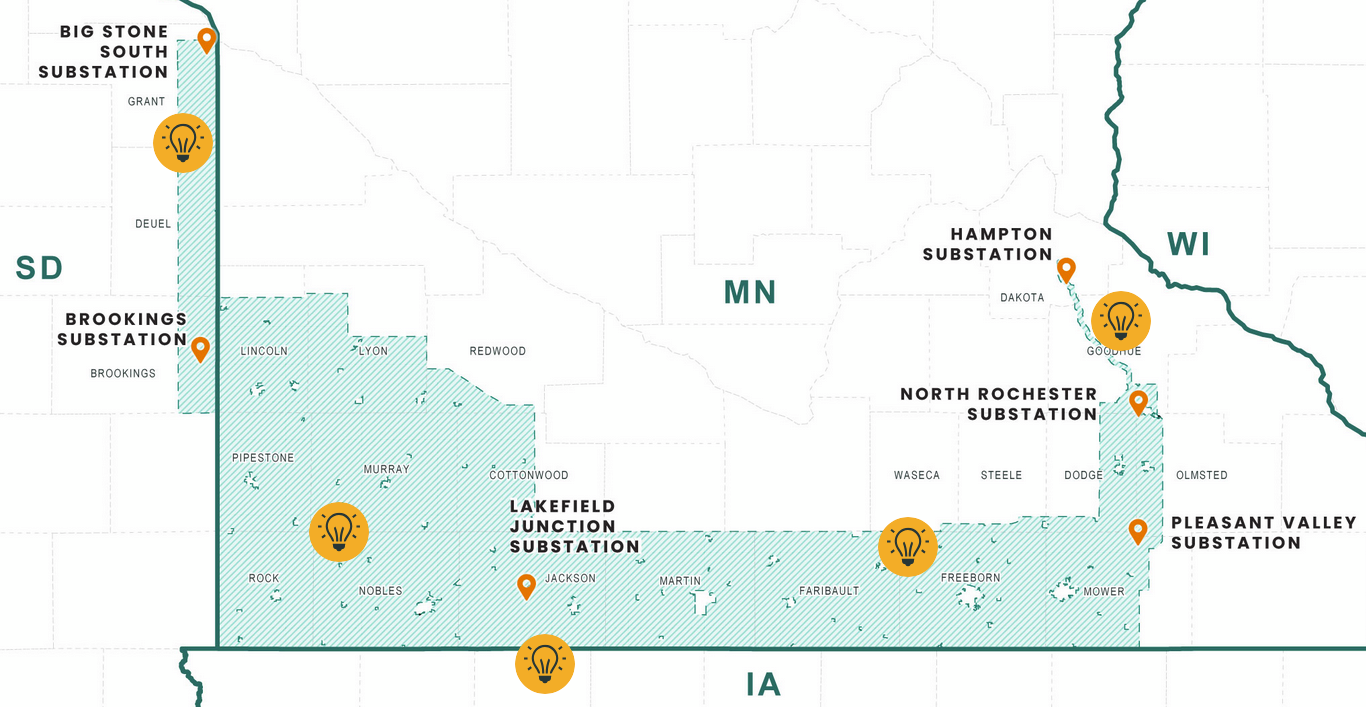
Filed this week in Ramsey County District Court, a Minnesota Environmental Rights Act challenge of Xcel’s “Minnesota Energy Connection” transmission line’s crossing of the Mississippi River, a 3.2 mile segment of its 185 radial transmission line The purpose of this transmission line is to allow Xcel to retain its “valuable transmission interconnection rights,” at an expense to ratepayers of $1.367 BILLION. Yes, that’s BILLION!

Before this transmission project had even been applied for, the Dept. of Natural Resources let Xcel know, in writing, that it did wanted Xcel to utilize existing transmission line crossings of the Mississippi for this project, that it should not use a new crossing. And not just this initial Comment, but followed by others too! Why use an existing crossing, why not use this new crossing that Xcel wanted? Well, there are so many reasons…

DNR Comments, July 10, 2023, prior to Application, included in Application Appendix E. Remember that first sentence? Here it is again in a later comment:

DNR Scoping Comments, February 2, 2024 (attached). And that first sentence? Once more with feeling:

DNR Comments, November 25, 2024.

These tan routes in Figure 11 were preferred by the DNR, in addition to the “Purple Route” and expressly NOT the Xcel preferred route, the BLUE LINE route on the map:

Rather than pay attention and site it properly, Xcel hid the DNR’s “STRONG preference” and with more than a little sleight of hand, in its “Response to Agency Comments,” on page 2:

The ALJ omitted it from “DNR Route Preference” citing Xcel, not the DNR (!), and this “MDNR Route Preference” appeared in the Recommendation as if it WERE the DNR’s preference, which it was not, and next it morphed into what was called a “DNR Proxy Route.”

The excuse for this “DNR Proxy Route,” also in the ALJ’s report, the “DNR Proxy Route” that omitted the DNR’s one “strong preference” is convoluted and does not account for the DNR STRONG preference of the Purple Route or Route Segment 246 of the Blue Route:

Citing Xcel and not the DNR. “… to allow for some comparison among MDNR’s route preferences…” Oh, give me a break…

Again, basing this “MDNR Route” on Xcel’s Response to Hearing Comments.

The so-called “Evidentiary Hearing” was a farce, a transcript of 10 pages shows that there was little discussed, and the DNR was not called in to testify!

The “DNR Proxy Route” carried through to Staff Briefing Papers and to the Public Utilities Commission’s ultimate Order. Here’s the story from that Order:

“To enable a like-for-like comparison of route alternatives for which a route could be feasibly issued, Xcel developed a DNR Proxy Route that incorporated the most reasonable route segments in regions where the DNR supported more than one route segment.” Hmmmm, no mention of the DNR’s support of more than one segment crossing the Mississippi — the Purple Route and Route Segment 246 of the Blue Route. How did they get by with this omission?

The last line, “G” of that chart includes the Mississippi River Crossing, and it does NOT include the DNR’s preference of the “Purple Route” or Route Segment 246 of the Blue Route, bot utilizing existing Mississippi River crossings.

Once more with feeling:

In this map above, note how the Route Segment 246, proposed to utilize existing transmission for the Mississippi River crossing and route, was inexplicably routed not on the existing transmission side of County Road 8, proposed to utilize existing transmission corridor, but on the side of County Road 8 with NO transmission and with a large cluster of lakefront homes!

Xcel dismissed these two alternatives in Direct Testimony of Langan and attachments:

And then there’s the matter of burying the DNR Comments. The DNR is the agency charged with protection of our natural resources. Despite this charge, the Comments were hidden in the “Combined Hearing Exhibit” list filed by Xcel, and in the Dept. of Commerce’s long list of exhibits identified only by the eDockets filing number. The DNR Comments were not made an independent part of the record, and agency Comments were not identified in the “Combined Hearing Exhibit List.” Instead, these Comments were entered in a jumble of all the Comments received, with 15 links to batches of “Public Scoping Comments” labeled EERA-4. The DNR’s multiple Comments are buried within eDocket Document ID 20243-204514-03, pages 183-220 of the 227 page “Combined Hearing Exhibit List” filing. Is that nearly impossible to find? You betcha. To find them requires believing, knowing, that they’re there somewhere, opening each link and scrolling through thousands of pages of comments. Another DNR Comment is in the Xcel Application, Appendix E, which also requires knowing it’s there, and though the DNR Comment in Xcel’s Application is cited, once, it does not mention the opening sentence about the Mississippi River crossing stating its strong preference for an existing Mississippi River crossing. That initial sentence was repeated as the initial sentence of each comment regarding the Mississippi River crossing, yet omitted…

Note that when the ALJ in her Recommendation cites the DNR, she’s more often using “Xcel’s Response to Hearing Comments” which incorrectly characterizes, misstates, and omits the DNR’s strong preference of an existing Mississippi River crossing. If the ALJ cites actual DNR Comments, it’s from eDockets, and not a hearing exhibit from the “Combined Hearing Exhibits list, so not referring to a hearing exhibit! Hmmmmmmm…

This river crossing segment is a roughly 3.2 mile section of the 185 mile route, maybe 1.8% of this route? A similar portion of the cost? How hard can it be to route the transmission line with the existing transmission line along County Road 8, avoid all those lakeshore homes they’re so concerned about, and use an existing crossing of the Mississippi River?

We shall see… we’re asking Xcel to stop land acquisition activities on this small section, stop construction prep, stop final engineering, etc., as this winds it way through Ramsey County Court. Yes, we shall see…

p.s. look at this map, look at the pink transmission line alongside of County Road 8. In the Draft and Final EIS, that transmission line disappears as it heads to, or from, the northwest, it disappears to the right of the river crossing. Yes, it disappears! It’s hard to see here — I need to make a HUGE copy of this map!

Administrative Law Judge Ann O’Reilly has filed her Findings of Fact, Conclusions, and Recommendation on the Mankato/Wilmarth to Mississippi transmission line:

NOT AI, taken near Stillwater, scary, a really close call!

Here it is — no notice yet of a Comment Period:

On page 30 of the report, there’s reference the “Xcel Energy Large Load Studies,” which reveals non-disclosure agreements related to data center energy use, similar to the non-disclosure agreements that city officials and staff are signing!

Given these data centers are anticipated large users, with likely “requirement” of new transmission, shouldn’t ratepayers and landowners have access to this information?

Keep in mind that Xcel Energy has Petitioned separately fora new “large user” tariff, meaning special for data centers, and that is now an open docket. To access this docket, go to PUC’s eDockets HERE, and enter docket numbers to access:

As above, docket 25-99 for the Biennial Transmission Plan

Enter docket 25-289 for the Xcel Energy Petition for Tariff (Data Centers).

Read up on what’s going on, and when there’s a Comment Period, WRITE YOUR COMMENTS! Use others’ comments as guidance.

NSPM-7 And this refers to???

November 3rd, 2025

From KTLA.com

This seems a bit broad, note the parts in italics and bold, and we know all about their bogus claims of violent activity, that our cities are “WAR ZONES,” filled with violent and destructive terrorists.

Do these descriptions italics and bold remind you of any elected official, elected officials, appointed officials?

Domestic terrorism, anyone?

Michigan Gov. kidnapping plot?

Where’s the link, email, phone to send documentation of domestic terrorism? There are so many videos of violent deprivation of rights. And what of all the pardons of domestic terrorists, felons, fraudsters, and money launderers that we’ve seen since January 21st?

In light of all this, a particular tweet is worth remembering:

+++++++++++++++++++++

NSPM-7

Countering Domestic Terrorism and Organized Political Violence

Presidential Memoranda

September 25, 2025

NATIONAL SECURITY PRESIDENTIAL MEMORANDUM/NSPM-7

MEMORANDUM FOR THE SECRETARY OF STATE, THE SECRETARY OF THE TREASURY; THE ATTORNEY GENERAL; THE SECRETARY OF HOMELAND SECURITY

SUBJECT:       Countering Domestic Terrorism and Organized

               Political Violence

By the authority vested in me as President by the Constitution and the laws of the United States of America, I hereby direct the following:

Section 1.  Domestic Terrorism and Organized Political Violence.  Heinous assassinations and other acts of political violence in the United States have dramatically increased in recent years.  Even in the aftermath of the horrifying assassination of Charlie Kirk, some individuals who adhered to the alleged shooter’s ideology embraced and cheered this evil murder while actively encouraging more political violence.  This was preceded by the 2024 assassination of a senior healthcare executive and the 2022 assassination attempt against Supreme Court Justice Brett Kavanaugh.  Two separate assassination attempts against my own life in less than 3 months took place during the 2024 Presidential election cycle.  Riots in Los Angeles and Portland reflect a more than 1,000 percent increase in attacks on U.S. Immigration and Customs Enforcement (ICE) officers since January 21, 2025, compared to the same period last year.  Just yesterday, a shooting targeting an ICE facility in Dallas resulted in multiple casualties.  Separate anti-police and “criminal justice” riots have left many people dead and injured and inflicted over $2 billion in property damage nationwide.

This political violence is not a series of isolated incidents and does not emerge organically.  Instead, it is a culmination of sophisticated, organized campaigns of targeted intimidation, radicalization, threats, and violence designed to silence opposing speech, limit political activity, change or direct policy outcomes, and prevent the functioning of a democratic society.  A new law enforcement strategy that investigates all participants in these criminal and terroristic conspiracies — including the organized structures, networks, entities, organizations, funding sources, and predicate actions behind them — is required. 

These campaigns often begin by isolating and dehumanizing specific targets to justify murder or other violent action against them.  They do so through a variety of fora, including anonymous chat forums, in-person meetings, social media, and even educational institutions.  These campaigns then escalate to organized doxing, where the private or identifying information of their targets (such as home addresses, phone numbers, or other personal information) is exposed to the public with the explicit intent of encouraging others to harass, intimidate, or violently assault them.  As in the case of several ICE agents in Los Angeles being doxed, the goal of these campaigns can be to obstruct the operations of the Federal Government as well as aid and abet criminal activity the Federal Government is lawfully pursuing.  These campaigns are coordinated and perpetrated by actors who have developed a comprehensive strategy to achieve specific policy goals through radicalization and violent intimidation.

There are common recurrent motivations and indicia uniting this pattern of violent and terroristic activities under the umbrella of self-described “anti-fascism.”  These movements portray foundational American principles (e.g., support for law enforcement and border control) as “fascist” to justify and encourage acts of violent revolution.  This “anti-fascist” lie has become the organizing rallying cry used by domestic terrorists to wage a violent assault against democratic institutions, constitutional rights, and fundamental American liberties.  Common threads animating this violent conduct include anti-Americanism, anti-capitalism, and anti-Christianity; support for the overthrow of the United States Government; extremism on migration, race, and gender; and hostility towards those who hold traditional American views on family, religion, and morality.  As described in the Order of September 22, 2025 (Designating Antifa as a Domestic Terrorist Organization), the groups and entities that perpetuate this extremism have created a movement that embraces and elevates violence to achieve policy outcomes, including justifying additional assassinations.  For example, Charlie Kirk’s alleged assassin engraved the bullets used in the murder with so-called “anti-fascist” rhetoric.  

The United States requires a national strategy to investigate and disrupt networks, entities, and organizations that foment political violence so that law enforcement can intervene in criminal conspiracies before they result in violent political acts.  Through this comprehensive strategy, law enforcement will disband and uproot networks, entities, and organizations that promote organized violence, violent intimidation, conspiracies against rights, and other efforts to disrupt the functioning of a democratic society.

Sec. 2.  Investigating Domestic Terrorist Organizations.  (a)  The National Joint Terrorism Task Force and its local offices (collectively, “JTTFs”) shall coordinate and supervise a comprehensive national strategy to investigate, prosecute, and disrupt entities and individuals engaged in acts of political violence and intimidation designed to suppress lawful political activity or obstruct the rule of law.  This strategy shall include the investigatory and prosecutorial measures set forth in this section.

(b)  The JTTFs shall investigate potential Federal crimes relating to acts of recruiting or radicalizing persons for the purpose of:

(i)   political violence, terrorism, or conspiracy against rights; or

(ii)  the violent deprivation of any citizen’s rights.

(c)  The JTTFs shall also investigate:

(i)   institutional and individual funders, and officers and employees of organizations, that are responsible for, sponsor, or otherwise aid and abet the principal actors engaging in the criminal conduct described in subsections (a) and (b) of this section; and

(ii)  non-governmental organizations and American citizens residing abroad or with close ties to foreign governments, agents, citizens, foundations, or influence networks engaged in violations of the Foreign Agents Registration Act (22 U.S.C. 611 et seq.) or money laundering by funding, creating, or supporting entities that engage in activities that support or encourage domestic terrorism.

(d)  The JTTFs shall consult and coordinate with executive departments and agencies (agencies) as needed to determine whether such agencies can apply existing authorities or exercise their own authorities, as appropriate, to support the JTTFs’ investigations and relevant prosecutions of political violence.

(e)  The JTTFs may, to the extent permitted by law, request operational assistance from and coordinate with law enforcement partners when investigating domestic terrorism.

(f)  The National Joint Terrorism Task Force shall provide regular progress updates to the President through the Assistant to the President and Homeland Security Advisor. 

(g)  The Attorney General shall direct the Department of Justice to prosecute all Federal crimes, to the maximum extent permissible by law, related to the investigations described in subsections (a) through (c) of this section.

(h)  The Attorney General shall issue specific guidance that ensures domestic terrorism priorities include politically motivated terrorist acts such as organized doxing campaigns, swatting, rioting, looting, trespass, assault, destruction of property, threats of violence, and civil disorder.  This guidance shall also include an identification of any behaviors, fact patterns, recurrent motivations, or other indicia common to organizations and entities that coordinate these acts in order to direct efforts to identify and prevent potential violent activity. 

(i)  The Secretary of the Treasury (Secretary), in coordination with the Attorney General, shall make available all resources, to the maximum extent permitted by law, to identify and disrupt financial networks that fund domestic terrorism and political violence.  The Secretary, acting through the Terrorism and Financial Intelligence Office of the Department of the Treasury, shall deploy investigative tools, examine financial flows, and coordinate with partner agencies to trace illicit funding streams.  The Secretary shall provide guidance for financial institutions to file Suspicious Activity Reports and investigate indicia of illicit funding streams to ensure such activity is rooted out at the source and referred for law enforcement action, as appropriate.

(j)  The Commissioner of the Internal Revenue Service (Commissioner) shall take action to ensure that no tax-exempt entities are directly or indirectly financing political violence or domestic terrorism.  In addition, where applicable, the Commissioner shall ensure that the Internal Revenue Service refers such organizations, and the employees and officers of such organizations, to the Department of Justice for investigation and possible prosecution.

(k)  All Federal law enforcement agencies with investigative authority shall question and interrogate, within all lawful authorities, individuals engaged in political violence or lawlessness regarding the entity or individual organizing such actions and any related financial sponsorship of those actions prior to adjudication or initiation of a plea agreement.  Investigations should prioritize crimes such as the following:  assaulting Federal officers or employees or otherwise engaging in conduct proscribed by 18 U.S.C. 111; conspiracy against rights under 18 U.S.C. 241; conspiracy to commit offense under 18 U.S.C. 371; solicitation to commit a crime of violence under 18 U.S.C. 373; money laundering under 18 U.S.C. 1956; funding of terrorist acts or otherwise facilitating terrorism under 18 U.S.C. 2339, 2339A, 2339B, 2339C, and 2339D; arson offenses under 18 U.S.C. 844; violations of the Racketeer Influenced and Corrupt Organizations Act (18 U.S.C. 1961 et seq.); and major fraud against the United States under 18 U.S.C. 1031.

(l)  All Federal law enforcement agencies with investigative authority shall adopt strategies similar to those used to address violent crime and organized crime to disrupt and dismantle entire networks of criminal activity.

Sec. 3.  Department of Justice Designation.  In the course of and as a result of the investigations directed by section 2 of this memorandum, the Attorney General may recommend that any group or entity whose members are engaged in activities meeting the definition of “domestic terrorism” in 18 U.S.C. 2331(5) merits designation as a “domestic terrorist organization.”  The Attorney General shall submit a list of any such groups or entities to the President through the Assistant to the President and Homeland Security Advisor.

Sec. 4.  Domestic Terrorism as a National Priority Area.  The Attorney General and the Secretary of Homeland Security shall designate domestic terrorism a national priority area and develop appropriate grant programs to allocate funding for law enforcement partners to detect, prevent, and protect against threats arising from this area.

Sec. 5.  General Provisions.  (a)  Nothing in this memorandum shall be construed to impair or otherwise affect:

(i)   the authority granted by law to an executive department or agency, or the head thereof; or

(ii)  the functions of the Director of the Office of Management and Budget relating to budgetary, administrative, or legislative proposals.

(b)  This memorandum shall be implemented consistent with applicable law and subject to the availability of appropriations.

(c)  This memorandum is not intended to, and does not, create any right or benefit, substantive or procedural, enforceable at law or in equity by any party against the United States, its departments, agencies, or entities, its officers, employees, or agents, or any other person.

(d)  The Secretary of Homeland Security is authorized and directed to publish this memorandum in the Federal Register.

                               DONALD J. TRUMP

+++++++++++++++++++++

This is SO…

OAG-RUD’s overview of issue!

PUC extends Comment Period with Supplemental Comment due December 5, 2025. Schedule:

+++++++++++++++++++++++++++++++

Concerned about energy use of data centers? There’s a docket at the Public Utilities Commission focused on an Xcel Energy Petition of a tariff proposal for data centers. If you’re concerned about data centers sucking energy and that we may have to pay for the energy and infrastructure necessary to support the data centers, now’s the time to actually do something about it — you can “participate” by making comments, attending meetings, but most importantly, you can intervene in the process and become a party.

After Xcel filed its Petition, the Commission opened a Comment period, and with too much going on, I missed it completely! Out of the country, hard enough to get to the train on time, much less track filings at the PUC, that’s my excuse and I’m sticking to it!

There has been one extension already, initial comment deadline of October 13, 2025 and a reply comment deadline of November 5, 2025, and now a request from Minnesota Citizens Utility Board for another extension on this schedule:

With this CUB request for an extension of time for Comment, it’d be good to weigh in with a “me too” and also request more time! Here’s a simple example of how to request a time extension:

What did the Commission want to hear about? A LOT! And it’s COMPLICATED! On its earlier schedule, and even the proposed extension, it’s tough to imagine there’d be enough info to make a reasonable determination on all these issues (and there are likely more not amongst these questions!):

To review the docket, go to eDOCKETS HERE — and in this space, type in the docket number, 25-289:

Then the eDocket will come up and all documents filed will be there, with a link in the left with the document ID, click on it and check it out! At the docket page you can also subscribe, AND more importantly, sign up on eDockets (it’s simple, really) so you can directly upload Comments, and whatever filings — THIS IS IMPORTANT ACCESS AND IMPORTANT SO OTHERS KNOW OF YOUR FILINGS. Help is here: eFiling Help Instructions

Here’s Xcel’s proposal, pages 3-30 of the pdf are the narrative of Xcel’s proposal, and beyond that, the redline of Xcel’s tariff:

Here’s a filing to pay attention to — the Office of Attorney General, Residential Utilities Division. OAG-RUD does a good job of actually representing the ratepayers, and a good resource for information and ideas on positions to take. Here are Comments and a few Information Request responses (good to know what info they are interested in:

Another filing to pay attention to is Commerce-DER, Comments AND also some Information Request responses, and in this Comment they’re also requesting more information:

And while you’re at it, check ALL the Comments, and particularly the information requests that are filed with the two Comments above.

This is a major undertaking that, as noted by OAG-RUD and Commerce-EERA, requires more information and MORE TIME!

Now’s the time, folks, weigh in, and request a time extension for Comments!