Nuclear documents are “disappeared”
March 3rd, 2006
….sigh… I should be getting used to it by now, the Mesaba related Wabash River Technical Report isn’t there anymore, nor is the MISO study that says Mesaba electricity isn’t deliverable. (Thanks to Charlotte Neigh, who did a lot of digging and found the new location of that Wabash River Technical Report!) I’ve been chained to the computer researching the issues to address storage of nuclear for 200 years, beyond the 20 year license period. And I did manage to find the documents I was looking for, buried in the references for the Yucca Mountain EIS. GREAT! So go to the EIS References, download, and off they go to Judge Mihalchick… WRONG!
Here’s the first one:
101910 Poe, W.L., Jr. 1998. Long-Term Degradation of Concrete Facilities Presently Used for Storage of Spent Nuclear Fuel and High-Level Waste. Revision 1. Las Vegas, Nevada: Jason Technologies. TIC: 244048.
Click on the “101910” and whaddya get?
SECURITY NOTICE
OCRWM recently removed technical information and documents from its Internet site. This decision reflected an awareness of the need to protect the public following the September 11th terrorist attacks and the need to inform the public through an open process. Although the information was not accessible on the Internet, it remained available to the public upon request. We are working diligently to incrementally repost information on the Internet. If specific documents in which you are interested are not yet re-posted, call our toll-free information line at 1-(800) 225-6972 for information on receiving them.
Oh, please, give me a break. Concrete degradation study is taken down, why, so that terrorists don’t know how long they have to wait until the concrete outer containers or bunkers fall apart? Or because then people like me might know that they’ll fall apart. This is SO absurd.
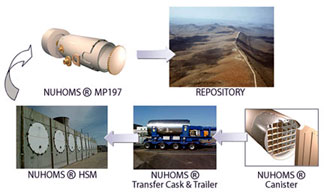
From the Transnuclear site
For Monticello, they’re planning on using “NUHOMS” casks (that is SO smarmy), which is a cask that’s put into a concrete bunker. As we all know from driving around Minnesota, concrete doesn’t last too long. So is this a good idea? And how do we evaluate it if the one study on the subject in dry cask storage is “disappeared?” I requested all four of the documents I need, but I imagine the black helicoptors will land out in the street and haul me off. Ain’t freedom grand…
News from Yucca & PFS
February 23rd, 2006
Yes, it is certainly Nuclear Waste Daze all over again.
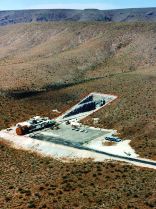
This from today’s Las Vegas Review Journal, reminds me of Sunday nights at the Magic Wand with eggs and dilled potatoes while they washed the truck before the run down the hill to LA… oh… where was I… nuclear waste, Las Vegas Review Journal:
Yucca feeling heat on humidity: Stop work order prompted by failure to calibrate gauges
By KEITH ROGERS
REVIEW-JOURNALAnother problem has surfaced in the scientific work that is supposed to ensure the safety of entombing the nation’s most lethal nuclear waste in Yucca Mountain.
A spokesman for the project confirmed Wednesday that concerns by nuclear regulators about flawed humidity measurements in corrosion-rate studies of the metal waste disposal packages have prompted them to order a halt to that work.
The stop-work order took effect Jan. 30, about three weeks after inspectors from the Nuclear Regulatory Commission’s safeguards office wrote to the project’s licensing director to say that the work was based on humidity gauges that weren’t calibrated. Project contractor Bechtel SAIC had claimed that the work was “technically sound” with “defensible results.”
The revelation comes nearly a year after the Energy and Interior departments revealed that several U.S. Geological Survey hydrologists had exchanged e-mails discussing “fudge factors” and possible falsification of quality assurance documents on water infiltration research.
Bob Loux, executive director of Nevada Nuclear Projects Agency and a leading critic of the government’s effort to dispose of spent nuclear fuel at Yucca Mountain, 100 miles northwest of Las Vegas, said the latest revelation means the project’s entire quality assurance program is flawed.
“This strikes right in the heart of the whole corrosion issue. If some of the data is suspect, it’s huge,” Loux said.
Steve Frishman, a full-time consultant for the Nevada Nuclear Projects Agency, said that if they used improperly calibrated or uncalibrated equipment, government scientists might have underestimated corrosion rates of the nickel alloy, known as Alloy-22, that will be the outer cover of the stainless-steel waste packages. The packages are supposed to contain 77,000 tons of spent fuel assemblies and highly radioactive defense wastes in a maze of tunnels inside the mountain.
“They did not only not follow their quality assurance measures, they also didn’t follow the scientific procedures for the experimental work. … It isn’t science if quality assurance isn’t there,” Frishman said.
“Now we have the corrosion rate of the container in question, and because of the USGS stuff we have the infiltration of water in question, and these are two critical pieces of the repository design,” he said.
An investigation into the uncalibrated instruments used in corrosion experiments is under way to determine the root of the problem and what corrective actions must be taken, said Allen Benson, a Department of Energy spokesman for the Office of Repository Development in Las Vegas.
“We take these quality assurance concerns very seriously, and we will look into and address all the concerns raised by the NRC,” Benson said.
He said the investigation will focus on high-temperature humidity instruments called “Vaisala probes,” and “any other instruments at or beyond documented calibration ranges.”
In August, observers from the NRC staff examined an audit by a Bechtel SAIC team into the quality assurance of waste package corrosion experiments conducted between 2002 and 2005 at Lawrence Livermore National Laboratory in California, 45 miles east of San Francisco.
The NRC observers found that:
â?¢ Experiments were started without calibrated instruments.
â?¢ Calibration was not documented.
â?¢ Lawrence Livermore scientists planned to conduct an “in-house” experiment to calibrate the probes and qualify data “after experiments were completed.”
A Lawrence Livermore spokesman deferred comment Wednesday to DOE’s Office of Repository Development.
Benson said the investigation is expected to be completed in late March. Until then, project officials won’t know whether any or all of the Lawrence Livermore work on the corrosion studies will have to be redone.
Sandia National Laboratories currently is redoing the infiltration model, anticipating that the lack of traceable quality assurance documentation of the scientific work will lead to failure to pass the scrutiny of a license application review by the NRC.
As for the corrosion experiments, Frishman said lack of calibration of the humidity instruments would skew results of how dust containing minerals and salts could accelerate the corrosion of the waste packages’ outer shell. Some of the experiments were exploring the impact of “deliquescence,” in which some minerals and salts soak water vapor form the air, creating a corrosive solution.
At a Feb. 1 technical review panel meeting in Las Vegas, scientists estimated that corrosion will take its toll on waste packages after they have been in the mountain for 40,000 to 60,000 years. Water moving through the mountain at first would be driven away by heat from the decaying waste, but eventually moisture would condense and infiltrate the tunnels, carrying off deadly, long-lived radioactive materials.
While the news was breaking about the calibration issues Wednesday, state Attorney General George Chanos and members of the statewide environmental group Citizen Alert met in Las Vegas with Minnesota legislators who wanted to hear the state’s concerns on Yucca Mountain before touring the site today.
“Our new attorney general said as long as he is attorney general, Yucca Mountain is not going to happen,” said Peggy Maze Johnson, executive director of Citizen Alert.
==============================================================================
And there’s also Private Fuel Storage in the News:
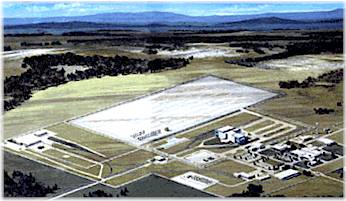
Proposed PFS site at Skull Valley Goshute Reservation
Today in the Christian Science Monitor.
Is used nuclear reactor fuel headed for the reservation?
By Faye Bowers | Correspondent of The Christian Science Monitor
SKULL VALLEY GOSHUTE RESERVATION, UTAH â?? It’s a question that has dogged the nuclear industry since the 1970s: What can it do with spent fuel rods?
The radioactive waste, eventually slated for permanent storage at a still unfinished site in Nevada, has been piling up, mostly at the nation’s 65 commercial nuclear power plants. Late Tuesday, the Nuclear Regulatory Commission (NRC) gave its blessing to a solution: a storage site on a barren patch of a reservation in Utah that’s home to some 25 native Americans, next to a proving ground for chemical and biological weapons, and near an Air Force bombing range.
The NRC licensed what would be the nation’s largest – and only private – nuclear-waste storage facility. A consortium of utility companies would store for up to 40 years some 40,000 metric tons of spent nuclear fuel for an industry rapidly running out of space.
But the plan has powerful opponents, including Utah’s entire congressional delegation and its governor, who have developed a multipronged attack plan to try to beat back this latest effort.
“Our position is this represents public policy at its absolute worst,” says Mike Lee, general counsel to Utah Gov. Jon Huntsman Jr. “What these people want to do is take spent nuclear fuel and put it above ground in casks in a valley that’s located 40 miles immediately upwind from Utah’s only population center. To make matters much worse, this aboveground, open-air facility lies immediately under the low-altitude flight path of 7,000 F-16s a year en route to a bombing range.”
But it is precisely those conditions that make the reservation land unfit for most anything else, says Leon Bear, chairman of the Skull Valley Goshute Reservation. In addition, Utah has outlawed gambling in the state, so the Goshutes can’t open a casino. That is one reason the tribe leased 840 acres of its sprawling reservation for an undisclosed sum to Private Fuel Storage (PFS), the consortium that would house the nuclear fuel rods.
“What do they think we can do, sell bottled water?” Mr. Bear asks.
Standing on a hill, where small mounds of snow-covered Great Basin sage and rabbit bush stretch as far as the eye can see, he explains his vision. It includes the return to this 18,000-acre reservation of many of his small band of 123 Goshutes. They would join the 25 or so who currently live here because the deal would provide enough money for decent housing, education, a cultural center, and healthcare – and spin off several jobs as well.
The tribe’s efforts to land a nuclear storage facility date back to the late 1980s, when Mr. Bear’s father, Richard, and uncle, Lawrence, began to look into the process and the risks involved.
Mainly with grants from the Department of Energy, and financial backing from PFS, which is also paying most of the tribe’s legal fees for pushing this project, Bear and a few others from the tribe have toured spent nuclear storage facilities in England, France, Sweden, and Japan. They’ve also visited the two federal aboveground storage facilities, in Idaho and Minnesota.
But the state’s public servants say they worry that, with all the delays and problems involved with opening the permanent storage site at Nevada’s Yucca Mountain, the proposed temporary storage site at Skull Valley may become a permanent one. And they are pursuing multiple options to derail the project.
For example, Rep. Rob Bishop (R) of Utah was able to include a measure to declare lands around the reservation national wilderness area in the Defense Authorization bill that passed in December. That effectively stops PFS from building a rail spur into Skull Valley Reservation from the main railroad parallel to Interstate 80, about 33 miles north of the reservation. That will force PFS to find an alternative transportation method, which will require the Bureau of Land Management (BLM) issue rights of way. The governor’s office plans to lobby the BLM so it won’t issue them.
Moreover, the state has one more chance to stop the effort by appealing to the Bureau of Indian Affairs, according to Mr. Lee of the governor’s office. The BIA must approve the lease agreement between PFS and the reservation.
Such moves are only the latest by opponents, which include environmentalists and even members of the Goshute tribe. They have waged a protracted nine-year battle to prevent the reservation from taking possession of the dry-storage casks containing spent nuclear fuel, and don’t plan to give up their fight anytime soon.
Margene Bullcreek, leader of PFS opposition at Skull ValleyThe Bears, for their part, say they are patient, and that this effort is only a continuation of the Goshutes being good neighbors, good hosts. When they’ve been asked to host other government projects, such as a rocket motor testing program, or the storage of solid waste from Salt Lake City, they’ve done it.
“Whenever we’ve been asked to go to war for this country, or to host something, we have been willing to help as long as they have asked,” says Tomy Bear, Leon Bear’s wife.
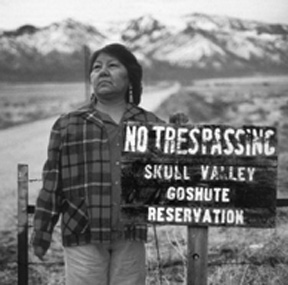
PFS nuclear waste site approved — LAST WEEK
February 23rd, 2006
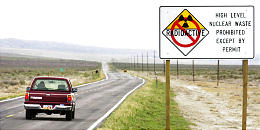
This is really about Yucca Mountain and PFS – it’s Nuclear Waste Daze all over again.
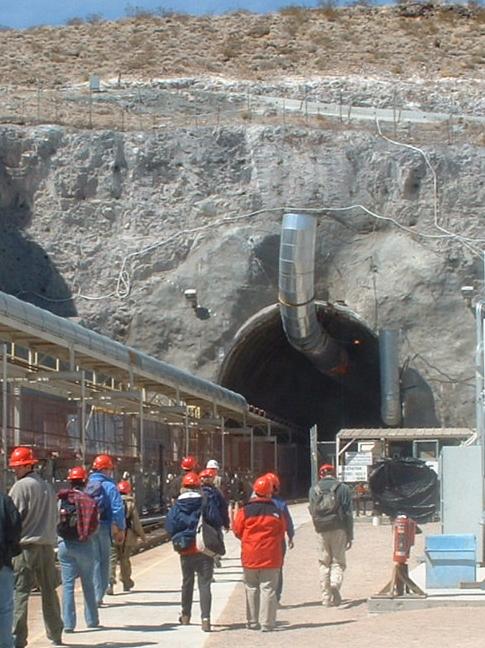
There’s a Minnesota delegation out in Nevada today touring Yucca Mountain, 4 members of the Red Wing City Council, members of the Prairie Island Indian Community Tribal Council, and Representatives and Senators who are on the Legislative Electric Energy Task Force. When I tell people about this they laugh, and say “WHY????”
Yesterday on MPR, it was annouced that NSP’s Private Fuel Storage (PFS) in Utah was licenced by the Nuclear Regulatory Commission for Part 72 storage of high level nuclear waste. It’s not been reported in any other Minnesota media outlet. Problem is, this happened last week. Problem is, it was announced at the very moment that a plane landed in Nevada carrying a delegation from Red Wing’s City Council, Prairie Island’s Tribal Council and the Minnesota Legislature. They don’t know about PFS. I checked with Red Wing Council members Peterson and Cook and they did not know anything at all about PFS, and Kay Kuhlman, City Administrator, did not know it had been approved until I’d told her last week. Hmmmmmmmmm…
Today’s questions:
1) Why is news of PFS licensing delayed in this area?
2) Why is Xcel, the lead utility in PFS, backing off of supporting it?
3) Why is Xcel encouraging Minnesotans to lobby in Nevada for nuclear waste storage in Yucca?
Any thought that Yucca is going to happen is delusional, and the DOE and NRC said so and were quoted in the New York Times last week! Red Wing, my home town, is going to have to deal with OUR problem.
Xcel is withholding their funding? Yup, here’s their letter: View image
And here’s one from Southern withdrawing completely: View image
FYI, here’s the Private Fuel Storage site
Here’s the Skull Valley Goshute’s site.
Here’s the State of Utah’s site.
Here’s Ken Verdoia’s documentary about Skull Valley
And Joan Marshman, of the Florence Town Board, tells me the Red Wing paper has an article in today’s paper about the Yucca tour, so I’m off to get a paper, more later…
Here’s the article from the Red Wing Republican Eagle: Yucca Mountain from the Inside and PFS nuclear storage facility licensed Download file It says that touring the facility are members of the Red Wing City Council, Prairie Island Indian Community Tribal Council, and members of the Legislative Electric Energy Task Force. In this article, well, see for yourself:
Though he express pessimism over the prospect, Castner said he and other council member will attempt to lobby Nevada officials to favor the project.
“We’re going to try to sell it to the people.” he said.
Council members Dean Hove, Mike Hall and Gary Nordmark and Castner will accompany members of the Legislative Electrical Energy Task Force and Xcel Energy officials…
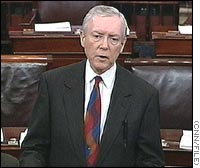
Here’s from Utah Sen. Orrin Hatch’s site: PFS License means nothing without lease approval
Here’s the Feburary 13, 2006 article from the New York Times:
Big Question Marks on Nuclear Waste Facility
by Matthew L. Wald
Washington The Energy Department no longer has an estimate of when it
can open the nuclear waste repository that it wants to build at Yucca
Mountain, 90 miles northwest of Las Vegas, and it may never have an
accurate prediction of the cost, the energy secretary said on Monday.The secretary, Samuel W. Bodman, said at a nuclear power industry
conference that his department was redoing research and design for
Yucca, which was supposed to start accepting civilian power-plant waste
in 1998. But it is a first-of-a-kind project, making cost estimates
difficult, he said, and the best that the department may be able to do
is publish an estimate with a very wide range of error.Last week the deputy energy secretary, Clay Sell, hinted for the first
time that the money that the Energy Department had been collecting from
the nuclear utilities since the 1980’s might not be enough to pay for
the project; the last published cost estimate was $60 billion, in 2001.
The last date given for its planned opening, provided a year ago, was
2012. The department is facing lawsuits from utilities that want to
recover extra costs created by the delay.Mr. Bodman spoke Monday to hundreds of nuclear industry executives at a
conference organized by Platts, an energy information division of
McGraw-Hill. Other speakers said that various companies were considering
building as many as 16 new reactors soon; none have been ordered in this
country since the 1970’s.A lawyer in the audience asked how the industry could build new plants
without assurances of a plan for the waste, as the Nuclear Regulatory
Commission requires.Mr. Bodman did not answer, but instead began describing the problems of
the Yucca project.For one, he said, government scientists and their commercial contractors
were trying to cope with research work that was done poorly by the
United States Geological Survey. Another problem is a court decision
that forced the Environmental Protection Agency to publish standards
governing leakage of radioactive waste for one million years, he said;
initially the Energy Department had planned on a timeline of 10,000 years.In addition, he said, the project managers recently decided that they
had to space the wastes more widely to prevent temperature inside the
mountain from reaching the boiling point, because the effects of steam
are more difficult to predict.“There are problems with the U.S. Geological Survey work that was done,
there are problems with the E.P.A. standards that are there, there are
problems with the efforts of the Department of Energy. There’s plenty of
blame to go around,” Mr. Bodman said.His comments came more than six years after the Energy Department issued
a “viability assessment” asserting that the mountain could hold waste
from power plants and nuclear weapons plants, and two years after the
department had planned to submit an application to get a license for the
project.Mr. Bodman had come to talk mostly about the Bush administration’s new
Global Nuclear Energy Partnership, a plan that includes reprocessing
nuclear wastes to reduce their volume and toxicity. Despite a spirited
description of the program, he got no questions on that subject.Some in the industry said, though, that the partnership introduced a new
complication for Yucca. If used reactor fuel were put through a factory
to recover reusable parts, as the proposal calls for, the new wastes
could not be buried at Yucca until the project was reanalyzed, they said.Another complication is that the department recently told utilities that
they should ship fuel to Yucca in containers that could go directly into
the mountain for burial. But some of the waste is now packaged in other
kinds of containers, in locations where the reactors have been torn
down, which means there is no easy way to repackage the materials.Other nuclear professionals present, including the chairman of the
Nuclear Regulatory Commission, Nils J. Diaz, predicted that the nation
would shift to a system of above-ground interim storage and perhaps the
solution called for in the nuclear partnership: breaking up old nuclear
fuel to recover reusable materials. But this could help spread material
useful in nuclear weapons.
Miss Nevada on nuclear waste
January 22nd, 2006

Oh, my, reality collides with Miss America…
Girls show up to see Miss America Hopefuls
Miss Nevada’s mother isn’t happy the judges’ interview of her daughter touched on a sensitive political subject.
One of the judges in Thursday’s interview with Crystal Wosik asked her what she thought about the nuclear waste repository proposed in her home state at Yucca Mountain. The facility has to go someplace, and Yucca Mountain is the best-built facility in the country, she replied.
And if people die?
“We just have to take one for the team,” said Wosik, 23, of Las Vegas.
“They really nailed her on the interview,” Lena Wosik told the Las Vegas Review-Journal. “The judges were ruthless.”
The elder Wosik, an orthodontist assistant, said the judges shouldn’t have put her daughter on the spot.
“It’s a tragedy that we have nuclear waste, but it’s got to go somewhere. I’m sure she’ll get hate mail. I felt they should have been asking about education,” she added.
According to the Las Vegas Sun:
Sheriff Bill Young said the unit is on the alert for animal rights and environmental groups “and, God forbid, anything worse.”
Duck!!! The NRC has a bead on Minnesota!
December 28th, 2005
I’ve found some more info on the NRC’s take on Minnesota legislation that the agency thinks is going too far, where the agency opinion is that the NRC has jurisdiction and that some Minnesota legislation is encroaching on that jurisdiction.
Here’s the document I found originally:
Here’s the approval of the NRC of the Agreement that the Pawlenty administration had requested, an agreement that gives the state limited jurisdiction over some small nuclear matters:
Commission Voting Record
November 2, 2005
Here’s what the Chair, Nils Diaz, of the NRC had to say:
Chairman Diaz’s Comments on SECY-05-0170
I approve the staff’s recommendation to proceed with processing the State of Minnesota agreement application pursuant to Section 274 (b) of the Atomic Energy Act of 1954, as amended. While I understand the concerns expressed by the Team Leader, I believe that the staffs recommendation is sound and appropriate. In addition, I support Commissioner Merrifield in requesting that the General Counsel prepare an options paper for the
Commission’s consideration on possible approaches to the handling of preemption issues.

Commissioner McGaffigan wants staff to get right on it:
Somewhat reluctantly, I approve the staff’s recommendation to complete processing of the Minnesota Agreement application. I am concerned with the preemption issues that were included in this paper and I commend the Team Leader for raising them. I believe these concerns were insightful and significant enough to be raised. I also want to commend the staff for putting together a paper which included the Team Leader’s concerns. This allows the Commission to make informed decisions on these important issues.
I agree with Commissioner Jaczko that NRC’s authority is clear, and I too am a strong believer in preserving our authority. NRC has spent significant resources over the last few years ensuring that other agencies do not encroach into our jurisdiction and attempt to apply inappropriate security requirements on our licensees. In the decommissioning area, we have expended a great deal of time and effort working with EPA to reduce dual regulation. This case should not be any different.
The staff should work with Minnesota, and any other State where we are aware of preemption issues, and try to resolve the issues. I look forward to the options paper requested from OGC by Commissioner Merrifield on possible methods to address this issue.

Here’s what Commissioner Merrifield had to say:
I understand the concern raised by the Team Leader. While I do not believe that this issue affects the proposed Agreement with the State of Minnesota, I would like to see the Commission take a more aggressive posture in challenging State actions on preemption issues. I also agree with the Office of the Inspector General that a formal written policy on how the agency will address possible preemption issues is necessary. To this end, I would request that the General Counsel prepare an options paper for the Commission’s consideration on possible approaches to the handling of preemption issues, including the resource implications for the implementation of any new agency policy.

On a different vein, here’s Commissioner Jaczko’s Comments:
Only the NRC has the authority and responsibility under the AEA to regulate nuclear power
reactor operations, and I am a firm believer in preserving the authorities of the agency. Therefore, the State of Minnesota should not be setting standards for exposure levels at independent spent fuel storage installations located at nuclear power facilities. I applaud the staff for bringing this difficult issue to the attention of the Commission because of the potential policy questions it raises.The Agency’s mission, however, is to protect the public health and safety. Minnesota’s actions to create a more restrictive standard in no way threatens that mission. The NRC has set the precedent that when a democratically elected state government decides its citizens demand additional preventive measures be taken against radiological hazards, and the involved parties do not object, the NRC does not pro-actively work to undermine that effort.

And Commissioner Lyons is much less concerned than the others:
I am aware that Minnesota may have statutes and regulations that could potentially intrude into
areas reserved to the Commission. These state statutes and regulations, however, do not concern areas over which Minnesota is seeking authority as part of the agreement with NRC. In this regard, I believe that the staff is correct that a finding of compatibility of a State’s program with NRC’s program is a matter separate from possible Federal preemption issues. In addition, nothing in the proposed agreement with Minnesota precludes the staff from
addressing possible preemption issues should it wish to do so in the future.