Walton’s Bill Grant and “low carbon coal”
May 14th, 2007

Bill Grant, Midwest director of the Izaak Walton League, a national conservation organization, had this to say: “We can ignore this reality until it’s too late to avert the worst effects of global warming, or we can lead by example at home and implement low-carbon coal technologies and carbon capture.”
Low-carbon coal? Say what???? Really, I’m not making this up. This was in a Neal St. Anthony STrib column this weekend… I cannot believe. The full article is below. But this is no suprise given that Bill Grant was at the Sawmill in Grand Rapid, ostensibly to speak on “Conservation” per the program, but instead, like the others present, was promoting IGCC – coal gasification near the site Excelsior Energy has proposed for the Mesaba Project:
To let the Izaak Walton League know what you think, click on “CONTACT” at the bottom of their home page… and since that doesn’t work, I guess you’ve got to call STAFF and BOARD OF DIRECTORS. Here’s the contact info for Bill Grant in the Midwest Office:
Izaak Walton League – Midwest Office (MWO)
1619 Dayton Ave Suite 202
St. Paul, MN 55104
(651) 649-1446
To look up your IWLA chapter, CLICK HERE
Neal St. Anthony: ‘Clean coal’ possible, experts say, but needs federal help
By Neal St. Anthony, Star Tribune
Last update: May 11, 2007 – 9:47 PM
Xcel Energy CEO Dick Kelly says the Minnesota-based utility will be a national leader in the pursuit of “clean coal” — including a proposed plant in Colorado that will divert carbon emissions to underground burial. But it’s going to need help.“We’re first going after conservation from residential and business customers because we need to slow the growth in electricity usage,” Kelly said in an interview this week. “Then we’re going after carbon-free sources of energy such as wind, hydro, solar and natural gas. But we’ve got to eventually get to ‘clean coal.’ And we can’t do it alone.”
Kelly’s comments followed the release of a study by a coalition of utilities, state regulators and environmental groups that criticized the federal government’s feeble commitment to the challenge of reducing CO2 emissions from coal, America’s most abundant boiler fuel for power plants.
The report of the Coal Gasification Work Group, shepherded by the nonprofit Great Plains Institute of North Dakota, is significant because it has eight states from the heartland acknowledging the threat of global warming and the importance of U.S. leadership in fixing the problem.
Xcel has pledged several million dollars this year and is looking for other investors in a next-generation Colorado plant of up to 600 megawatts that would use integrated gasification combined cycle technology that can capture 90 percent or more of the CO2 and mercury emissions. The company hopes the technology can be adapted to existing plants.
Boosting efficiency
The “clean-coal” technology uses a chemical process to convert coal into a gas. It is burned in a modified combustion turbine to generate electricity, increasing the efficiency of the plant and reducing emissions. The captured CO2 can be stored underground or piped to depleted oil wells for storage and to aid in the extraction of hard-to-get oil.
A 1970s-vintage gasification plant in North Dakota already is capturing thousands of tons daily of CO2 for injection into an oil field in Saskatchewan, Canada. But integrating the technologies for widespread use is going to require the Bush administration to do more than talk about clean coal, critics say. The Great Plains report said federal spending on related research and development has declined over the past several years.
“Early adopters of these technologies face greater risks, especially with low-rank coals,” said Charlie Bullinger, senior engineer with Great River Energy of Elk River, Minn. “That’s why we’re encouraging an expansion of federal incentives to reduce the risk.”
President Bush has pointed to clean coal as a partial solution to America’s energy issues, including conversion of coal to liquid fuels, and approved some research funding. But the administration has barely acknowledged global warming despite mounting scientific evidence and even calls by industrialists for American leadership in “green technologies.”
Beyond wind and hydro
“We’re doing a lot with wind and some with hydro,” said Mike Gregerson, a retired Xcel engineer who was a technical adviser to the Great Plains group. “Down the road the feds are going to [limit carbon emissions], we feel, but the technology won’t be proven yet.
“The U.S. needs to get going,” he said. “My history in the utility industry says if you encourage the utility industry now, they’ll get to where they need to go.”
Xcel, under Kelly already the largest U.S. seller of wind-generated electricity, has joined with several other leading utilities calling on the industry to lead globally in carbon-avoidance. Kelly said Xcel will need industry and government partners to prove that large-scale coal gasification paired with carbon sequestration can work over the next decade.
“We need to invest in this technology and we can fix this,” said Kelly. “We do need some help from the government.”
Bill Grant, Midwest director of the Izaak Walton League, a national conservation organization, had this to say: “We can ignore this reality until it’s too late to avert the worst effects of global warming, or we can lead by example at home and implement low-carbon coal technologies and carbon capture.”
Neal St. Anthony • 612-673-7144 • nstanthony@startribune.com
Like Pawlenty, Minner is toadie for IGCC
May 11th, 2007

From 2006 Gov’s Wade In event!
Then, she was almost in over her head, and now she’s as bad as Governor Pawlenty, shamefully promoting IGCC, coal gasification, when the truth is out there for all the world to see…
In today’s News Journal:
Gov. Ruth Ann Minner still believes a coal gasification plant could be right for Delaware, despite the Public Service Commission’s endorsement this week of wind power.
The governor said it might make sense to combine wind power with NRG Energy’s proposed coal plant, a combination that provoked skepticism from some energy specialists.
Tell Gov. Minner what you think about her stand on IGCC: (302) 744-4101 Dover; (302) 577-3210 Wilmington.
Email her Chief of Staff, Mark Brainard at mark.brainard@state.de.us
What did NRG propose? Worth a look see to check out their professional redaction job:
Gov. Minner puts her credibility on the line for NRG? Why? IGCC (coal gasification) is the biggest boondoggle to come down the pike. The people of Delaware are not aware of the details of the NRG proposal because it has been kept shrouded in secrecy. But it’s all public information in Minnesota’s Excelsior Energy docket about the PPA for the Mesaba Project.
Shouldn’t Gov. Minner be paying attention to this extensive record and detailed decision?
What the record, agency staff analysis, and the ALJ decision in our proceeding demonstrates, and NRG has NOT proven otherwise, is that IGCC is not environmentally superior. It does not significantly reduce major pollutants when compared with state of the art coal. IGCC does not do one thing for CO2 levels other than greatly increase them! Like the Mesaba Project, NRG does not commit to carbon capture and storage (CSS), and that’s because it’s not a demonstrated option, no commercial IGCC plant is doing it. CSS is not happening anytime soon, and the DOE said so in its addendum to the Gilberton coal-to-liquids EIS.
Shouldn’t Gov. Minner be paying attention to the DOE?
Another thing the Excelsior record demonstrates is that IGCC is very very costly, and not in the public interest. The whole point of HB6 and the PSC’s RFP docket is to gain price stability for the SOS ratepayers, and IGCC, with its reliance on a commercially undemonstrated technology, one deemed by the DOE to be “too risky for private investment” is not a reasonable way to achieve it. IGCC, because it is “too risky,” can only gain a foothold with massive federal and state subsidies, on the backs of the taxpayers, and what would we get? Another economic and environmental disaster like Wabash River, so unreliable it took 22 full time engineers to cobble it together, it was shut down because it was inoperable, it was routinely violating the water permit… great idea…
Shouldn’t Gov. Minner be paying attention to the past IGCC projects?
As I testified before the PSC on Tuesday, admonishing DNREC’s Phil Cherry for his astounding false statements in support of IGCC, there’s just no excuse for supporting IGCC given the MN record that is PUBLIC for the world to see and consider. Their statements are contrary to the evidence. Politically, that’s a bad spot to be in.
Shouldn’t Gov. Minner recognize the opportunity to direct Delaware energy policy in a sustainable, renewable direction? Shouldn’t Gov. Minner reject unreliable, costly and risky IGCC?
DOE schedules more transmission meetings
May 11th, 2007
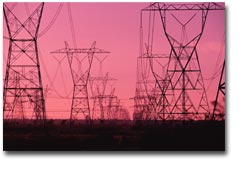
Not long ago, I was calling and emailing the few contact people I could find about those “National Interest Electric Transmission Corridor” meetings — THREE meetings for the whole damn country — THREE. That entire program is such a crock, because we don’t need no stinkin’ transmission… however, THEY do if they want to accomplish their goal of bulk power transfer, capturing megabucks, holding pass-through communities hostage as they build a grid on local land… WHO BENEFITS? WHO PAYS?
I wasn’t the only one incensed by their THREE meetings. From Sen. Charles H. Schumer, D-NY:
“This uninformed decision by the DOE simply defies logic and places an unacceptable and noxious burden on the communities that would be affected by NYRI’s proposed power line,†Schumer said. “Why is it easier or better to hold a hearing in Rochester than in Utica, or Oneonta or Norwich or Middletown or another locale easily accessible to the communities that lie directly in its path? I am very concerned that DOE may be trying to duck these communities so their voices won’t be heard. This needs to be immediately rectified by setting a hearing in a locale easily accessible to the communities that lie directly in its path.â€
Schumer: More power hearings needed
Way to go! And lo and behold, they scheduled FOUR more, again, for the whole country, only FOUR:
DOE sets more meetings for draft National Corridors
And why would they want transmission corridors declared? Why to build transmission lines, of course:
… it’s getting a little greedy in here…
Where is all this going? Check out the PJM 2007 Strategic Report.
… sigh…
IGCC DEAD IN DELAWARE, WIND/GAS MOVING FORWARD!
May 9th, 2007
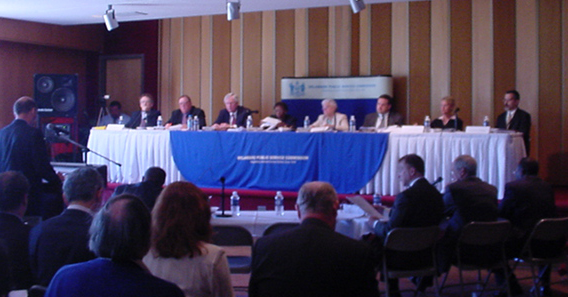
Oh, it was a LONG meeting. It makes an equally long post.
As in Minnesota, it’s not quite dead, but the plug has been pulled and we’re waiting for the inevitable.
The good news is that the PSC did adopt the staff recommendation for a wind/gas hybrid! Sure makes my day when state agency staff recommend something I’ve been pushing for so long, and then the PSC actually adopts it, like wow, a bit of progress. And staff is recommending a big broad look at energy policy. I don’t have the exact quote, but in his presentation to the Commissioners explaining how they got to proposing the hybrid, Bob Howatt, PSC staff, said something like, having done all the work of analyzing the proposals, and seeing the necessary path, “It’s time staff just said what needs to be done” (Bob, if that’s off, let me know). They did a superb job on it, of course I can pick at points, but the overview was, indeed, just what was needed, and this is a trend that needs nurturing — FORETHOUGHT IN POLICY!
Here’s the report from the News Journal, something to do while I’m finishing my write up:
PSC endorses offshore wind farm with gas backup for Delmarva
And yes, DNREC’s Phil Cherry needs a little awakening, spouting things about IGCC that are patently false. So much for his credibility as a public servent charged with protecting the state’s natural resources! I’ll be sending him his own personal copy of the ALJs’ recommendation that the Mesaba PPA be denied. He’s got access, they know the Mesaba info is all public record, and there’s no excuse for misrepresenting IGCC — which then leads me to question… WHY???
The PSC motion passed was to accept the staff recommendation of the wind/natural gas hybrid EXCEPT that both Conectiv and NRG are to negotiate at same time. Bluewater Wind is also to be evaluated as single supplier, and that the PPA shall be reduced but it shall not be a fixed figure, to provide flexibility. The precise words will appear in a PSC order soon.
Here’s the PSC Staff Recommendations (p. 63-71, click below for link) in its entirety — it’s too well done to omit any of it:
Staff’s conclusions with respect to the process at this time are as follows:
Today is Delaware PSC meeting
May 8th, 2007
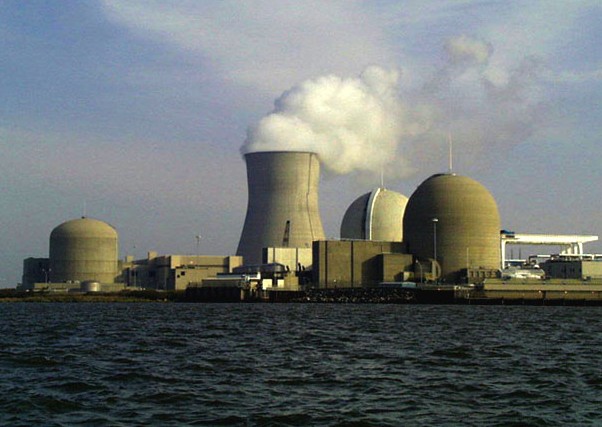
It’s about as perfectly beeeeauuuuuteeeful a spring day as can be found anywhere. From my desk looking out an easterly window towards the river, this Salem plume would be visible if a block’s worth of houses weren’t in the way — and unfortunately, not being able to see it does reduce its presence, much like the way my Prairie Island nuclear plant is nestled behind a bluff, but directly upwind and upriver… Here in this nuclear zone, they don’t get calendars, they don’t get pottasium iodide, though they do have the nuke sirens.
There have been some very interesting reports coming out of the PSC lately, things that look like thoughtful energy planning — and I hope it’s not a ruse. There was that staff recommendation of a wind/gas combo on the RFP side of things, and the recommendation focused on the broader policy issues that need to be addressed, those pesky little things like the need for a portfolio approach, the state’s dependence on transmission and need for its own generation… like wow!
Then there’s a report about transmission and generator interconnection:
And a short update/correction with additional runs on the RFP evaluation:
Overland’s take? The staff recommendation is a good option, in the public interest, and it gets wind going as dispatchable generation, removing one of the primary objections to wind, it’s variability. The IRP is the venue to make the larger policy changes, where, as staff noted in the RFP recommendation, a portfolio approach can be established. This is where the policy directives establishing DSM with TEETH (not present in DE yet), establishing the need for Delaware generation to prevent extortion by generation and transmission owners, demonstrating the need for specifically sited generation that would eliminate voltage problems in this electrical island. This RFP docket is one step and can propel the state into energy planning in the IRP — that’s what I’d like to see.
Imagine DE fulfilling its “baseload” needs with dispatchable wind — wind in combo with backup generation! Arizona is using concentrated solar and gas, Minnesota is using wind/gas and wind/hydro, Delaware can do wind/gas!
Imagine DE, through policy declarations, systematically choosing not to buy dirty coal! Indian River Units 1 and 2 are only 160 MW, not hard to replace. If Xcel can do it (well, we know, anything but IGCC!), imagine…
An MPR piece on the Bluewater Wind proposal in the RFP:
Here’s the Delaware State Treasurer standing up for the public interest (stolen from Green Delaware): State Treasurer Jack Markell’s Letter to Delmarva Power.
Plus there’s a new report – a consultant’s view of reregulation! Where is it??? Can’t find it. I’ll post it as soon as I do…