CRWP photos of Wolf Creek
September 3rd, 2007

The Cannon River Watershed Partnership is the only group keeping an eye on water in Rice County, well, the Cannon River Watershed, to be precise. And on August 24th, after the heavy rains, here’s some of what that eye, the camera of Beth Kallestad, sees:

This is the dam at Circle Lake, right by that “development” of Jerry Anderson’s, the one that was shut down by the Army Corps of Engineers for lack of a permit. In this photo, “Wolf Creek flows out of Circle Lake, where the two dogs died recently from drinking toxic algae in the lake water.”
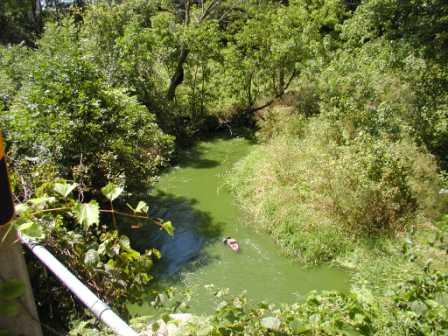
This one is near “County Road 8, at a volunteer water quality monitoring station on the bridge below Claude and Marie Brown’s.”

This is a dramatic photo of the “confluence of Wolf Creek (green, right) and the Cannon River (brown, left) near Grandpa’s Farm on Hwy 3.”
Link: MPCA’s Impaired Waters List.
Catching Up – GRHR Opinion Page
September 3rd, 2007

FINALLY I’m getting around to posting the latest from the Grand Rapids Herald Review. In the first, someone’s not happy about CAMP, an effective group opposing the Mesaba Project:
A different kind of wind power
Herald Review
Last updated: Wednesday, August 29th, 2007 10:45:48 AMEditor:
I recently had a conversation with one of these C.A.M.P. fellows. He informed me that this wind power was the only answer to our energy needs. I said I agreed that wind power was probably a good thing, but from my observations and from everything I had read on the subject, the wind did not blow all of the time. Normally in the evenings and at night the wind dies down, so we would still need back-up power as industry, business, both small and large and almost everybody else in this day and age needs constant power 24 hours a day. He then informed me that I was just plain misinformed and that these wind turbines produced power 24 hours a day, seven days a week and 365 days a year where they were being built.
Later that day when I was contemplating what this fellow had expounded, I got to thinking, you know what this fellow said could probably be true if he would just round up the rest of his C.A.M.P. buddies and take them out and they could all pitch their tents around one of these wind energy farms because they all really do produce a lot of wind.
Frank Hendricks
Bovey
Project teaches an expensive lesson
Herald Review
Last updated: Friday, August 24th, 2007 04:34:25 PMBy Aaron Brown
When it comes to “job creation” projects in this region, most Iron Rangers take a well-worn wait and see attitude. After all, big shots have promised economic diversification since the beginning of our economy. We’ve seen a defunct chopsticks factory, tech centers that became defunct telemarketing centers and a decade-long attempt to turn our local peat bogs into fuel. Our hopes have been raised, dashed, raised and dashed again.
We’ve seen some success, yet today natural resources like taconite and wood products still provide the backbone of our local economy. No one has figured out how to solve that problem. We’ve survived because our unique state agency – Iron Range Resources – draws many millions each year in taconite taxes (in lieu of the property taxes that mines used to pay to our towns and schools) to build our communities and stimulate economic development.
The leaping and lurching nature of our economy produces either great victories or great failures. In 2001 and the years after, many leaders were almost in despair over the shutdown of several local mines, including the permanent closure of LTV. It was at this time that local officials on the IRR board gave or loaned almost $10 million to a group of lawyers and lobbyists calling themselves Excelsior Energy. It was an act of unmitigated trust in a company that has never produced a single kilowatt of power.
On Aug. 2, the Minnesota Public Utilities Commission voted to reject the power purchase agreement needed by this startup company to build Excelsior’s Mesaba Energy Project. The project is a large proposed power plant near Taconite that promises experimental new coal technology that would burn cleaner than traditional coal-fired plants. While commissioners endorsed the technology, they declared the proposal to be far too expensive and risky. They ordered Excelsior to continue negotiating with the big utilities to fix the problems, but those utilities have no reason to change their longstanding opposition.
Excelsior Energy gambled – almost successfully – that authorities would blindly accept a project that brought jobs and the promise of cleaner energy production to the Iron Range. But, in reality, this project failed the people.
Excelsior and many local, state and federal leaders of both parties failed to make a plan that would produce energy at a competitive price. They failed to honestly explain or question the logistical difficulties of building a large experimental coal gas plant in a place hundreds of miles from the necessary coal mines, carbon sequestration sites, and markets that need the power right away. Worse yet, Excelsior took subsidized loans and grants from the Iron Range people and used it to cover nearly all of their corporate spending.
Public documents from Iron Range Resources show how Excelsior is spending the $9.5 million Iron Range Resources loan from 2003 to present. It would appear that for years the loan funded nearly every aspect of the business – payroll, offices furnished with expensive décor, right down to their subscription to the “Wall Street Journal.” It seems there’s very little private money in this project at all. In addition, both the IRR and federal government have given millions in grants while the state provided many unprecedented shortcuts in environmental and regulatory laws.
The outcome of Excelsior’s spending of public funds is murky. Hundreds of thousands of dollars from the IRR loan went to consulting firms and legal offices in the Twin Cities – literally too many to list here. Certainly, much of that paid for legitimate expenses, but we have no accounting for how that money was spent or who exactly benefited from the spending. Or for that matter, who pays for the many Excelsior lobbyists who patrol the halls of the State Capitol each session.
I know who this spending doesn’t benefit: the people of the Iron Range. This project is a combination of the worst parts of socialism and capitalism. It relies on public money to survive while protecting a private company from market forces.
Excelsior officials will say that the IRR loan has a high interest rate and that they intend to pay it back. But the actual loan agreement is the legal equivalent of Swiss cheese, full of delicious holes. Furthermore, Excelsior is banking on getting PUC approval this year to receive generous federal tax credits. They also need the agreement to open federal loan guarantees so they can continue spending money. In reality, Excelsior probably won’t get PUC support this year for an Iron Range plant, despite what their officials say in the media. The whole project is and always was a long shot. Our state leaders should have created more protections for the money and the possibility of the company’s failure or alteration of their original proposal. Instead many accepted legal campaign donations from Excelsior’s lobbyists while giving the green light to any shortcut, regulatory change or funding request they were presented.
We Iron Rangers allowed the desperation of the early 2000s create this ugly, expensive mess. This “company” has spun the many virtues of coal gasification while, from day one, lacking the money necessary to build the super-clean, super-efficient plant implied. Everybody’s power bill goes up a little if the plant works, a lot if the plant fails (another risk in this new technology). My biggest fear is not a new power plant on the Iron Range, but a failed project. This project was always a tremendous risk. Anyone with Google could have found that out for themselves in 2002.
I know this is a complicated issue. We need jobs. We will, eventually, need more energy production in northern Minnesota. We shouldn’t do it this way. The Mesaba project, while claiming innovative technology, is actually just an innovative way to shield entrepreneurs from risk. Government should regulate and, when appropriate, aid private industry; they shouldn’t provide nearly all the startup capital. In short: Excelsior Energy’s proposal remains a risky boondoggle.
The people of the Iron Range deserve better. With a new, focused effort on homegrown economic diversification and infrastructure improvements, we can show the world what the word “innovation” really means. It’s up to the people who live here to take renewed interest in making the Iron Range open and competitive in the modern economy. We’ve just learned a very expensive lesson in what not to do ever again. I hope.
Aaron J. Brown is a columnist for the Hibbing Daily Tribune, a Superior Publishing Corporation newspaper. E-mail him at aaronjbrown@yahoo.com.
Big Stone & Commerce do a deal
August 31st, 2007

More as it becomes available, but here’s the Agreement, just out today, and the Press Release from BS:
Nope, it’s too big to scan the whole thing in… grrrrrrr. So I’m scanning in the guts and not the exhibits for posting:
Settlement Agreement – Big Stone Partners and Minnesota Dept. of Commerce
And here’s the Big Stone Partners press release about it:
The big question now is what will the other Intervenors do? There’s the enviro Intervenors, MCEA, representing themselves, the Waltons, Fresh Energy and Union of Concerned Scientists. And then there’s lil’ ol’ moi, representing mncoalgasplant.com, an intervention limited by the ALJ to only those issues pertaining to Excelsior Energy’s Mesaba Project. Oh, this does get complicated, doesn’t it!
For the full Big Stone II docket, go to www.puc.state.mn.us and then to “eDockets” and then to “Search Documents” and then search for 05-619.
Here’s the STrib article — will someone explain to me why Sen. Ellen Anderson is suprised about this? Goodpaster “doesn’t understand?” Give me a break… Pawlenty’s supported it all along, and it was exempted from the “Global Warming” bill, DUH, wake up:
Minnesota has deal on coal power plant
A deal between utilities and the Minnesota Commerce Department swings support to building a $1.6 billion coal-fired power plant in South Dakota. Environmentalists say that’s the last thing Minnesota needs, and they’re accusing the governor of a flip-flop.
By Mike Meyers, Star Tribune
Last update: August 31, 2007 – 8:19 PM
The Minnesota Commerce Department Friday unveiled a pact with utilities that could smooth the way to build a $1.6 billion, coal-fired power plant in South Dakota, on the border 175 miles west of Minneapolis.A top Minnesota official said the deal will reduce mercury pollution, find ways to offset greenhouse gas emissions and ensure that rural Minnesota gets the power it needs.
But foes of Big Stone II accused the Pawlenty administration of suddenly shifting course and supporting a plant that’ll release 4.7 million tons of carbon dioxide into the environment every year for the next half-century.
“I’m just spitting mad,” said state Sen. Ellen Anderson, DFL-St. Paul. Hours before, she had introduced Gov. Tim Pawlenty to a group of children at the State Fair, hailing him as an environmental champion. “I’m outraged the governor has turned around and flip-flopped on this coal plant and is supporting it now.”
But Pawlenty’s point man on the Big Stone II agreement said the governor’s environmentalist credentials are underscored in the deal.
The agreement with the utilities that want to build Big Stone II includes a requirement that they offset the emission of greenhouse gases, offering the utilities nine options for doing so, said Edward Garvey, deputy commissioner of energy and telecommunications at the Minnesota Department of Commerce.
“The agreement between the [Commerce Department] and the Big Stone II owners resolves issues related to project costs, mercury emissions, water use, energy conservation, renewable energy,” the agency said in a statement.
Pawlenty earlier this year championed and signed new laws setting strict limits on greenhouse gas emissions and mandating that utilities use more renewable energy. Garvey said the deal on Big Stone II advances those goals.
“This is the first and only carbon offset applied to a new facility that we know of in the country,” said Garvey, who in January wrote a letter outlining problems with Big Stone II — from carbon dioxide emissions to the source of water for cooling towers to electricity rates. The letter said the proposal at the time was unacceptable but left the door open to talks.
All of those objections, Garvey said, are answered in a 17-page agreement reached in talks between state commerce officials and a consortium that includes Otter Tail Power, Central Minnesota Power, Great River Energy and the Southern Minnesota Municipal Power Agency. They already operate another coal plant, Big Stone I, next to the Big Stone II site.
Opponents skeptical
Opponents of Big Stone II were skeptical that the Pawlenty administration did anything but side with utility interests, however.
“This seems to be a political response when the governor’s own analysts found the plant should not go forward,” said William Grant, associate executive director of the Isaak Walton League, a national environmental group with an office in St. Paul.
“To me, this is a case where the higher-minded principles the governor announced a few months ago have now been trumped by realities of the economic interests that want this project to go forward,” Grant said.
Beth Goodpaster, lawyer for the Minnesota Center for Environmental Advocacy, said Pawlenty is doing an about-face on fighting global warming in the Big Stone II deal.
“It’s the hypocrisy of the Pawlenty administration, talking about the new direction of creating jobs and economic vitality with clean energy,” she said. “To say you have to help the rural economy with a coal plant, I just don’t understand at all.”
Mike Meyers • 612-673-1746
Mike Meyers • meyers@startribune.com
Mesaba Order out IN WRITING
August 30th, 2007

IGCC on the ropes… or has it been revived? Hard to tell.
The PUC’s Order is finally out. It’s the Order, from the August 2, 2007 decision, where the PUC decided it would be “disapproving Power Purchase Agreement” for the Excelsior Energy Mesaba Project. And that’s very good, but what’s scary about it is written right there in the caption, the part about “resolving to explore the potential for a statewide market for project power under Minn. Stat. 216B.1694, Subd. 5.
So time to fire up another cup of coffee and read this thing. I’ll probably have nightmares tonight…
American Transmission Company offers $$$$$
August 29th, 2007
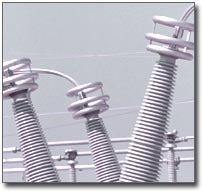
In today’s St.PPP about a two week old transmission line bomb scare (WARNING: KIDS, THIS IS A FEDERAL OFFENSE — DON’T TRY THIS AT HOME…):
Power line company offers reward
The Associated Press
Article Launched: 08/29/2007 10:00:26 AM CDTUNDATED—The company building a power line from Duluth, Minnesota, to Wausau, Wisconsin, is offering a reward to help find those responsible for leaving homemade explosives along the construction site.
American Transmission Company project manager Pete Holtz says they’re concerned about the safety of their workers and are offering a $1,000 reward.
The 210-mile line has long been the target of protests of property owners from Wausau to Superior and Duluth.
Fifteen to 25 soda bottles filled with explosive chemicals were found by a power line worker about two weeks ago in Wisconsin’s Douglas County. The bomb squad from the Air National Guard’s 148th Fighter Wing was called to the scene to take care of the bottles.
The FBI office in Green Bay, Wisconsin, is working to identify the chemicals.
The 420 million dollar line is expected to be finished later this year.
Here’s more from KJBR, a Duluth TV station:
Bomb Scare Forces Powerline Crews To Evacuate Construction Site
KBJR-TV
August 17, 2007Duluth MN / Superior WI, MN – Several bombs have been found in and around the controversial Arrowhead Weston Power Line construction site. The project has seen its share of protests from people who are opposed to the power line, but officials are not pointing any fingers right now.
Posted 9:06 a.m. – Several bombs have been found in and around the controversial Arrowhead Weston Power Line construction site.
As Dan Hanger reports, authorities are not taking this lightly.
“Well, luckily it wasn’t serious in the fact no one got hurt or killed, but that was the potential harm,” Sheriff Tom Dalbec, Douglas County Sheriff’s Office.
A potentially deadly situation on Lyman Lake Road in Parkland, Wisconsin was prevented Tuesday.
Several chemical bombs were found there, along a mile stretch of the Arrowhead–Weston Power Line construction site.
This is video nearby.
“The intent is to cause injury, harm, potentially death.”
The Douglas County Sheriff’s Office and the FBI, actively investigating, searching for the person or people who put these dangerous homemade explosives together.
“There are statutes,” said Raymond Greco, FBI. “If anybody causes damage to or destroys an energy facility, it’s a federal offense, so the power lines fall into that statute.”
Officials say the construction crews working on the project had just set the foundation for the power poles.
Those crews were evacuated.
No one was hurt.
And they aren’t allowed back for now because the sheriff’s office says there may be more bombs.
“We don’t know if someone’s intent was to make a statement against the power line or if they were to make a statement against government in general or if it potentially was maybe some kids screwing around having fun.”
The power line project has seen its share of protests from people who feel it threatens the environment and their homesteads, but officials are not pointing any fingers right now.
Anyone who knows anything about this case is asked to call the Douglas County Sheriff’s Department.