NRG in hiding at DNREC hearing
February 24th, 2008
MILLSBORO, DE — It was another one of those hearings where it was so absurd we had to laugh, either that or barf or be up in arms or all of the above. January 21, 2008, a hearing was held regarding the water permit for the noxiously polluting NRG Indian River coal plant. Here’s one news report posted on Alan’s site:
DNREC’s blatant disregard for people, aquatic life and the environment leaves ME speechless
You really have to listen to the responses of DNREC to questions to get the full flavor of this meeting (well, hey, who can complain, at least the room was heated!!!)
And here’s a choice one from the transcript, Alan was asking why it took 16 years for this permit to get to a public hearing, 16 years after it expired… and when asked, “WHY?” the answer is priceless:
MR. MULLER: Is that really the best answer that’s available from the Department?
Yes, folks, there you have it… straight from DNREC’s north end of a horse headed south… “__it happens!”
——————————-
It was so awful that even NRG was hiding, the NRG whose power plant water permit was the subject of the hearing, who was the beneficiary of DNREC’s 16 year delay:
NRG actually filed some comments, and there is a representative from NRG here. He is hiding. Okay.
All I wanted to do was to make sure that the primary documents were in the record — and for some reason that was a problem…
MR. HAYNES: Well, just ask what you want, and we will see.
MS. OVERLAND: Well, what I want is, because this permit has been dragging on 16 years, 16 years worth of those reports, because I think it’s important to look at, you know, what you are really talking about here. Without that in the record, how do you know? They could provide a summary to make it easier so you could have the backup to refer.
MR. HAYNES: How do you know what?
MS. OVERLAND: How do you know what these discharges are?
MR. HAYNES: They are on the reports.
MS. OVERLAND: Right, and so without the reports, you don’t know.
MR. HAYNES: Well, we know, because we have the reports. The Department has the reports.
MS. OVERLAND: But they are not in the record.
MR. HAYNES: Well, let me explain. You are alawyer, so I —
MS. OVERLAND: It’s okay, I am not that kind of lawyer. (Laughter) I have to wait to finish, but I am not that kind of lawyer.
MR. HAYNES: As the hearing officer, I am acting for the Secretary. The Secretary, obviously, can look at everything he wants to look at. I mean essentially this is the public hearing record where the public makes their comments into the record. We develop an administrative record, which is kind of the basics, but anything I — Anything that I need to look at as a designated person acting on behalf of the Secretary tonight in preparing my report and my recommendation, I have investigatory powers, I have powers to subpoena as part of that. So does the Secretary. So there is that greater, bigger record.
MS. OVERLAND: Uh-huh.
MR. HAYNES: We don’t have to develop everything tonight is what I am saying, in terms of tonight is to hear from the public. It’s a public comment period. So I guess it’s not like in a court of law where tonight we have to develop every single piece of information to be considered by the Secretary. That’s not what tonight is. Tonight is to hear from the public, to hear public comments, suggestions what the permit should be doing, and exactly the comments that Mr. Austin, Mr. Zak, and Mr. Muller all made were excellent comments. Okay?
MS. OVERLAND: Okay, but it also turns on the word “may” and you may look at them if you want to. What I want to do is assure that that gets into the record. So what would it take, say, then, for me to get copies of these? Can you send them out? Are they electronic?
MR. HANSEN: For you to have copies of them?
MS. OVERLAND: Sure.
MR. HANSEN: All we need is a FOIA request telling us exactly what you want, and we will get it for you.
MS. OVERLAND: And when does the record close here? That was another question.
MR. HAYNES: Well, it could close tonight or it could stay open, if there is a request and then no opposition to it. Obviously, there is a certain — I can’t say there is — Of course, we haven’t — Somebody has told us to be expeditious about it, so —
MS. OVERLAND: Well, 16 years.
(Laughter)MR. HAYNES: What would you like?
MS. OVERLAND: Well, what I am looking for is the discharge monitor reports for 16 years that this permit has been sitting around, and a record of violations, which you had also discussed earlier, and that those be either I get them or that they be entered into the record. I would be happy to take them and then enter them into the record myself, but that the record be open long enough to get that into the official record of this proceeding.
MR. HAYNES: Okay, why don’t we — Mr. Hansen, do you know how long — I mean some of those are going to be archived, unless you have them at your office. I don’t want to commit to a large search on your part.
MR. HANSEN: It’s probably going to take us two weeks to be able to go back 16 years. If you wanted to go back six, five or six years, we can get those pretty quickly.
MS. OVERLAND: Why don’t we start there?
MR. HANSEN: Whatever you would like.
MR. HAYNES: Alright, we will commit to providing those to you.
MS. OVERLAND: Thank you. That’s important.
Transcript p. 62 , l. 11- p. 66, l. 4.
Gee, wouldn’t you think that it’d be a matter of course to have DNREC’s records of violations and discharges in the official hearing record?
Green Chameleon toadying for coal… again
February 24th, 2008
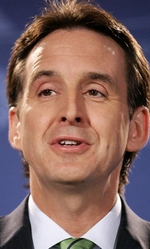
And to think they called Rudy “Governor Goofy!” Pawlenty takes the cake for goofy toadyism when he sucks up to coal. McCain better let this guy know what a liability he is when he says stupid things like:

“Next-generation coal is going to need to continue to be part of our energy future for this country,” said GOP Gov. Tim Pawlenty of Minnesota, chairman of the National Governors Association.
“It is abundant, it is available, it is Americanized in the sense that we control the supply,” he said Saturday. “We would be incomplete and doing a disservice to the debate and the ultimate policy direction that we’re going to take if we don’t envision coal being part of that.”
Pawlenty announced another bowl of alphabet soup: SCEF
You can find a story on the National Gov’s Ass. winter meeting here:
With cute quotes like:
Presidents of two big power companies urged governors not to dismiss coal. “We cannot ignore coal, we cannot demonize coal,” said Thomas Farrell, chairman of Richmond, Va.-based Dominion Resources Inc.
Well, DUH, of course, what else would big power companies say???
Something similar in the STrib:
And to all that I say, “NO NEW COAL!” DUH!
When does “Equal Time” campaign provision kick in?
February 23rd, 2008
From a stranger in a very strange land, a question posed from the home of former Gov. Jesse Ventura, current Gov. Tim Pawlenty, soon-to-be U.S. Senator Al Franken, former Congressional candidate Wendy Wilde and former State House Rep. Mike Osskopp, all radio personalities who quit when they were campaigning:
Here’s David Oxenford’s post last October on this very question:
And regarding that question posed, from Oxenford himself:
Sounds to me that, in your situation, if the candidate bought the time,
it’s just like the Hillary Clinton hour on the Hallmark Channel – other
candidates probably have equal opportunity rights – but they just have
the opportunity to buy an equal amount of time on the cable channel.
They don’t get free time unless the first candidate got her time for
free.
Yup, that’s just what I was thinking…
If anyone wants to check that out with the expert himself, he’s got 25 years of FCC and campaign experience, BROADCAST LAW, get the real poop, CLICK HERE FOR A PROFESSIONAL OPINION!
Mesaba – Extend the hearing!
February 23rd, 2008

IGCC and coal gasification — Excelsior Energy’s Mesaba Project is the bloated and thrashed equine carcass that keeps coming back for more. The Mesaba Project is still dead…
Whew! That Mesaba hearing in January was such a farce… some was detailed in a previous post, foreshadowing mostly, and some more here in this post. The transcripts of it have to be read to be believed. They’re in St. Paul, as always, at the Dept. of Commerce, and they’re also, thanks to the efforts of CAMP (Citizens Against the Mesaba Project), in the libraries in Hoyt Lakes and Grand Rapids. Really, it’s worth the drive to check these out. This transcript has, in black and white, some of the most egregious examples of procedural bullshit I’ve ever seen, there really is no other term for it. It’s hard to say what sticks in my craw the most, but I’ve got a few more quotes that I’ll stick below.
I’ve been shaking my head in disbelief for almost a month now, and had to do something, this just couldn’t go unacknowledged, so once the transcripts arrived, I had a little help getting some choice quotes and had a couple of questioners of witnesses eager to do some more questioning so we filed this Motion for Extension of Hearing:
MCGP Motion for Extension of Hearing
Here are some snippets:
—————————————————–p. 20
5 JUDGE MIHALCHICK: Ms. Overland.
6 MS. OVERLAND: Is there an MPCA representative
7 here?
8 JUDGE MIHALCHICK: Is there a what?
9 MS. OVERLAND: Is there a representative of
10 the MPCA here today? MPCA, anyone?
11 JUDGE MIHALCHICK: Nobody is raising their
12 hand.
13 MS. OVERLAND: Shouldn’t they be here?
14 JUDGE MIHALCHICK: I don’t know. That’s their
15 choice.
—————————————————–p. 28-29
9 MS. OVERLAND: I have a procedural issue.
10 Carol Overland for MCGP. I have a procedural issue
11 regarding Mr. Starns’ comments early on. Mr. Starns
12 had made a specific reference to size, type and timing.
13 And under Minnesota Rule 7849.5710, Subpart 4, under
14 issues it says, “Once the Public Utilities Commission
15 has determined the questions of need, including size,
16 type and timing, questions of system configurations and
17 questions of voltage, these issues must not be
18 addressed in the public hearing.”
19 Now, the Public Utilities Commission has not
20 determined the question of need and it has not
21 determined questions of system configuration, questions
22 of voltage. So I wanted to point that out, that this
23 proceeding is exempt — their project is exempt from
24 certificate of need requirements. But there has not
25 been a determination made by the PUC about need or any
1 of these other issues.
2 JUDGE MIHALCHICK: Mr. Starns, do you want to
3 address that?
4 MR. STARNS: Your Honor, because the project
5 is exempt from certificate of need, that’s why size,
6 type and timing are not to be considered.
7 MS. OVERLAND: Your Honor, again, that’s not
8 what the rule says. It says “The PUC has determined,”
9 and the PUC hasn’t determined, they have not.
10 JUDGE MIHALCHICK: In my judgment the statute
11 exempts this project from the certificate of need
12 requirements. In essence, it seems to me that exempts
13 them also under that rule as if — so it should be
14 interrupted as if the commission had determined that.
15 If we did otherwise, we’d be bringing back in a
16 requirement that the legislature said shouldn’t be
17 there. So I think his statement was accurate, Mr.
18 Starns’ statement was accurate.
19 Any other preliminary matters?
—————————————————–p. 308
2 JUDGE MIHALCHICK: We’re going to go back on
3 the record. This is the second session of the public
4 hearings in the matter of the joint applic366ation to the
5 Minnesota Public Utilities Commission for the following
6 pre-construction permits: Large electric generating
7 plant site permit, high voltage transmission line route
8 permit, and natural gas pipeline routing.
9 We’re going to go back, essentially, to the
10 originally scheduled process of doing the Stage 1
11 proceedings at the start of today, meaning the company
12 will call its witnesses and have them testify. If I or
13 the department have any questions, we’ll take those,
14 and then when we’ve completed those witnesses, we’ll
15 move into Stage 2, the public comments and questions.
16 Mr. Starns.
—————————————————-p. 366
2 JUDGE MIHALCHICK: We’re not taking public
3 questions. We’ve changed the process. We’ve gone back
4 to the original process that we’re going to do the
5 Stage 1 portion of the applicant putting in its
6 exhibits or testimony. Then when we’re done with that,
7 we’ll take questions from the public.
8 MS. OVERLAND: Does that mean all the
9 witnesses?
10 JUDGE MIHALCHICK: That’s right. We’re about
11 halfway done.
12 MS. OVERLAND: You mean through the entire
13 list of witnesses?
14 JUDGE MIHALCHICK: Right.
So he rammed through 16 witnesses in one day, it took all day:
Applicant witnesses:
Todd Royer
Thomas Henning
George McVehil
Jeffrey Davis
John Lee
Charles Michael
Kelly Henry
Brad Kovach
Anne Ketz
Bret Johnson
David McKenzie
Robert Mantey
Stephen Sherner
Paul Young
Richard Stone
Bob Evans
In Hoyt Lakes, the gym the hearing was held in was unheated, and Mihalchick made us sit all day through introductions of all those witnesses and it was DAMN COLD, and as Alan got up to start questioning:
15 MR. MULLER: My name is Alan Muller. Before I
16 begin, I’d like to note that Mr. Micheletti is wearing
17 gloves, representatives of the Department of Commerce
18 are wearing gloves. Many people in the room are
19 wearing gloves and overcoats. I don’t know if the
20 rules of the Office of Administrative Hearings call for
21 holding public hearings in heated facilities, but that
22 might be something to consider in the future.
23 JUDGE MIHALCHICK: Nobody is suffering more
24 than I am.
————————————- p. 629-630
16 A. I’m addressing the comments we received.
17 Q. At what point will you —
18 JUDGE MIHALCHICK: I think that’s enough. I’m
19 going to have to ask you, if you want to submit
20 anything more, please do so within the next month in
21 writing. I have one person back here who seems to
22 really want to talk, but maybe not. So I’m going to
23 take some other comments now and then adjourn.
24 MR. MULLER: Okay. Well, I’d like the record
25 to show that I do have more questions for more
1 witnesses.
2 JUDGE MIHALCHICK: Thank you. It will show
3 that.
———————————————-p. 631-632
20 JUDGE MIHALCHICK: Take one more comment. I
21 didn’t mean to have cut off Mr. Muller, but I think the
22 hearing has gone long enough. We’ve got adequate time
23 for the public comment and the company. I’ve extended
24 the public comment period. I certainly invite all of
25 you to submit comments during that time. And I think
1 we’ll close. Is there anything else, any procedural
2 things to wrap up here? Thank you all for coming and
3 enjoy the rest of the winter.
… and TB in cows in MN too…
February 19th, 2008
And another problem, as if mad cow wasn’t enough…
And will someone explain to me what pasteurization has to do with the “beef cattle industry” and TB found in 11 “beef cattle herds” in the state? Better yet, just delete that last sentence from the article.
State beef cattle industry dealt setback with another bovine TB discovery
By PAUL WALSH, Star Tribune
Last update: February 19, 2008 – 9:53 AM
The state’s beef cattle industry has suffered a crucial setback with news today that a Beltrami County herd has tested positive for bovine tuberculosis.
This is the fourth positive herd detected since October 2007, the state Board of Animal Health reports this morning, and it will likely result in the downgrade of Minnesota’s bovine TB status, as required by the U.S. Department of Agriculture.
Since bovine TB was discovered in a northwest Minnesota beef cattle herd in July 2005, the disease investigation has found 11 infected beef cattle herds, all in Roseau and Beltrami counties.
USDA regulations call for a downgrade in status when more than three herds are detected within a 12-month period.
The downgrade moves Minnesota to the third of five status levels and two steps away from the highest status level, TB-free.
When the downgrade becomes official, state producers will have to adhere to stricter federal and state testing requirements when shipping cattle or bison.
“All Minnesota producers planning to ship animals interstate should still contact their veterinarian to determine state import requirements prior to movement,” said Board of Animal Health Executive Director and State Veterinarian Dr. Bill Hartmann. “Individual state import requirements may differ from federal requirements, so it’s important to verify them prior to shipment.”
Hartmann added: “While the downgrade in our status is a setback, we are committed to eliminating this disease from the state.”
Human exposure to bovine tuberculosis through the milk or meat supply is extremely unlikely, the Board of Animal Health says. Meat inspectors check all cattle entering the marketplace for signs of the disease before and after slaughter. Any animal showing these signs is withheld from the food supply. In addition, adequate cooking destroys the bacteria. Further, the milk pasteurization process at processing plants destroys any potential bacteria.
PAUL WALSH