Minn. Stat. 117.189 Legislative History
August 6th, 2009
This is one of those things that’s been bugging me for a long time, and I’m finally getting around to looking it up. There are a few twists and turns, and this is a long post, with a lot of links and a lot of audio listening for you to dig in if you’re interested. If you’re a landowner, you sure better be! If you’re a landowner affected by utility infrastructure, this is required reading and listening!
Here we go!
History of Minn. Stat. 117.189
Here’s the statute (the specific statutory cites below are linked):
117.189 PUBLIC SERVICE CORPORATION EXCEPTIONS.
Sections 117.031; 117.036; 117.055, subdivision 2, paragraph (b); 117.186; 117.187; 117.188; and 117.52, subdivisions 1a and 4, do not apply to public service corporations. For purposes of an award of appraisal fees under section 117.085, the fees awarded may not exceed $500 for all types of property.
History:
Short version – this bill was a bipartisan sell-out that exempted CapX 2020 and any other public service corporation project from eminent domain that every other entity must comply with. Why on earth would they do this… or rather, what innocent explaination is there for this 117.189 section of the bill?
So far that I’ve heard (only ~6 hours thus far), Sen. Scott Dibble is the only one asking “Why exempt public service corporations?”
The only Senators who voted against this were:
Anderson, Cohen, Dibble, Hottinger, Marko, Moua, Pappas, Ranum, Skoglund
The only Reps who voted against this were:
Davnie, Ellison, Goodwin, Hausman, Hornstein, Huntley, Johnson, S., Kahn, Lanning, Lenczewski, Mahoney, Mariani, Mullery, Paymar, Thao, Wagenius, Walker
Please take a few minutes and send them a thank you note! Here’s a link to their emails:
*****************************************************
First, some more history, going back to my all time favorite bill:
Remember, this was the bill that grew from the deal the enviros did in 2003, incorporating the material terms of that deal into the 2005 Omnibus bill.
And… why… look, there’s language in the 2005 Transmission Omnibus Bill from Hell mandating an “Eminent Domain Landowner Compensation — Landowner Payments Working Group!”
55.35 ARTICLE 1155.36 EMINENT DOMAIN LANDOWNER COMPENSATION56.1 Section. 1. [LANDOWNER PAYMENTS WORKING GROUP.]56.2 Subdivision 1. [MEMBERSHIP.] By June 15, 2005, the56.3 Legislative Electric Energy Task Force shall convene a landowner56.4 payments working group consisting of up to 12 members, including56.5 representatives from each of the following groups:56.6 transmission-owning investor-owned utilities, electric56.7 cooperatives, municipal power agencies, Farm Bureau, Farmers56.8 Union, county commissioners, real estate appraisers and others56.9 with an interest and expertise in landowner rights and the56.10 market value of rural property.56.11 Subd. 2. [APPOINTMENT.] The chairs of the Legislative56.12 Electric Energy Task Force and the chairs of the senate and56.13 house committees with primary jurisdiction over energy policy56.14 shall jointly appoint the working group members.56.15 Subd. 3. [CHARGE.] (a) The landowner payments working56.16 group shall research alternative methods of remunerating56.17 landowners on whose land high voltage transmission lines have56.18 been constructed.56.19 (b) In developing its recommendations, the working group56.20 shall:56.21 (1) examine different methods of landowner payments that56.22 operate in other states and countries;56.23 (2) consider innovative alternatives to lump-sum payments56.24 that extend payments over the life of the transmission line and56.25 that run with the land if the land is conveyed to another owner;56.26 (3) consider alternative ways of structuring payments that56.27 are equitable to landowners and utilities.56.28 Subd. 4. [EXPENSES.] Members of the working group shall be56.29 reimbursed for expenses as provided in Minnesota Statutes,56.30 section 15.059, subdivision 6. Expenses of the landowner56.31 payments working group shall not exceed $10,000 without the56.32 approval of the chairs of the Legislative Electric Energy Task56.33 Force.56.34 Subd. 5. [REPORT.] The landowner payments working group56.35 shall present its findings and recommendations, including56.36 legislative recommendations and model legislation, if any, in a57.1 report to the Legislative Electric Energy Task Force by January57.2 15, 2006.
Now, let’s take a look at who was on that Committee:
REPRESENTATIVE MEMBERS
1. Jim Musso (Xcel Energy) representing transmission owning investor-owned utilities
2. Bob Ambrose (Great River Energy) representing electric cooperatives
3. Mrg Simon (Missouri River Energy) representing municipal power agencies
4. Chris Radatz-representing the Minnesota Farm Bureau
5. Tim Henning (farmer) representing the Minnesota Farmers Union
6. Jack Keers (Pipestone County Commissioner) representing county commissioners
7. Robin Nesburg (Rural Appraisal Services) representing real estate appraisers
AT LARGE MEMBERS
8. Beth Soholt (Wind on the Wires)
9. John Nauerth III (farmer)
10. George Crocker (North American Water Office)
11. Bob Cupit (Public Utilities Commission)
12. Bill Blazar (Minnesota Chamber of Commerce)
Here’s the report of the Work Group:
LANDOWNERS’ PAYMENTS WORKING GROUP
REPORT TO THE LEGISLATIVE ELECTRIC ENERGY TASK FORCE (LEETF)
Laws 2005, chapter 97, article 11, required the Legislative Electric Energy Task Force (LEETF) to create a landowners’ payments working group to study alternative methods of remunerating landowners on whose land high-voltage transmission lines have been constructed.
The group was created, met twice, and this is a report of its findings and recommendations.
LANDOWNER PAYMENTS GROUP FINDINGS
1. Farm owners in southwestern Minnesota want compensation for high-voltage transmission line easements to be paid annually as a percentage of the current value of the land so that as land values rise or drop, the payments rise or drop accordingly.
2. Easement acquiring utilities are not in favor of the proposal described in item #1 and do not want to fundamentally change the current method of payment for easements, which consists of a onetime payment based on a percentage value of the land over which the easement is acquired.
3. The Legislature has the authority to mandate the payment system described in item #1.
4. There are no jurisdictions that have the payment system described in item #1.
5. The payment system described in item #1 would be more expensive than the current payment system, assuming the percentages proposed by the landowners with attendant upward pressure on rates.
6. There is a social value to having a harmonious, nonadversarial process to acquire high-voltage transmission line easements that has an economic value that is hard to quantify.
7. There is a sense that the process for negotiating an easement and/or contesting it by a landowner is too expensive and complicated and it may be helpful to search for legislative ways to ensure that all similarly situated landowners receive the same just compensation without being intimidated by the process or forced to great expense by the process.
8. While this group was formed due to farm landowner concerns, the scope of the charge extends to all landowners. Guidance from the task force is necessary as to the scope of the charge because the scale of the issue is altered if any easement over any land is the subject of the discussion.
9. While the direct parties in interest–the landowners and utilities–are stalemated, the current push to acquire easements for new lines makes the issue one that should have a firm handle kept on it.
RECOMMENDATIONS
1. If further work is to be done on this topic, the task force should provide the guidance described under finding #8.
2. If the task force wants to continue work on this topic and wants more public input, it should consider utilizing the same persons who are on the current study group.
3. The task force may wish to consider whether there are flaws in the current easement acquisition process related to its expense to landowners to contest and perceived intimidating qualities.
*****************************************************
Let’s look at the eminent domain bills the following session, Senate bill, SF 2750 and the House bill, HF 2846.
SF 2750
Senate Authors, none added after introduction: Bakk ; Kiscaden ; Bachmann ; Chaudhary ; Kubly
Bill as introduced, had the Public Service Corporation exemption AND the appraisal fee limitation:
On the Senate side, there are some interesting statements in the first Committee hearing, Judiciary, discussion about limiting who can speak at county meetings about eminent domain (!!!), limitations of attorneys’ fees… and there’s a discussion that I’m trying to transcribe … will post soon…
Senate Judiciary – March 9, 2006 – PART I
Senate Judiciary – March 9, 2006 – PART II
Senate State and Local Government Operations – March 13, 2006 – Part I
Senate State and Local Government Operations – March 13, 2006 – Part II
Here’s Sen. Dibble questioning, in State and Local Government Operations – March 13, 2006 Part I (linked):
Senate State and Local Operations Committee
Chair: We’ll ask Senator Bakk to address this question.
*****************************************************
HF 2846
As introduced it had the Public Service Corporation exemption:
*** The sentence about appraisals did not appear in it as introduced or in the 5 engrossments online.
Here’s the House Research explanation of that paragraph:
12 Public service corporation exception. Provides that the provisions for attorneys’ fees (section 4 ), compensation for loss of going concern (section 8 ), minimum compensation (section 10 ), and limitations (section 11 ), do not apply to public service corporations.
*****************************************************
Conference Committee
04/12/2006 Senate conferees Bakk, Murphy, Betzold, Higgins, Ortman
04/12/2006 House conferees Johnson, J.; Abrams; Davids; Anderson, B.; Thissen
*****************************************************
Here are the reports of House and Senate adoption of Conference Committee Report, including votes:
Baron’s recovering from surgery
August 4th, 2009
Yesterday, Baron, one of our German Shepherd buddies, had emergency surgery. He’d had a bump, his owner thought he might have a hernia or something, and she brought him to the vet, nada, she and the vet couldn’t find a thing. Then, a couple of weeks later, he was acting like he was hurting, whimpering and laying around, and she found it again, what felt like a small bump, and brought him in again. They took an X-ray and OH MY DOG! It looked “bigger than a softball, maybe soccor ball size!” He was instantly scheduled for surgery on Monday.
Here’s what they found attached to his spleen:

EEEEEEEEEEEEEUW, that tumor weighed in at 7.5 pounds. It’s as if the poor dear had a cesarean. WOW! What more is there to say. It’s a good thing his owner was persistent. He’ll be a lot happier pup now that that’s gone. WOW! YEOW! Oh, it hurts to think about…
PUC’s wind turbine noise docket in the news
August 4th, 2009
It’s out today, Dan Gunderson at MPR has done an extensive piece on the Minnesota Public Utilities Commission “investigation” of wind turbine noise and health impacts, looking at, per the PUC:
The Commission is gathering information to determine if current permit conditions on setbacks remain appropriate and reasonable.
PUC – Notice WITH SERVICE LIST
Here’s the audio — full text is way below:
What concerns me is that, again, they only gave notice of this docket to the wind industry, and not the people intervening or commenting in PUC wind dockets who raised this issue in the first place, and my comment on that to the PUC, urging them t expand the Notice:
Overland Comments – Request for Broader Distribution of Notice
To see the PUC’s wind turbine setback docket, go to www.puc.state.mn.us, click “eDockets” on lower right, and search for docket 09-845.
And here’s the MPR piece in writing:
Wind turbine noise concerns prompt investigation
by Dan Gunderson, Minnesota Public RadioIn Minnesota, those complaints prompted the Public Utilities Commission to investigate.
Soon after they moved in, dozens of wind turbines sprouted in a neighbor’s nearby field.
In Minnesota, a handful of groups have organized to demand tougher regulation. They want the state to require more distance between wind turbines and homes. A report by the Minnesota Department of Health concluded there are potential health concerns.
Read the rest of this entry »
South Heart coal gasification is alive ‘n’ kickin’
August 1st, 2009

The South Heart North Dakota coal gasification is now going to be an ELECTRIC GENERATION plant. DUH! The 800 pound gorilla has just started jumping around the room. This IGCC plant will be up and ready just in time to use CapX 2020 transmission — DUH! And if you’re surprised, you’re in the wrong business.
A change in plant plans
By: Jennifer McBride and Beth Wischmeyer, The Dickinson Press
The plant will be located four miles south and two miles west of South Heart and will be a
coal-to-hydrogen electrical generation plant.
The cost to build Great Northern’s plant is estimated at $1 billion.
Are we going to let them get away with this? I love it when my hunches are right, but I hate it when anyone has the audacity to propose something so utterly stupid as this. It will be hard for them to get it up and running… except who has a power plant application ready to rock (except that it’s a joke, but it takes some time to prove that to the PUC)? Drat… and here I thought Tom would be down in Honduras trying to build Mesaba down there…

Metachem meeting in Delaware City Tuesday
July 30th, 2009
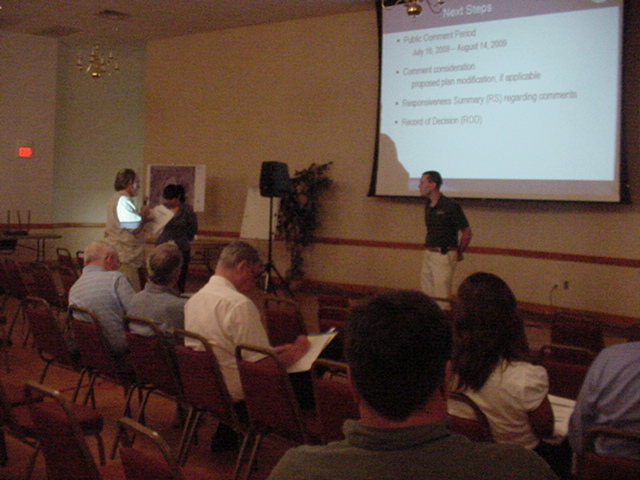
Alan Muller, Green Delaware, questioning and commenting at the meeting
Tuesday night, there was a meeting in Delaware City regarding the “Standard Chlorine of Delaware, a/k/a Metachem Superfund Site.” This meeting was to gather comments on the “OU3 Proposed Plan.”
Here’s a link to the News Journal article about it — and the full story is below:
EPA: Metachem toxins will linger
Comments must be sent in by August 14, 2009, postmarked if mailed by that date, to:
thornton.hilary@epa.gov Hilary Thornton, Mailcode 3HS23 US EPA, Region 3 1650 Arch Street Philadelphia, PA 19103
****************************************
Here are my comments, sent just now:
Now, take a few minutes and work on yours!
****************************************
The way they handle these proceedings, it’s misleading and diversionary, a false, technical compartmentalization of the problem and solutions, which leads to a preordained, incomplete, and probably ineffective “clean-up.” Part of the problem is that it’s not clear that cleaning up is a priority. My impression is that they’re just interested in “dealing with it” in some way, the CHEAPEST way, checking off the “OU3 box” and moving on.
Their plan, their PREFERRED plan, is to cover it up and move on to “OU4.” Their “Preferred Plan” is, direct from their powerpoint slide 8:
2A. Surface Cap/Institutional Controls Impermeable Surface CapInstitutional Controls
- Cap materials TBD during Remedial Design Phase
- Cap materials and thickness would vary depending on future land use
Five-Year Reviews
- Future land use must not interfere with ongoing remedies
Est. $11.5 – 18.5 Million
- Required for any Superfund Site where contaminants remain
Why look! Imagine that! This is the CHEAPEST of the options. All options are “cap” crap, with “materials TBD” and, based on prior past bad experience with DNREC’s “hare-brained” ideas (yes, that’s a direct quote)for “beneficial use” and using coal ash and sewage sludge to cap the dump next to the river:
- I asked whether they’d use coal ash in the “TBD” cover material, and they would NOT commit to rejecting coal ash.
- I asked whether they’d use sewage sludge in the “TBD” cover material, and they would NOT commit to rejecting sewage sludge.
This is where that compartmentalization becomes a problem. They said that was not an issue for “OU3” and that it would be addressed in the “design phase.” Uh-huh, and the public is involved in that exactly HOW? And hello — WHAT the impermeable surface is has much to do with the appropriateness of using an impermeable cover. Rainfall on the impermeable cover will trickle off the cover over the edge, onto and into the ground, groundwater, etc. Even if it’s asphalt, that should be considered. Isn’t the EPA is in the process of addressing coal ash, and a rule pending?
Cost… Their “preferred” option 2A costs $11.5-18 million. The others?
The other options, from their powerpoint:
2B Surface Cap/ICs, with Soil Vapor Extraction Same surface cap and ICs as mentioned in 2A, plus an in Situ SVE system:2B Surface Cap/ICs, with ISTD Same surface cap and ICs as mentioned in 2A, plus in Sit thermal Desorption:
- Est. 200-500 air extraction wells at 50′ depth
- Treat contaminated air from beneath the cap
- treat off-gas from SVE system before discharge
- Additional sampling to identify “hot spots”
- Pilot study first, to test effectiveness
- Est. $19.1-20.2 Million
- Est. 2,800 heater and 1,400 heated vapor extraction wells, 8-12′ apart through 330,000 sq. ft. area
- Additional sampling to identify “hot spots” within 10′ of barrier wall
- Pilot study first, to test effectiveness
- Est. $92.8-99.8 Million
Let’s see… $11.5-18.5 v. $19.1-20-2 & $92.8-99.8. Doesnt’ take a rocket scientist to see that the cheapest “option” is “preferred,” and since when is cost the primary driver? Is this an indication of how they value those living here, drinking the water, breathing the air?
Oh, and did I mention they admitted, finally, that the contamination goes down at least 140 feet! That’s something they haven’t wanted to talk about before.
These options are the only ones looked at, the only ones that are under consideration.
CONSIDER THIS: One other option I want them to consider is to dig up part of the site, the cleaner part, and put a liner down there and take the contaminated dirt from the rest of the site and bury it there with the solid multi-layer liner, and then cover it.
Here’s an example of that in Minnesota, showing that it can and should be done. This is a scenario where it’s been sitting there since before the mid 70s, it has contaminated ground water in Lake Elmo and Oakdale, Minnesota. They’re using three layers of liner over packed clay and another three layers of plastic, plus sand with a collection and draingae system. In the Metachem case, they know groundwater is contaminated, that it’s seeping down, so what, short of this, will stop it? Take a look — Tom Meersman did a very good job on this:
History-making landfill do-over in Washington County