Our coalition of the “Municipal Intervenors,” Stop the Lines! and “Environmental Intervenors” has filed a Motion to Dismiss in PSEG’s Susquehanna-Roseland proceeding in New Jersey.

Here it is – enjoy!

Notice of Motion, Proposed Order

Motion – Supporting Brief

Motion – Exhibits 1-8

Motion – Exhibits 9-20

Nutshell version:

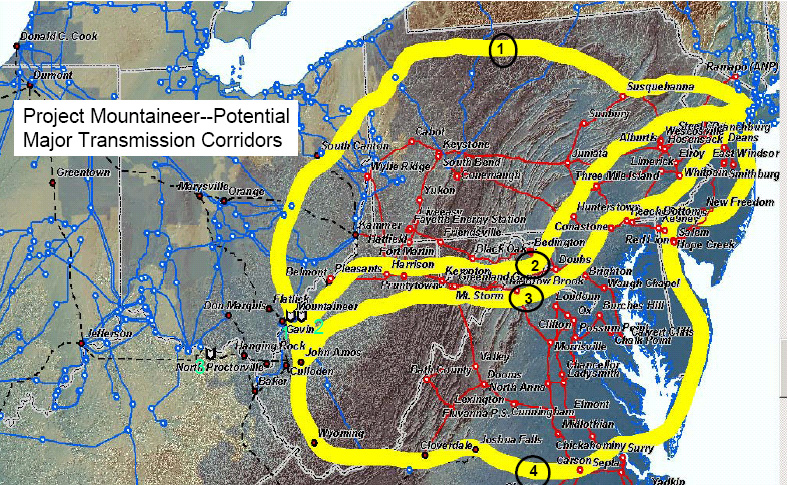
projectmountaineermap

arrowdown

NO!

… ahem… really, it’s that simple!

The hearing is set to begin on the Monday after next, November 16th, and we’re having a phone conference next Monday.  They ought to just toss it out, and tell them to come back when they’ve really got something.  I kinda feel sorry for PSEG, because they’re having to carry the water here when it’s not even their project.  PJM’s the one that should be in the hot seat.

Sussex County has held off on taking a formal stand on Delmarva Power’s Mid-Atlantic Power Pathway, or MAPP, but Delmarva is pushing,  so now’s the time to call them with a simple message:

No, don’t encourage and facilitate coal!

Say NO! to Delmarva Power’s Mid-Atlantic Power Path transmission proposal!

Delmarva Power is going around drumming up support for its Mid-Atlantic Power Pathway, or MAPP.  They approached Sussex County to support the line (what do we know about that?  Not much.  Perhaps a FOIA to see what they’ve been doing is in order?) and because there’s a zoning matter before the County, they held off..

Delaware Electric Coop would like to use the MAPP line to bring in electricity from a new Old Dominion coal plant in Virginia.  Oh… great idea… I’ve posted about this before:

Delaware Electric Coop annual meeting

Here’s Alan’s Green Delaware Alert and handout for DEC’s last annual meeting:

Green Delaware – Alert 666

Synapse Report – Fact Sheet – Hampton Road/Cypress Creek

Building a coal plant is a really bad idea, and building transmission for coal is a really bad idea plus… two wrongs do not make a right.

Call all the County Council, thank them for putting on the brakes, and let them know what you think about Delmarva Power’s transmission for coal:

Michael H. Vincent   (302) 629-2396

Samuel R. Wilson   (302) 856-2972

Joan R. Deaver   (302) 645-6657

George B. Cole   (302) 539-1611

Vance C. Phillips   (302) 542-1501

Here’s a report from the Cape Gazette:

Sussex County council delays support of transmission line

Pathway could pump $260 million in county’s economy

By Ron MacArthur

More than a dozen elected bodies and agencies are throwing support behind the Mid-Atlantic Power Pathway, but Sussex County Council will not join that list – at least not right away.

The 150- to 170-mile high-voltage transmission project, scheduled to be completed in June 2014 at a cost of $1.2 billion, would include 35 miles of lines from Vienna, on Route 50 in Maryland, to the Indian River power plant near Millsboro.

Delmarva Power and Pepco Holdings Inc. were seeking council’s support of the Mid-Atlantic Power Pathway (MAPP) project during the county’s Tuesday, Oct. 27 meeting. But council is handcuffed because a zoning application is pending before county officials. A converter station will need to be built near Millsboro.

“Would we be pre-judging this zoning application with support of this?” Council President Vance Phillips asked county attorney Everett Moore.

Moore responded with an emphatic yes.

Phillips told Delmarva Power representatives the council would discuss the matter with its attorney. “We will see if we can come up with some sort of endorsement broad enough not to get ourselves in trouble,” he said.

“This is one of the most important projects ever undertaken by Delmarva Power and Pepco,” said Jim Smith, Delmarva Power senior public affairs manager.

Demand exceeds generation

Jerry Elliott, a Delmarva Power retiree with 35 years’ experience, has come out of retirement to help with the project. In a presentation to council, he said the Delmarva Peninsula depends on imported power, with demand exceeding generation by 500 megawatts during peak periods. Officials say demand will increase by 20 percent during peak periods over the next 10 years.

Power is transmitted from north to south from a single connection point in New Castle County. As a result, he said, more brownouts and blackouts are projected in the future for residents in southern Delaware.

“Even with the economic downturn, without MAPP there is insufficient transmission and power generation capacity to meet demand by 2014,” Elliott said. “The peninsula is isolated from power sources on the western shore and cannot import enough power in the event of an emergency.” He said the single point of access to the grid also results in higher costs for electricity on the peninsula when lower-cost power is available in the region. “MAPP will lower the cost of power by relieving transmission-line congestion,” he said.

Because no new transmission lines have been built on the peninsula in the past 25 years and the area is susceptible to brownouts and blackouts, the area has been designated a Department of Energy National Interest Electric Transmission Corridor.

Matt Likovich, Delmarva Power community and communications coordinator, said the 51 million customers in the project area will be charged 30 cents a month, a charge that will be offset by a savings in congestion charges.

“The cost of electricity during periods of congestion is much higher than at other times. The MAPP project will help relieve transmission-line congestion on the Delmarva Peninsula, resulting in cost savings to customers,” Likovich said.

He said anticipated savings are about 60 cents per month in charges related to congestion.

Line will go under the bay

Elliott said 500-kilovolt and 640-kilovolt lines will tie into power plants starting in southern Maryland at Possum Point to Calvert Cliffs with 11 miles taken under the Chesapeake Bay through Dorchester County to a plant in Vienna and then to the Indian River plant.

Almost all of the project will take place on existing rights of way, except in Dorchester County. “Dorchester County does not support this yet,” Elliott said. That is why the exact mileage of the project is not yet known. The final figure depends on what officials in that county decide.

While most of the new lines will be built in place of existing lines, the Dorchester County portion will add new lines to the landscape, which county officials say would harm tourism and agriculture. Dorchester County Council would like the MAPP lines to be placed underground or underwater, both of which would add to the cost of the project.

Replacing existing lines with new lines would pump an estimated $260 million into the Sussex County economy during construction, Elliott said. The 27-mile Sussex County line would be built on existing Delmarva Power rights of way and would start in Delmar and pass through Dagsboro en route to the Indian River plant.

Two new poles, made of steel, and foundations will be placed in the same location as the existing poles.

The new poles will range in height from 155 to 165 feet and be about 16 feet apart. The line will terminate at a new AC/DC converter station near the power plant. Construction is expected to begin in 2012 in Sussex County.

Elliott said MAPP would create a bigger pipeline for delivering new, clean energy solutions for an increase in wind, solar and even nuclear energy opportunities.

“MAPP is the most effective way to secure reliable, diverse and low-cost energy for all residents on the peninsula,” Elliott said.

The original project contained another 100 miles of lines north from the Indian River plant to the Salem, N.J., nuclear power plant. Elliott said because of economic reasons that portion of the project was removed. “It was found there was no need to spend the additional money,” he said.

Big Stone is dead, dead, dead

November 2nd, 2009
bigstoneiiproject1

Hot off the press from MDU — there’s contact info at the bottom.

DO SEND THEM CONDOLENCES AND A THANK YOU NOTE!!!

From MPR just now:

Controversial power plant won’t be built

And a BSII Press Release found in the inbox:

November 2, 2009

Participating utilities announce wind-down of Big Stone II project

The participating utilities announced today that they will not build the Big Stone II Project, a planned 500-to-600-megawatt coal-fired power plant to be located near Milbank, South Dakota, and its associated transmission. The project required additional participants to move forward; however none have committed.

Big Stone II, a fully permitted project, had been determined to be the least-cost, environmentally sound baseload power plant for the project participants. The project’s high voltage transmission facilities were to be sized to also serve the region’s burgeoning wind energy development.

The Big Stone II Project participants were Central Minnesota Municipal Power Agency, Heartland Consumers Power District, Missouri River Energy Services and Montana-Dakota Utilities Co.

For information specific to each company, contact:

Mark Hanson, Montana-Dakota Utilities Co., 701-530-1093 or mark.hanson@mduresources.com.

Bill Radio, Missouri River Energy Services, 605-731-2522 or billr@mrenergy.com.

Russ Olson, Heartland Consumers Power District, 605-256-6536 or rolson@hcpd.com.

Lori Frisk-Thompson, Central Minnesota Municipal Power Agency, 507-526-2193 or lorift@cmmpa.org.

lspoweroct10crop

Oct 19 Chisago County meeting re: LS Power Sunrise River Energy Station

How odd… it’s in both STrib and StPPP today… so comment opportunities abound!

Here’s the story from Dennis Lien:

Skeptics question Chisago power plant

Residents fear water pollution, say plans are too vague


By Dennis Lien
Updated: 11/01/2009 11:22:19 PM CST

At first blush, a proposal for a large power plant in rural Chisago County would seem to have a lot going for it, including apparent need and general support from clean-energy interests.

But that doesn’t mean LS Power’s natural gas-fired project is racing along. Far from it. Many county residents, skeptical of the company’s assertions and irked by what they consider a secretive approach, don’t like it one bit.

“Whether they are for it or against it, people in this area have a right to know what this is about,” said Joyce Marienfeld, a member of an opposition group called Friends of the Sunrise River. “This has been real slippery — just not right.”

County residents have been on edge since earlier this year when the East Coast power plant builder offered what residents viewed as a vague proposal to build a 780-megawatt power plant on a 40-acre site northwest of Lindstrom, 30 miles north of St. Paul. The plant, expected to cost $300 million to $500 million, would use low-polluting natural gas to supplement the state’s growing wind industry by operating when wind power isn’t available or during periods of peak demand.

The Legislature quickly approved tax breaks similar to those given to other plants, provided local governments follow suit. If that happens, the project would be free to seek various air and water permits and Public Utilities Commission approval.

Critics soon objected, especially over plans to use 2 million gallons of groundwater a
Advertisement
Quantcast
day and to discharge that water into the nearby Sunrise River, which empties into the nationally protected St. Croix River.

Earlier this month, the company backed off that approach, opting instead to use treated water from two area wastewater treatment plants.

Opponents, however, continue to maintain the proposal is heavy on general concepts and light on specifics.

“It’s kind of common sense to judge what they are actually planning on doing, instead of vague things on paper,” said state Rep. Jeremy Kalin, DFL-Lindstrom. “We can’t do that.”

Blake Wheatley, LS Power’s assistant vice president, promised more detail will follow, once lingering property tax issues are addressed locally.

“In order for us to be comfortable spending many hundreds of thousands of dollars doing studies, we really need some level of comfort that we can put that economic albatross at bay,” he said.

But critics have other concerns about what could be the largest natural-gas plant in the state.

They say it doesn’t fit into the rural, agricultural landscape and is just a half-mile from the popular Carlos Avery State Wildlife Management Area. Moreover, they fear increased truck traffic, annoying plant lights and, despite company denials, new power lines. Pollution, they said, could filter through the sandy soil into the Mt. Simon-Hinckley aquifer or get to the Sunrise River.

Building in an already zoned industrial park would be more appropriate, according to Marienfeld, who lives three miles from the proposed site.

Wheatley said the company wants to build the plant to fill a demand for electrical power in Minnesota and the Upper Midwest. He said a “great portion” of the power would be sold in Minnesota, with some going to other states.

LS Power has been talking to state utilities about buying the power but hasn’t reached any agreements, he said. “If we can’t identify markets, we are not going forward with it,” he said, adding that discussions with Minnesota utilities “have been very, very positive.”

Placing the plant near the existing Chisago County power substation eliminates the need for additional transmission lines, according to Wheatley. “That substation is one of the biggest, if not the largest, in the state of Minnesota,” he said.

The plant, he said, would not be as visually intrusive as many people fear. “The rural way of life they are used to will continue,” he said.

If everything goes according to plan, Wheatley said, construction would start in 2011, and the plant would open a couple of years later.

Without addressing the proposal’s specifics, St. Paul-based Fresh Energy said it likes the idea of natural gas being used to fill gaps in wind power.

“It’s important for Minnesota to add a modest amount of new high-efficiency, low-emission natural gas power stations to be available when renewable energy sources like solar and wind need a bit of help,” said Michael Noble, its executive director. “Remember that Minnesota is on course to add $10 billion in wind power this next decade.”

Earlier this month, the state Office of Energy Security released a study that said the state needs more natural gas-fired power plants over the next 15 years to provide intermittent and peak power upon demand.

Asked about the LS Power proposal, Energy Security director Bill Glahn said, “It would definitely be most welcome to help us meet our needs for power in the coming years.”

“That report is so far off it’s scary,” responded Carol Overland, an attorney for opposition group Concerned River Valley Citizens. “They are using outdated information.”

Before the Public Utilities Commission takes up the proposal, the Lent Township and Chisago County boards must approve development agreements. Kalin recently urged them to include six conditions, such as a ban on groundwater use and new transmission lines.

“None of them have flagged their intentions,” County Administrator John Moosey said of the five county commissioners. “This is just a great microcosm of local government. Both sides have very strong points, and there are benefits to each.”

And from the STrib’s Tom Meersman:

Protected aquifer feared at risk


By TOM MEERSMAN, Star Tribune

It’s about appropriate land use

Many of us who live near the proposed LS Power Plant are not against power plants in general or the jobs that building them create. We are … read more against a New Jersey-based private equity investment firm, taking our natural resources, spoiling our rural way of life, and getting a $8-9 Million/year tax break to boot. The power is not needed locally. This is not just a peaker plant to offset wind power, when the wind isn’t blowing. It’s a huge (855MW)albatross stuck in the middle of a residential, agricultural area – in direct opposition to the Township and County Comprehansive Land Use plans. Go to LS Power’s website and take a look at what an equivalent plnat looks like. Build the power plant where it belongs – in an industrial area

Pooling underneath the Twin Cities area is drinking water so old and pristine that it’s protected by state law.

It can’t be used for industrial purposes in the seven-county metro area.

But the rules that protect the 900-foot-deep Mount Simon-Hinckley aquifer in the metro don’t apply to Chisago County, where LS Power wants to build a $300 million to $500 million power plant.

The New Jersey-based company’s proposal to use groundwater from the aquifer has intensified opposition to the plant and has raised interest in changing the law to put the water off-limits.

“It is certainly a last-resort aquifer,” said Chris Elvrum, manager of water supply planning for the Metropolitan Council. “It is used by some municipalities when there’s no readily available other source, and only for potable use.”

Elvrum said age-dated samples show that the water ranges from 1,000 to 35,000 years old. Depending on where it is withdrawn, it can take hundreds of years to recharge.

Since the 1989 law forbidding its use for industrial purposes in the metro area, that region has expanded: the U.S. Census Bureau now defines the metropolitan statistical area as 13 counties, including Chisago and several others not part of the original seven-county list.

A change in plans

LS Power knew of Mount Simon’s importance, said D. Blake Wheatley, lead project developer for the company. But he said it proposed last summer to use the deeper water anyway, for fear of competing with any city and private wells that draw water from shallower aquifers. The proposal called for the plant to use water from one or two nearby sewage treatment plants and, if necessary, to supplement that with as much as 2 million gallons of groundwater per day, including some from Mount Simon.

However, the company recently abruptly changed direction; Wheatley said it will not use any groundwater.

“We’re going to make do with the water that we have” from the North Branch and Chisago Lakes joint sewage treatment plants, he said.

The company also abandoned plans to discharge 1 million gallons of water a day from the plant into a tributary of the Sunrise River, said Wheatley, and will develop a “zero-discharge liquid system.”

The decision stems from a change in the design of the natural-gas-fired plant, he said, not from citizen concerns.

Plant meeting draws 500

About 500 people attended a meeting last week to debate the proposal. Some said they supported the plant because it would generate tax revenue and construction jobs.

Others expressed doubts about the company’s change of mind on groundwater use.

Rob Kravitz lives about 2 miles from the site and opposes the plant, period.

“They’ve made concessions, at least on paper, regarding the water use issues,” he said. “My fear is that, after it’s built, they they’ll apply for groundwater permits anyway.”

Kravitz and others are also concerned that the 780-megawatt plant would require more high-voltage power lines in the area. The company denies that.

The proposed 40-acre site is less than a mile from a large electrical substation and within 5 miles of two interstate natural gas pipelines.

Friends of the Sunrise River, a citizens’ group opposed to the project, contends that it will lower property values, increase noise and traffic and conflict with the rural character of the county.

“If the truth were known, it would have more negatives than positives,” said Larry Baker, chairman of the group.

LS Power is only at the beginning of the project, Wheatley said, and hasn’t submitted a formal plan to regulators.

It is seeking a development agreement with the township board and Chisago County commissioners that pertains mainly to property tax exemptions that require local approval. Those decisions likely will be made in December, after which the company would begin pursuing required permits and approvals from state agencies.

Whatever happens next with the project, Rep. Jeremy Kalin, DFL-Lindstrom, said that he is determined to close the loophole that allows the Mount Simon aquifer to be tapped for multiple uses. Kalin said that he and Sen. Rick Olseen, DFL-Harris, who also represents the area, will introduce a bill next year to extend protection of the aquifer beyond the seven-county metro area.

“It takes dozens or hundreds of years for that water to filter down and to be pure and drinkable,” Kalin said. “We’re not going to just use it for cooling a power plant.”

xcel-logo

The decline continues, of course, of course…

mred

Xcel’s 3rd Quarter investor conference call was this morning.  I really enjoy these calls, because I get to hear them forced to tell bad news.  And the bad news for me this morning was that it wasn’t as bad as I’d hoped it would be.

You can listen to the call on Xcel’s site:

3rd Q 2009 Xcel Energy Earnings Conference Call

You can also get a transcript of the call at Seeking Alpha:

Transcript – will show up here soon

Today I actually listened to it, and Krie, who sits next to me most of the day, got all fired up, and jumped off the couch and started in on her “squeaky bark,” not the bit #100 lb. German Shepherd “something’s going on down on the street” roar, or her frantic “I see a cat and I want LUNCH!” lunge, buther “squeaky bark,” sounding like a Pomeranian, too cute, and each time David Sparby said something, she start squeaky barking, like she does when she hears puppies on a Doggyspace video… hilarious.  But I wonder what she was saying… or what she was hearing!

Anyway, here’s the real poop:

Xcel 3rd Quarter

or at the SEC site:

SEC – Xcel 3rd Quarter Earnings

It’s down, down, down, but … well, I want to see it down even more!!

electricrevenue

Note the massive decrease in electric revenues, but that’s offset by an equal drop in fuel and purchased power, so the bottom line looks better.  What I care about is sales, though, not the bottom line, and it’s good news to see Electric Revenues drop by 955 in 2009 thus far, or a tadbit under 15%.  Works for me!!!
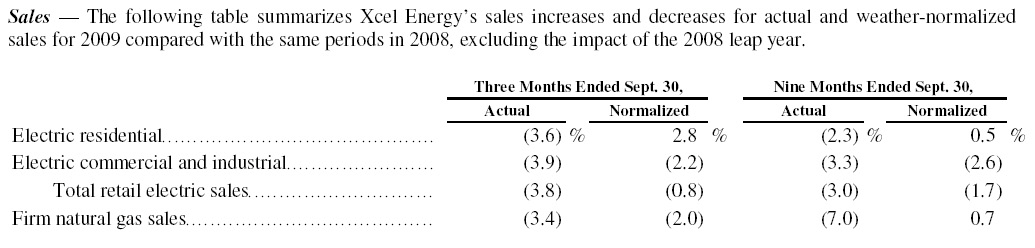
electricsales

Looks to me like it’s down 3%!  Need, schmeed, there isn’t any…

Capitalism happens — let the market decide!!

xcelstayawaystayalive