PUC’s Health Impacts of Wind Turbine Docket
January 26th, 2010
9:30 a.m. on February 1, 2010
Minnesota Public Utilities Commission
Large Hearing Room
121 – 7th Place E., 3rd Floor
St. Paul, MN 55101
Remember the PUC’s docket that they opened after release of:
Apparently they’re looking at doing something — and here’s what the staff Briefing Papers say:
Here’s how staff defines the issue before the PUC:
Should the Commission find that current permit conditions regarding setbacks remain appropriate and reasonable in light of recent concern and the Minnesota Department of Health’s White Paper, Public Health Impacts of Wind Turbines?
And here’s the bottom line, what staff thinks should happen:
Staff recommends that the best approach to mitigate the issues discussed above would be comprised of two modifications to our current process.
1) Increase setbacks from non-participating landowner residences
a. Continue to use the existing 500-foot or noise standard residential setback (whichever is greater) to allow participating landowners to maximum their land use.
b. Increase the setback required from non-participating landowner residences to 1,000 feet or the state noise standard (whichever is greater) or some other number deemed appropriate by the Commission.
2) Require additional information from developers during the siting process to provide accurate and specific information to the Commission on the impacts of the project. Staff will continue to work on refining the specifics of these requests, additional information is anticipated to be (at a minimum, but could be subject to change):
a. During the application process:
I. noise modeling report (at different frequencies and at various distances from the turbines at various wind directions and speeds) throughout the project area;
II. if flicker is to occur on non-participating residences, shadow flicker modeling report, indicating anticipated maximum;
b. Preconstruction (submitted at time of final site layout):
I. final noise modeling report of final layout and noise monitoring proposal (both at different frequencies and at various distances from the turbines at various wind directions and speeds) throughout the project area;
II. final shadow flicker modeling report;
c. Post construction:
I. noise monitoring reports of the development (at different frequencies and at various distances from the turbines at various wind directions and speeds) throughout the project area.
To check out the whole docket and look at the various comments, CLICK HERE FOR PUC SEARCH PAGE , then scroll down a bit to the “Search” button and below that enter 09-845 and then click “Search.” Voila, there it all is!
So, be there or be square.
9:30 a.m. on February 1, 2010
Minnesota Public Utilities Commission
Large Hearing Room
121 – 7th Place E., 3rd Floor
St. Paul, MN 55101
That line’s going to fall in my living room…
January 24th, 2010
MID-Atlantic Power Pathway and all of PJM’s “backbone” projects in the news:
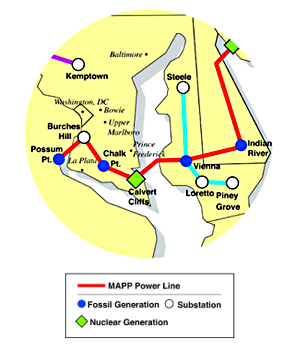
She’s worried about a larger line rising in the shadow of her house. If the poles somehow get knocked over, “Where’s that line going to fall? That line’s going to fall in my living room.
That’s Farah Morelli’s question. She’s a regular person who woke up one day with a monstrously large transmission line planned literally in her back yard. That’s usually the most effective way to get someone to learn about transmission. It’s a steep learning curve, and what I’ve found in my work with people in the path of proposed transmission is that once they start looking, they find a disturbing fact: Utilities propose transmission lines not because they’re “needed” but that they’re wanted, wanted to increase their ability to transmit and SELL cheap power in areas where it’s higher cost, and make a bundle in the process. It’s not that people don’t have electricity (and high price is the best instigator of conservation), but it’s that people want more and want it cheaper and the utilities which make $$$ from that equation want to make it happen.
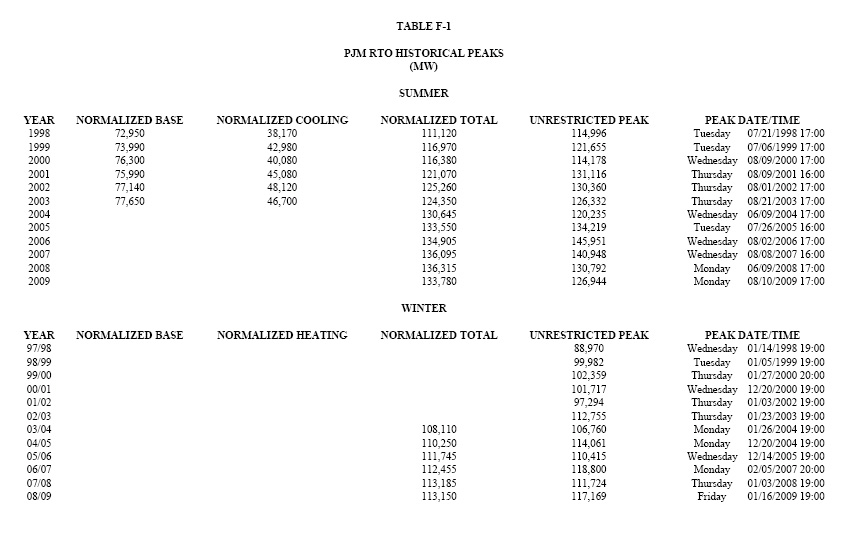
HERE’S THE REALITY — The PJM 2010 Load Forecast Report and the Monitoring Analytics “PJM 3Q State of the Market” report show that this market decline isn’t anything new and that it’s not going away anytime soon. The PJM market peaked in 2006:
Today’s News Journal article is a start at pulling it all together, taking a look at the bigger picture, and that bigger picture is what these transmission lines are all about. Three lines were proposed together, the Potomac Allegheny Transmission Highline (PATH), the Mid-Atlantic Power Pathway (MAPP) and the Susquehanna-Roseland line. These aren’t just transmission lines, they’re BIG HONKIN’ ELECTRICAL AUTOBAHNS, quad (or now maybe tri?) bundled 500kV lines. Like WOW. HUGE!
Here’s today’s article:
Lower energy projections put brakes on power lines
Guess what we’re doing tomorrow?
January 20th, 2010
We’ve put in an application with Sixth Angel Shepherd Rescue, went out to Long Island last week for a “meet and greet,” and we’ve gotten through the “house visit” (whew!), and tomorrow we’re getting our new grrrrrrrrrrrrl:

STrib editorial on wind setbacks
January 20th, 2010

Oops, there goes a Suzlon…
Anyway, today the STrib has an editorial today about increasing setbacks — it’s a mixed bag — scroll way down below to read it. This concern of setbacks is ramping up and goes back to concerns raised over the years regarding individual projects as they wind their way through the permitting process. Now there is this PUC Docket that is coming to a head, based on a survey report commissioned by the Commission — they’re supposed to have a PUC meeting addressing this docket, maybe this month, but no word yet, don’t worry, I’ll post notice here (we know they’re not so hot on giving notice to non-wind industry interests in this docket):
To look at that docket, CLICK HERE FOR PUC SEARCH, and search for docket 09-845.
This also comes at the time that Comments are due in the Goodhue Wind PPA docket. To look at that, go to CLICK HERE FOR PUC SEARCH, and search for dockets 09-1349 and 09-1350. For the Certificate of Need docket for Goodhue Wind, see Docket 09-1186.
Yesterday (the comment deadline WAS yesterday) I filed this for Goodhue Wind Truth:
Then it turns out the PUC had filed another extension for MOES (seems they can’t meet a deadline these days, the EIS for CapX was also just delayed today too) and the deadline is now 2/12 for Comments and 2/22 for Reply Comments. GREAT! Another whack at the apple… Now’s your chance. You can eFile them at the PUC site, or mail in, take a look at the Comment above to get an idea how to do it.
Back to wind generally — This opinion piece was in the Republican Beagle a few days ago:
Study of wind project may blow you away
Let me share a few things I have learned since I read through this packet.
The property line setbacks are less stringent: 500 feet for a 400-foot tall wind turbine.
Here’s the response of Ann Occhiato, a landowner who lives in the proposed Greenvale project in Dakota County to the STrib editorial, below:
I am writing in response to today’s editorial on increased wind turbine setbacks. While the editorial highlights the critical need to increase setbacks to maintain wind’s momentum, it minimizes the reasons why setbacks are important in the first place.
There is, in fact, credible evidence that low frequency sound from wind turbines can have a negative impact on health. The Minnesota Dept. of Health’s white paper on the Public Health Impacts of Wind Turbines outlines this and recommends the cumulative affect of multiple turbines be taken into account when evaluating sound impacts, which is not currently done. There is a huge amount of circumstantial evidence from homeowners living near turbines all over the world on the negative impacts to quality of life, health, safety, and property values. While the wind industry and proponents of wind like to point to studies that minimize these issues, numerous other studies show these impacts to be real.
The fact is there are serious issues related to wind farming that need to be addressed including setbacks, environmental regulation, property rights, health, safety, quality of life, and economic justice, among others. Industrial scale wind turbines clustered in “farms” can ruin neighborhoods and seriously alter the course of people’s lives. Belittling their concerns will not help the wind industry in Minnesota and it certainly does not make us a national leader.
As wind continues to spread these problems will only become more pronounced. Increased setbacks, pre-permitting site guidelines, community support and involvement, alternative modeling, and other solutions are necessary for the continued growth of the wind industry in Minnesota. Developers, public officials, legislators, and environmental groups have a responsibility to address these issues.
Ann Occhiato
Here’s the STrib’s editorial:
Editorial: Reconsider setbacks for wind turbines
Expand wind energy while respecting rural livability.
As the Star Tribune’s Tom Meersman reported last week, complaints about wind turbines are mounting, less on their merits than on their occasionally inappropriate locations. A family near Austin, for example, lives just across the road from a wind farm. One giant turbine, about 900 feet away, casts a flickering shadow over their 100-year-old farmhouse. There’s little they can do. State law allows commercial turbines as close as 500 feet from dwellings, although decibel restrictions typically stretch the actual distance to 700 to 1,000 feet. That’s still too close for a 400-foot turbine, especially if it’s not on your property.
Read the rest of this entry »
Susquehanna-Roseland delay in the news
January 16th, 2010
Here are the articles on the NJ BPU delay of decision on Susquehanna-Roseland transmission line, but before that, here’s the letter the BPU sent to PJM requesting more information based on yesterday’s decision to put on the brakes:
Color me jaded, but what is needed is what Stop the Lines requested in our STL – Reply Brief, based on the sensitivity analysis ordered for PATH:
• PSE&G must waive any claim to FERC “backstop” authority in the pendancy of this sensitivity analysis and Board deliberation.
• The sensitivity analysis must include, but is not limited to those scenarios Ordered in the PATH docket:
1. Susquehanna-Roseland load flow analyses updated to reflect the following changes in generation: (i) all existing generation as of January 7, 2010, which is not scheduled to be retired before 2014; (ii) all proposed generation that cleared the May 2009 PRM Auction; and (iii) all proposed generation with a signed ISA as of January 7, 2009 (“Scenario 1 generation”);
2. Susquehanna-Roseland load flow analyses updated for the changes in Scenario 1 generation, and updated to reflect PJM’s 2010 load forecast (“Scenario 2”);
3. Susquehanna-Roseland load flow analyses updated for the changes in Scenario 1 generation, and updated to reflect the demand response and energy efficiency resources that cleared the May 2009 RPM Auction;
4. Susquehanna-Roseland load flow analyses updated for the changes in Scenario 1 generation, and PJM’s 2010 load forecast (i.e., Scenario 2) and updated to reflect the demand response and energy efficiency resources that cleared the May 2009 RPM Auction;
5. Susquehanna-Roseland load flow analyses updated for the changes in Scenario 1 generation, PJM’s 2010 load forecast, and to reflect the demand response and energy efficiency resources that cleared the May 2009 RPM Auction (i.e. Scenario 4), and updated to reflect the forecasted additional demand response and energy resource reasonably available for 2014, 2015 and 2016 (i.e. using MW from PATH of 367, 420, and469 respectively); and
6. Susquehanna-Roseland load flow analyses updated for the changes in Scenario 1 generation, PJM’s 2010 load forecast, the demand response and energy efficiency resources that cleared the May 2009 RPM Auction, the forecasted additional demand response and energy resource reasonably available for 2014, 2015 and 2016; and updated to reflect additional demand response and energy efficiency projected (i.e. using MW from path of 1,825, 2,140 and 2,403 respectively).
These results shall be distributed to the parties as soon as possible and shall be subject to limited discovery and cross examination, after which the Board shall consider them together with the balance of the record in this matter.
See why it’s frustrating — they just missed the boat completely with the vague request to PJM…
So, on with the press coverage about yesterday’s decision to delay:

New Jersey regulators delay decision on PSEG transmission line
By Mark Peters
Of DOW JONES NEWSWIRES
Public Service Enterprise Group shares were at $32.32, down 50 cents, or 1.5%, in recent trading.
-By Mark Peters, Dow Jones Newswires; 212-416-2457 mark.peters@dowjones.com
================================================================
Decision delayed on power project
Saturday, January 16, 2010
Lawrence Ragonese
STAR-LEDGER STAFF
Lawrence Ragonese may be reached at (973) 539-7910 or lragonese@starledger.com
===============================================================
State officials delay decision on PSE&G powerline for a month
By COLLEEN O’DEA • STAFF WRITER • January 16, 2010
Karen Johnson, a PSE&G spokeswoman, said the utility was discouraged by the delay.
Colleen O’Dea: 973-428-6655; codea@gannett.com.
===============================================