Vivian Maier exhibition opening next week
January 2nd, 2011
Thanks to Al Haug for posting about this.
January 8 – April 3, 2011
FINDING VIVIAN MAIER: CHICAGO STREET PHOTOGRAPHY
Chicago Cultural Center
78 E. Washington St, Michigan Avenue Galleries
Chicago IL 60602

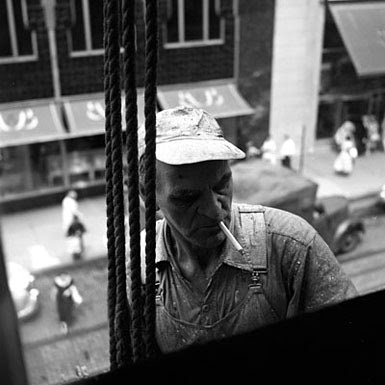
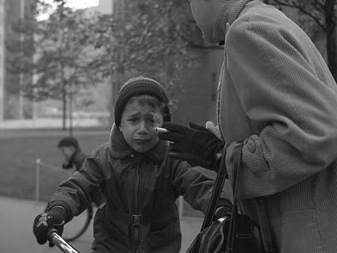
Vivian Maier was a nanny in the Chicago area who spent her time off with a camera…
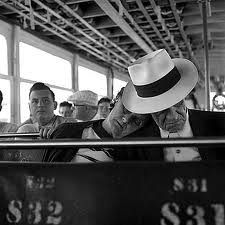
… a slight understatement…

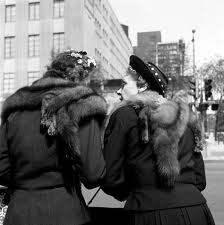
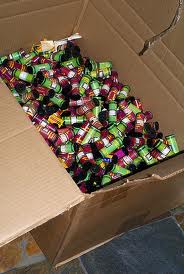
… and after she died last year, in her 80s, boxes and boxes of hundreds of thousands of negatives were discovered…

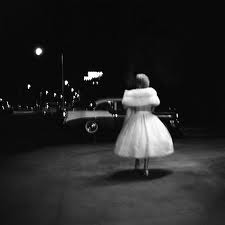
… and boxes of undeveloped rolls of film.
Next week, an exhibition opens at the Chicago Cultural Center, running until early April.

Sunday – Benefit for Dawn Husbyn
December 31st, 2010
Benefit for Dawn Husbyn
2-5 p.m. Sunday January 2, 2010
Oak Center General Store
(So. of Lake City on Hwy. 63)
From the RW Beagle and the inbox from Steve Schwen, Oak Center:
AWA Goodhue Wind files Motion for Summary Disposition
December 31st, 2010
Check the PUC filings yesterday — there goes Todd Guererro with his disposition problem!
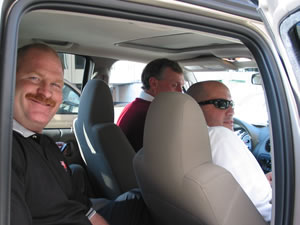 (Todd & cronies checking out an electric car at the fair! Or was it Living Green Expo?)
As you know, the PUC issued an PUC’s Order – Referral to OAH in which the AWA Goodhue wind project was sent to an Administrative Law Judge to address the following issues:
1. The ALJ assigned to this matter is requested to develop a record on every standard in Article 18 that is more stringent than what the Commission has heretofore applied to LWECS and make recommendations regarding each such standard whether the Commission should adopt it for Large Wind Energy Conversion Systems in Goodhue County. The Commission has identified two such standards in this Order (Section 4 and Section 6) but is not by this Order restricting the ALJ from developing the record and making recommendations regarding additional standards in Article 18 that upon further examination meet the “more stringent” qualification.
2. The ALJ assigned to this matter is requested to allow the parties to develop a factual record on the question of “good cause” as that term appears in Minn. Stat. § 216F.081 and to provide recommendations on whether, with respect to each standard in Article 18 identified in the course of her review as “more stringent” than what the Commission has heretofore applied to LWECS, there is “good cause” for the Commission to not apply the standard to siting LWECS in Goodhue County.
3. As the ALJ addresses the issues identified in the previous two sections, the ALJ is requested to include (but not limited to, by this Order) whether there is sufficient evidence regarding health and safety to support a 10 rotor diameter set-back for non-participating residents and the stray voltage requirements.
AWA Goodhue is not happy about this, and have filed this:
Here are a couple snippets for the gist of their argument:
We have to respond by January 14, 2010!
To check out the full docket, go to www.puc.state.mn.us and then to “Search eDockets” and search for docket 08-1233.
Bluster blather from Kenyon Wind
December 31st, 2010

Oh, man, I am really scared now!!! See something new every day… John Daniels has filed the following “Notice of Intent” letter on behalf of Kenyon Wind, LLC:
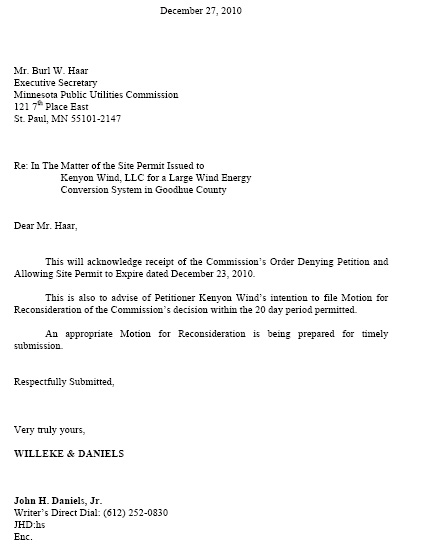
EH? Oh, OK, ja, sure, whatever… I’ll just shake and quake in my boots until the Motion for Reconsideration is really filed… Notice of Intent? WTF? Never seen one of those before!
 …. yawn….
Remember, Kenyon Wind was the first C-BED project out of the chute, oh, excuse me, not THAT C-BED, but THIS C-BED, the statute. Kenyon Wind was a wind project promoted by the principals of non-profit Windustry, and Kenyon Wind was the wind project that planned to put a turbine and substation on former Speaker Steve Sviggum’s land (see Section 13 on the R)…

…and I’m sure you all remember how helpful the Speaker was in passing the 2005 Chapter 97 – Transmission Omnibus Bill from Hell that gave birth to C-BED and gave the utilities everything they every wanted and more to be able to go forward with CapX 2020 transmission criss-crossing the state with transmission for export:
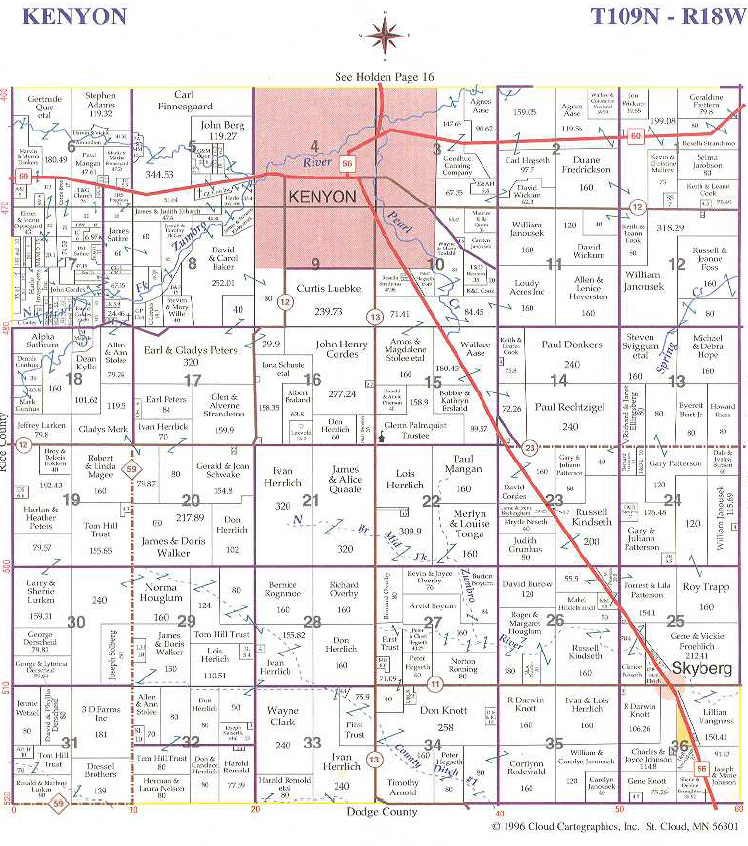
In the meantime, see the following (the one posted just above this) post on how it’s done. Todd Guererro, on behalf of AWA Goodhue Wind, has filed one even better, a Notice of Motion and Motion for Summary Disposition. Yup, AWA Goodhue Wind has a disposition problem all right!
2010 NERC Reliability Assessment
December 29th, 2010
In prepping for the PPSA Annual Hearing , I realized that I’d forgotten to post the 2010 NERC Reliability Assessment. How can that be? NERC, the North American Electric Reliability Corporation, has been issuing these for over a decade, and they have the greatest little gems, a must read that comes out usually in October.
SO, making up for lost time, here it is:
2010 NERC Reliability Assessment – Part 1
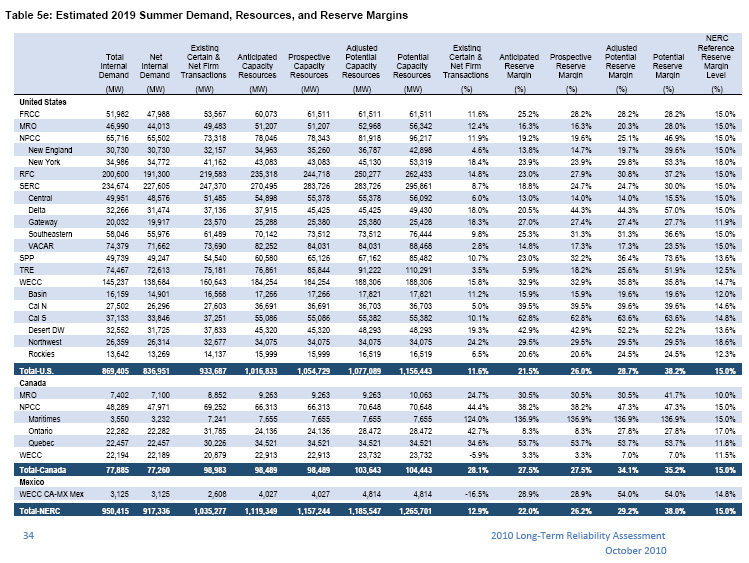
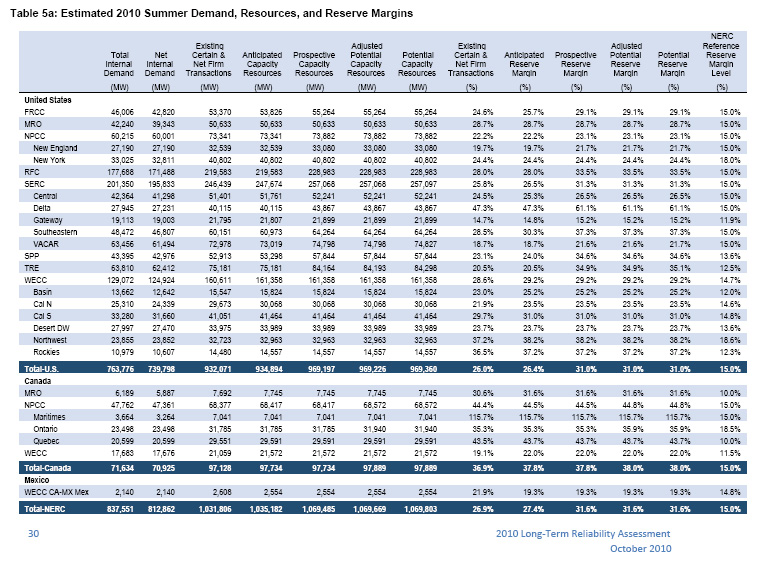
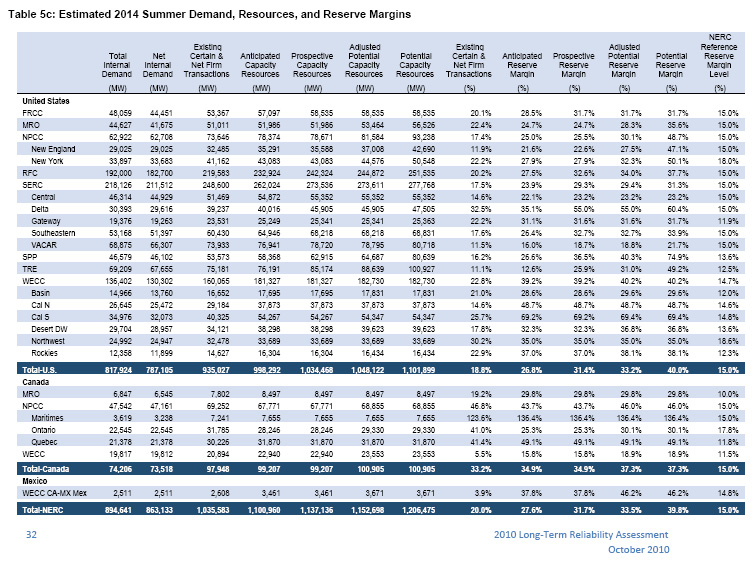
And here’s what I find to be the best part of this — the charts that show the reserve margins going out of sight!
Summer 2010 shows that we’re comfortable, plenty of electricity to go around. But wait, check the 2014 and 2019 projections — in 2019, where we “need” a 15% reserve margin, we have:
Anticipated Reserve Margin – 16.3%
Prospective Reserve Margin – 16.3%
Adjusted Potential Reserve Margin – 20.3%
Potential Reserve Margin – 28.0%
OK, so then let’s look at the East Coast for 2019:
New York
Anticipated Reserve Margin – 23.9%
Prospective Reserve Margin – 23.9%
Adjusted Potential Reserve Margin – 29.8%
Potential Reserve Margin – 53.3%
RFC– includes much of PJM – New Jersey, Delaware, and heading west
Anticipated Reserve Margin – 23.0%
Prospective Reserve Margin – 27.9%
Adjusted Potential Reserve Margin – 30.8%
Potential Reserve Margin – 37.2%
And again, the purpose of all this transmission build-out becomes clear — there’s too much electricity and they need a way to get it from here to there, anywhere to be able to sell it.
Click these charts below for a bigger view.
Estimated 2010 Summer Demand, Resources, and Reserve Margins:
Estimated 2014 Summer Demand, Resources, and Reserve Margins:
Estimated 2019 Summer Demand, Resources, and Reserve Margins: