Access to health care?
August 18th, 2012

There are days when life in the U.S.A. really pisses me off, and yesterday was one of them. We are, what, the ONLY developed country without available, accessible health care ready and waiting for its population? My dogs get better health care than I do, and I will be damned if I will give some HEALTH INSURANCE company my hard-earned money when what I need is HEALTH CARE. And I can’t call the vet for me. Thanks to Dog for the Red Wing Care Clinic, which I give a chunk to each time I go. Even without considering my parent’s veterans benefits (both were in WWII), they were covered well by Medicare and $102/month for Part B coverage. I’m counting the days until I’m 65, and can get Medicare and reasonably priced supplemental care coverage.
When these idiots are talking about dismantling Medicare, THAT gets my blood pressure up, HOW DARE THEY. “PRIVATIZE!” Privatize Medicare, privatize Social Security — privatize my fat my ass… The point is clear, they’re aiming to eliminate the surplus population with their draconian policies. Over my dead body! Oh, right, that’s exactly it…
Anyway, joys of self-employment and our damned “insurance” system… I had a cracked tooth, it started ages ago, and what little was left of it started screaming and I just couldn’t take it any longer:

OMD, what a relief… much better… much much better!!!
Xcel’s 2Q reports – sand mining increases sales
August 14th, 2012

Xcel Energy’s 2Q report came out almost two weeks ago (where DOES the time go?!?!), and one part stuck out:
This came from their transcript, on Seeking Alpha, linked above. So who is looking at the impacts of frac sand mining on energy use, sales and peak demand?
The earnings call and other info is available on Xcel’s Investor site at www.xcelenergy.com. CLICK HERE FOR THEIR INVESTOR RELATIONS PAGE (may need to agree to their “Safe Harbor Statement” to get here) Xcel’s demand isn’t anything to write home about, this from their 8/2/2012 Xcel Energy Second Quarter 2012 Earnings Report:

And from the SEC:
And in this filing, an amazing tidbit that I’d not noticed before — Firm Transmission Rights are regarded as COMMODITY DERIVATIVES:
< ![endif]–>
“Financial Transmission Rights” which “entitle the holder to one year of monthly revenues or charges based on transmission congestion across a given transmission path.” SAY WHAT?!?!?!
Now please, correct me if I’m wrong, but wasn’t “derivatives” in a tanking market what got Xcel’s NRG into bankruptcy?
MAPP is dead, dead, dead
August 8th, 2012
Just in today from PEPCO:
All,
I am writing to provide an update on PHI’s proposed Mid Atlantic Power Pathway (MAPP) project.
Today PJM issued the final results of its 2012 transmission analysis and due to factors such as lower load growth from the sluggish economy, the installation of new gas fired power plants, and the increase in demand response programs, no reliability violations were identified within the transmission planning window. As a result, the PJM Transmission Expansion Advisory Committee (TEAC) issued a recommendation that the MAPP project be canceled. On August 24, 2012, the PJM Board of Managers will meet to make a final decision on the TEAC’s recommendation.
I would like to express my sincere appreciation for your interest and participation in the MAPP project over the past few years.
Thank you,
Mark Okonowicz
MAPP – Environmental Coordinator
Pepco Holdings, Inc.
P – 302-283-6115
C – 302-463-5438
mark.okonowicz@pepcoholdings.com
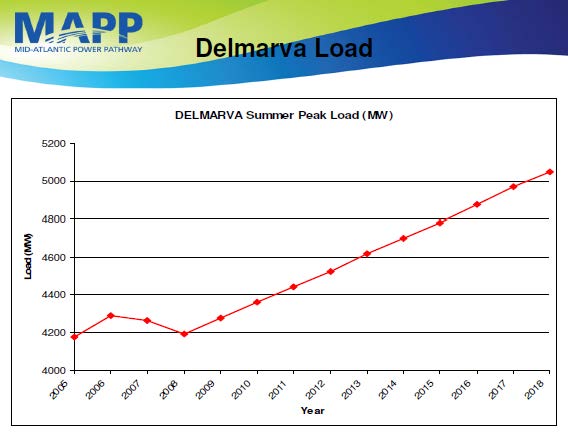
This is after their bogus claims, in 2008, of skyrocketing peak demand (utterly unsupported by fact) from a June 25, 2008 MAPP Presentation found on the DNREC site — this “forecast” is so outrageous, and cancellation is SO HILARIOUS in light of Todd Goodman’s objections to my chalenging demand:
So let’s take a step back – what is MAPP?

No, this isn’t about the Mid-Continent Area Power Pool… it’s the Mid-Atlantic Power Pathway (MAPP), and it is DEAD!
The Mid-Atlantic Power Pathway, a transmission line that was part of “Project Mountaineer,” a coal transmission web that was hatched at a 2005 FERC meeting. MAPP was the NE part of line 4, below (Susquehanna-Roseland is the eastern part of line 1):
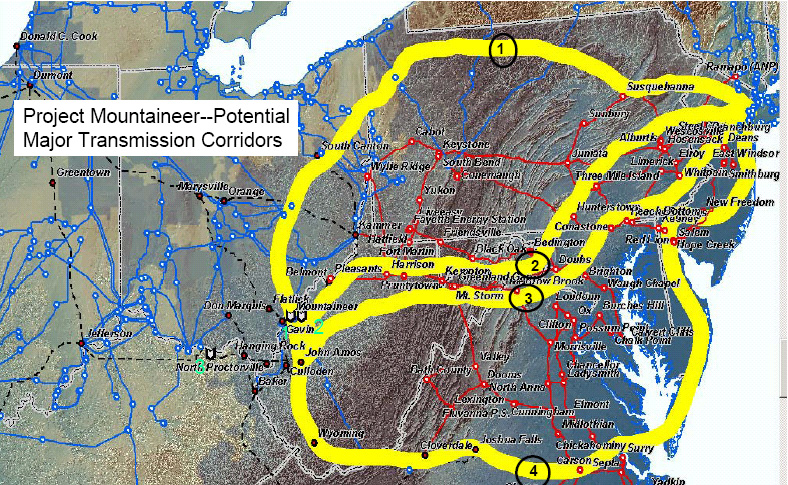
Here’s the transcript of that meeting, too scary, but it’s important to read this:
They tried and tried and tried, against evidence, to ram all these projects through. The did manage to get the first one through, the TrAIL (Trans-Allegheny Interstate Line) project, but PATH (Potomac-Appalachian Transmission Highline) is dead, Susquehanna-Roseland is permitted but not yet built…
Slowly but surely, PJM is admitting that transmission is not “needed” by any measure. With MAPP, first they planned it as above, in the first map, and then they eliminated the part in Delaware from Indian River to Salem/Hope Creek nuclear plants:
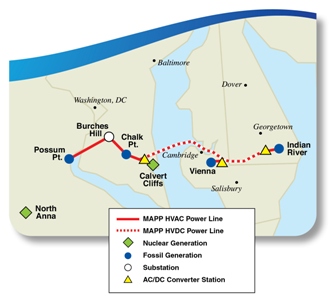
Despite this, Delaware’s DNREC issued permits for part of this project in Sussex County, Delaware! Whatever for? Why would they do this? Aren’t they paying attention to things electrical? DNREC should know this is not needed
Here is today’s good news — PJM’s latest review, just released, showing NO THERMAL VIOLATIONS — DUH:
Here are two slides that say it all, the first focused on PATH but including MAPP, and the second, the “MAPP Project Analysis” results:


And the bottom line? Another DUH, GOODBYE PATH AND GOODBYE MAPP:


Once again, we’re proven right. How long have we been fighting all these transmission projects, how much time, effort and money showing it’s not needed, even when using INDUSTRY studies, documentation, forecasts. All their claims of need are fabricated, reverse-engineering to get the result they want, billions of dollars of PRIVATE INTEREST, not PUBLIC interest, projects, built on the backs of landowners, with a FERC guaranteed 12+% rate of return for the owners/builders/developers.
The down side is the ratepayers are probably going to be hit with all these development costs because so many jurisdictions allow recovery for “CWP,” construction work in progress. So we get screwed, but not as badly as if they had built the projects.
Like CapX 2020, this project was another of those personal projects. MAPP was originally heading up through Delaware to the Salem/Hope Creek nuclear plants, and the Delaware part would have gone near us in Port Penn, we’re right across the Delaware River from Salem/Hope Creek. They should know better than to try something like that!
DOE’s Preliminary Findings 2012 Congestion Report
August 7th, 2012
The DOE is hosting webinars on its 2012 transmission congestion study:
The study isn’t released out, even a draft, and the powerpoint isn’t available yet online. GRRRRRRRR, we need that to have an idea what’s going on… oh, that’s probably why it isn’t there. Soon, I’ll post it when it appears.
The first webinar was today, just over, and there are two more — just click on linked date to register:
- Thursday, August 16, 2012 2-3:30 pm ET (industry and others)
- Tuesday, August 21, 2012 2-3:30 pm ET (state focus)
What I’m seeing here from the powerpoint is that congestion is a non-issue. And what is very clear from the congestion maps for 2009-2011 is that in 2009 there was essentially NO congestion, and it got worse in 2010, and then not so bad in 2011 but still far more than in 2009. In essence, apparently what they’re doing has made it worse.
They did ask my question, based on the above observation of the 2009, 2010 and 2011 maps, and asked what the explanation was for absence of congestion in 2009:
A: He said that the relatively low level of economic activity was certainly a factor. Temperatures were more severe in 2010 so that was a factor. Yes, congestion, in terms of these three graphics, congestion is worse in 2010 than in the other two years, that is generally in the context of a generally declining pattern over a couple of years we’ve been looking at. Don’t want anyone to get the impression that …. So part of this is that this is a function of scaling also? Yes…
Uh-huh… right…
And then from slide 22, Preliminary Regional Findings: Midwest:
- Data indicate on significant, persistent constraints, apart from those related to the development of remote renewable resources
- Data do not indicate any areas with major reliability problems
- The economic congestion that is occurring is small in relation to the total cost of wholesale electricity traded in organized spot markets.
- Inconsistent market designs and practices between RTOS — as distinct from lack of transmission capacity — are a significant impediment to economically beneficial electricity trade.
But hey, we knew that!
Here are the prior “studies” from DOE:
And remember, the purpose of this is, in THEIR words, from THEIR site:
DOE’s Congestion Studies may contribute information needed to support the future designation of one or more National Interest Electric Transmission Corridors (National Corridors). On the basis of a congestion study, and after reviewing and considering public comments, the Secretary of Energy is authorized but not required to designate related geographic areas as National Corridors. Designation of a National Corridor has two effects: 1) it emphasizes that the Department considers the particular congestion problem to which the corridor pertains to be sufficiently acute to merit federal concern; and 2) it enables the Federal Energy Regulatory Commission to exercise “backstop” authority (under conditions specified in the Federal Power Act) to approve the siting of transmission facilities within the area of the corridor. In particular, the Commission may exercise its jurisdiction if a state agency has “withheld approval” for more than one year of an application to site a transmission facility within the corridor.
But wait, even they admitted in today’s Webinar that the courts have invalidated the designation of National Interest Electric Transmission Corridors both generally and specifically:
So we’re doing this … why???
It’s all about market, it has nothing to do with electric reliability, and billions are being spent to address a problem that does not exist and which is illegal to implement. WRONG? Prove it, please…
Frac sand mining air permit at MPCA
August 7th, 2012
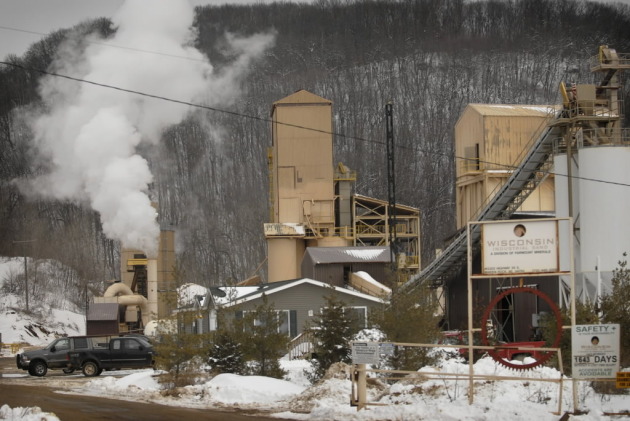 Photo of Maiden Rock frac sand mining operation across the river
The MPCA has announced a frac sand mining air permit comment period for the mine proposed in Scott County near Shakopee.
I believe this is the first frac sand mining permit to go through MPCA air permitting (I’ll check). Here’s the MPCA’s Frac Sand Mining Page.
If you write comments, there are specific things that have to be included, it says “must” in the Notice and “shall” in the rules, so I think they mean it. Here’s what the rules say about comments:
Subp. 2. Contents of written comments.
A person who submits comments under subpart 1 shall include in the comments the following:
You may request a contested case, and that must be done under Minn. R. 7000.1800 Petition for Contested Case. If you plan to do that, also check out Minn. R. 7000.1900 Criteria to Hold Contested Case Hearing.
Send Comments and Petitions by August 27, 2012 to the MPCA:
Steve Gorg, Air Quality Permits Section
Industrial Division, MPCA
520 LaFayette Road North
St. Paul, MN 55155
steven.gorg@state.mn.us
Here are the primary documents from the MPCA site:
Intent to Issue Air Emission Permit to Great Plains Sand LLC, Shakopee – Notice Full Text