The rest of the story… ???
September 27th, 2013
Back to transmission lines and pipelines…
Looking at the footprints, at what’s proposed, it makes sense, meaning that it fits together, the rest of the story. But does it? There’s the Not-So-Great Northern Transmission Line (Minnesota Power’s Great Northern Transmission Line), and there’s the Enbridge Sandpiper pipeline. But is it all connected? Or is there even more in store? How much do these companies want?
The Not-So-Great Northern Transmission Line:
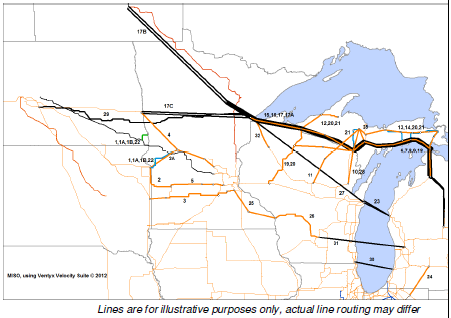
And there’s the Enbridge Sandpiper pipeline:
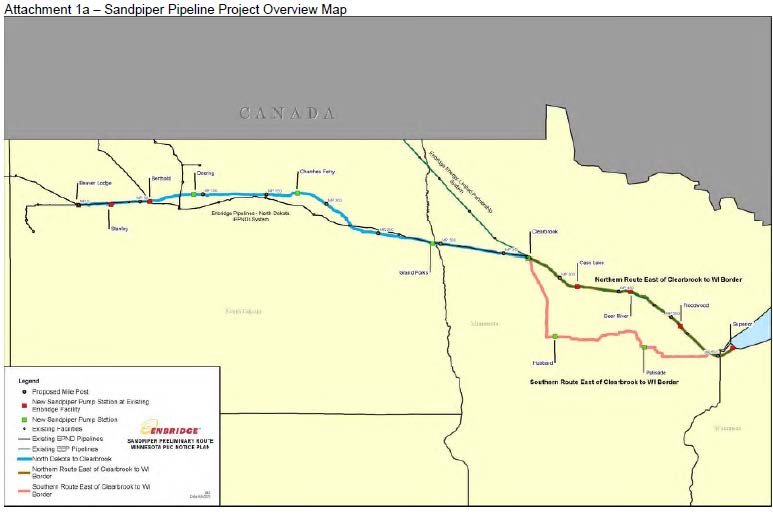
And then there’s this, the Allete Energy Corridor:
 There are differences… the Allete Energy Corridor is further south, headed straight east to Duluth. But look at the map that is in their Notice Plan, the “Preferred Route.” It’s also south:
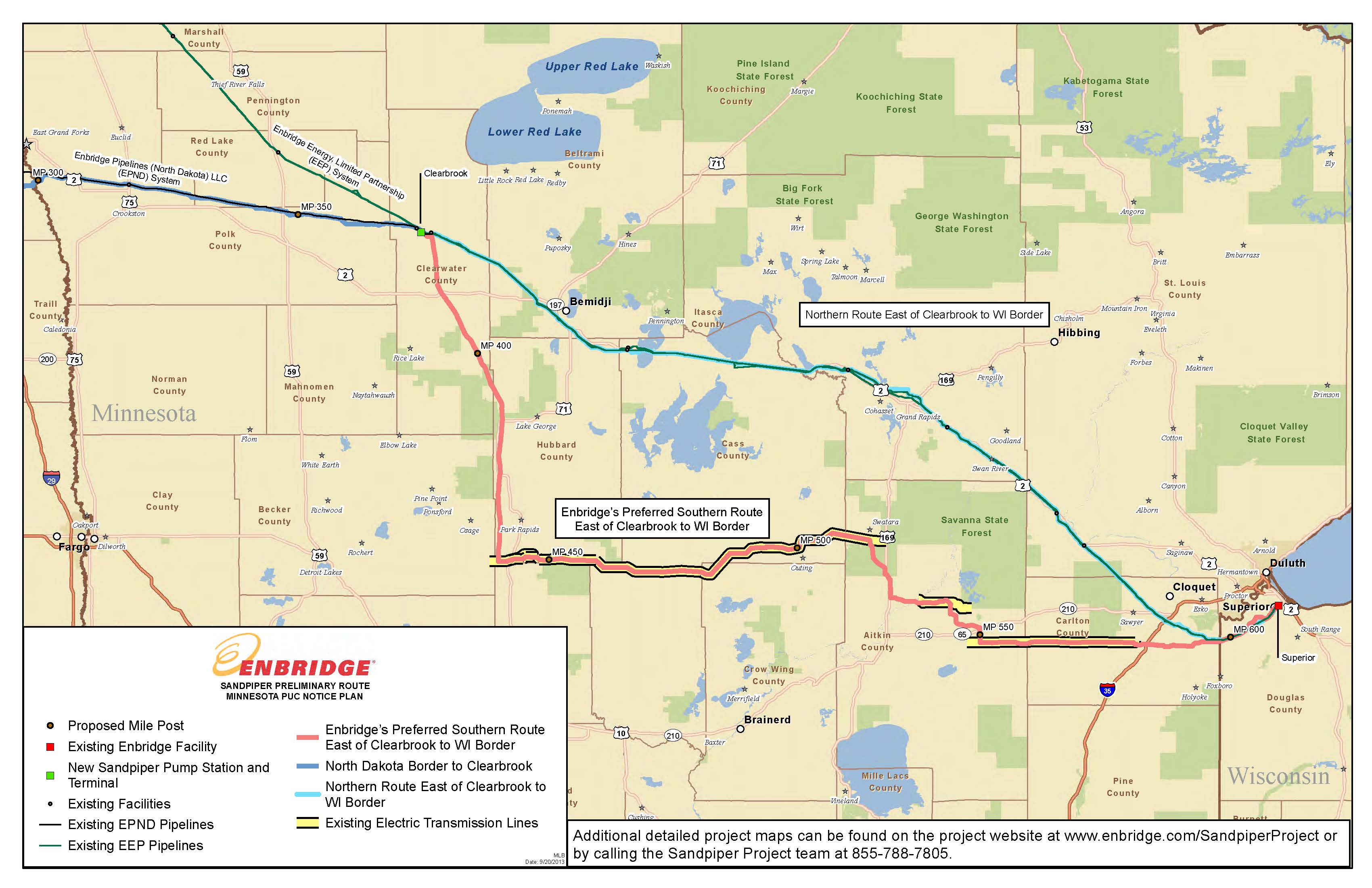
Do they need both? Is this all one and the same project(s)? As we say in transmission, it’s all connected. So do tell, what’s the connection with the two announced projects, one transmission and one pipeline, and this “energy corridor.” Enbridge must submit more detailed maps for the Notice Plan, so we should see soon their “preference.”
Meanwhile, what’s Allete up to? Seems it started over two years ago:
And yesterday:
ALLETE Energy Corridor Would Offer Efficient Movement of Multiple Products, from Flared Gas to Water
by Business Wire via The Motley Fool Sep 25th 2013 12:30PM
Updated Sep 25th 2013 12:32PM
ALLETE Energy Corridor Would Offer Efficient Movement of Multiple Products, from Flared Gas to Water to Carbon
N.D. governor supports comprehensive solution
BISMARCK, N.D.–(BUSINESS WIRE)– ALLETE (NYS: ALE) today laid out its vision for a comprehensive energy transportation corridor that could help provide solutions for the movement of natural gas, petroleum products, water and wastewater, wind energy and future sequestered carbon across a coordinated, shared right-of-way.
The energy corridor’s backbone would follow an existing 465-mile path that contains a direct current transmission line running between Center, N.D. and Duluth, Minn. This 250-kilovolt line, purchased in 2009, is used to transmit electric energy from the lignite-fired Young Generating Station in Center and the nearby Bison Wind Energy Center to Duluth, Minn., home of the nation’s busiest inland seaport. The energy corridor would expand a pathway along strategic portions of the existing right of way to minimize land use and optimize energy delivery infrastructure development within North Dakota.
A top priority of the ALLETE Energy Corridor is to develop an extension of the existing energy delivery path some 60 miles westward to the burgeoning Bakken shale oil fields of west-central North Dakota. ALLETE subsidiary ALLETE Clean Energy has been working diligently with potential partners to study the co-location of facilities and assess the capital needs for the Bakken link. It is envisioned that various lengths of the corridor would be used for different purposes.
“We see the ALLETE Energy Corridor as a comprehensive infrastructure solution in North Dakota that could serve many products and producers across the region,” said ALLETE President, Chairman and CEO Alan R. Hodnik. “We value Gov. Dalrymple’s support of our vision and appreciate him bringing it forward to other members of the state’s energy sector.”
“ALLETE has been invested in North Dakota for decades,” Hodnik added. “We are confident that our rich history of partnering with others can help forge creative solutions to today’s new challenges facing energy markets in the Upper Midwest.”
North Dakota Governor Jack Dalrymple voiced support of the ALLETE Energy Corridor today in remarks to EmPower North Dakota, a commission established to develop a comprehensive energy policy for the state. He said the energy corridor concept is a prime example of the way business can creatively tackle pressing problems like the proliferation of flare gas at oil wells dotting the Bakken field, and the traffic tie-ups caused by too many trucks and trains hauling petroleum products to market.
“The ALLETE Energy Corridor is a breakthrough opportunity to reduce flaring by locating a major natural gas pipeline from the Bakken to eastern markets,” Gov. Jack Dalrymple said. “While the corridor would support the transfer of many energy resources, it could also carry carbon dioxide from coal-fired power plants to western North Dakota for use in advanced oil recovery.”
The ALLETE Energy Corridor could accommodate several pipelines capable of transporting natural gas that would otherwise be flared, as well as wastewater and carbon sequestered from fossil fuel generation. Future wind expansions could also benefit.
“We look forward to working with project developers and government officials to implement this vision,” said Eric Norberg, president of ALLETE Clean Energy. “We have an opportunity to pursue investments that will help solve some current issues and lay the groundwork for more efficient movement of energy products, water and wastewater in the future.”
More information about the ALLETE Energy Corridor can be found www.ALLETECleanEnergy.com.
ALLETE, Inc., an energy company based in Duluth, Minn., has a well-established presence in North Dakota that includes BNI Coal, now undergoing a major expansion to extend coal delivery to its partner Minnkota Power, and the Bison Wind Energy Center, where work on a $350 million fourth phase is scheduled to begin this year. ALLETE’s energy businesses also include Minnesota Power, Superior Water, Light & Power Co. and ALLETE Clean Energy. More information about the company is available at www.allete.com.
The statements contained in this release and statements that ALLETE may make orally in connection with this release that are not historical facts, are forward-looking statements. These forward-looking statements involve risks and uncertainties and investors are directed to the risks discussed in documents filed by ALLETE with the Securities and Exchange Commission.
Photos/Multimedia Gallery Available: http://www.businesswire.com/multimedia/home/20130925005251/en/
ANOTHER tar sands pipeline across Minnesota?
September 26th, 2013
.
There’s a new tar-sands pipeline proposed to run across Northern Minnesota, the “Sandpiper” pipeline.

Doesn’t that name make you feel better? Yeah, didn’t think so.
Now that I’ve got your attention, check out the Minnesota Public Utilities Commission docket. Go to the “Search Dockets” page, and search for 13-473. Thus far, it isn’t far, it’s at the “Notice Plan” stage, which means that the company filed a Notice Plan, which states how they’ll give notice to affected local governments, landowners, etc., that the PUC reviewed it, and approved it, with some changes.
And the PUC did approve the Notice Plan, with a few changes:

But wait, there are already quite a few pipelines through Minnesota (click for larger version), and these do not include the upgrade of Line 67, one of those lines shown below, to 570,000 barrels/day from 450,000 barrels/day (PUC Docket 13-153):
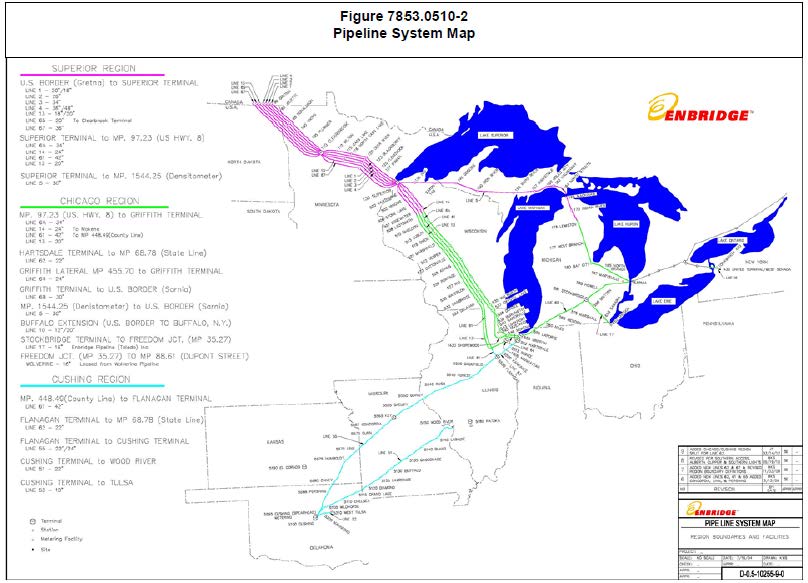
And I don’t see that MinnCan tar sands pipeline on that “system” map — perhaps only the Enbridge system:

So back to the Enbridge Sandpiper. Where is it proposed to go?
And why do they need it? It’s not really stated in the Notice Plan, but here’s what they’re saying in letters they propose as notice:

Yup, that’s right! They “need” it… well, because they want it… they “need” it because they want it because they “need” it because they want it, but remember, this is a Certificate of Need docket, where they have to prove they NEED it! The burden of proof is on them.
Red Wing adopts mining resolution
September 24th, 2013
Surprise!!!
Last week, the City of Red Wing’s Advisory Planning Commission adopted a very narrow resolution to support Goodhue County’s silica sand zoning efforts. The APC meeting was last Tuesday evening… who knew!?!?! Not these residents of Red Wing! Not a word on the Save the Bluffs listserve…
So we went to the City Council meeting last night after checking the agenda.
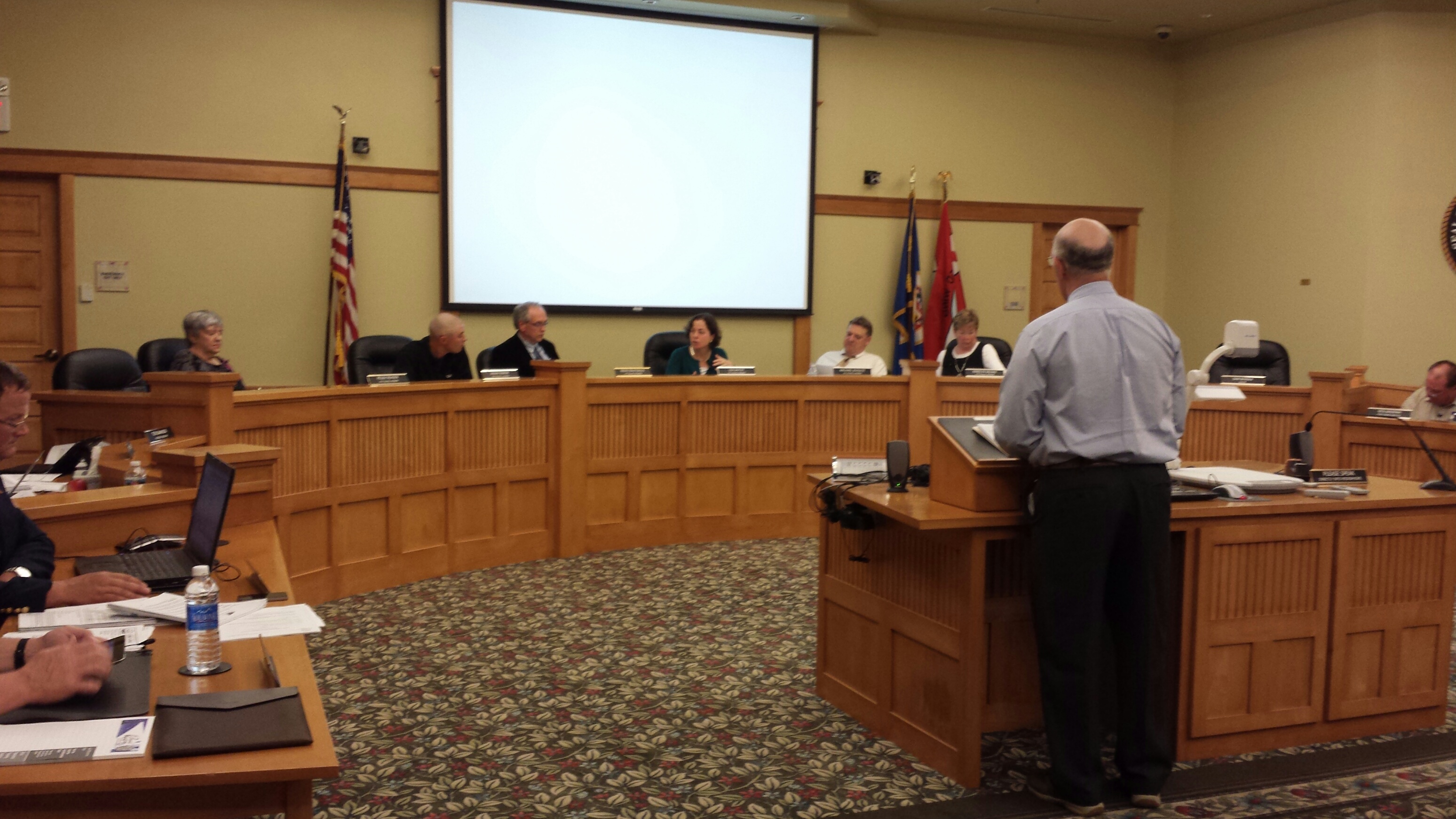
The Red Wing city planner, Brian Peterson, did a good job making the proposed resolution relevant to Red Wing, using related Red Wing prior actions as the basis for the Resolution, changing the “one size doesn’t fit any” generic resolution to one that also acknowledges that the one mile setback from the river doesn’t even reach Highway 61, the Great River Road ostensibly at issue, in a number of places:
The Save the Bluffs organization recently made a request to the Red Wing City Council asking that the City adopt a resolution that supports the idea of Goodhue County establishing a one mile prohibition of silica sand mining operations from the high water mark of the Mississippi River. The City Council has asked the Advisory Planning Commission and the Sustainability Commission to meet to discuss the request and make a recommendation to the City Council. Attached is the draft resolution that was provided to the City by Save the Bluffs. It is a generic resolution drafted for municipalities and townships to weigh in their support for the idea of a setback.
Option # 1, is a revised resolution for your consideration. It acknowledges that the City of Red Wing has already taken action by amending its zoning regulations to include an overlay zone that prohibits mining operations in the bluff overlay zones. It also refers to one of the recommendation from the Silica Sand Mining report that the council adopted in 2012 that recommended the city to collaborate with Goodhue County and surrounding townships to establish regulations regarding these operations. Option #1 would simply
support the Save the Bluffs initiative.Option #2, further revises the resolution by adding onto option #1 and supporting a larger prohibition area because bluffs within the view shed of Highway 61 would not be protected in areas located in Welch Township and Florence Township by a 1 mile setback from the Mississippi River. This resolution suggests that the prohibition area should be everything between I mile west of Highway 61 and the Mississippi River.
Option 2, in the packet above, was adopted last Tuesday, and last night, it was before the Red Wing City Council:
09C – Resolution 6601 Supporting Setbacks RE Mining Activities – CC 09-23-2013-1
What struck me when I finally did get a chance to review it was that the Resolution proffered, and in the part adopted by the APC, referenced Minnesota Statute 6125.8100. Oh, right… Seems to me the first thing anyone should do is check the references, but nooooooo, so I asked that the Resolution be corrected to reflect that 6125.8100 is a RULE! And Peterson did make that correction. GOOD!
Now, let’s get the City of Red Wing address the other model Standards and Criteria the EQB is developing, and the four rulemaking proceedings! Make it so!
EQB meeting on frac sand mining
September 21st, 2013
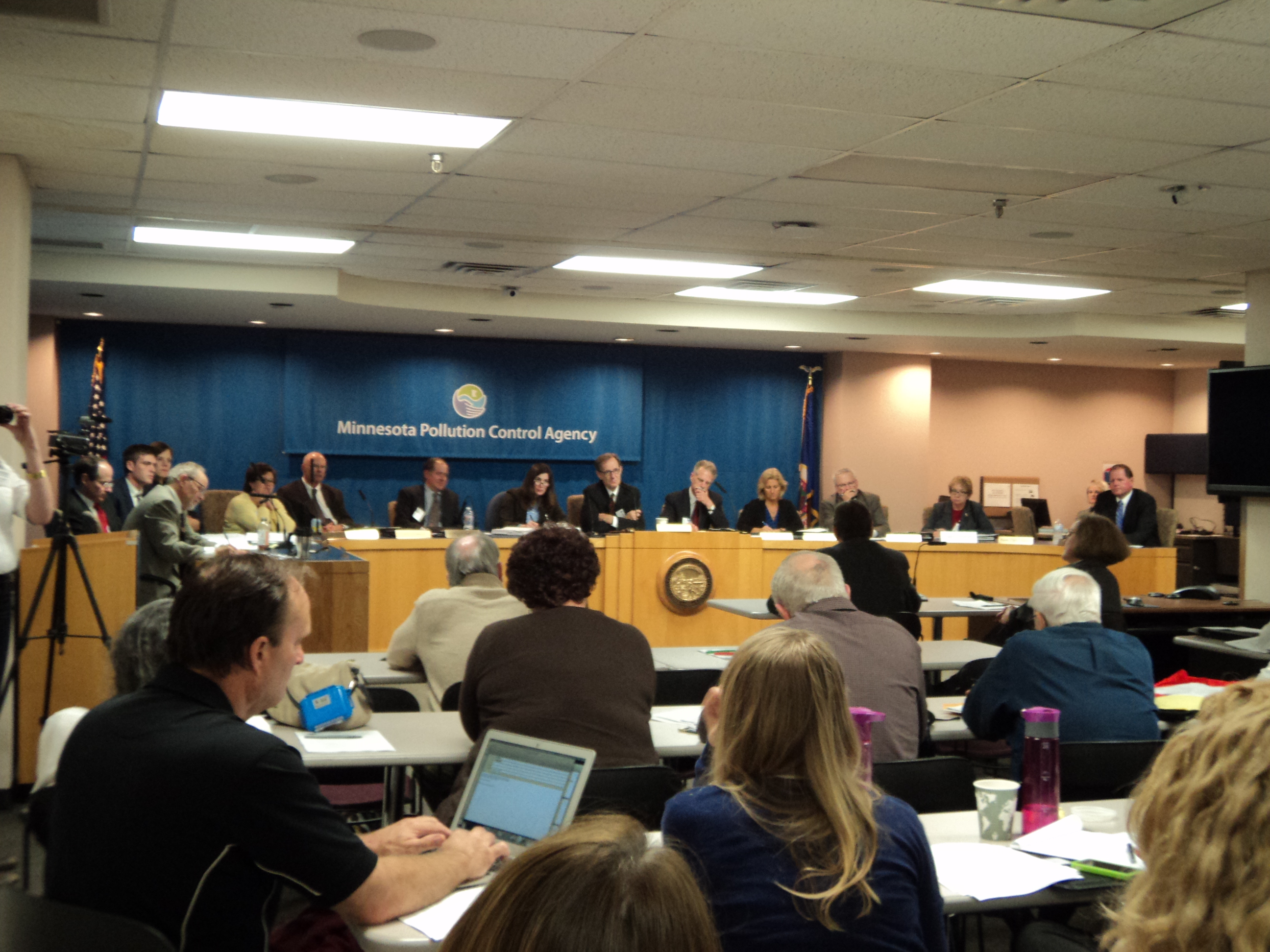
Wednesday was the EQB’s monthly meeting, and this one was all about frac sand mining. There are TWO things going on here. The EQB Standards and Criteria, which is not a rulemaking, and then four mandatory rulemaking tasks, two at EQB, and one each at DNR and MPCA. The EQB was supposed to deal with, at some level, both of these assignments.
One is the model Standards and Criteria, “serving suggestions” to be adopted by local government, and the other is four rulemaking tasks at three agencies:
Sec. 105. RULES; SILICA SAND.
(a) The commissioner of the Pollution Control Agency shall adopt rules pertaining to the control of particulate emissions from silica sand projects. The rulemaking is exempt from Minnesota Statutes, section 14.125.
(b) The commissioner of natural resources shall adopt rules pertaining to the reclamation of silica sand mines. The rulemaking is exempt from Minnesota Statutes, section 14.125.
(c) By January 1, 2014, the Department of Health shall adopt an air quality health-based value for silica sand.
(d) The Environmental Quality Board shall amend its rules for environmental review, adopted under Minnesota Statutes, chapter 116D, for silica sand mining and processing to take into account the increased activity in the state and concerns over the size of specific operations. The Environmental Quality Board shall consider whether
the requirements of Minnesota Statutes, section 116C.991, should remain part of the environmental review requirements for silica sand and whether the requirements should be different for different geographic areas of the state. The rulemaking is exempt from Minnesota Statutes, section 14.125.
++++++++++++++++++++++++
Minnesota Department of Natural Resources_Notice of Rulemaking
Both require public input, both have not had enough! It’s our job to make that happen, to get local governments, grassroots groups, and members of the public hollering, kicking and screaming with specific suggestions for developing the protections for us, our communities and natural resources of the areas affected by frac sand mining.
The EQB staff proposed 500 foot setbacks from homes – here’s what that would look like at the capitol (given to me by Donna Buckbee, made by Kelly Stanage!) with the setbacks proposed:

Here’s the EQB packet:
As you can see from my Sept 7 comments above, I was not at all happy with staff Jeff Smyser’s comments about an Advisory Committee, from what he said, he was either clueless, misdirecting/misinforming the EQB, or both.
From the packet, p. 6 of 34:
i. Staff requests Board direction on a question that arose at the August 2nd public meetings.
Members of the public expressed interest in a citizen committee to participate in the rulemaking. It is not clear how a citizen committee would affect the rulemaking process laid out in Minn. Statutes Ch. 14. A multi-step public review and comment process is already required in that statute and we just completed the preliminary step. Rulemaking is essentially creating law: Minnesota Rules have the force and effect of law. Rulemaking is a lengthy process, averaging about two years.
“It is not clear…” NO NO NO! For someone in Smyser’s position, there’s no excuse for statements like this. The statute is very clear about the agencies’ authority to appoint an Advisory Committees and how an advisory committee it would affect rulemaking – it improves the output by providing input before the draft rule is issued:
Not good… and WORSE when Smyser repeated that line at the meeting, I almost got up and hollered, but I got a chance to make a comment during the meeting, so I waited until then. Earth to EQB, Advisory Committees are common, the norm, in rulemaking proceedings, so get with it!! You’ve got a rulemaking mandate and you need to get moving on it.
The staff had asked for “direction” on a rulemaking committee in their comments in the packet, and the Board never did say anything about it, no discussion and no recommendation.
The meeting got off to a hilarious start, for me anyway! I’d found a table in the back, a good observation location, and plopped my stuff down and wandered around a bit, signing up to speak, and a bit of meet & greet. When I went back, who do you think had taken up the other three spots at my table? Yes, the flacks from the Industrial Sand Council (who as lobbyists are listed under Aggregate Ready Mix Ass.) Peder Larson, _______, and…. (drum roll here!) Dennis Egan right next to me!
Sally Jo Sorensen thinks he was doing a grumpy cat at the meeting

Grumpy? NO ONE was happy with the outcome of that meeting. And that’s not only how it was from our table at the back of the room! Egan is just doing what lobbyists, and really all of us in the room, were doing — advocating for our interests. The good news is that now it’s clear where Egan’s interests are. Disclosure is everything, and failure to disclose was his problem.
The first Industrial Sand speaker was dreadful, going on and on, naming all the folks on EQB that they’d met with, lording it over about their special access to these officials — time to exercise some scripting because this guy clearly does NOT understand the impact of his statements alluding to exertions of their influence (ex parte? Unfortunately I can’t find rules about that for EQB), and they’re really pissing off folks in the audience, and probably making their EQB targets uncomfortable too. If he worked for me, I’d put him on the sidelines.
After some ice breaking with Egan (I suggested that in a photo op we could strangle each other!), we did find some common ground, such as incredulous snorts over Chair Fredrickson’s asking what the deadline would be for the “second draft” of Standards and Criteria. Second draft?? Chair, the statutory deadline for finished product is October 1st. Oh well, now they’re talking about February. Bizarre, guess the statute doesn’t mean anything. Guess that also means we’re not getting to public review and comment any time soon… which means WE’D BETTER COMMENT NOW! Before they issue anything for public comment.
Egan was not testifying Wednesday, and he talked publicly only via Stephanie Hemphill, MPR:
About the EQB’s failure to meet the October 1 deadline, that was pretty much the opinion of all of us in the audience, Sen. Matt Schmit too!

Obviously more time is needed to do a good job, and the EQB’s out-of-the-gate performance left a LOT to be desired. But about that deadline, see Minnesota Session Laws, Ch. 114:
(a) By October 1, 2013, the Environmental Quality Board, in consultation with local units of government, shall develop model standards and criteria for mining, processing, and transporting silica sand. These standards and criteria may be used by local units of government in developing local ordinances. The standards and criteria shall be different for different geographic areas of the state.
So let’s get some meetings scheduled around the state, the areas of the state affected by silica sand mining, present or proposed.
And once more with feeling, there are TWO things going on here. One, the EQB Standards and Criteria, which is not a rulemaking, and then secondly, four mandatory rulemaking tasks, two at EQB, and one each at DNR and MPCA.
New Era wind project withdrawal
September 18th, 2013

From New Era’s office, above, comes this letter, withdrawing its request for review of its Avian and Bat Protection Plan and requesting the Minnesota Public Utilities Commission “terminate” the siting permit.
‘Bout time…
This has been a LONG time in the making, it should have been shut down years ago. What’s particularly disturbing, is that two areas are at issue, the C-BED qualification, because it is NOT a C-BED project under the Minn. Stat. 216B.1612, and environmental review, which is not required under Minnesota wind siting statutes and wind siting rules.
In the Rochester Post Bulletin:
POST BULLETIN New Era CEO pulls plug on Goodhue wind project 09 17 13

In the Beagle:
New Era Wind will no longer pursue a turbine wind farm in Goodhue County.
She called the ongoing work done by the PUC and state employees “a waste of time and money.”
The $180 million project was originally slated to begin operation at the end of 2011.
And in the STrib: