Juhl in the news
September 22nd, 2019
Remember the Juhl Energy permit fiasco in Rock County earlier this month?
Rock County CUP granted
Now another Juhl project in the news, featuring Dan Juhl, who says he’s retired. HA! Doesn’t look like it… [After I published this, found another in the STrib, “Minnesota wind-solar hybrid project could be new frontier for renewable energy,” yup, “retired” guy on a big PR push!]
FYI, yes, distributed generation is where it’s at, siting small projects near load means that no new transmission is required, but because the massive transmission build-outs of CapX 2020 and MISO’s 17 project MVP portfolio have been built, well, it’s a little late.
BTW, Dan Juhl was present at the September 8, 2001 meeting at the Dinkytown Loring, after the first of Xcel’s 345kV transmission lines was proposed (Search for PUC Docket 01-1958) where Beth Soholt and Matt Schuerger asked a bunch of likely intervenors, “What would it take for you to approve of this project?” They never answered my question of what they were getting to promote it, but Matt Schuerger sure did get pissy and flustered and threatened to stomp out of the meeting! I did find documentation the $4.5 million (2001) and $8.1 million (2003) grants for “Wind on the Wires,” at that time a program of the Izaak Walton League. Clearly they got at least that much, and from other sources they got more, who knows how much… And all those transmission projects went through…
Anyway, here’s the recent report on a new project, from MPR:
New power generation: Rural co-op makes bet on wind, solar hybrid
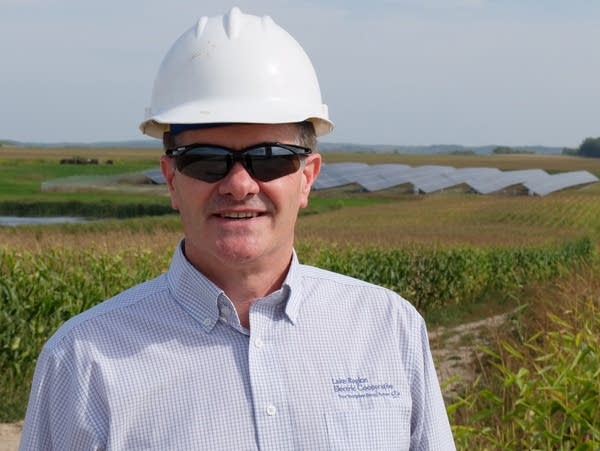
The electricity we use is often generated hundreds of miles away. Dan Juhl wants to keep it local.

To prove his theory, Juhl’s company — Juhl Energy — has built what he calls the first hybrid generating system in the country.
A smaller scale for energy resilience

A customer in co-ops
****************************************
New Power Generation? Just saw the reincarnation at the Sheldon last year…
Oh… nevermind…
Rock County CUP granted
September 11th, 2019
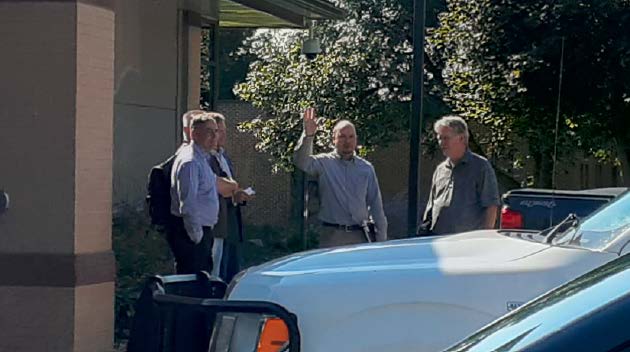
Here they are, the two County Attorneys bookending the three developer reps, probably congratulating themselves on the County’s granting of the “Juhl Energy Development in partnership with Agri-Energy/GEVO” Conditional Use Permits for Sections 17 and 19 in Rock County.
What’s the big deal? Well, let’s start with the application, which was “fluff” — incomplete to put it mildly, and yet it was forwarded to the Planning Commission, a hearing was held without necessary information and documentation, and then it went to the County Board. Really, no exaggeration. Here’s the full board packet:
And what’s odd about this? The “conditions” proposed in the Board packet:
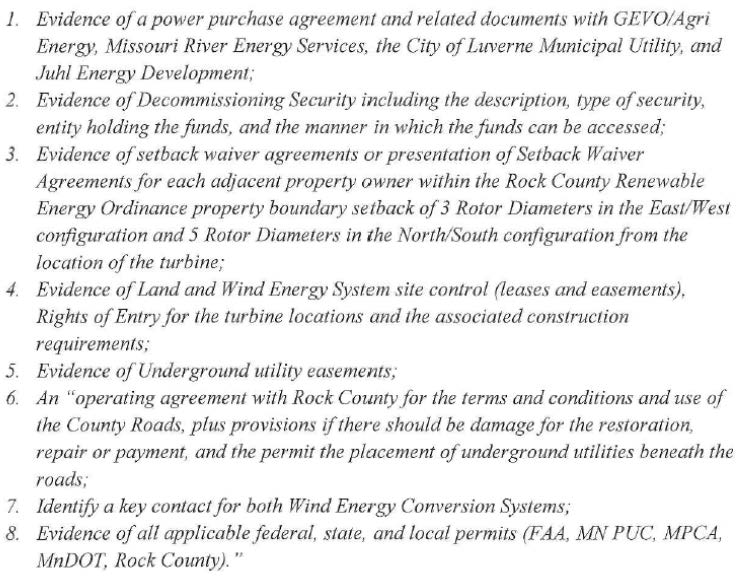
These are things that are to be included with an application, and if not, the Ordinance says that the application is not complete. FYI, this Ordinance was adopted in 2018, but is NOT posted on the County’s Website with the other Ordinances — really — check the link. WTF? Here it is (the County Attorney sent me a pdf, but it was only the even pages! Another WTF! Thankfully a little birdie sent the full Ordinance.):


NOTE in the heading: “An application to the County for a permit under this section is not complete unless it contains the following…” with all those 1-19 requirements constituting “the following.”
Take another look at the “application” in the board packet, two “applications” and a total of 10 pages! What a farce.
On behalf of the Jarchows, I’d sent a letter to the County Attorney, Administrator, and Zoning/Land-Use Administrator, and the County Board, laying out the problems, particularly stressing the egregiously incomplete application, together with an Affidavit of John Jarchow explaining their concerns with the potential nuisance coming to their property, a pre-existing permitted use:
And a Data Practices Act Request:
On to yesterday’s meeting. The County Attorney admitted that the Board had only the materials of the posted pack in front of them. As to the many missing items necessary for a complete application, one Commissioner asked about the Ordinance requirement of completeness, and the County Attorney said (not exact quote, but close) at least twice:
Oh, I wouldn’t be concerned about what the Ordinance says.
Really… I’d reminded the Commissioners of their Oath of Office, and I wonder if they thought about that. What’s the point of an ordinance if it’s ignored by the Board, the Planning Commission, and the Zoning Administrator who referred that incomplete application forward?
There were unstated claims that the biofuel plant needs this project to be able to sell to a California company. There’s a deadline approaching as the developers say this will be operational by year end.
IF THIS PROJECT IS SO IMPORTANT TO THE PLANT, AND TO THE COMMUNITY, why would the developer submit such an inadequate application? It’s on them, if they want to grease the skids and make it sail through, to do it right. But they didn’t.
Why would the Zoning Administrator forward such an inadequate and non-compliant application to the Planning Commission to review? Why would the Planning Commission hold a hearing and recommend it be approved when there is no record on which to base its “Findings.” Why would the County Board approve a CUP with so little record, and make a decision that has no record to support it? Why would the County allow a developer to put it in this position?
It’s on the developer to provide a complete application. If this project is so important, why would a developer make this strategic decision not to provide what’s required in an application?
Because they could? Because they couldn’t/can’t provide the information required? Because they knew the County wouldn’t make them follow the County Ordinance?
“Oh, I wouldn’t be concerned about what the Ordinance says.” Don Klosterbuer, Rock County’s County Attorney
Follow up Data Practices Act Request #2:
Court DENIES Freeborn Wind/Xcel Motion to Dismiss
August 27th, 2019
Freeborn Wind, now owned by Xcel Energy, tried to get Association of Freeborn County Landowners booted out of the Appellate Court. Freeborn Wind’s Motion DENIED!
And here’s the Order of the Appellate Court:
And this delightful snippet:
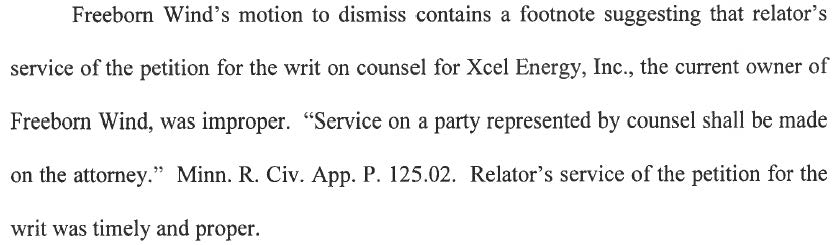
So now we’re off to the races!! We filed a Motion to Stay the Proceeding, because Xcel has filed its request for a site permit amendment. We shall see…
More transmission? They’re nuts!
August 19th, 2019
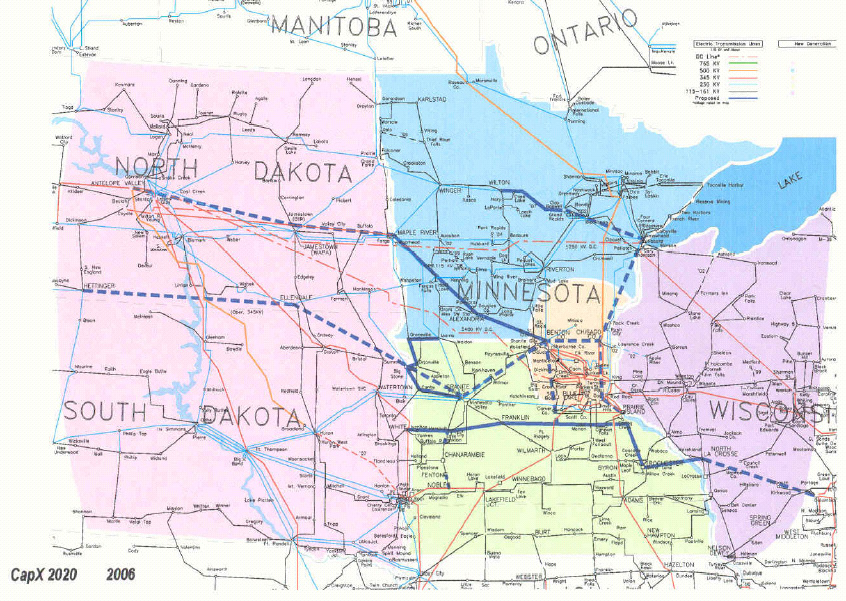
I saw this today and it’s nauseating.
First there was CapX 2020 transmission (following Arrowhead transmission, which was supposed to be the be-all and end-all of transmission)(and the SW MN 345kV line, precursor to CapX 2020. CapX transmission was based on a forecasted 2.49% increase in demand, which as we know, didn’t happen.
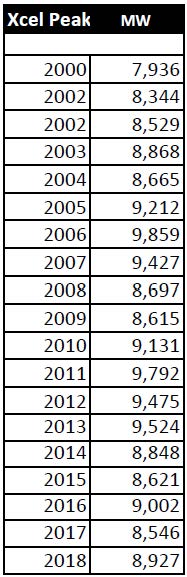
And there was the MISO 17 project MVP Portfolio:

Tomorrow, the Wisconsin Public Service Commission is making its decision regarding the Cardinal-Hickory Creek project, the southern part of #5 above, and the LAST of the MVP projects to go through state administrative approval.
So today, this is in the STrib:
Minnesota utilities will study if the $2B CapX2020 grid improvements were enough
By Mike Hughlett Star Tribune AUGUST 19, 2019 — 3:05PM

Photo: DAVID JOLESA utility worker assesses electrical power lines in south Minneapolis.
So that said, here’s Xcel Energy’s Integrated Resource Plan’s Appendix on transmission:Xcel IRP – Appendix I – Transmission & Distribution – from 20197-154051-03Download
The schedule for IRP hearings was just released, it’s in October, so there’s time to make time for it:
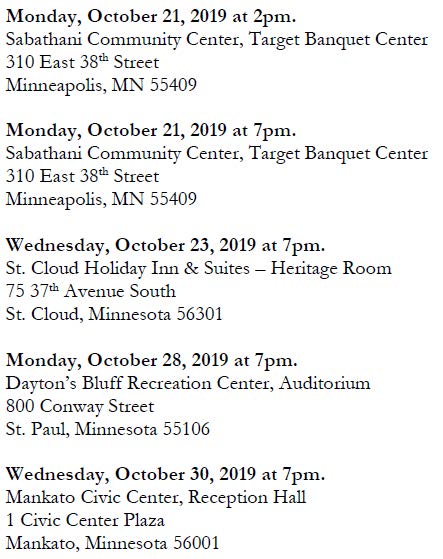
We know Xcel Energy gets a “handsome” rate of return for transmission capital expenditures (hence “CapX transmission), so of course they want to build more. The IRP is our time to tell them how they should get the electricity they need, whether their plans are making any sense.
How about shutting down some of those coal plants, and freeing up some capacity? How about siting solar on every rooftop, over every parking lot, putting the generation at load so we don’t need transmission? Oh, but wait, that makes too much sense, especially where a utility wants to keep control of the generation, and the expenditures, and rake in the dough.
Time to pay attention to the IRP. URP!
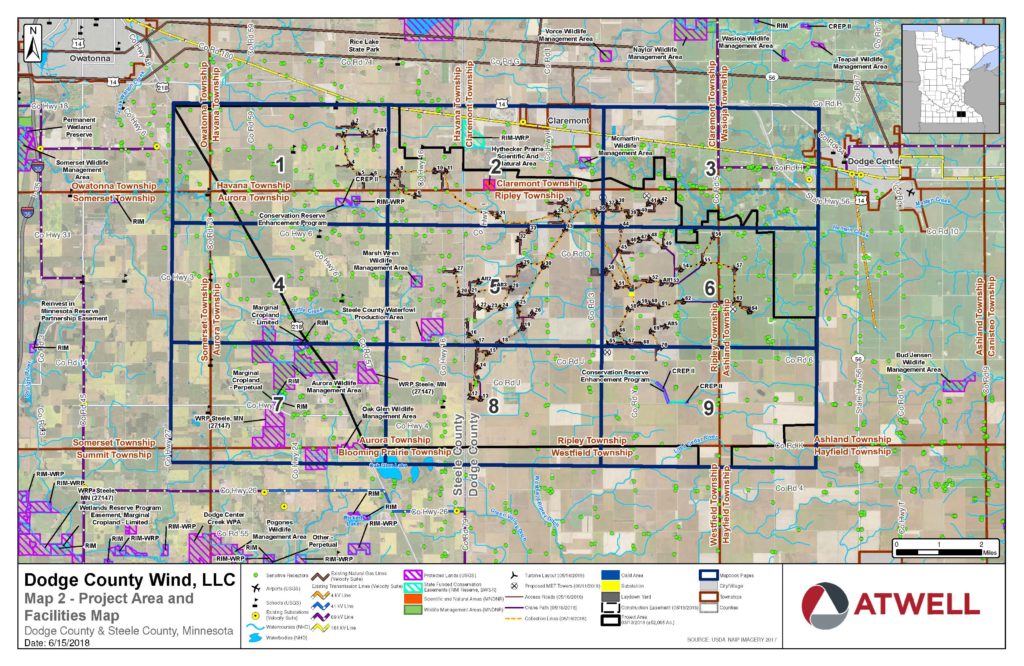
Oh my… just in, a request to suspend the permitting schedule for Dodge County Wind, the Certificate of Need, the wind site permit, and to WITHDRAW the transmission route permit!
There are 3 Dodge County Wind dockets, a Certificate of Need (17-306), wind siting (17-307), and transmission (17-308). Process wise, it goes to PUC for approval, and the PUC will probably announce a comment period in all 3 dockets. Then Commission will meet, and approve the withdrawal of the transmission without prejudice, so they can refile when they have a workable plan. That withdrawal process will take some time.
That time is an issue, because I don’t see any way they can come up with a transmission plan and get it through the MISO transmission studies to get a permit and start construction by year end. Tax credit implications — they have a problem.
As to the suspension of Certificate of Need and wind siting application proceedings, I’d like to see them dismissed without prejudice also, not suspended, gumming up the works at the Commission. We shall see.
This transmission was absurd from the get-go, a 345kV line with what, a 2,200MVA capacity, for a 170 MW project? They said it was part of a regional interconnection, from the application:
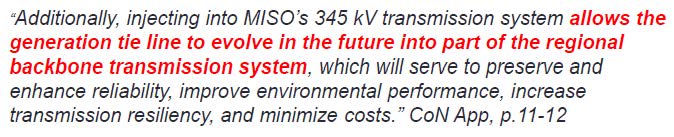
Oh, really? Don’t see it in the MISO MTEP. It’s not… and it’s a radial line, and you just don’t build short radial 345kV lines!
Here are Dodge County Wind’s requests for suspension and withdrawal:
“On August 9, 2019, DCW withdrew its MISO interconnection queue position no. J441, because of the significant interconnection costs associated with that queue position.”
Oh my… what does the MISO DPP Report have to say about that? Just search this report, issued July 25, 2019, for “J441.”
I figured the PUC should have that MISO report in the record:
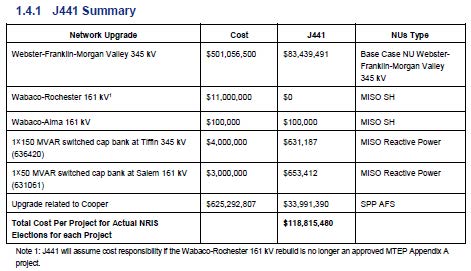

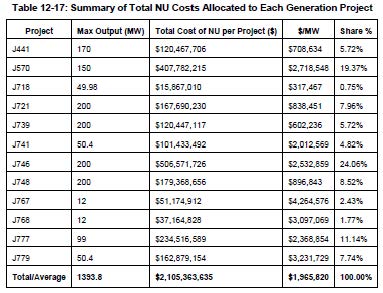
And check out the summary page on p. 149 of the 150 page pdf.
After getting the 345kV route alternatives “C” and “D” ejected, not to be considered in the FEIS, this is just the icing on the cake!!
Dodge Center Xmsn – Mission Accomplished!
Here’s some background info from just over a year ago:
Dodge County Wind info presentation
July 29th, 2018
From the very beginning, with Dodge County Concerned Citizens working hard to inform people of the project, all three dockets, and Dodge Center’s Tom Applegate going door to door and encouraging people to write comments and send photos showing how the transmission line would affect their neighborhood in Dodge Center, this public input helped call the entire project into question. With the DEIS rejecting transmission alternative routes C and D, and with the MISO interconnection study showing so many network upgrades needed at a very high cost, this project is no longer viable. The people affected by this project have had a tremendous impact.