Mulling over Rock-Tenn incinerator
June 20th, 2007
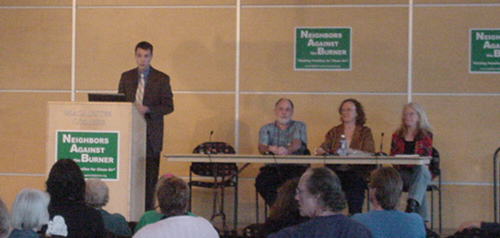
Last night the Neighbors Against the Burner held a meeting at Macalaster, featuring none other than Alan Muller! And no, I didn’t have anything to do with it, they found him independently, serendipitous, eh?
There have been several reports written about the proposal for Rock-Tenn and Minnesota incineration issues that are worth reading.
What Ramsey and Washington Counties want to do:
Foth report for Ramsey County on RDF/”Biomass” incinerator at Rock-Tenn
A Green Institute Report that had a very limited and limiting scope (a $50,000 make-work grant to show that something cleaner than garbage just isn’t possible???) :
The MPCA has posted its annual air quality report:
Alan learned from the MPCA website that the MPCA Waste Combustor rules DO NOT MEET THE FEDERAL STANDARDS and must be updated. They “started” this a coon’s age ago yet it’s not even reached the SONAR stage… seems it’s not exactly a high priority. Why?
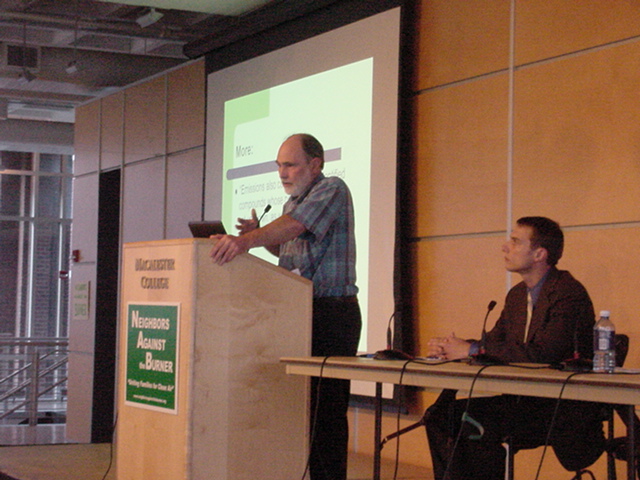
Be sure to check out the Neighbors Against the Burner site:
Here’s the article from today’s St.PPP:
St. Paul / Neighbors oppose incinerator plan
Rock-Tenn wants to burn garbage for fuelBY JASON HOPPIN
Pioneer PressAn opposition movement came to Macalester College’s Kagin Commons Tuesday night.
More than 125 neighbors attended a meeting by a group opposed to burning fuel derived from household garbage at a proposed Midway power plant. They filtered in from neighborhoods that have grown up around Rock-Tenn, the 99-year-old St. Paul paper recycling facility at the core of the controversy.
The neighbors say they’re concerned about the future, as are many who are following the Rock-Tenn story.
The plant is losing its source of cheap steam energy, a byproduct of the conversion of Xcel Energy’s coal-powered High Bridge plant to natural gas. Local officials are worried that Rock-Tenn may close – resulting in the loss of 500 high-paying jobs there.
Several parties are exploring whether to build an on-site power plant to provide Rock-Tenn a new, affordable source of energy. But one alternative for that proposed plant – using “refuse-derived fuel,” or RDF, to help power it – is generating opposition among many neighbors.
“We will not allow an incinerator to be (built) in St. Paul,” said Nancy Hone, who started Neighbors Against the Burner through meetings held in her living room. “This is insane.”
At first the group was small, but it appears to be growing in scale and sophistication. On Tuesday, members handed out buttons, T-shirts and lawn signs – a holy trinity for grassroots organizations.
The group also flew in Alan Muller, who heads Green Delaware, an environmental advocacy group, to argue that burning any biomass – whether it’s garbage or any of several alternatives being explored for the site, including farmed native grasses or construction waste – is dangerous to people’s health.
“The only way to protect your health from a burner is to just say ‘no’ to it,” said Muller, who drew from a 2005 study published by a group of British doctors for most of the conclusions during his PowerPoint presentation.
Supporters say harmful emissions can be filtered out and that the Minnesota Pollution Control Agency would have to sign off on the plant. A handful of similar power plants currently are in operation throughout the state.
Neighbors Against the Burner’s growth could make building the power plant politically difficult. The group was formed partly out of dissatisfaction that a second neighborhood group – which drew a similarly sized crowd during its first public meeting – was not taking a strong enough stand against refuse-derived fuel.
That group, called Rock-Tenn Interested Neighbors, is being run in collaboration with neighborhood district councils and has made no conclusions about what kind of materials should be used to fire the plant.
The second group will also serve as a neighborhood voice on a state-funded, $4.5 million feasibility study on the plant soon to get under way. But with the rise of Neighbors Against the Burner, there is the possibility that, at the very least, mixed messages will be sent about the wishes of Rock-Tenn’s neighbors.
Officials connected to the power plant efforts have said they would prefer the plant be able to burn a variety of fuel sources. But some have acknowledged that to make the project work financially, RDF would have to be used.
The project is being headed by the St. Paul Port Authority, which would own the plant. It would be operated by District Energy, which burns wood waste and coal at its downtown plant to provide heating and cooling to much of the downtown area.
Jason Hoppin can be reached at jhoppin@pioneerpress.com or 651-292-1892.
Kenyon Wind at PUC
June 17th, 2007

More in the Beagle – an article about Kenyon Wind. One thing, of several, that concerns me about this project are some facts that are being ignored:
Steve Sviggum was Speaker of the House in 2005.
In 2005, the House Republicans gave unprecedented support to the Omnibus Energy Bill.
The 2005 Omnibus Energy Bill created C-BED, a legislative change in the permitting and financing of wind projects.
The first C-BED project out of the chute is Kenyon Wind.
Kenyon Wind was certified as a C-BED project by Commerce’s Mike Bull.
CFERS requested the underlying documentation of the organization structure of Kenyon Wind that revealed ownership.
Commerce’s Mike Bull stated that he had the organizational documentation, certified it as a C-BED project, and did not keep the documentation.Â
Kenyon Wind is a group long-time wind activists developing their first wind project.
Steve Sviggum is the primary party of the trust that owns the land that Kenyon Wind’s turbine 6 and the collector substation sit on.
Steve Sviggum’s interest and the trust’s lease and/or ownership interest in Turbine 6 and the collector substation has not been disclosed.
The ownership of turbine 6 has not been disclosed.Â
Just the fact that the former speaker is doing business with long-time wind advocates who have never built a wind project before is enough to put red flags up… Steve Sviggum knows House ethics standards well — he testified about it at former Rep. Loren Jennings’ felony trial. Loren Jennings is now in the hoosegow.
Loren Jennings – Appellate Court Opinion citing Sviggum’s Testimony
When did Sviggum first have a financial interest in C-BED?
Has Rep. Sviggum disclosed his interest in C-BED when it comes up for a vote???

Jen Cullen
The Republican Eagle – 06/15/2007ST. PAUL — The Syverson family’s vision of their Kenyon Township farm never involved giant wind machines.
Now — against their wishes — it does.
The Minnesota Public Utilities Commission on Thursday approved a permit allowing construction of a nine-turbine wind farm just outside of Kenyon.
“There are other alternatives,” landowner Selmer Syverson said after the commission’s decision. “This is bad, but I’ll have to put up with it.”
A small group of private investors dubbed Kenyon Wind LLC is behind the more than $20 million project.
Xcel Energy will purchase electricity from the 18.9-megawatt commercial-size farm.
The turbines, which tower 406 feet into the air, will be placed on land leased from property owners in Kenyon and Cherry Grove townships.
Syverson and his son, Steve, joined other members of Citizens for Environmental Rights and Safety at the meeting.
The recently formed grass-roots group still has major environmental and safety concerns, among other issues, with the project.
Red Wing attorney Carol Overland asked commissioners Thursday to take a closer look at those concerns. Commissioners changed nothing in the final permit, despite Overland’s attempts.
“We are probably not able to address the issues to the satisfaction of everyone in the area who has a concern,” said PUC Chairman LeRoy Koppendrayer. “We do the best we can.”
Discussing tactics with her clients after the meeting, Overland said the group could take its case to the Minnesota Court of Appeals or formally ask the state to reconsider Thursday’s decision.
Mike Chase, president of the local citizens group, said Thursday’s outcome will not stop them from scrutinizing the wind farm project.
“We expect to be very active in this project as it moves on — very vigilant, very involved,” Chase said. “I’m disappointed that in spite of all the valid concerns raised they weren’t fully investigated.”
John Daniels Jr., chief manager of Kenyon Wind LLC, said Overland’s game plan Thursday was about throwing up roadblocks instead of addressing valid concerns.
Daniels said issues raised Thursday had already been dealt with.
“This discussion is really obstructionist,” Daniels told the commission. “It’s not really helpful.”
Issues remain
Overland and her clients aren’t buying Daniels’ claims.
They continue to be unsatisfied with how the permit addresses the following:
• Safety — Are the turbines the best model? What happens if they were to fall down or be struck by lightning?
• Setbacks — Overland said the 250-foot setback from nearby roads needs to be moved back to at least 500 feet.
• Environmental issues — Protection of wetlands, farmland and wildlife in the area is a big concern to Overland and her clients. Overland claimed Thursday that the rotors of the turbines impede on wetlands, which goes against DNR suggestions, she said.
• Decommissioning of the wind farm — Money to take down the project won’t be saved right away. Overland argues that’s not the best way to do business.
• Ownership of the project — Overland has filed requests for information on who specifically owns the wind farm project. She said simply labeling the company as Kenyon Wind LLC isn’t transparent enough.
“We want to know what the underlying ownership structure is,” Overland said. “They present it as Kenyon Wind. We don’t know who that is.”
Daniels said he and his partners haven’t kept any secrets on their identity. Only four people have been publicly named as partners: Daniels, his wife and two others. It is unclear if there are more.
“We’re not a secret organization,” Daniels said. “We’re out in the public.”
Chase said he and other members of the citizens group who attended Thursday’s meeting are still miffed at what they consider a lack of public discussion regarding the wind farm.
While they aren’t against wind energy, most landowners in the area don’t agree with the way the Kenyon project has panned out, Chase said.
Chase’s ultimate goal would be to have the wind farm axed completely or for the public to have input on turbine location.
“We believe the turbines didn’t belong in this location,” he said. “This is, above all, about the environment.”
Steve Syverson, whose father owns 80 acres in the affected area, still gets fired up when wind farm discussion surfaces. He will inherit his father’s land someday. Property littered with turbines, he said, doesn’t appeal to him.
Or anyone else, he feels.
“Respect people’s rights,” Syverson said. “Go somewhere less populated.”
It’s the MREA Energy Fair!
June 16th, 2007
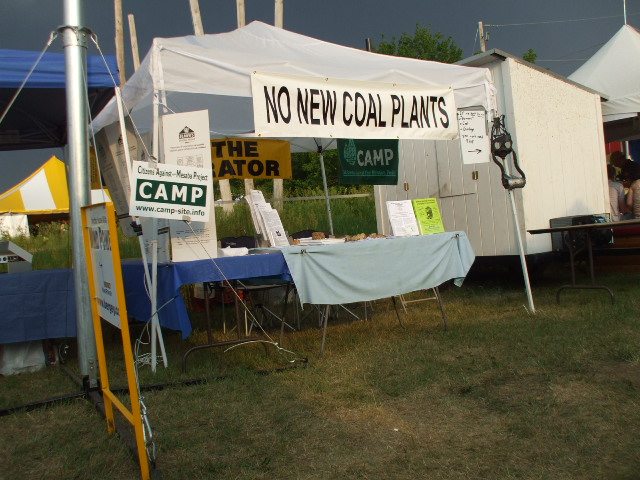
NO NEW COAL PLANTS at the MREA Energy Fair!
Here’s the booth, complete with requisite gas mask. This is just after a brief storm as the Fair was closing last night. Hot day from the start, I must confess that mid-day we took a “time out” and splashed around in the motel pool. What decadence…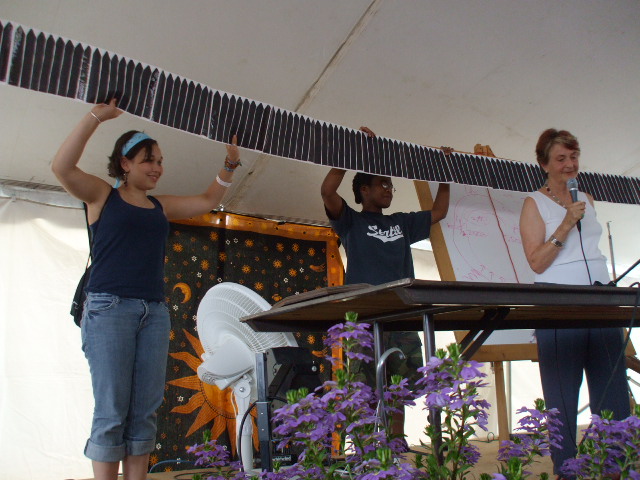
Helen Caldicott was Friday’s speaker, and as Alan said, “She was her usual self… saying what she thinks.” She was plugging her book, Nuclear Power is Not the Answer. She also announced a new report called “Roadmap for a Carbon Free and Nuclear Free Future” that’s supposed to be on her site, www.nuclearpolicy.org. I wanted to know what she was proposing, and nope, it’s not at www.nuclearpolicy.org, and I’ve asked where it is. grrrrrrrrrrrrrrrrrr So I don’t have any review to offer on that… grrrrrrrrrrrrrr
OH-OH… It’s raining and the roof of the display tent is bound to have collapsed, it was wrecked in a rain a while back and pieces are missing, and I don’t even want to know…
CapX 2020 in the Beagle
June 14th, 2007
It’s about time, some serious attention paid to this huge group of 345kV transmission lines criss-crossing the state.  Red Wing and Prairie Island are the most affected of all Minnesota communities, because we have three lines in the CapX plan, one coming in from the southwest, one going south into Wisconsin, and another coming down from the Chisago substation. IS ANYONELISTENING????
Power line plan may be live wire
Mike Longaecker
The Republican Eagle – 06/14/2007Xcel Energy officials are gearing up to make a case that Minnesota’s electricity needs require a massive expansion of transmission lines.
Depending on the outcome, the 150-mile-long project could mean new power lines being draped over Red Wing.
The project would extend new high-voltage transmission lines from the Twin Cities to Rochester.
Xcel officials anticipate the line would head south through Hampton on its way to Rochester, though they won’t rule out a second option that would run lines east to the Prairie Island nuclear plant.
Utility officials will present their case — possibly by July — to the state’s Public Utilities Commission.
Notices to be sent
Before that hearing begins, Red Wing residents will be among the approximately 17,000 area landowners who receive notice of the project, an Xcel official said.
“We’re at the beginning of what will be a long and expensive and very open public process,†said Laura McCarten, co-executive director for what’s called the CapX 2020 initiative.
Preliminary cost estimates for the CapX 2020 project are at about $1.3 billion, she said. Xcel predicts that would mean about $1.50 more a month for the average customer.
McCarten said Department of Commerce figures show electricity use in Minnesota has doubled since 1980 but transmission infrastructure hasn’t kept pace.
Is it needed?
Opponents of the project reject Xcel’s claim that the state’s electricity needs will soon outstrip the ability to deliver them. The PUC will be tasked with sorting that out, but one Red Wing resident has her doubts that the need even exists.
Carol Overland, an advocacy attorney on utility, regulatory and land-use issues, said Xcel overestimates the need, citing a North American Electric Reliability Council study showing demand in the immediate area growing by .6 percent.
She suspects the project — to be linked with other transmission lines — is instead using Minnesota land as a conduit to provide more power to the East Coast.
“Is that something that should be built on the backs of Minnesota ratepayers and landowners?†Overland said.
She also noted that a Minnesota Supreme Court decision limits transmission projects to existing corridors. That would likely mean the project following the alternate route to Prairie Island, she said.
Also watching the CapX 2020 project closely is the Prairie Island Indian Community. Attorneys for the tribe filed a letter with the PUC, stating that the project could have “a significant potential impact, whether direct or indirect.â€
In the March 2007 letter, tribal officials said they would reserve judgment on the project, but pledged to be heavily involved in a process McCarten said could take more than a year.
Statewide transmission efforts received a major boost from the Legislature during the 2005 session.
Sen. Steve Murphy, DFL-Red Wing, said he sees a need for the new power lines, especially considering the new wind generation sources that were mandated through a renewable energy standard signed into law this year.
“If we’re going to be a leader in this state in renewable energy,†Murphy, an Xcel employee said, “you’ve got to move it from where you generate to where you need it.â€Â
Gathering steam to oppose Rock-Tenn
June 12th, 2007
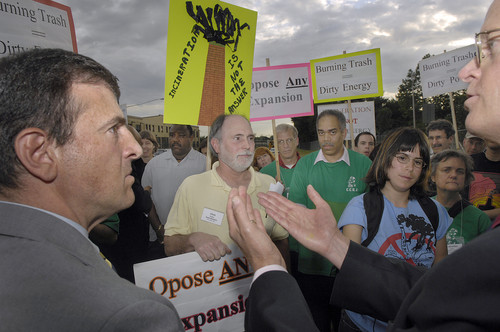
[FAIR USE, stolen from the Hartford Courant. Photo caption: IN FRONT of the Connecticut Resources Recovery Authority trash-to-energy plant in Hartford on Monday, Paul Nonnenmacher, CRRA’s director of public affairs, listens as Peter W. Egan, environmental affairs and development director, answers a question by protester Alan Muller, center. (RICHARD MESSINA)]
This Sunday through Wednesday, the Global Alliance for Incinerator Alternatives (GAIA) is having a conference in Hartford, and as part of the festivities, well, see above! Apparently the toadies/stooges from the Connecticut Resources Recovery Agency were not happy, “two incredibly tight-assed guys who were vibrating with anxiety.” That is apprent in this photo — they would have been better off staying inside instead of coming outside to play. They were not in the mood to deal with any PDO (Public Display of Opposition). And yes, obviously someone else wrote that sign…
Look who’s ranting in today’s Hartford Courant:
Groups Vow To Fight Incinerator Expansion
June 12, 2007
By JOEL LANG, Courant Staff Writer
About 30 protesters gathered outside the gates of the Connecticut Resources Recovery Agency’s trash-to-energy plant in Hartford’s South Meadows Monday evening to warn that they’re ready to fight any attempt to increase the plant’s capacity.
Dr. Mark Mitchell, president of the Connecticut Coalition for Environmental Justice and a longtime CRRA adversary, said the protesters were concerned the CRRA might close a smaller regional incinerator in Wallingford and bring even more trash to the Hartford plant, already the fifth-largest in the country.
Peter Egan, CRRA director of environmental affairs and development, confirmed an engineering feasibility study had been done about whether boilers could be added to the plant, but insisted it is hypothetical.
No decision has been made about what will be done with the 150,000 or so tons of trash now burned annually in Wallingford, he said. And any proposal to expand the Hartford incinerator, which receives about 2,850 tons a day from 70 towns, would be discussed with the city and Mitchell’s group.
Mitchell’s group had billed the demonstration as a “non-protest protest” against CRRA’s “non-proposal” plan to expand the Hartford incinerator.
“They’re not proposing and we’re not protesting,” said June O’Neil, chairwoman of Mitchell’s board. “But if they do go ahead, this is what our protest would look like. This is like a dress rehearsal,” she said.
It began almost ritualistically with Mitchell leading chants of “One, two, three, four – We don’t want your trash no more” and “Zero waste is possible, incineration is criminal.”
The Rev. Dr. Alvan N. Johnson, pastor of Bethel AME Church in Bloomfield, read a verse from the Book of Ezekiel, about shepherds who keep the best pastures for themselves and still trample the pastures of others, that he said was a biblical example of environmental injustice.
Like others, Johnson cited the high asthma rate among Hartford children, which has been linked to higher levels of air pollution. “Lungs are supposed to expand, not trash plants,” he said.
Also participating in the protest were out-of-state members of the Global Alliance for Incinerator Alternatives. Its U.S. coordinator, David Ciplet, said the group would make Hartford a test case if the CRRA tried to expand the incinerator.
After the chants and speeches, some demonstrators angrily challenged Egan and CRRA public affairs director Paul Nonnenmacher at the plant’s gate to defend the trash-to-energy plant’s compliance with pollution regulations.
They said the plant was well within standards set by the state Department of Environmental Protection and challenged their questioners to show scientific evidence the plant contributed to Hartford’s asthma rate.