Chuck Michaels, others MIA?
September 12th, 2007

Rumor has it that Chuck Michaels has departed Short Elliot Hendrickson, or at least projects on the Range, i.e., MSI, and Excelsior Energy’s doomed and crashing Mesaba coal gasification plant? Where’s Clarence??? Can it be? I noticed my SEH hits had dropped… so it must be?!?!? Well… now who do I pick on? Who will be held accountable for all these goofy infrastructure ideas?
Coal Fly Ash NON-Regulation
September 12th, 2007
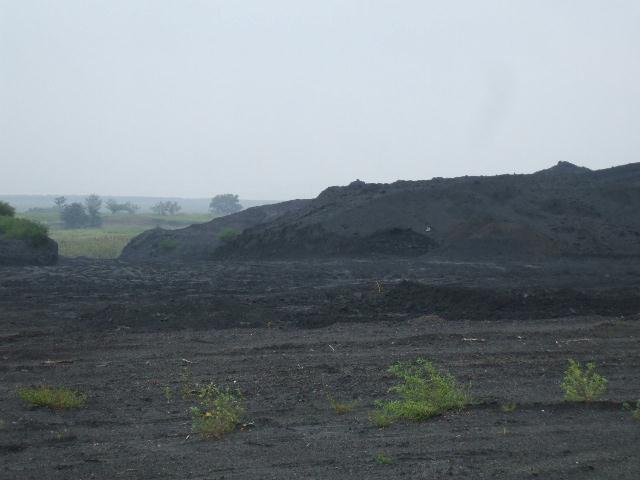
Dumped coal fly ash at Pigeon Point, taken yesterday.
Coal Fly Ash… dumping it, using it for purposes we’re not aware of… It’s happening everywhere. I think that’s what’s sitting outside the USG ceiling tile plant just south of Red Wing. Coal fly ash is not regulated, it’s deemed “not hazardous” though it’s just a semantic obfuscation of the character of the stuff. In Minnesota there are regulations, but the regulations are about what you CAN use coal fly ash for, and not addressing the components of coal fly ash. Here’s the run down for Minnesota, where coal fly ash can be combined with dirt in a feedlot to “stabilize” the soil… STABILIZE???
“Feedlots Stabilizing with Coal Ash”
From a report, “Engineering and Environmental Specifications of State Agencies for Utilization and Disposal of Coal Combustion Products: Volume 2 – Environmental Regulations” you can learn how this is addressed by each state. In Minnesota:
Minnesota
Under Minnesota regulations, fly ash, bottom ash, slag, and flue gas emission control waste generated from the combustion of fuel which is at least 51% coal or other fossil fuel and the balance of the fuel does not contain hazardous waste is exempt from regulation as hazardous waste, MINN. R. 7045.0120(1)(F).Minnesota regulations provide that CCB, when used in accordance with MINN. R. 7035.2860, have a standing beneficial use determination. A standing beneficial use determination means the generator or end user of a material can do so in accordance with applicable rules without contacting the agency. Standing beneficial uses for coal ash include:
• Coal combustion slag when used as a component in manufactured products such as roofing shingles, ceiling tiles, or asphalt products.
• Coal combustion slag when used as a sand blast abrasive.
• Coal combustion fly ash as defined by ASTM C618 when used as a pozzolan or cement replacement in the formation of high-strength concrete.
• Coal combustion fly ash or coal combustion gas scrubbing by-products when used as an ingredient for production of aggregate that will be used in concrete or concrete products. This does not include use in flowable fill.
MINN R. 7035.2860(4)(K), (L), (M), (N).
Materials that are beneficially reused are not exempt from storage standards set forth in MINN. R. 7035.2855. The storage design standards are intended to prevent contaminants from migrating into ground or surface waters and prevent nuisance conditions from occurring on the storage facility. The Minnesota Pollution Control Agency will consider proposed beneficial uses not listed as a standing beneficial use on a case-by-case basis. To be considered a beneficial use, the
material:
• May not be special actively accumulated.
• Must be characterized in accordance with R. 7035.2861.
• Must be an effective substitute for an analogous material or a necessary ingredient in a new product.
• Will not adversely impact human health or the environment.
• Is not used in quantities that exceed accepted engineering or commercial standards.
Minnesota Pollution Control Agency, 520 Lafayette Road North, St. Paul, MN 55155-4660.
Contact: Matt Herman, (651) 296-6603; Web Site: www.pca.state.mn.us.
The above is from the University of North Dakota (coal country, remember?), which is home of the Coal Ash Research Center.
There’s a federal EPA docket open on this, click below for docket:
To get to the docket, copy this docket number:
EPA-HQ-RCRA-2006-0796
and click on this “regulation” link and fill out, specify search “EPA” and that you’re looking for a docket, and paste the docket number in. Here’s the link to click:
In Delaware, they’re proposing sending fly ash and sewage sludge to a dump that’s been “closed” but at which they’re dumping, and worse, “Part of the design requires the use of thousands of “wick” drains around the site to quickly draw liquid from the surface of the disposal area into underlying aquifers.” It’s located on the banks of the Delaware River… WHATEVER ARE THEY THINKING????
You can find Delaware’s take on regulation (and lack thereof) in that UND report, “Engineering and Environmental Specifications of State Agencies for Utilization and Disposal of Coal Combustion Products: Volume 2 – Environmental Regulations” at page 15.
There’s a hearing tonight about DNREC’s role in dumping fly ash and sewage sludge, that’s TONIGHT, at the Rose Hill Community Center located at 19 Lambson Lane in New Castle, Delaware, at 6:00 PM.
From Alan Muller, Green Delaware, some questions to ask:
- What is DNREC’s role?
- What does DNREC plan to do about this?
- When are they going to really CLOSE the dump?
- What are they going to do to clean it up?
- Where’s the criminal investigation of this dumping in a closed dump?
From the News Journal:
Old dump at port eyed for tons of ash
Key contractor for job has record of offensesBy JEFF MONTGOMERY, The News Journal
Posted Friday, August 31, 2007Wilmington and federal officials are considering a multimillion-dollar deal that would send 2 million tons of power plant fly ash and sewage sludge to a closed dump near the Port of Wilmington.
The proposed agreement — which could be finalized as early as next month — drew protests from some environmental groups concerned about threats to the river and groundwater posed by huge volumes of ash coming from coal-burning power plants.
State environmental officials questioned other aspects of the plan — including the sheer amount of ash. The material would be deposited in a series of 300-foot-wide berms near the river to create a 10-foot-deep, 110-acre storage bowl.
“We’re still looking at what regulatory oversight we have, and if there are additional controls that we might like to exercise,” said David Small, deputy secretary of Delaware’s Department of Natural Resources and Environmental Control.
A key contractor for the project, Headwaters/VFL Technologies, was fined $100,000 earlier this month for a string of environmental offenses, with dozens of other violations still under review.
Headwaters would be the sole contractor under the proposed three-year job that could be worth more than $50 million in gross revenues, based on current industry-reported prices for disposal of ash.
“We’re working to finalize a draft … and we’ll hopefully issue the final agreement with the city of Wilmington on Sept. 21,” said Charles J. Myers, project manager for the Army Corps of Engineers.
In April, a Wilmington official said that the city had retained an engineering company to design a reopening of the dump, a dredge spoils site near the mouth of the Christina River. Head-waters/VFL would spend an estimated $3.5 million to build berms needed to contain the spoils “at no cost to the corps” in exchange for a city right to use stabilized sludge for construction material.
William S. Montgomery, chief of staff to Wilmington Mayor James M. Baker, said late Thursday he was unaware of schedules under the agreement. Montgomery also said the city does not know how much Headwaters earns under its subcontract for managing the 50,000 tons of treated sewage — called sludge — produced by the northern Delaware wastewater plant annually.
“We’re not trying to do anything other than find uses for our sludge, so we don’t have to drop it in its unadulterated form in the landfill,” Montgomery said.
Under the process, Headwaters mixes treated sewage sludge with fly ash from power plants. While officials have long considered the mixture safe, questions have been raised recently about its toxicity and its effect on the environment.
“Unbelievable! The materials are loaded with toxins and infectious agents and they want, in effect, to dump it in the river,” said Alan Muller, who represents the environmental group Green Delaware.
Part of the design requires the use of thousands of “wick” drains around the site to quickly draw liquid from the surface of the disposal area into underlying aquifers.
The project has surfaced amid a widening national debate over environmental risks associated with coal combustion wastes. The Environmental Protection Agency this month released new data on potential cancer and ecological risks posed by mismanagement of fly ash and other power plant residues.
Burnt coal contains an assortment of heavy metals and other toxic compounds, but currently is regulated as a non-hazardous waste. Most of the 120 million tons generated annually now goes to landfills.
And Wilmington has emerged as a regional destination for fly ash and other products.
Ingredients for the Headwaters/VFL process include incinerator ash and dusts from refineries and a metal processing plant. Most of the material comes from out of state power plants.
Delaware Solid Waste Authority is demanding the right to review the plan, noting that it owns 56 acres involved in the proposal.
Contact Jeff Montgomery at 678-4277 or jmontgomery@delawareonline.com.
Service for Bob Jacobsen
September 12th, 2007
As reported in the Northfield News:
NORTHFIELD – Funeral arrangements have been announced for longtime Northfield businessman Robert “Bob” Jacobsen, 82, who passed away Thursday.
A representative of Bierman Funeral Home said Monday morning that visitation will be held Wednesday, Sept. 19 from 4 to 7 p.m. at the funeral home, 1316 Division St. S.
The funeral is scheduled for 11 a.m. Thursday, Sept. 20 at the First United Church of Christ in Northfield, 300 Union St.
A full obituary will be printed in a future edition of the Northfield News and will be available on the website.
Bob Jacobsen checks out…
September 8th, 2007
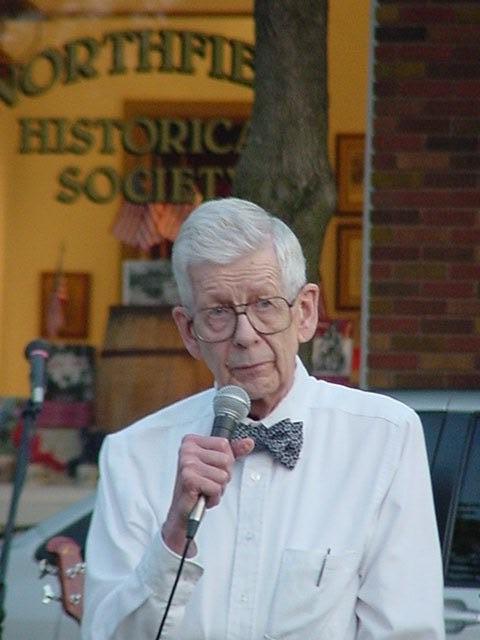
From the Northfield News:
City says goodbye to beloved businessman, Bob Jacobsen
See also Locallygrown and northfield.org…
Bob Jacobsen died this week, it’s such sad news. He will be missed. Bob was my “adoptive” father, mentor, and friend, without a doubt the most supportive and influential person shaping my life. Rollie had called and left a message and we connected later — I’m in the midst of the Chisago Transmission Project hearing, already a melancholy proceeding because it was Mike and Nancy Casper who got me fired up about transmission the first time the Chisago line was applied for. We logged more than a few miles in ‘96-98 going up to help them fight that one — and WIN! Mike died not too long ago, after having suffered from Ahlzheimers for several years. This is a photo of Mike and Nancy on Bridge Square the evening of the “grand closing” of Jacobsen’s store where most of Northfield came together and closed out an era:

To get that call about Bob’s death in a break between witnesses in this Chisago hearing was so appropriate — Bob always encouraged me to stand up and fight for what was right. We often disagreed about politics, but as often, came around from different views to complete agreement. He’s the one of his generation who I’ve spent the most time talking with, and learned much about things like WWII, marketing, and determination.
He “adopted” me not long after I met him while looking for a place to live after law school. I’d been living in Kenyon, and regularly looked down Division and thought I’d like to live there. After I got a good sized settlement on a case, I set out to find a home in “the canyon” of Northfield’s main drag, and started calling around, shots in the dark. A realtor referred me to Bob, and we chatted and I went to visit him and twist his arm more than a little. I did, and he didn’t protest too much. He showed me the apartment that was piled high with the former long-gone renter’s leftovers, and knew it was where I wanted to be, it felt like home. So he grinningly and begrudgingly agreed to get it cleaned out some, I agreed to do some painting, and I moved in. He hated cats and did not allow cats, as Maggie Lee will attest, but as he did with Maggie, he let me and my brown tabby “fish” live in the best rental unit in Northfield with the best view, the best landlord, and the best downstairs neighbors. Later, when the other tenant in the front of the building moved out, he let me rent out the other unit and tear out the wall between the living rooms, opening up a 36 foot living room with seven foot windows and fifteen foot ceilings. It was the brightest most delightful place I’ve ever lived (hell in the heat of August). I wanted to condoize it and stay there forever, but hard as I tried, that I could not convince him to do.
Bob was generous in every way. He opened up the town for me, a conservative with liberal introductions and the inside story, gleefully argued politics and traded lobbying tips, freely offered an awful lot of advice and a broad view of history. We spent a lot of time hashing out city politics, county politics, and state legislative races — Northfield’s in one of the most closely divided and hotly contested districts in the state, a good case against current redistricting schemes, which left District 25B in the shape of a jackass! (click here, squint, and you’ll see…)
In what would be our last visit, I brought Alan for introductions and Bob’s stamp of approval, and they quickly got a little rowdy trading stories of fighting garbage incinerators, Bob, about the one they’d planned for Northfield, and Alan about his in Delaware, New Jersey, Pennsylvania and now St. Paul. I didn’t know NSP had tried to pass off a Red Wing styled burner on Northfield, and didn’t know Bob was passionately against garbage burning and how much he promotes and believes in recycling (there’s always a twist that we don’t know about Bob!) Within minutes, those two were grinning and waving their hands in the air as they shared their victories and struggles. Bob was twinkling — he heartily approved and wished us well, and later put it in writing in a touching note. Well, ahem…he also called Alan my “dream dinghy.”
I’m oh so grateful to have been blessed with Bob Jacobsen. I couldn’t have asked for a better mentor — a tireless public watchdog and the most delightful pain in the governmental posterior! He had a full and good life, freely giving and “giving what for” to all who deserved it.
On Monday, it’s back to fighting the Chisago Transmission Project, and I’ll try to give NSP a few jabs in memory of Jake!
CRWP photos of Wolf Creek
September 3rd, 2007

The Cannon River Watershed Partnership is the only group keeping an eye on water in Rice County, well, the Cannon River Watershed, to be precise. And on August 24th, after the heavy rains, here’s some of what that eye, the camera of Beth Kallestad, sees:
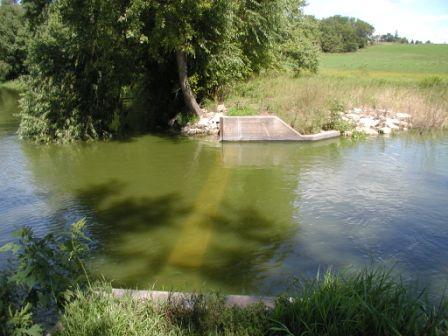
This is the dam at Circle Lake, right by that “development” of Jerry Anderson’s, the one that was shut down by the Army Corps of Engineers for lack of a permit. In this photo, “Wolf Creek flows out of Circle Lake, where the two dogs died recently from drinking toxic algae in the lake water.”
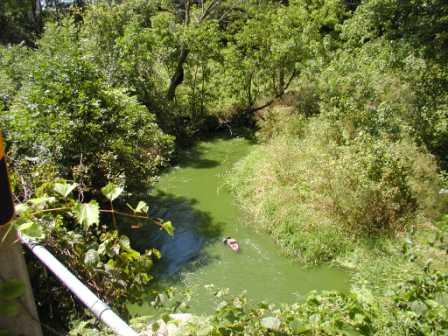
This one is near “County Road 8, at a volunteer water quality monitoring station on the bridge below Claude and Marie Brown’s.”
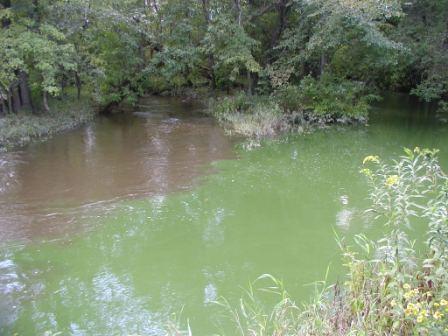
This is a dramatic photo of the “confluence of Wolf Creek (green, right) and the Cannon River (brown, left) near Grandpa’s Farm on Hwy 3.”
Link: MPCA’s Impaired Waters List.