Mesaba – Extend the hearing!
February 23rd, 2008

IGCC and coal gasification — Excelsior Energy’s Mesaba Project is the bloated and thrashed equine carcass that keeps coming back for more. The Mesaba Project is still dead…
Whew! That Mesaba hearing in January was such a farce… some was detailed in a previous post, foreshadowing mostly, and some more here in this post. The transcripts of it have to be read to be believed. They’re in St. Paul, as always, at the Dept. of Commerce, and they’re also, thanks to the efforts of CAMP (Citizens Against the Mesaba Project), in the libraries in Hoyt Lakes and Grand Rapids. Really, it’s worth the drive to check these out. This transcript has, in black and white, some of the most egregious examples of procedural bullshit I’ve ever seen, there really is no other term for it. It’s hard to say what sticks in my craw the most, but I’ve got a few more quotes that I’ll stick below.
I’ve been shaking my head in disbelief for almost a month now, and had to do something, this just couldn’t go unacknowledged, so once the transcripts arrived, I had a little help getting some choice quotes and had a couple of questioners of witnesses eager to do some more questioning so we filed this Motion for Extension of Hearing:
MCGP Motion for Extension of Hearing
Here are some snippets:
—————————————————–p. 20
5 JUDGE MIHALCHICK: Ms. Overland.
6 MS. OVERLAND: Is there an MPCA representative
7 here?
8 JUDGE MIHALCHICK: Is there a what?
9 MS. OVERLAND: Is there a representative of
10 the MPCA here today? MPCA, anyone?
11 JUDGE MIHALCHICK: Nobody is raising their
12 hand.
13 MS. OVERLAND: Shouldn’t they be here?
14 JUDGE MIHALCHICK: I don’t know. That’s their
15 choice.
—————————————————–p. 28-29
9 MS. OVERLAND: I have a procedural issue.
10 Carol Overland for MCGP. I have a procedural issue
11 regarding Mr. Starns’ comments early on. Mr. Starns
12 had made a specific reference to size, type and timing.
13 And under Minnesota Rule 7849.5710, Subpart 4, under
14 issues it says, “Once the Public Utilities Commission
15 has determined the questions of need, including size,
16 type and timing, questions of system configurations and
17 questions of voltage, these issues must not be
18 addressed in the public hearing.”
19 Now, the Public Utilities Commission has not
20 determined the question of need and it has not
21 determined questions of system configuration, questions
22 of voltage. So I wanted to point that out, that this
23 proceeding is exempt — their project is exempt from
24 certificate of need requirements. But there has not
25 been a determination made by the PUC about need or any
1 of these other issues.
2 JUDGE MIHALCHICK: Mr. Starns, do you want to
3 address that?
4 MR. STARNS: Your Honor, because the project
5 is exempt from certificate of need, that’s why size,
6 type and timing are not to be considered.
7 MS. OVERLAND: Your Honor, again, that’s not
8 what the rule says. It says “The PUC has determined,”
9 and the PUC hasn’t determined, they have not.
10 JUDGE MIHALCHICK: In my judgment the statute
11 exempts this project from the certificate of need
12 requirements. In essence, it seems to me that exempts
13 them also under that rule as if — so it should be
14 interrupted as if the commission had determined that.
15 If we did otherwise, we’d be bringing back in a
16 requirement that the legislature said shouldn’t be
17 there. So I think his statement was accurate, Mr.
18 Starns’ statement was accurate.
19 Any other preliminary matters?
—————————————————–p. 308
2 JUDGE MIHALCHICK: We’re going to go back on
3 the record. This is the second session of the public
4 hearings in the matter of the joint applic366ation to the
5 Minnesota Public Utilities Commission for the following
6 pre-construction permits: Large electric generating
7 plant site permit, high voltage transmission line route
8 permit, and natural gas pipeline routing.
9 We’re going to go back, essentially, to the
10 originally scheduled process of doing the Stage 1
11 proceedings at the start of today, meaning the company
12 will call its witnesses and have them testify. If I or
13 the department have any questions, we’ll take those,
14 and then when we’ve completed those witnesses, we’ll
15 move into Stage 2, the public comments and questions.
16 Mr. Starns.
—————————————————-p. 366
2 JUDGE MIHALCHICK: We’re not taking public
3 questions. We’ve changed the process. We’ve gone back
4 to the original process that we’re going to do the
5 Stage 1 portion of the applicant putting in its
6 exhibits or testimony. Then when we’re done with that,
7 we’ll take questions from the public.
8 MS. OVERLAND: Does that mean all the
9 witnesses?
10 JUDGE MIHALCHICK: That’s right. We’re about
11 halfway done.
12 MS. OVERLAND: You mean through the entire
13 list of witnesses?
14 JUDGE MIHALCHICK: Right.
So he rammed through 16 witnesses in one day, it took all day:
Applicant witnesses:
Todd Royer
Thomas Henning
George McVehil
Jeffrey Davis
John Lee
Charles Michael
Kelly Henry
Brad Kovach
Anne Ketz
Bret Johnson
David McKenzie
Robert Mantey
Stephen Sherner
Paul Young
Richard Stone
Bob Evans
In Hoyt Lakes, the gym the hearing was held in was unheated, and Mihalchick made us sit all day through introductions of all those witnesses and it was DAMN COLD, and as Alan got up to start questioning:
15 MR. MULLER: My name is Alan Muller. Before I
16 begin, I’d like to note that Mr. Micheletti is wearing
17 gloves, representatives of the Department of Commerce
18 are wearing gloves. Many people in the room are
19 wearing gloves and overcoats. I don’t know if the
20 rules of the Office of Administrative Hearings call for
21 holding public hearings in heated facilities, but that
22 might be something to consider in the future.
23 JUDGE MIHALCHICK: Nobody is suffering more
24 than I am.
————————————- p. 629-630
16 A. I’m addressing the comments we received.
17 Q. At what point will you —
18 JUDGE MIHALCHICK: I think that’s enough. I’m
19 going to have to ask you, if you want to submit
20 anything more, please do so within the next month in
21 writing. I have one person back here who seems to
22 really want to talk, but maybe not. So I’m going to
23 take some other comments now and then adjourn.
24 MR. MULLER: Okay. Well, I’d like the record
25 to show that I do have more questions for more
1 witnesses.
2 JUDGE MIHALCHICK: Thank you. It will show
3 that.
———————————————-p. 631-632
20 JUDGE MIHALCHICK: Take one more comment. I
21 didn’t mean to have cut off Mr. Muller, but I think the
22 hearing has gone long enough. We’ve got adequate time
23 for the public comment and the company. I’ve extended
24 the public comment period. I certainly invite all of
25 you to submit comments during that time. And I think
1 we’ll close. Is there anything else, any procedural
2 things to wrap up here? Thank you all for coming and
3 enjoy the rest of the winter.
… and TB in cows in MN too…
February 19th, 2008
And another problem, as if mad cow wasn’t enough…
And will someone explain to me what pasteurization has to do with the “beef cattle industry” and TB found in 11 “beef cattle herds” in the state? Better yet, just delete that last sentence from the article.
State beef cattle industry dealt setback with another bovine TB discovery
By PAUL WALSH, Star Tribune
Last update: February 19, 2008 – 9:53 AM
The state’s beef cattle industry has suffered a crucial setback with news today that a Beltrami County herd has tested positive for bovine tuberculosis.
This is the fourth positive herd detected since October 2007, the state Board of Animal Health reports this morning, and it will likely result in the downgrade of Minnesota’s bovine TB status, as required by the U.S. Department of Agriculture.
Since bovine TB was discovered in a northwest Minnesota beef cattle herd in July 2005, the disease investigation has found 11 infected beef cattle herds, all in Roseau and Beltrami counties.
USDA regulations call for a downgrade in status when more than three herds are detected within a 12-month period.
The downgrade moves Minnesota to the third of five status levels and two steps away from the highest status level, TB-free.
When the downgrade becomes official, state producers will have to adhere to stricter federal and state testing requirements when shipping cattle or bison.
“All Minnesota producers planning to ship animals interstate should still contact their veterinarian to determine state import requirements prior to movement,” said Board of Animal Health Executive Director and State Veterinarian Dr. Bill Hartmann. “Individual state import requirements may differ from federal requirements, so it’s important to verify them prior to shipment.”
Hartmann added: “While the downgrade in our status is a setback, we are committed to eliminating this disease from the state.”
Human exposure to bovine tuberculosis through the milk or meat supply is extremely unlikely, the Board of Animal Health says. Meat inspectors check all cattle entering the marketplace for signs of the disease before and after slaughter. Any animal showing these signs is withheld from the food supply. In addition, adequate cooking destroys the bacteria. Further, the milk pasteurization process at processing plants destroys any potential bacteria.
PAUL WALSH
They’re actually saying “MAD COW”
February 19th, 2008
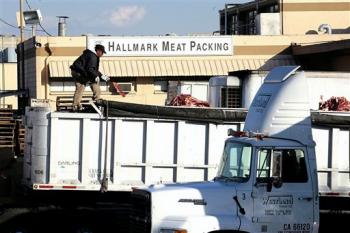
Stolen from AP-Damian Dovarganes
And another update, in the Feb. 20 STrib:
Minnesota school districts used most of the ground beef from California company
Update on the downer cows — in a Duluth Tribune run of a Washington Post story, they’re actually talking about “BSE,” or Bovine Spongiform Encephalathophy, or “Mad Cow” disease, and about that being a factor in the massive recall of 143 million pounds of meat, the biggest in U.S. history:
But most of that 143 million pounds has been eaten. What to do, send the digested remains to them in brown envelopes with no return address? Induce vomiting? This “too little, too late” effort shows the problem with after the fact recalls rather than constant inspection and rigorous enforcement of basic common sense regulation.
And from CNN’s report on it, here’s an Ag official sounding pretty reluctant and lackadaisical:
There are repeated statements in article after article that the practices at Hallmark were “common place” and “blatant.” If you go to any other slaughterhouse, is it any different? Yet these practices, these conditions, continue? There’s a recall, AFTER the meat is consumed, mostly by SCHOOL KIDS??? And people still eat meat? What will it take?
Oh, but we don’t need to worry…
143 million pounds of beef recalled, “most of it has been consumed” yet “not here!” anywhere! Yup, I sure feel good knowing that the USDA and its crew of inspectors is at work protecting the public safety…

It’s still no laughing matter — Al Franken on coal gasification
February 17th, 2008

Earth to Franken – IGCC is a pipedream!
Published today in the Bemidji Pioneer:
Brad Swenson Bemidji Pioneer
Published Sunday, February 17, 2008
The operative word the electorate seems to be embracing this election cycle is “change.”And, in Minnesota, you probably couldn’t get a more obvious “change” than in Al Franken, a Democrat vying for the party nomination to run against incumbent Republican U.S. Sen. Norm Coleman.
Franken has never held an elective office, has never until recently shown an interest in organized party politics (although he hasn’t been shy about which way he leans), he’s not a lawyer or a career politician and while growing up in Minnesota, Franken was born in New York and spent most of his life in New York.
My goodness, the man’s a comedian, a funnyman — a satirist.
Yet the former “Saturday Night Live” writer and actor draws a crowd most places he gathers for meet-and-greets, including 250 people recently in a Wadena café and likewise packed a Park Rapids café.
“Once they hear me speak, they know I speak from the heart, from the head and from the gut,” Franken told me a week ago as he overnighted in Bemidji on the way to a Senate candidate debate in International Falls. He’s on the trail with Twin Cities attorney Mike Ciresi and St. Thomas University Professor Jack Nelson-Pallmeyer.
He’s visiting a lot of rural towns, especially in northern Minnesota, not so much for name recognition — thanks to his “other” career — but to drill in that he understands Minne-sota and lived in Minnesota (St. Louis Park). It’s why he’s run-ning barrage of television ads now, to solidify his Minnesota connection before anyone can tag him a “Hollywood” candidate because of his entertainment friends and their money.
“Going around, I discovered it was important for people to know I grew up in Minnesota,” he said.
Minnesotans do want to know their candidate, want to eyeball him or her in person, and want to know what they say about issues important to them. In our talk at the Green Mill, just a mention of Coleman’s role as chairman of the Permanent Subcommittee on Investigations and the war in Iraq wound Franken up for 15 minutes. And it must be touchy, as Sen. Coleman called me late last week to spend a half hour refuting all that Franken had said, quipping that Franken tells “half-truths and whole lies,” something sounding suspiciously like an Al Franken book title.
But what does candidate Franken know about northern Minnesota? Obviously, as a New Yorker, he hasn’t spent much time in the woods with a deer rifle. In fact, last fall Franken went hunting for the first time and had with him as his guide U.S. Rep. Collin Peterson, DFL-7th District, an avid hunter and founder of the Congressional Sportsmen’s Caucus.
“My briefing was, ‘Shoot this,’ and a picture of a pheasant rooster, ‘Not this — Collin,’” Franken said of the second picture of Peterson. “Mission accomplished. I shot two roosters and not Collin.”
That episode aside, Franken said people have the right to have guns for collection, protection and hunting, recreation and target shooting. “I don’t think people should have artillery,” he said with a deep chuckle.
More seriously, “I think we should just enforce the laws that we have,” he said.
Franken’s been criticized of being a little light on farm is-sues, but says he’s learning. And he says he knows of the plight of northern Minnesota’s timber industry, and hopes a niche can be found in renewable energy production from the forest.
“Ag is obviously important to this state and it’s important to this country,” he said, adding that “I’ve been consulting with Collin Peterson, as well.” Peterson is chairman of the House Agriculture Committee.
“I do think that the green economy will be very good for rural Minnesota,” he said. “And also we’re talking about renewables and energy efficiency, and creating jobs through both of those.”
He’s been asked about the Iron Range’s current build-up and the need for more energy, with a “clean-coal” coal gasifi-cation plant proposed to gen-erate power. While it seems Franken may oppose the plant, he says he supports the techn-ology but is unsure if it’s appro-priate for that place at this time.
“The idea of coal gasification where you can sequester the CO2 is a technology that we ought to develop,” Franken said. “I’m just not sure at that plant is the best project. We want to get the most bang for the buck, and you want to make sure it’s sequestered properly.”
The technology is needed, he said, as China and India put up a coal-fired plant once a week. It does no good for the United States to seek a zero-carbon footprint when the other two nations continue unabated with carbon emissions.
“We need international agreements,” Franken said, such as a global cap-and-trade program to control carbon dioxide emissions, or the ability to sell U.S. clean-coal technology abroad.
On forestry, Franken says one of his strongest supporters is Sen. Tom Saxhaug, DFL-Grand Rapids, who specializes in forestry issues. “Tom is a big champion of sustainable forests, and I think there’s tremendous possibilities of using forest products for biomass gasification.”
If it’s any indication of his willingness to learn northern issues, Franken has been also been endorsed by Assistant House Majority Leader Frank Moe of Bemidji, Rep. Brita Sailer of Park Rapids and Sen. Rod Skoe of Clearbrook. He also recently won the endorsement of former U.S. Agriculture Secre-tary Bob Bergland of Roseau, who also served as U.S. House member from the 7th District.
Brad Swenson is the Bemidji Pioneer’s Opinion page and political editor.
Health benefits of coal
February 15th, 2008

BENEFITS OF COAL???
Can you describe the health benefits of coal, the economic benefits of coal?
Coal has costs, we all know that. A refresher… Remember Dr. Ed Anderson’s testimony in the Mesaba case, about the cost of pollution, health impacts of coal, and the studies we included:
Edwin Anderson, M.D. Rebuttal Testimony
Ex. 3 – Environmental Costs of Diseases and Disabilities
Ex. 4 – Environmental Pollutants and Disease in American Children
Well, there’s been this recurrent theme of the “benefits” of coal, sort of like when the Mayor of Hoyt Lakes, regarding all the mercury testimony, said, I SWEAR TO DOG, that “We’re used to mercury here!” Anyway, Ed Anderson, M.D., had submitted the above in the Excelsior Energy PPA docket, and “the benefits of coal” came up at the Mesaba hearing two weeks ago when Alan Muller was questioning Excelsior’s witness Skurla, from the Uof M Duluth Labovitz Center:
Q. Table at 3.4-2 identifies, by my arithmetic, a total of something over 15 million pounds per year of regulated air pollutants. And without getting into detail, let me just suggest, if I may, for purposes of this question, suppose that 15 million pounds a year of regulated air pollutants would constitute a negative impact. If those 15 million pounds a year air pollutants were to cause asthma, bronchitis, cancer of the lungs and so on and so forth, in a certain number of people, those people would need — might very well, probably would seek medical care for those problems,and they would buy inhalers, they would go to the emergency room, they would experience surgicalprocedures at the local health care facilities and so on. In your model would that be a component of economic stimulus?
MR. STARNS: Object to the form of the question.
JUDGE MIHALCHICK: Can you answer that?
A. Not really. I don’t — I mean, he’s asking a hypothetical question I don’t quite understand. I mean, he’s trying to lead me to say that it’s going to cause economic damage, and I’m not in a position to — I’m not an environmental person, so I’m not going to say that that’s necessarily going to happen. There’s other witnesses that maybe could answer that question.
Q. I appreciate that, and I’m trying to focus my question to you on the specific issue of whether —
JUDGE MIHALCHICK: Is the question whether his model included such a cost?
Q. Yes, whether increased use of health care facilities, funeral homes and so on and so forth would constitute a form of economic stimulus that would be acknowledged as such in your model?
A. I mean, if you want to look at it in a bizzare way, yeah.
Q. How is that bizzare?
A. Well, funeral homes are businesses. Hospitals are businesses. They need sick people, I mean, if you want to look at it. We’re not taking that into account, taking that pollution into account here, and you need to ask other witnesses about, you know, the environmental impacts or the effects of those.
MR. MULLER: I don’t have anything more. Thank you.
The theme… continues in the Grand Forks Herald, in an opinion piece, where the writer, a STATE SENATOR for Dog’s sake, says:
Externalities are artificial values that are intended to offset hidden impacts to society and the environment. However, Minnesota was only looking at what would be considered as negative externalities. There also are positive aspects of coal-based electricity that weren’t considered. For example, there have been peer-reviewed studies that show how low-cost, reliable coal-fired electricity contributes to the health and wealth of Americans, because those Americans then have more money available for health care, fresher foods and refrigeration to preserve foods longer.
Really, coal is good “because those Americans then have more money available for health care…” Here’s the link:
Yup, ain’t it a good thing that we’ve got that money for health care? I’m sure that will make Dr. Anderson feel a lot better about coal… Eh, Ed? We’ll all feel better…