FOIAs to feds, subpoena requests to state agencies
March 16th, 2008
The Comments of the EPA and U.S. Army Corps of Engineers about the Excelsior Energy Mesaba Project EIS drove a few stakes into the slimy heart of Excelsior Energy’s Mesaba Project, the IGCC coal gasification proposal from hell. Now that they’re finally public… It’s going to be an interesting week.
U.S. Army Corps of Engineers Letter January 31, 2008 and attachments
These agency Comments, and the way they were disappeared, made me wonder what else might be out there, so I fired off Subpoena Requests yesterday:
Cover letter – Subpoena Requests from OAH
Subpoena Request – Department of Commerce
Subpoena Request – Public Utilities Commission
And from there, it’s time to move on to the feds, so I fired off a Freedom of Information Act request to the U.S. Army Corps of Engineers, the DOE, and soon the Environmental Protection Agency:
FOIA- U.S. Army Corps of Engineers
FOIA – Department of Energy – NETL
EPA FOIA sent via email…
Oh, yes, we are having fun…
“Biomass” burner violates air permit – fines likely
March 16th, 2008

OOPS, quick, somebody get ahold of Foster Wheeler, PDC Harris Group, Newport Partners, and get a handle on this.
Let me see if I understand… they put up this “biomass” burner as “clean energy” and violated the air permit, so egregiously that the MPCA is “most likely” to fine them, and are saying that the air permit has to be amended (loosened up, duh) because they based the permit on a biomass/fossil fuel combo… in other words, straight biomass is more polluting than biomass and coal, so they have to loosen up the permit or they’ll continue to be in violation. Oh, great. So I’d guess that everyone out there now has enough information to come to the reasonable conclusion that biomass is not “clean energy?”
From the Mesabi Daily News:
Utilities will likely get MPCA fines
Negotiations continue on manufacturer reimbursementBy JIM ROMSAAS
City Editor
Published: Thursday, March 6, 2008 9:59 PM CSTThe boiler manufacturer will likely reimburse the utilities for the fine, according to the release.
US EPA Comment on Mesaba
March 14th, 2008

This is just to good to believe. Excelsior Energy’s Mesaba Project is not faring well under the eye of federal agencies, hard to believe, but there it is, in black and white as found in their DEIS Comments. And what’s also too good to believe is that we’ve caught the DOE and Minnesota’s Green Chameleon Gov. Tim Pawlenty’s agency hiding important documents from the public.
First, once more with feeling, the US Army Corps of Engineers:
U.S. Army Corps of Engineers Letter January 31, 2008 and attachments
Now, let’s move on to the Comment of the Environmental Protection Agency. Can this be? They’re gettin’ DOWN! Like WOW!
Here’s the poop in short:
Based on the information provided in the DEIS, EPA has assigned a rating of “EO-2.” The “EO” indicates that we have environmental objections to the proposed project. The “2” indicates that additional information needs to be provided to support the impact analysis documented in the DEIS.
The EPA gives it a thumbs down. There are a number of issues, but in tandem with the USACE, there’s a “project purpose” problem identified and the alternatives scenario is flat out rejected:
The selection of alternatives is etermined in part by the project’s purpose…
This project has four stated purposes, which are to : 1) demonstrate the commercial viability of IGCC technology on a utility-scale application, 2) help satisfy Minnesota’s baseload power needs, 3) implement Mnnesota’s energy poloikcies, 4) and utilize state and federal incentives under the Innovative Energy Project initiative. These four stated purposes are actually a combination of two project purposes and a set of modifiers that specify the applicant’s desired conditions and benefits for the project. The demonstration of the commercial viability of IGCC technology on a utility-scale application (1) is one project purpose that can be accomplished anywhere in the United States, not just in Minnesota. The need to provide additional baseload power in Minnesota (2) is another project purpose, which can be accomplished using a number of different technologies, fuels, and locations within the State. It does not require the use of IGCC technology. The purpose to implement Minnesota’s energy policies (3) is actually a desired benefit from the second project purpose. This benefit cannot be considered as a project purpose because it isn’t associated with an actual project. Lastly, the purpose to utilize staet and federal incentives (4) is a desired condition by the applicant that cannot be considered a project purpose. The economic savings and development benefits associated with these incentives do not define an actual project either.
… therefore, we would, in reviewing the CWA Section 404 permit, reject the project purposes as stated by the applicant and the resulting alternatives analysis up on which it is based.
This Comment was withheld by the DOE and Minnesota’s Department of Commerce. Can you believe???
Just for the record, “purpose” jumped out at me too, and here’s what I said in the MCGP DEIS Comment January 11 2008:
6) The DEIS, in Section 1.4, p. 1-6 to 1-9, improperly shifts the purpose of the project, from that of public need, as framed in the DoC scoping document, to one focusing on project proposer need. EIS must address the public need for the project and eliminate discussion of “project proponent need.”
7) The DEIS, in section 1.4.1.2, provides a narrative regarding the DOE purpose, and it does not include “demonstrate” in line one where the purpose of the DOE’s action is explained. This is a “demonstration” project, mentioned elsewhere, and that is a material term in the purpose of this project.
8) In section 1.4.14 of the DEIS, the State Purpose is addressed. One important omission that must be corrected is the state’s need to provide for public participation opportunities under the Power Plant Siting Act and in the PPA docket.
So now what… how dare they hide documents that are so important… how dare they. The DOE and Minnesota Department of Commerce are in deep, deep shit…
US Army Corps of Engineers on Mesaba
March 14th, 2008

(This is changing and shifting quickly, but I’ll keep adding as it develops, and I think I’ll have a separate post soon for the EPA Comments, they’re that good.)
The nightmare of IGCC – coal gasification takes an interesting twist… very interesting… there’s Comments and correspondence flying around to the DOE and Minnesota’s Department of Commerce about Excelsior Energy’s Mesaba Project. Hot off the press is a MONTH OLD letter to Richard Hargis of the DOE, the one in charge of the Mesaba Project Environmental Impact Statement at DOE. The Department of Commerce was copied on this, as was Bob Cupit from the PUC. But the public? Hey, we don’t exist, why would we want to know about this…
Let’s look and see what they’ve done on the Commerce project site — why, it’s now been published on the site, but it’s hidden in the January 11, 2008 comments, way down at the bottom, scroll down and look in Agency Comments, see for yourself:
There’s also a big long list of EIS Comments on the PUC’s eDockets “Excelsior Energy Mesaba Project Siting Docket” for the Mesaba Project. Click HERE and then search for docket 06-668.
Now, let’s check out the US Army Corps of Engineers (USACE). The USACE filed Comments on the Mesaba EIS on February 21, 2007. Look for US Army Corps of Engineer Comments. Find it? Right… they’re not there. The USACE sent a letter on January 31, 2008, about it, a LENGHTY letter with attachments of Comments of 2/21/07 and others — look for it in the docket. Find it? Right, it’s not there… Well, it will show up because I finally filed it myself in disgust. Oh, and the EPA, the EPA filed Comments in a letter dated January 11, 2008. See it on the MN Commerce Project Docket or the PUC siting docket? Find it? Right.. it’s not there… Do you notice a trend?
Remember the Mesaba Project joke of a siting hearing, held January 29 and 30? And what date was this sent, January 31, the day after it ended??? And it pops up, from a little birdie, a MONTH later? And it’s not published anywhere on the official sites? How dare they… and thanks to the little birdie:

Maybe it has something to do with the nature of the comments, essentially, they’re saying that the MN Dept. of Commerce and the DOE did a piss poor job of the EIS and that it’s not adequate. Yup, they’re saying it sucks. Really sucks!
Here’s their January 31, 2008 letter
U.S. Army Corps of Engineers Letter January 31, 2008 and attachments
This is good stuff. There’s the letter, which notes IN BOLD that an appendix attached to the DEIS, appendix F1, but a different version than the one they’d reviewed, and contains information that “had previously been removed at our request.” Oh, great… and it ends on this happy note:
The Corps also believes that there continue to be several NEPA deficiencies in the DEIS. These are 1) not addressing the alternative of a stand alone Phase I project; 2) not all direct actions are disclosed (e.g., not all wetland impacts appear to be disclosed in the impact tables); 3) not all impacts of connected actions are disclosed (e.g. need for additional high voltage transmission lines beyond the nearest substation); 4) not all impacts due to plant operations are disclosed (e.g., no evaluation of train and truck emissions over the 20 year life of the plant); and 5) an unresolved issue regarding the DOE’s ability to evaluate alternatives to the applicant’s proposed project.
Here are some more choice snippets in the packet that was sent with the letter:
3. Page S-4 second paragraph. The Corps has requested in prior comments that a “Phase I project only” be evaluated in the EIS. The DOE had informed the Corps that a phase I only project would not be considered because it isn’t being considered by the Minnesota Public Utilities Commission [SAY WHAT?!?]. However, CEQ 40 questions specifically state that “An alternative that is outside the legal jurisdiction of the lead agency must still be analyzed in the EIS if it is reasonable.” CEQ 40 questions also states that “In determining the scope of alternatives to be considered, the emphasis is on what is “reasonable” rather than on whether the proponent or applicant likes or is teself capable of carrying out a particular alternative. In this case, a phase I only project is not outside the legal jurisdiction of the DOE, and can be carried out by the applicant. Whether the applicant desires a phase I only project, and whether the state is considering this option, are not sufficient to determine this alternative is not reasonable under NEPA.
Yeah, you tell ’em! “…not being considered by the PUC?” And they can get away with that as long as that kind of response is not public.
And here’s a hilarious one, coming after Chair Koppendrayer’s famous “Nobody needs it, nobody wants it, and we’re not going to force this on anyone!”
8. Page 1-6 discusses the need for additional baseload power and references documentation in Appendix F1. Because a reasonable review of the project need is an important part of our public interest review, and several utility companies have prepared and submitted new 2007-2008 resource plans, this information should be updated to reflect current projections.
Now THAT’s funny! And what a coincidence, it just so happened that I challenged their need statement and attached a link to NSP’s Notice of Changed Circumstance to my DEIS comment — great minds… see P. 3.
And then there’s transmission:
12. Page 2-30 Section 2.2.2.4 Infrastructure requirements. The discussion on the MISO studies is from DOE’s response to our February 07 comments. What is the current status of the MISO studies? This information should be updated and reflected in the FEIS.
… and it gets better:
13. Page 2-30-31 Section 2.2.2.4 Includes discussion of the network upgrades that would be necessary (Boswell to Riverton, and full power deliverability to the Twin Cities). It does not appear that impacts resulting from these actions are discussed or evaluated.
Yup, and that’s a fact! SNORT!
What’s most interesting about this is the cover letter, which lays out the timeline of various letters and meetings where the Corps has tried to bring the EIS in line with federal requirements, and it’s just not happening, and the frustration is evident in the letter and in the Comments. It’s also good to see the evolution, with heightened stress on cumulative impacts, and the careful attention to wetlands.
I’ll pick out some more choice snippets, but in the meantime, dig this, just in, the response to my FOIA request!
Yes, the EPA Comment deserves a separate post… I cannot believe… this is Bush’s EPA saying this! Again, I’ll pick out some snippets, but it’s worth reading the whole damn thing. And it’s worth sending an email to Bill Storm and Richard Hargis and asking why they’re hiding this!
meanwhile, the doggies want to go out, and it’s a beautiful day…
Eating his words…
March 13th, 2008
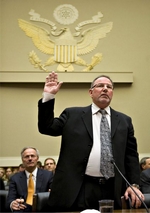
Steve Mendell, president of Westland/Hallmark, the meatpacker disclosed as flagrantly violating health regulations by pushing downer cows to slaughter… How dense can they be? Methinks he’s suffering from neurological impacts of eating too much of his own beef:
The panel’s chairman, Rep. Bart Stupak, D-Mich., asked Mendell whether it was logical to conclude from the video that at least two downer cows entered the nation’s food supply.
“That would be logical, yes, sir,” Mendell said.
“Has your company ever illegally slaughtered, processed, or sold a downer cow?” Stupak asked.
“I didn’t think we had, sir,” Mendell said.
Reminding him that he was appearing under oath, lawmakers asked him why he had claimed in written testimony that the abused cows where headed to be euthanized, not for the food supply.
“I had not seen what I saw here today,” Mendell said. He said the Agriculture Department had refused to allow him to see some of the undercover video shot by the Humane Society of the United States.
Stupak pointed out that the video has been posted on the Humane Society Web site.
There’s an interesting difference in the AP article in the Delaware News Journal and the one in the Mpls. Star Tribune.
Delaware News Journal:
Mpls. STrib:
Nowhere does the Delaware article mention the incubation period of mad cow disease. Given that incubation period, any statement that “No illnesses have been reported” is patently absurd. That none have been “reported” may be true, but it’s misleading. Mad cow wouldn’t be evident for quite a while…